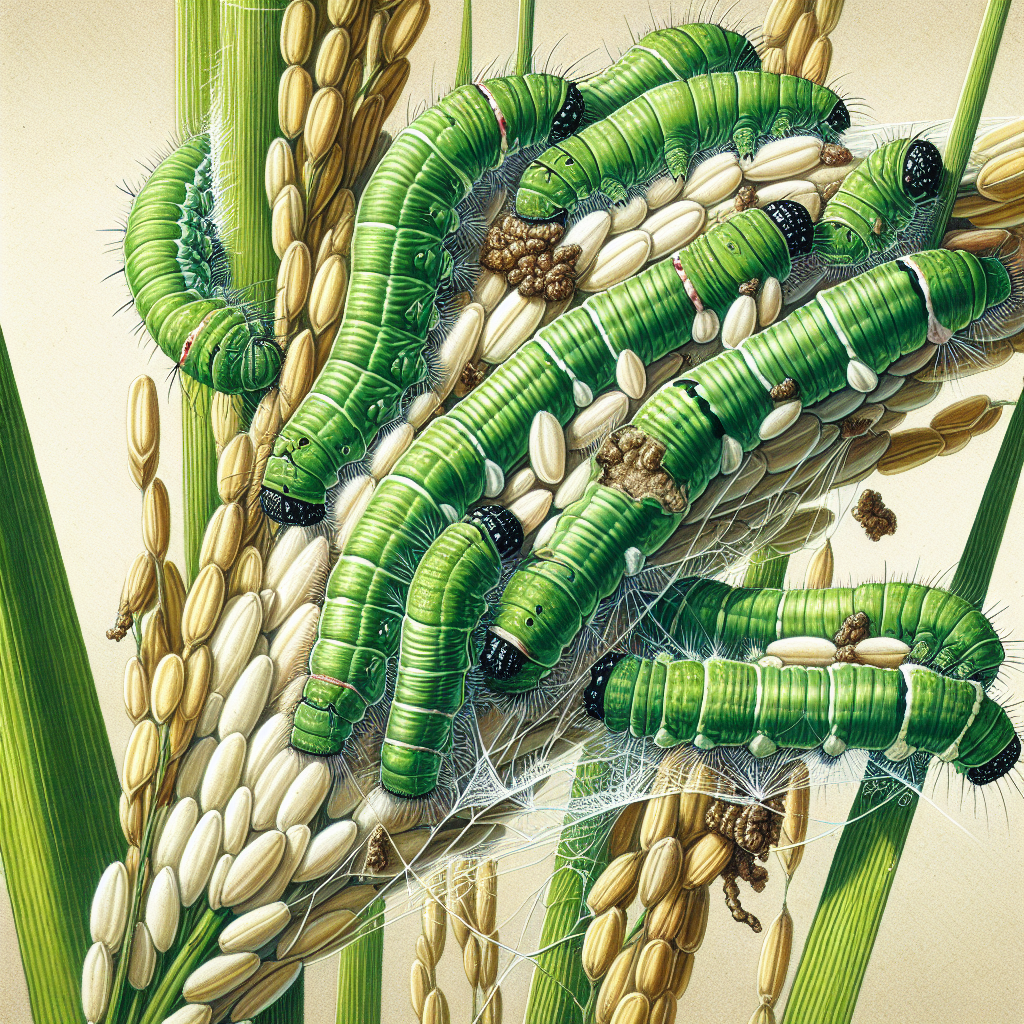
Introduction to earhead feeders
Earhead feeders represent a critical group of pests in cereal agriculture, primarily consisting of lepidopteran larvae that infest the reproductive structures of grains like rice, wheat, and sorghum. These pests, often referred to collectively due to their shared feeding habits, include species such as the rice ear-cutting caterpillar (Mythimna spp.), sorghum headworm (Helicoverpa armigera), and various earhead-feeding caterpillars ([/wiki/earhead-feeding-caterpillars]). Their damage peaks during the grain-filling stage, directly impacting food security in tropical and subtropical regions where cereals are staple crops.
Understanding earhead feeders is essential for farmers aiming to protect yields. These insects synchronize their life cycles with crop phenology, emerging when earheads are most vulnerable. Global losses from earhead feeders can exceed 20-30% in unmanaged fields, underscoring the need for integrated pest management (IPM). This guide provides diagnostic tools, lifecycle insights, and proven organic strategies to mitigate their impact, drawing from decades of agronomic research. For small-scale farmers, early detection via regular scouting can prevent outbreaks, preserving profitability. Learn more about Spring Pest Patrol: Organic AI Strategies to Shield Your Crops from Common Invaders for tech-enhanced monitoring tips.
Identifying Symptoms & Damage
Diagnosing earhead feeder infestations requires keen observation during the booting to milky grain stages. Primary symptoms include hollowed-out earheads with frass (insect droppings) resembling sawdust at the base. Grains appear chaffy, shriveled, or missing entirely, often with silk webbing binding florets together. Larvae, typically 1-3 cm long, green to brown with dark spots, bore into central spikes, feeding on developing kernels.
Damage manifests as 'white ears' where entire panicles bleach due to larval clipping or feeding. Secondary signs include bird predation on weakened heads and increased susceptibility to grain mold or head-feeding insects. Yield losses correlate with larval density: 5-10 larvae per panicle can reduce yields by 50%. Differentiate from head bugs by the presence of piercing mouthparts versus chewing damage. Use a hand lens to spot entry holes and live larvae within glumes.
Scout weekly from panicle initiation, checking 20-30 hills per acre. Thresholds: 2% infested earheads warrants action. Photosynthetic efficiency drops as larvae skeletonize glumes, accelerating senescence. In severe cases, fields show patchy whitening, mimicking downy mildew. Accurate ID prevents misapplication of controls, saving costs.
Lifecycle and Progression of earhead feeders
Earhead feeders exhibit complete metamorphosis, with eggs, larvae, pupae, and adults. Females lay 200-500 eggs singly or in clusters on earhead leaves 5-10 days pre-booting. Eggs hatch in 3-5 days into neonates that mine leaves before migrating to panicles.
Larval stage (5-7 instars) lasts 15-25 days, with peak feeding in 3rd-5th instars. They consume 90% of their diet here, growing from 1mm to 30mm. Pupation occurs in soil or panicle debris, lasting 7-10 days. Adults are nocturnal moths with 20-30mm wingspans, living 7-14 days to mate and oviposit.
Generations: 3-6 per season, synced to crop cycles. In rice, first generation hits tillering; in wheat, flowering. Diapause in pupae allows overwintering. Progression accelerates in warm, humid conditions (25-35°C, 70-90% RH). Monitoring moth flights with pheromone traps predicts larval waves, enabling proactive IPM.
Environmental Triggers & Risk Factors
Earhead feeders thrive in high-nitrogen fields with dense canopies, where humidity traps favor egg survival. Temperatures above 28°C trigger rapid development; droughts stress crops, enhancing susceptibility. Monsoon overlaps with booting amplify outbreaks, as moths exploit lush foliage.
Risk factors include continuous cereal monocropping, late planting delaying maturity into peak moth seasons, and poor weed control harboring alternate hosts like corn. High fertilizer rates boost tender tissues, attracting oviposition. Refugee crops from adjacent fields seed infestations. Climate change extends generations, per recent studies showing 10-15% more cycles in warming tropics.
Soil moisture >60% post-rain favors pupal survival. Avoid susceptible varieties; opt for resistant hybrids. Scout after heavy dews or winds carrying adults.
Organic Control & Treatment Plans
Organic management emphasizes prevention and biologicals. Cultural: Clip and destroy infested earheads at dusk when larvae enter. Intercrop with marigold to deter moths. Maintain 20-25cm plant spacing for ventilation.
Biological: Release Trichogramma wasps (5,000/ha/week for 3 weeks) to parasitize eggs. Promote predators like spiders, birds via perch poles. Neem oil (5ml/L) or Bacillus thuringiensis (Bt) kurstaki (1g/L) sprays at egg hatch target larvae, safe for pollinators. Apply evenings, repeat 7-10 days.
Threshold-based: Treat at 5% infestation. For head-feeding caterpillars, light traps (4/ha) capture adults. Soil solarization pre-season kills pupae. Rotate with legumes like chickpeas to break cycles.
Integrated Plan: Week 1: Scout + traps. Week 2: Bt/neem if eggs present. Monitor 10 days. Efficacy: 70-90% reduction vs. untreated. Avoid broad-spectrum sprays preserving earhead caterpillars predators.
Preventing earhead feeders in the Future
Long-term prevention builds resilient systems. Select resistant varieties like IR36 rice or hybrid sorghums with tight glumes. Time planting to evade peak moth flights—early sowing in rabi season dodges monsoons.
Crop rotation (cereals-legumes-fallow) disrupts pupal banks. Deep summer plowing (15-20cm) exposes pupae to sun/predators. Balanced NPK (100:50:50 kg/ha) avoids lush excess. Border crops like mustard repel moths.
Pheromone traps (10-12/ha) for monitoring/mass trapping. Encourage natural enemies via flowering hedges (thyme, yarrow). Clean farmyards; destroy stubble. Seed treatments with biofungicides curb weak seedlings attracting early pests. Annual IPM audits track progress, aiming <2% infestation.
Crops Most Affected by earhead feeders
Earhead feeders devastate small-grained cereals. Rice ([/wiki/rice], incl. Basmati Rice): 20-40% losses in rainfed uplands. Sorghum ([/wiki/sorghum]): Headworms clip 30% grains. Pearl Millet ([/wiki/pearl-millet]): Similar damage in semi-arid zones.
Wheat ([/wiki/wheat], Durum Wheat): Secondary pest, spikes in irrigated fields. Maize ([/wiki/corn]): Earworms akin, though cob-focused. Minor: barley, finger millet. Tropical Asia/Africa hotspots; yield hits 1-2 t/ha untreated.