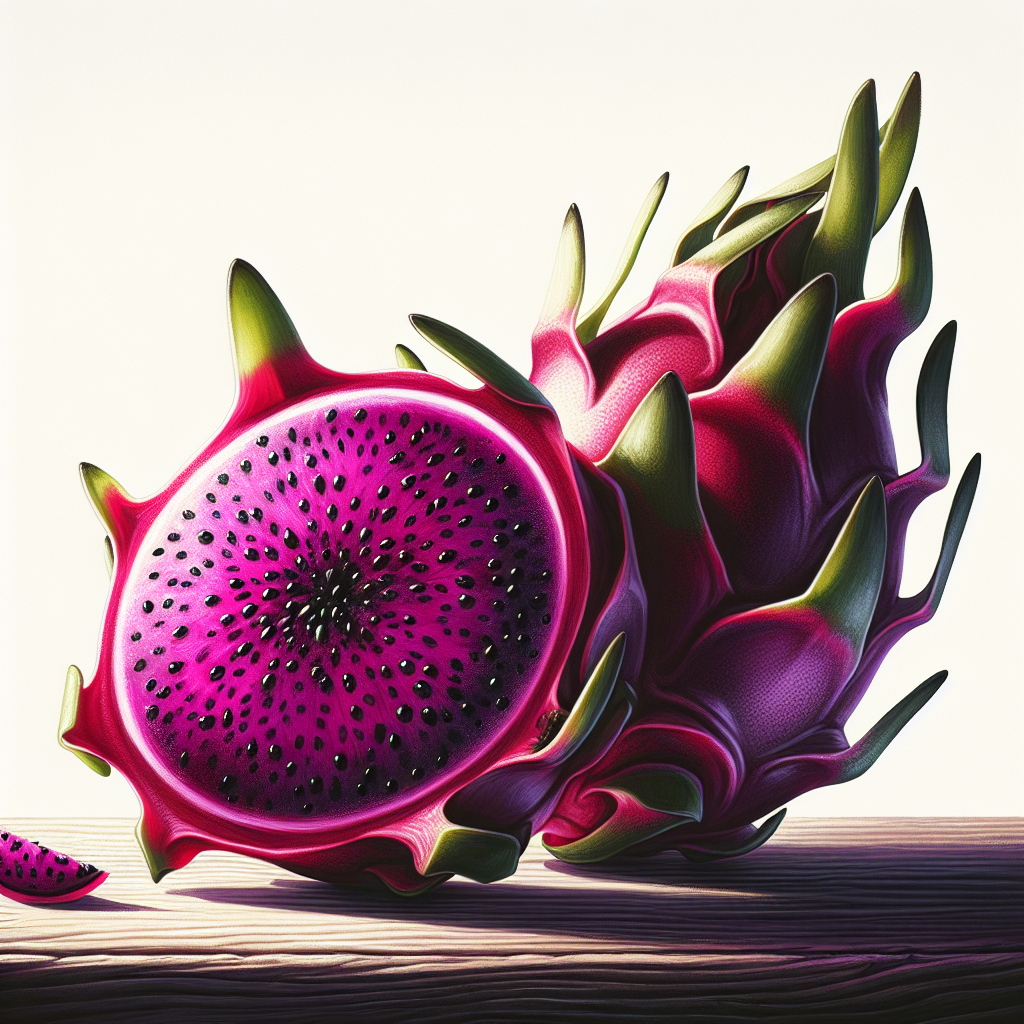
Introduction to Dragon Fruit (Dark Star)
Dragon Fruit (Dark Star), a premium cultivar of Dragon Fruit, captivates growers with its dramatic appearance and superior flavor profile. Known scientifically as Hylocereus undatus 'Dark Star', this variety stands out due to its exceptionally dark, almost black-purple rind that contrasts vividly with its rich, fuchsia-colored flesh. Unlike standard dragon fruit, Dark Star offers intensified sweetness—often scoring 18-22 Brix—paired with a creamy texture and fewer, smaller seeds, making it a favorite for fresh eating, smoothies, and gourmet markets.
Originating from selective breeding programs in Southeast Asia and refined by U.S. hybridizers, Dark Star combines the vigor of Hylocereus undatus with traits from Hylocereus costaricensis, resulting in larger fruits (up to 1.5 pounds each) and reliable self-pollination. This makes it accessible for solo growers without the need for hand-pollination common in other varieties. In optimal conditions, a single mature plant can yield 20-40 fruits per season, providing substantial returns for small-scale operations. Its adaptability to containers and greenhouses extends its appeal to temperate regions, where it serves as a profitable niche crop. For more on general dragon fruit cultivation, see the comprehensive Dragon Fruit (crop) wiki.
Growers appreciate Dark Star's resilience to heat and brief droughts, though it demands excellent drainage to prevent root issues. With proper trellising, plants reach 15-20 feet, producing fragrant, bat-pollinated nocturnal blooms up to 14 inches wide. Harvested fruits store well, retaining flavor for weeks under refrigeration, enhancing its commercial viability. This guide delivers professional-grade insights for maximizing yields, from propagation to post-harvest handling.
Botanical Profile of Dragon Fruit (Dark Star)
Dragon Fruit (Dark Star) belongs to the Cactaceae family, specifically the Hylocereus genus, which encompasses epiphytic cacti native to Central and South America. 'Dark Star' is a tetraploid hybrid (Hylocereus undatus × Hylocereus costaricensis), exhibiting hybrid vigor with thicker stems (1-2 inches diameter), deeper green areoles spaced 1-2 inches apart, and enhanced cold tolerance down to 28°F for short periods. Stems are three-ribbed, winged, and segmented, growing rapidly at 2-4 feet per year under ideal conditions.
Flowers emerge at night from mature stems (2+ years old), lasting 24-48 hours, with creamy white petals, green bracts, and a vanilla-like fragrance attracting moths and bats. Pollination yields oval fruits maturing in 30-50 days, featuring glossy, scale-covered skin in near-black purple hues. Internally, the flesh is seed-speckled magenta, radiating from a central white core, with flavor notes of kiwi, pear, and berry. Nutrient-dense, each fruit provides antioxidants, vitamin C (20% DV per serving), fiber, and iron.
Roots are shallow and fibrous, extending 3-5 feet laterally for water uptake, while aerial roots enable climbing. Plants are dioecious in wild forms but Dark Star's self-fertility stems from bred hermaphroditic flowers, ensuring 90-100% fruit set without cross-pollination. Lifespan exceeds 20 years, with peak productivity from years 5-15. Compared to Hass Avocado, Dark Star offers faster establishment and higher caloric returns per square foot.
Soil, pH, and Climate Requirements for Dragon Fruit (Dark Star)
Dark Star flourishes in well-draining, sandy loam or cactus mix soils amended with 30-50% perlite, pumice, or coarse sand to mimic arid habitats. Avoid heavy clays prone to waterlogging, which invite root rot. Optimal pH ranges 6.0-7.5; test and adjust with dolomite lime if below 6.0 or sulfur if exceeding 7.5. Incorporate 2-4 inches of organic mulch (coconut coir or bark) to retain moisture without sogginess.
Climatically, Dark Star demands USDA zones 10-11, thriving at 70-90°F daytime and 50-70°F nights. It tolerates brief dips to 32°F but suffers below 28°F, with stem paddling and dieback. Full sun (6-8+ hours) is essential for fruit coloration and sugar development; partial shade reduces yields by 30-50%. Humidity of 60-80% suits flowering, but excellent airflow prevents fungal issues. In marginal zones, use high tunnels or LED grow lights for winter extension.
Irrigation requires moderation: deep water every 7-10 days in summer, allowing top 2 inches to dry. Overwatering halves productivity. For small farms combating heat stress, check Why Summer Heatwaves Are Silently Killing Small Farm Yields - And 7 Organic Strategies to Fight Back. Annual soil tests guide amendments: 100-200 ppm N, 50-100 ppm P, 200-300 ppm K pre-flowering.
Step-by-Step Planting & Propagation
Propagate Dark Star via stem cuttings for 95% success, bypassing seeds' 6-12 month wait. Select 12-18 inch, pencil-thick segments from healthy, non-fruiting stems in spring. Submerge basal end in 50 ppm IBA rooting hormone, air-dry 24-48 hours to callus. Plant in 1-gallon pots with 50/50 cactus mix/perlite at 75-85°F under 50% shade cloth. Roots form in 4-8 weeks; transplant at 6-12 inches tall.
For field planting, space 8-10 feet apart along sturdy T-posts or concrete-embedded poles (4-6 inch diameter, 6-8 feet tall) with chicken wire or wooden frames for climbing. Dig 2x2x2 foot holes, backfill with native soil + 40% sand + 4-4-4 slow-release fertilizer. Plant at soil grade, water deeply, then withhold for 2 weeks to establish. Grafted plants (onto Selenicereus megalanthus rootstock) boost vigor by 20%; source from certified nurseries.
Seed propagation suits breeding: extract pulp, ferment 3 days, sow on damp sand at 80°F with bottom heat. Germination: 2-4 weeks. Thin to 2-inch spacing, pot up gradually. Harden off over 2 weeks before outdoor placement. Expect first fruits in 2-3 years from cuttings, 4-5 from seeds.
Care & Maintenance regimes for Dragon Fruit (Dark Star)
Fertilize monthly during growth (March-October) with 10-5-20 + micronutrients at 1 lb per mature plant, split applications. Prune post-harvest: remove 30-50% of thin, etiolated stems to promote branching and airflow. Thin crowded canes to 4-6 per pole for optimal light penetration. Support heavy fruit loads with slings to prevent stem breakage.
Water consistently but sparingly: 1-2 inches weekly via drip irrigation, tapering in winter. Mulch bases with gravel to suppress weeds and regulate soil temps. Monitor for nutrient deficiencies—yellowing indicates iron/magnesium shortfall; apply chelated foliar sprays. Winter care in pots: move indoors at 40°F, reduce water 75%. Pollinate manually if <80% set: soft brush at dusk during bloom peaks (summer monsoons).
Train stems spirally up supports for maximum exposure. Annual top-dress with compost for microbial health. Yields escalate with age: 10 fruits year 3, 30+ by year 5. Integrate legumes like peas at bases for nitrogen fixation.
Pests, Diseases & Organic Management
Common foes include ants farming mealybugs, scale insects, and spider mites. Scout weekly; blast with water jets, apply neem oil (2% solution) weekly, or introduce ladybugs/Chrysoperla. For root-knot nematodes, solarize soil 6 weeks pre-plant or use marigold marigold rotations.
Diseases: Phytophthora root rot from poor drainage—ensure 20% slope, use copper fungicide drenches. Anthracnose causes stem lesions; prune infected parts, apply Bacillus subtilis. Avoid overhead watering to deter powdery mildew. Birds ravage fruits—net entire structures. For broader strategies, explore Why 90% of Small Farms Fail at Pest Management - And 8 Organic Fixes That Actually Work. Organic IPM: beneficial nematodes for soil pests, kaolin clay barriers for chewers.
Harvesting, Curing & Optimal Storage
Harvest when skin shifts fully dark purple and yields slightly to thumb pressure (30-50 days post-bloom). Twist or clip with shears, leaving 1-inch stem stub. Yields peak July-October; pick every 3-5 days to stagger. Handle gently to avoid bruises.
Cure at 55-60°F, 85% humidity for 3-5 days to mellow tannins and boost sugars 10-15%. Store ripe fruit at 45-50°F (90% RH) for 3-5 weeks, losing <5% weight. Frozen pulp (pureed, tray-frozen) lasts 12 months. Market fresh, dried chips, or purees—shelf life doubles with wax coatings. Post-harvest dips in 100 ppm STS extend vase life of cut flowers.
Companion Planting for Dragon Fruit (Dark Star)
Pair Dark Star with shallow-rooted companions to optimize space: Thai Basil repels aphids, nasturtium traps flea beetles, and yarrow attracts pollinators. Nitrogen-fixers like clover or pigeon pea enrich soil without competing. Avoid deep-rooted potato or water-hungry corn. Base-plant garlic or onion for nematode suppression. Trellis understory with vining peas or black-eyed peas. Benefits include 15-20% pest reduction, improved pollination. Learn more in Why Companion Planting Feels Like Guesswork for Small Farms - And How AI Makes It Foolproof.