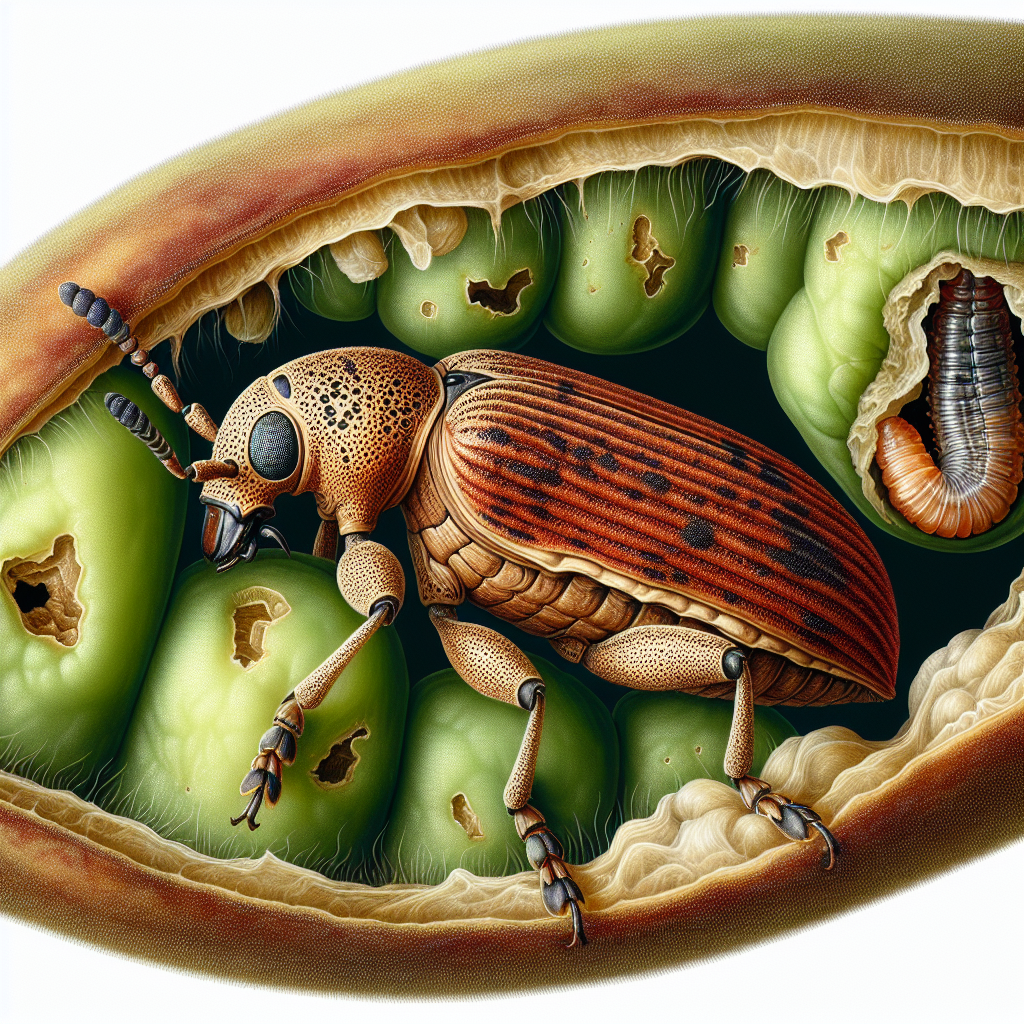
Introduction to Cowpea curculio
The cowpea curculio, scientifically known as Chalcodermus aeneus, stands as one of the most notorious pests in legume production, particularly devastating to cowpeas (Vigna unguiculata), also called southern peas, black-eyed peas, or crowder peas. Native to the southeastern United States, this weevil has earned a reputation for inflicting severe economic losses, with infestations capable of reducing yields by up to 50% or more in untreated fields. Adult weevils are small, shiny metallic blue-black beetles measuring about 3-4 mm in length, featuring a distinctive curved snout and V-shaped ridges on their wing covers.
Farmers often first encounter this pest during pod development stages, where both adults and larvae feed voraciously. Unlike weevils that primarily attack stored grains, the cowpea curculio completes its entire lifecycle in the field, making timely intervention critical. This guide equips growers with professional-grade diagnostics, lifecycle insights, and proven management strategies to safeguard crops. Understanding this pest's biology is key to implementing effective integrated pest management (IPM) programs, minimizing chemical inputs while maximizing yields. For small-scale and commercial operations alike, proactive scouting and cultural controls form the backbone of successful defense against this persistent threat.
Identifying Symptoms & Damage
Accurate identification of cowpea curculio damage is essential for timely intervention. Adult feeding manifests as characteristic circular punctures on pods, stems, and pegs, often appearing as small, neat holes about 1 mm in diameter. These feeding sites exude clear gum-like sap, a hallmark sign distinguishing curculio from other pests like pod borers or stink bugs. Heavy adult activity leads to pod deformation, scarring, and premature drop.
Larval damage proves most destructive, with white, legless grubs (up to 6 mm long, head capsule brown) boring directly into developing seeds. Infested pods show dark entry holes, internal frass (sawdust-like excrement), and discolored, shriveled seeds unfit for market or consumption. Yield losses stem from seed destruction—each larva can ruin multiple seeds per pod—and secondary infections from fungal blights entering wounds. Plants exhibit stunted growth, yellowing leaves, and reduced pod set under severe pressure.
Scout weekly from flowering onward: shake plants over white paper to detect adults (they feign death when disturbed). Thresholds vary by region, but 1-2 weevils per 10 sweeps signals action. Differentiate from Bruchids (seed beetles), which attack post-harvest, by noting curculio's field-based lifecycle and metallic sheen. Early symptoms mimic drought stress or nutrient deficiency, underscoring the need for close inspection. Photoperiod-sensitive varieties show heightened vulnerability during long summer days.
Lifecycle and Progression of Cowpea curculio
The cowpea curculio completes 2-4 generations annually, synchronized with host phenology in warm climates (USDA zones 7-10). Adults overwinter in leaf litter, soil duff, or nearby weeds, emerging in spring (March-May) as soil temperatures exceed 18°C (65°F). Drawn by cowpea bloom volatiles, females lay 200-300 eggs singly under calyces or near pegs.
Eggs (0.5 mm, white) hatch in 4-7 days into larvae that tunnel into pods or pegs. Larval stage spans 10-20 days across four instars, feeding on seeds and producing diagnostic frass. Mature larvae drop to soil, forming pupal cells 5-10 cm deep. Pupation lasts 7-14 days, yielding new adults that feed briefly before seeking mates. Total cycle: 25-45 days, accelerating in heat (>30°C).
Multiple broods overlap, with peak damage during pod fill (June-August). Photoperiod regulates diapause; short days (<12 hours) trigger soil entry for next overwinter. Males produce aggregation pheromones, concentrating infestations. Lifecycle ties directly to cowpea maturity groups: early varieties escape first generation, while late ones face compounded attacks. For more on weevil biology, check this Spring Pest Patrol post.
Environmental Triggers & Risk Factors
Cowpea curculio thrives in humid subtropical conditions, with optimal ranges of 25-35°C and >60% relative humidity. Sandy loam soils facilitate larval pupation and survival, explaining prevalence in the Southeast US coastal plain. Continuous cowpea culture—common in rotation-poor systems—amplifies populations, as adults disperse <1 km but infest adjacent fields.
Risk escalates with early planting (before June), allowing first-generation buildup. Volunteer plants and weed hosts like pigeon pea, sesbania, or crotalaria serve as reservoirs. Drought stress weakens plants, increasing susceptibility; irrigated fields see higher infestations due to extended pod set. Nearby soybeans or peanuts heighten spillover risk.
Monocultures exceed 20 weevils/plant thresholds faster than intercropped systems. No-till residue shelters overwintering adults, while excessive nitrogen promotes lush foliage over pods, indirectly favoring pests. Climate change extends generations northward, with models predicting range expansion into mid-Atlantic states. Monitor via degree-day models (base 15°C) for emergence forecasts.
Organic Control & Treatment Plans
Organic management hinges on IPM, integrating cultural, biological, and mechanical tactics. Cultural: Destroy post-harvest residue by deep plowing (15-20 cm) to expose pupae to predators and desiccation. Rotate with non-hosts like corn or wheat for 2-3 years. Plant resistant varieties (e.g., 'Iron Clay', 'CB 50') early (post-May 15) to evade peak flights. Trap crop borders of bushy southern peas lure adults away.
Mechanical: Hand-collect adults early morning; use sweep nets (20-30 sweeps/100 plants). Blue sticky traps (10/acre) capture via color attraction. Kaolin clay (Surround WP, 25-50 kg/ha) deters feeding when pods form.
Biological: Conserve natural enemies—ground beetles, birds, parasitic wasps (Bethylidae)—via reduced tillage edges. Neem oil (azadirachtin, 1-2%) or spinosad (Entrust, 0.2-0.4 L/ha) targets larvae when <20% pods infested. Bacillus thuringiensis (Bt) kurstaki offers marginal control against adults.
Treatment Timeline: Scout at 50% bloom; apply at 1 weevil/5 plants. Reapply every 7-10 days, rotating modes. Combine with overhead irrigation to dislodge pests. Yields recover 30-60% with vigilant IPM versus none. Certify compliance with OMRI-listed products.
Preventing Cowpea curculio in the Future
Long-term prevention builds resilient systems. Select varieties blending resistance and earliness: 'Pinkeye Purple Hull', 'Mississippi Purple'. Implement 3-year rotations incorporating sorghum or cover crops like clover to disrupt cycles. Pre-plant soil solarization (6 weeks, >40°C) kills pupae in high-value plots.
Sanitation is paramount: disk residues immediately post-harvest, avoiding windrows. Perimeter trap crops (20% area) and mulches reduce dispersal. Enhance biodiversity with hedgerows of marigold and thyme, repelling via companion volatiles. Monitor with pheromone traps (Delta traps, 4/ha) from soil warmup.
Soil health underpins resistance: maintain pH 6.0-6.5, balanced NPK via compost. Avoid over-fertilization. Scout grids (1/4 acre) weekly; use action thresholds dynamically. Educate laborers on detection. For sustained success, integrate with broader IPM, tracking via farm logs. These strategies cut future infestations by 80-90%.
Crops Most Affected by Cowpea curculio
Cowpeas top the list, with 90% of US production (1.5 million acres) at risk, especially varieties like California Blackeye and cream types. Southern peas (crowders, creams) suffer highest, with losses up to 100% in susceptible cultivars. Minor hosts include lima beans, okra, and wild legumes, but economic impact centers on Vigna spp.
Infestations spill to peas, chickpeas, and lentils in mixed rotations, though less severely. Rare attacks occur on tomato pegs or eggplant fruits. Focus protection on primary cowpea belts: Georgia, Alabama, Florida, Texas. Diversify with non-hosts like squash to buffer.