Introduction to citrus greening disease (huanglongbing)
Citrus greening disease, scientifically termed Huanglongbing (HLB) or citrus greening, represents one of the most destructive threats to global citrus production. Caused by the unculturable bacterium Candidatus Liberibacter asiaticus (CLas), this disease is primarily spread by the Asian citrus psyllid, a tiny insect vector that feeds on citrus phloem tissue. Native to Asia, HLB has spread to every major citrus-growing region, including Florida, Brazil, and South Africa, devastating orchards and costing the industry over $10 billion annually in lost production and control measures.
Unlike many fungal or viral diseases, HLB targets the tree's vascular system, blocking nutrient and water transport. Trees decline gradually over 3-5 years, producing bitter, misshapen, asymmetrical fruits with aborted seeds and green islands on mottled leaves. No effective cure exists, making prevention and early removal of infected trees the cornerstone of management. For detailed background, see the comprehensive entry on huanglongbing.
This guide provides professional-grade diagnostic criteria, lifecycle insights, organic management strategies, and prevention protocols tailored for commercial groves and small farms. Understanding HLB's insidious progression is essential for protecting orange, lemon, and lime crops from total collapse.
Identifying Symptoms & Damage
HLB symptoms vary by citrus variety, tree age, and environmental stress, often mimicking nutrient deficiencies or phytophthora root rot. Key diagnostic markers include:
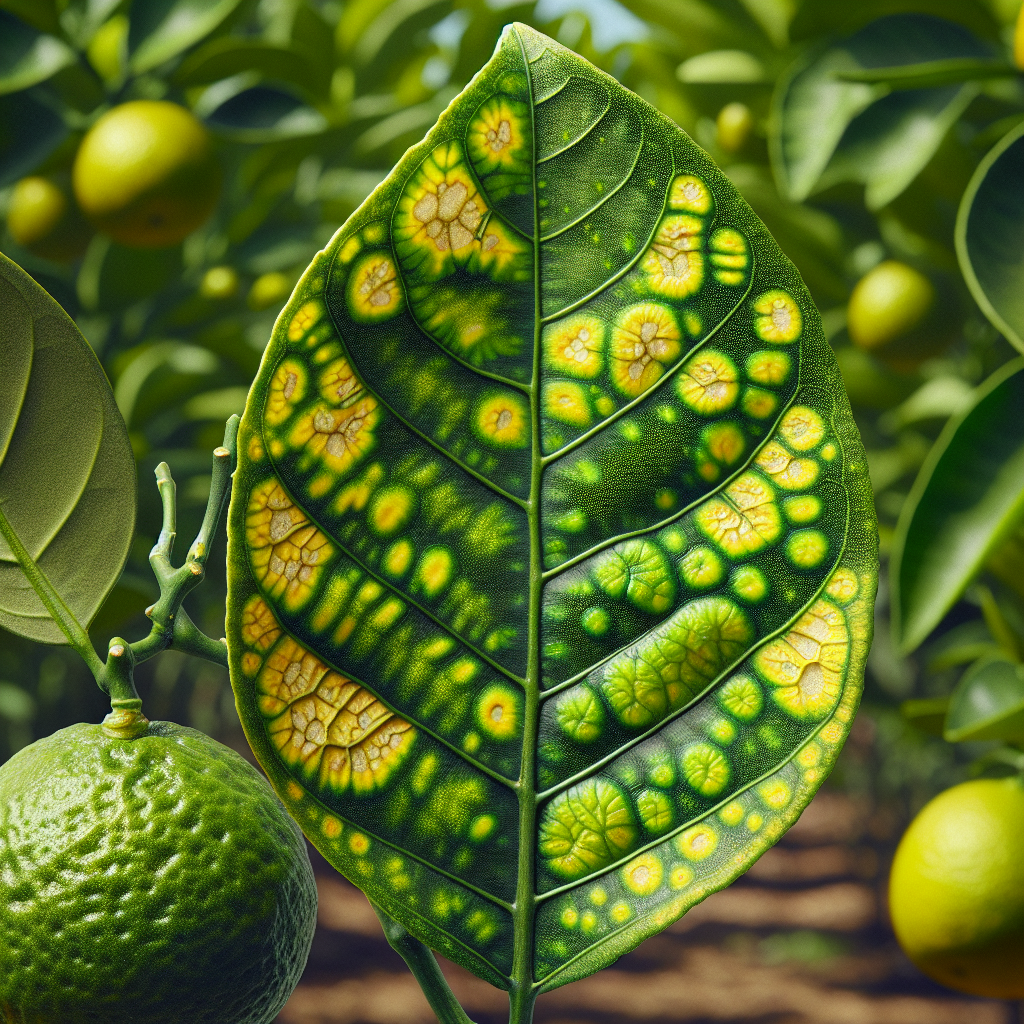
- Foliar Symptoms: Blotchy mottling with yellow shoots amid green tissue, creating 'blotchy mottle.' Leaves show asymmetric patterns—half green, half chlorotic—with starch accumulation forming green islands. Veins may thicken or cork, and severe cases lead to defoliation.
- Fruit Symptoms: Small, lopsided fruits with an enlarged calyx, bitter taste, and dark vascular staining. Color inversion occurs—fruits remain green at the bottom while ripening unevenly at the top. Seed abortion is common, reducing yield by 30-100%.
- Tree Decline: Stunted growth, excessive shoot flushing, thinning canopy, and dieback. Roots show cortical decline and fibrous root loss, exacerbating drought stress.
Diagnostic Confirmation: PCR testing of leaf petioles or fruit peduncles detects CLas DNA with 95% accuracy. Field scouts look for psyllid honeydew and sooty mold. Differentiate from zinc deficiency (uniform yellowing) or citrus tristeza virus (symmetrical symptoms). In advanced stages, trees yield <10% normal fruit, becoming uneconomical.
Damage escalates rapidly: In Florida, HLB reduced orange production by 75% since 2005. Early identification via visual scouting and lab tests prevents spread.
Lifecycle and Progression of citrus greening disease (huanglongbing)
HLB follows a systemic progression driven by psyllid transmission and bacterial replication:
- Transmission: Adult psyllids acquire CLas while nymphs on infected flush, transmitting within 24 hours to healthy trees. Latency period: 1-8 weeks.
- Early Infection (Months 1-6): Bacteria colonize phloem sieve tubes, causing callose deposition and plugging. Subtle mottling appears on new flush.
- Systemic Spread (6-18 Months): CLas moves bidirectionally via phloem, reaching roots. Canopy thins; fruit set drops 50%.
- Chronic Phase (2-5 Years): Severe decline with <20% leaf area functional. Roots die back 80%, leading to collapse.
Psyllid lifecycle (14-30 days) amplifies spread: Eggs on tender flush hatch into nymphs that acquire/transmit bacteria. Multiple generations per year in warm climates accelerate epidemics. Read our Spring Pest Patrol blog post for vector monitoring tips.
Environmental Triggers & Risk Factors
HLB thrives in tropical/subtropical climates (20-35°C optimal for CLas). Key triggers:
- Temperature: Psyllids inactive below 10°C; CLas dies above 37°C. Humid, mild winters favor outbreaks.
- Vector Density: High psyllid populations in abandoned groves or near Murraya hedges (Murraya psyllid hosts).
- Tree Stress: Poor drainage, root-knot nematodes, or drought weaken defenses.
- Planting Density: Close spacing (e.g., <5m) hastens spread.
Risk is highest in young groves (<5 years) and varieties like Valencia orange. Soil pH >7.5 reduces root health, compounding damage.
Organic Control & Treatment Plans
No curative organic treatments exist, but integrated strategies extend tree life 2-5 years:
Vector Management:
- Plant Thai basil or marigold as trap crops.
- Apply kaolin clay (Surround WP) or neem oil weekly during flush.
- Release Tamarixia radiata parasitoids (USDA-approved).
Nutritional Therapy:
- Foliar micronutrients (Zn, Mn, Fe at 1-2 lbs/acre) every 21 days.
- Soil drenches with potassium phosphite enhance defense.
Cultural Practices:
- Rogue infected trees promptly (remove 10-20m radius).
- Prune to improve airflow; mulch to retain moisture.
- Drip irrigate to counter root loss.
Biologicals:
- Bacillus subtilis or Beauveria bassiana sprays target psyllids.
Monitoring Protocol: Scout 20 trees/acre biweekly; threshold: 1 psyllid/10 taps. Yields can stabilize at 60% with aggressive IPM. Avoid antibiotics to preserve organic certification.
Preventing citrus greening disease (huanglongbing) in the Future
Proactive prevention is 90% effective:
- Quarantine: Inspect nursery stock; use HLB-free certified trees.
- Vector-Free Start: Psyllid-proof screenhouses for propagation.
- Resistant Scions: Plant US-942 or US-897 rootstocks (tolerant).
- Barrier Crops: Surround groves with guava or non-hosts.
- Scouting Tech: Use AI apps for psyllid traps (Why Misidentifying Plants Costs Small Farms Thousands).
- Area-Wide Management: Coordinate with neighbors for 5km buffer zones.
New groves on tolerant rootstocks yield 80% longer. Annual costs: $1,000/acre, vs. $10,000+ for remediation.
Crops Most Affected by citrus greening disease (huanglongbing)
HLB devastates Rutaceae family, especially:
| Crop | Susceptibility | Impact |
|---|---|---|
| Navel Orange | High | 90% yield loss in 3 years |
| Valencia Orange | High | Bitter fruit, seedless |
| Eureka Lemon | Moderate | Mottling, drop |
| Persian Lime | High | Defoliation |
| Mandarin (Satsuma) | Moderate | Uneven ripening |
| Grapefruit | High | Asymmetrical, green fruits |
Commercial varieties like Hass Avocado are unaffected but serve as windbreaks. Wild relatives (e.g., trifoliate orange) show tolerance. Global losses: Florida (4M tons/year), Brazil (1M ha abandoned).