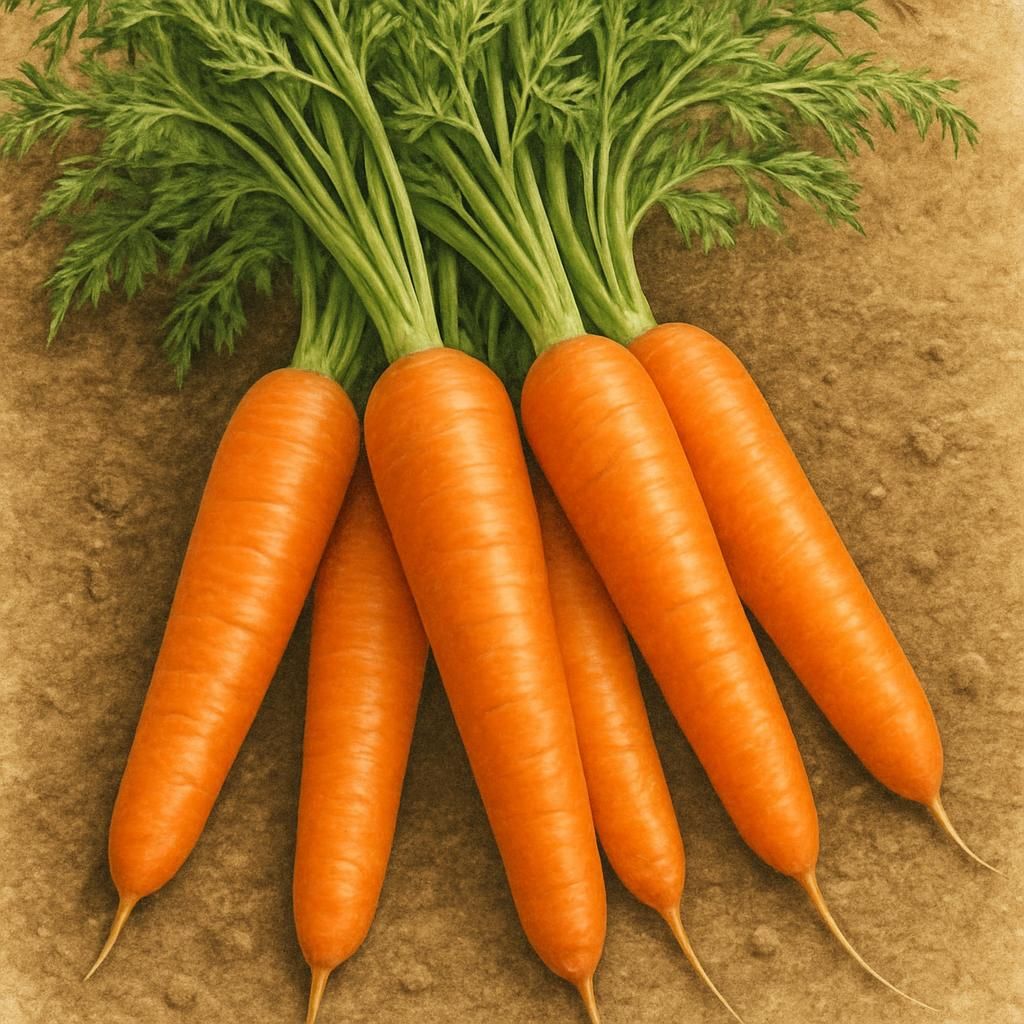
Introduction to Carrot (Nantes Coreless)
Nantes Coreless carrots are a beloved heirloom-type variety known for their smooth, cylindrical roots that taper only slightly and end in a distinctive blunt tip. Unlike tapered Imperator or Danvers types, Nantes varieties were developed in France in the 19th century specifically for their sweet flavor, crisp texture, and minimal woody core. The "Coreless" designation highlights the variety’s exceptionally small or nearly absent central core, delivering uniform sweetness throughout the root. Home gardeners and market growers favor Nantes Coreless for its reliable performance in cooler climates, rapid maturity (typically 55–70 days), and excellent storage qualities when harvested at peak tenderness.
This variety excels in both home gardens and small-scale commercial operations because of its adaptability to heavy soils and its resistance to splitting. Its deep orange color signals high beta-carotene content, making it a nutritional powerhouse for fresh salads, juicing, and light cooking. Nantes Coreless also stores exceptionally well in cool, humid conditions, retaining crispness and sweetness for weeks after harvest.
Botanical Profile of Carrot (Nantes Coreless)
Carrot (Nantes Coreless) belongs to the Apiaceae family and is botanically classified as Daucus carota subsp. sativus. The plant produces a biennial taproot in its first year that stores carbohydrates and develops the characteristic orange pigmentation. Foliage consists of finely divided, feathery leaves arranged in a basal rosette. The edible portion is the enlarged taproot, which in Nantes Coreless measures 15–18 cm long and 3–4 cm in diameter at maturity, with a smooth skin and minimal lateral root hairs when grown in loose, stone-free soil.
Flowering occurs in the second year after vernalization, producing an umbel of tiny white flowers that attract pollinators. Seeds are small, ridged, and brown, requiring light for germination. Nantes Coreless roots are notably less prone to forking compared to other varieties when soil conditions are managed properly.
Soil, pH, and Climate Requirements for Carrot (Nantes Coreless)
Carrots demand deep, loose, well-drained soil free of stones and clumps to allow straight root development. Nantes Coreless performs best in sandy loam or light loam amended with well-rotted compost. Heavy clay soils should be lightened with coarse sand or raised beds to prevent forking and stunted growth.
| Parameter | Ideal Range/Value | Notes |
|---|---|---|
| Soil Type | Sandy loam to light loam | Stone-free, deep tilth essential |
| Soil pH | 6.0 – 6.8 | Slightly acidic to neutral |
| Soil Temperature | 7–24 °C (45–75 °F) | Optimal germination 10–21 °C |
| Air Temperature | 15–21 °C (59–70 °F) day; 10–15 °C night | Cool-season crop; avoid heat stress |
| Spacing | 5–8 cm between plants; 30–45 cm rows | Thin seedlings early to prevent crowding |
| Depth | Sow 0.5–1 cm deep | Keep seedbed moist until germination |
| Sunlight | Full sun (minimum 6–8 hours) | Partial shade reduces root sweetness |
Step-by-Step Planting & Propagation
- Site Preparation: Till soil to 30 cm depth, removing stones and breaking up clumps. Incorporate 5–8 cm of well-aged compost or leaf mold. Avoid fresh manure, which causes forking.
- Seed Sowing: Direct sow Nantes Coreless seeds 2–3 weeks before the last spring frost when soil reaches 7 °C. Sow in rows 30–45 cm apart; cover lightly with 0.5–1 cm of fine soil or vermiculite.
- Moisture Management: Keep the top 2 cm consistently moist until seedlings emerge (7–14 days). Use row covers or shade cloth in hot weather to maintain even moisture.
- Thinning: When seedlings reach 5 cm tall, thin to 5–8 cm spacing. Use scissors to avoid disturbing neighboring roots.
- Succession Planting: Sow new rows every 2–3 weeks through midsummer for continuous harvest into fall.
- Transplanting: Not recommended; carrots develop taproots early and resent root disturbance.
Care & Maintenance regimes for Carrot (Nantes Coreless)
Consistent moisture and balanced nutrition are critical for sweet, straight roots. Over-fertilization with nitrogen promotes foliage at the expense of roots, while potassium and phosphorus support root enlargement and flavor.
| Growth Stage | Watering Schedule | Fertilizer Application | Pruning/Thinning Notes |
|---|---|---|---|
| Germination (0–14 days) | Light daily misting to keep surface moist | None; avoid high-nitrogen amendments | None |
| Seedling (2–4 weeks) | 2–3 cm water/week; maintain even moisture | Side-dress with low-N, high-P/K organic fertilizer at 3 weeks | Thin to 5 cm spacing |
| Vegetative (4–8 weeks) | 2.5–4 cm/week; deep infrequent watering | Light compost tea or balanced organic fertilizer every 4 weeks | Weed regularly; avoid root disturbance |
| Root Bulking (8+ weeks) | 2–3 cm/week; reduce slightly near harvest | Stop nitrogen; potassium-rich amendments only if deficiency symptoms appear | Remove any flowering stalks immediately |
Mulch with 5–8 cm of straw or shredded leaves after thinning to suppress weeds, retain moisture, and moderate soil temperature. Hand-weed carefully to prevent damage to shallow feeder roots.
Pests, Diseases & Organic Management
Common pests of Carrot include carrot rust fly larvae, which tunnel into roots, and aphids that colonize foliage. Wireworms and cutworms may also damage young seedlings. Practice crop rotation on a 3–4 year cycle and use floating row covers during peak flight periods of carrot rust fly. Beneficial nematodes applied as a soil drench provide effective biological control of soil-dwelling larvae.
Diseases include Alternaria leaf spot, powdery mildew, and root rot caused by overly wet soils. Ensure good air circulation and avoid overhead irrigation. Remove and destroy infected foliage promptly. Nantes Carrot shows moderate tolerance to many foliar diseases when grown in well-drained soil.
Harvesting, Curing & Optimal Storage
Harvest Nantes Coreless when roots reach 1.5–2 cm diameter at the shoulder, typically 55–70 days after sowing. Loosen soil with a fork and pull gently to avoid breakage. For baby carrots, harvest at 45–50 days. Remove tops immediately, leaving 1–2 cm of stem to prevent moisture loss.
Curing is minimal; simply brush off soil and allow roots to air-dry for 1–2 hours. Store in perforated plastic bags or damp sand at 0–4 °C with 90–95% humidity. Properly stored Nantes Coreless roots maintain quality for 4–6 months. Avoid washing until ready to use.
Companion Planting for Carrot (Nantes Coreless)
Carrots benefit from aromatic companions that mask their scent from carrot rust fly. Onion, garlic, and leeks planted in alternating rows provide excellent protection. Lettuce and radish grow well alongside, maturing quickly and helping mark rows. Avoid planting near dill or parsley, which can cross-pollinate or attract similar pests.
Tomato and Nantes Carrot make a mutually beneficial pairing when spaced properly; tomatoes provide light shade in hot weather while carrots help aerate soil around tomato roots. Nasturtium serves as a trap crop for aphids, drawing them away from carrot foliage.