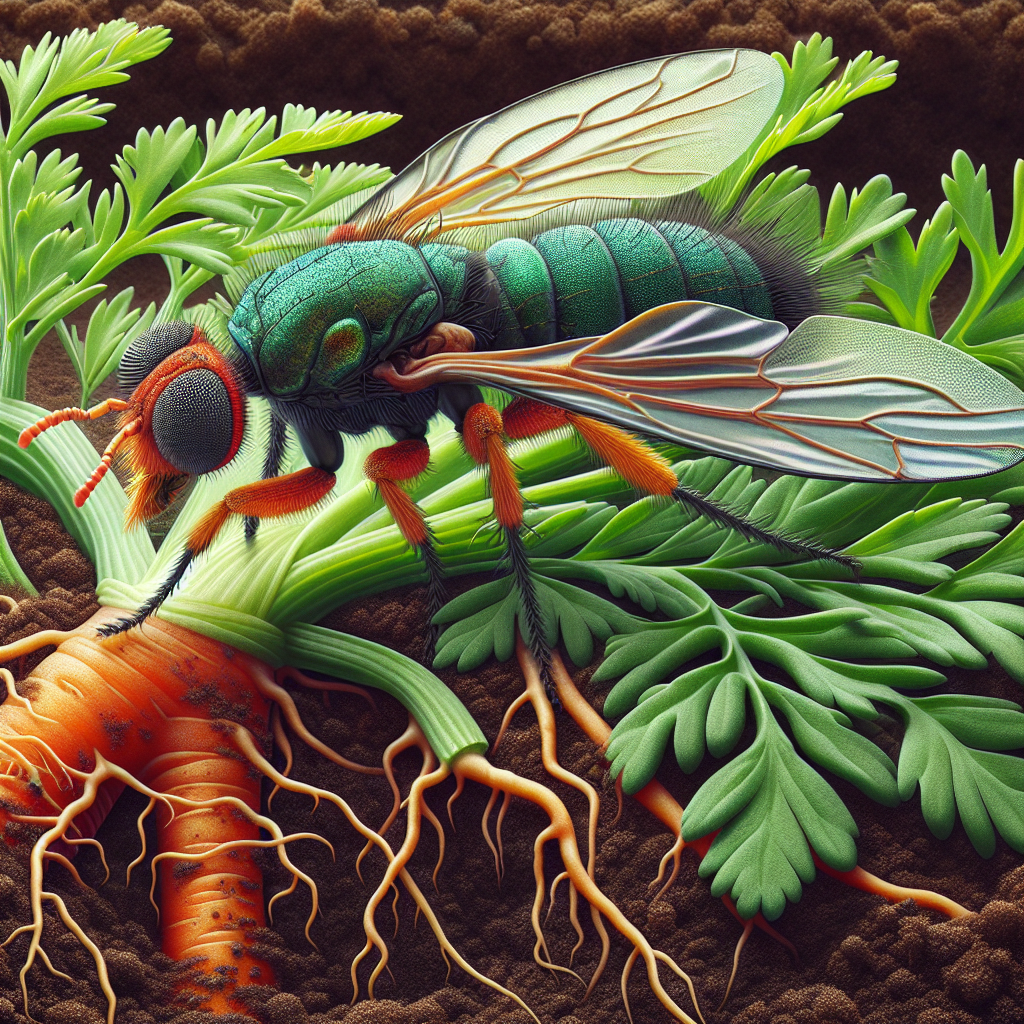
Introduction to Carrot rust fly
The carrot rust fly, scientifically known as Psila rosae, is one of the most destructive pests affecting root vegetables in temperate climates worldwide. Native to Europe but now widespread in North America, Asia, and other regions, this small fly targets the roots of carrot plants and closely related umbelliferous crops like parsnips, celery, and parsley. The pest earns its name from the rusty-brown coloration of infested roots, caused by larval tunneling that exposes tissues to soil pathogens and discoloration.
Farmers and gardeners dread the carrot rust fly because its maggots bore into roots just below the soil surface, rendering produce unmarketable. Damage often goes unnoticed until harvest, leading to 50-100% losses in severe infestations. Adults are slender, 5-9 mm long, shiny black flies with yellow legs and orange-reddish heads, active from late spring through fall depending on climate. Females lay up to 400 eggs over their 4-6 week lifespan, gluing them singly to leaf petioles or soil cracks near host plants.
Understanding this pest's biology is crucial for effective control. Overwintering as pupae in soil, flies emerge when soil temperatures reach 7-10°C (45-50°F), coinciding with carrot seedling emergence. Multiple generations (2-3 per year) amplify damage in warmer regions. This guide provides professional-grade diagnostics, lifecycle insights, organic management strategies, and prevention tactics to safeguard your crops. Early intervention and integrated pest management (IPM) can reduce populations by over 90%, preserving root quality and market value.
Identifying Symptoms & Damage
Diagnosing carrot rust fly infestations requires keen observation of above- and below-ground signs. Early symptoms appear 2-4 weeks after egg-laying, typically in late spring or early summer. Look for wilting or yellowing of outer leaves, starting from the oldest foliage—a classic 'flag leaf' symptom where one leaf droops while others remain upright.
The most definitive sign is the rusty-brown scarring on roots. Gently unearth a suspect plant: you'll find narrow, winding tunnels filled with pale yellow maggots (4-9 mm long, legless, with a hooked rear end). Heavily infested roots exhibit reddish-brown lesions, forking, or stunted growth, often accompanied by a foul odor from secondary bacterial or fungal rots like those caused by root rot. In severe cases, roots become honeycombed, cracked, or hollow, unfit for consumption.
Adult flies may be spotted hovering low over plants in sunny weather, especially on calm days. Entry holes at the root crown (1-2 mm diameter) are another giveaway. Differentiate from other pests: wireworms cause straight tunnels and chew seeds, while root-knot nematodes produce galls rather than linear mines. Use yellow sticky traps to monitor fly activity—catches exceeding 5 flies per trap per week signal high risk.
Damage thresholds vary: in commercial fields, 10-20% root infestation warrants action; home gardens tolerate less. Harvest early-maturing varieties promptly to minimize exposure. Cross-section roots to confirm maggots; live larvae wiggle when prodded. Consistent scouting every 7-10 days from planting prevents surprises at harvest.
Lifecycle and Progression of Carrot rust fly
The carrot rust fly completes 2-3 generations annually, synchronized with host availability and temperature. Overwintering pupae (3-5 mm, barrel-shaped, brown) reside 5-20 cm deep in soil near previous hosts, surviving cold via diapause. Emergence begins when soil hits 7°C, peaking at 15°C (59°F), typically mid-May in northern latitudes.
Adults live 4-8 weeks, feeding on nectar and laying eggs within days of emergence. Females oviposit 10-40 eggs daily near plant bases, preferring stressed or young seedlings. Eggs hatch in 7-14 days into maggots that burrow downward, feeding for 3-6 weeks. Mature larvae (9 mm) exit roots, pupate in soil, and produce the next generation 4-6 weeks later. Second-generation adults appear in July-August, with a partial third in mild falls.
Lifecycle duration shortens with warmth: 8-10 weeks per generation at 20°C (68°F). Pupal stage lasts 3-5 weeks, overwintering when days shorten below 12 hours. High humidity favors egg survival; dry soils kill neonates. Population peaks correlate with carrot growth flushes, amplifying damage in continuous plantings.
Disrupting this cycle is key: delay planting until after first emergence, rotate crops, or till soil post-harvest to expose pupae to predators and desiccation. Understanding progression allows precise timing for interventions like row covers or nematodes.
Environmental Triggers & Risk Factors
Carrot rust fly thrives in cool, moist conditions optimal for carrots. Soil temperatures above 7°C trigger emergence, with peak flight at 15-20°C and 60-80% humidity. Overly fertile, nitrogen-rich soils produce lush foliage attractive to ovipositing females. Poor drainage exacerbates larval survival and root rots.
Risk spikes near overwintering sites: infested fields, weedy borders with wild parsnip or Queen Anne's lace (host alternates). Continuous carrot monocultures build populations; nearby onion or celery plantings serve as reservoirs. Early planting (before June) overlaps with first generation; late sowings dodge second flights but risk frost.
Weed-free, tilled fields with high organic matter retain pupae moisture, boosting survival. Windbreaks shelter flies; south-facing slopes warm soil prematurely. Climate change extends seasons, adding generations in southern areas. Monitor local extension forecasts for 'biofix' (first sustained trap catch), initiating IPM.
Organic Control & Treatment Plans
Organic management emphasizes prevention but includes targeted treatments. Row covers: Fine mesh (0.4 mm) excludes adults from emergence; install at planting, seal edges with soil or weights. Effective 95%+ if timed pre-first flight—check local models.
Biological controls: Entomopathogenic nematodes (Heterorhabditis bacteriophora or Steinernema carpocapsae) applied as soil drench (2-5 billion/ha) when larvae active. Irrigate post-application for soil penetration; 70-90% mortality in trials. Predatory rove beetles and ground beetles naturally suppress pupae.
Cultural tactics: Rotate with non-hosts like potato or grains (3-4 years). Sow late (post-June) or under covers. Till deeply post-harvest (20-30 cm) to destroy pupae. Trap crops like radish draw flies away. Companion plant with onion or garlic, repelling via volatiles.
Organic sprays: Neem oil or spinosad targets young larvae via petiole drench, but efficacy <50% due to soil protection. Yellow sticky traps (20-30/m row) reduce adults 30-50%. Diatomaceous earth around bases deters egg-laying.
Integrated plan: Scout weekly, apply nematodes at first trap catch +10 days. Remove infested plants, destroy. For Spring Pest Patrol: Organic AI Strategies to Shield Your Crops from Common Invaders, combine with data-driven timing. Expect 80% control layering methods.
Preventing Carrot rust fly in the Future
Long-term prevention hinges on breaking the soil-based lifecycle. Implement 4-year rotations: follow carrots with cabbage, lettuce, legumes, then grains. Avoid umbellifers like parsley nearby. Clean equipment to prevent pupae spread.
Choose resistant varieties: 'Resistafly' or 'Flyaway' carrots deter oviposition via leaf traits. Plant late or succession-sow to miss peaks. Mulch heavily (10 cm straw) post-emergence to hinder adults. Solarize soil pre-planting in high-risk areas.
Enhance biodiversity: interplant nasturtium or marigold as traps/diversions. Encourage natural enemies with beetle banks. Monitor with traps; destroy volunteers. Post-harvest, harvest all roots, till, and cover with tarps to kill pupae. For zoning strategies, see Why Zoning Your Small Farm Chaos into Profit Zones Feels Impossible - And How AI Changes Everything. Annual planning yields pest-free crops.
Crops Most Affected by Carrot rust fly
Primarily attacks Apiaceae family: carrots (all varieties, especially early Nantes types), parsnips (up to 80% loss), celery, celeriac, parsley, fennel, and wild relatives like hogweed. Beet, turnip, and radish suffer minor damage. Rare on sweet potato or potato.
Commercial impact greatest on baby carrots and organic fields without synthetics. Home gardens hit hard due to proximity to wild hosts.