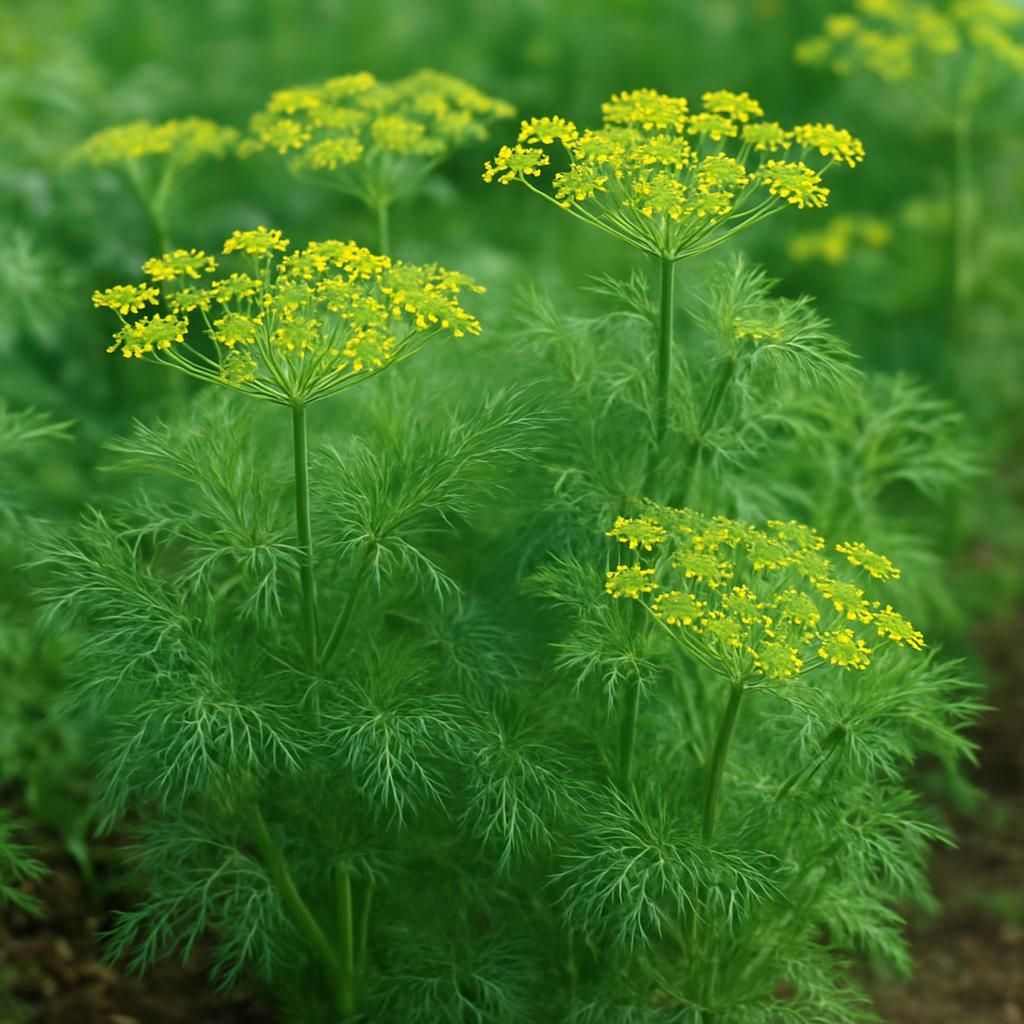
Introduction to Dill
Dill (Anethum graveolens) is a fast-growing annual herb belonging to the Apiaceae family, valued for its delicate, feathery leaves and pungent seeds. Native to the Mediterranean and southwestern Asia, it has been cultivated for thousands of years for both culinary flavoring and traditional medicine. Today, commercial and home growers produce dill for fresh herbs, dried seasoning, essential oil extraction, and pickling cucumbers. Its quick maturation (45–60 days to leaf harvest) makes it an excellent succession crop in temperate climates.
Botanical Profile of Dill
Dill is an erect, hollow-stemmed plant reaching 60–150 cm in height. Its bluish-green, finely divided leaves resemble those of fennel but are more delicate. Small yellow flowers form compound umbels that mature into flat, oval seeds. The plant produces a taproot system with secondary fibrous roots, making it moderately drought-sensitive once established. Dill is a self-seeding annual; if seed heads are left, volunteer plants often appear the following season.
Soil, pH, and Climate Requirements for Dill
Dill performs best in fertile, well-drained sandy loam or loam soils. It tolerates a wide pH range but yields highest between 6.0–7.5. The crop prefers cool temperatures (15–24 °C) and full sun (minimum 6–8 hours). Excessive heat or drought causes bolting and reduced leaf quality.
| Parameter | Ideal Range | Notes |
|---|---|---|
| Soil Type | Sandy loam to loam | Good drainage prevents root rot |
| Soil pH | 6.0 – 7.5 | Slightly acidic to neutral |
| Temperature (day) | 15 – 24 °C | Bolting occurs above 27 °C |
| Temperature (night) | 10 – 15 °C | Cool nights improve leaf flavor |
| Sunlight | Full sun, 6–8+ hours | Partial shade reduces oil content |
| Spacing (row) | 30–45 cm | Allows air circulation |
| Spacing (plant) | 15–20 cm | Direct sow; thin seedlings early |
| Soil Moisture | Evenly moist, not waterlogged | Critical during germination and flowering |
Step-by-Step Planting & Propagation
- Site Preparation: Till soil to 20–25 cm depth, removing weeds and incorporating 2–3 cm of well-rotted compost. Conduct a soil test and adjust pH if below 6.0 with agricultural lime.
- Sowing Time: Direct sow in early spring as soon as soil reaches 10 °C; successive sowings every 2–3 weeks extend harvest. In warm climates, sow in fall for winter production.
- Seed Treatment: No stratification required. Soak seeds in water for 12 hours to improve germination uniformity.
- Sowing Depth & Rate: Plant seeds 0.5–1 cm deep at 1–2 g per m². Rows spaced 30–45 cm apart.
- Germination: Expect emergence in 7–14 days at 15–20 °C. Keep seedbed consistently moist.
- Thinning: When seedlings reach 5 cm, thin to 15–20 cm between plants to reduce competition.
- Transplanting: Dill does not transplant well; direct sowing is recommended.
Care & Maintenance regimes for Dill
Dill requires minimal but consistent attention. Mulch with 5 cm of straw or leaf mold to suppress weeds and retain moisture. Avoid high-nitrogen fertilizers after initial growth to prevent excessive vegetative growth at the expense of flavor. Monitor for bolting in hot weather and provide afternoon shade if temperatures exceed 26 °C.
| Growth Stage | Watering Schedule | Fertilizer Application | Pruning / Harvest Action |
|---|---|---|---|
| Germination (0–14 days) | Keep top 2 cm moist daily | None; use starter compost | None |
| Vegetative (2–5 weeks) | 2.5 cm/week; deep soak twice weekly | Side-dress 5-10-10 NPK at 3 weeks | Pinch tips at 20 cm to encourage bushiness |
| Flowering (5–7 weeks) | Maintain even moisture | Light compost tea every 3 weeks | Remove lower leaves for airflow |
| Seed Set (7–9 weeks) | Reduce to 1.5 cm/week | No additional fertilizer | Cut seed heads when turning brown |
| Post-Harvest Regrowth | Resume 2.5 cm/week | Light nitrogen if continuing leaf crop | Cut back to 10 cm above soil |
Pests, Diseases & Organic Management
Common insect pests include aphids, spider mites, and cutworms. Dill is also a host for swallowtail larvae; hand-pick or use row covers. Fungal issues such as powdery mildew and root rot arise in poorly drained soils. Organic controls include insecticidal soap for aphids, neem oil for mites, and crop rotation to break disease cycles. Beneficial insects such as lady beetles and lacewings provide natural suppression.
Harvesting, Curing & Optimal Storage
Harvest leaves when plants reach 15–20 cm, cutting outer stems first to encourage regrowth. For peak flavor, harvest in early morning before flowering. Dry leaves in a shaded, well-ventilated area at <35 °C for 3–5 days, then store in airtight containers away from light. Seeds are ready when seed heads turn brown; cut entire umbels, hang upside-down in paper bags, and thresh after 10–14 days. Store seeds in cool, dark conditions for up to two years.
Companion Planting for Dill
Dill repels aphids and attracts beneficial insects, making it an excellent companion for cucumber, lettuce, onion, and brassicas. Avoid planting near carrot or tomato as cross-pollination can reduce seed purity. Pairing with nasturtium further deters pests while improving biodiversity.
For more on seasonal soil strategies that benefit herb crops like dill, see The Forgotten Art of Fall Soil Revival: 8 Organic Strategies for Small Farm Resilience.