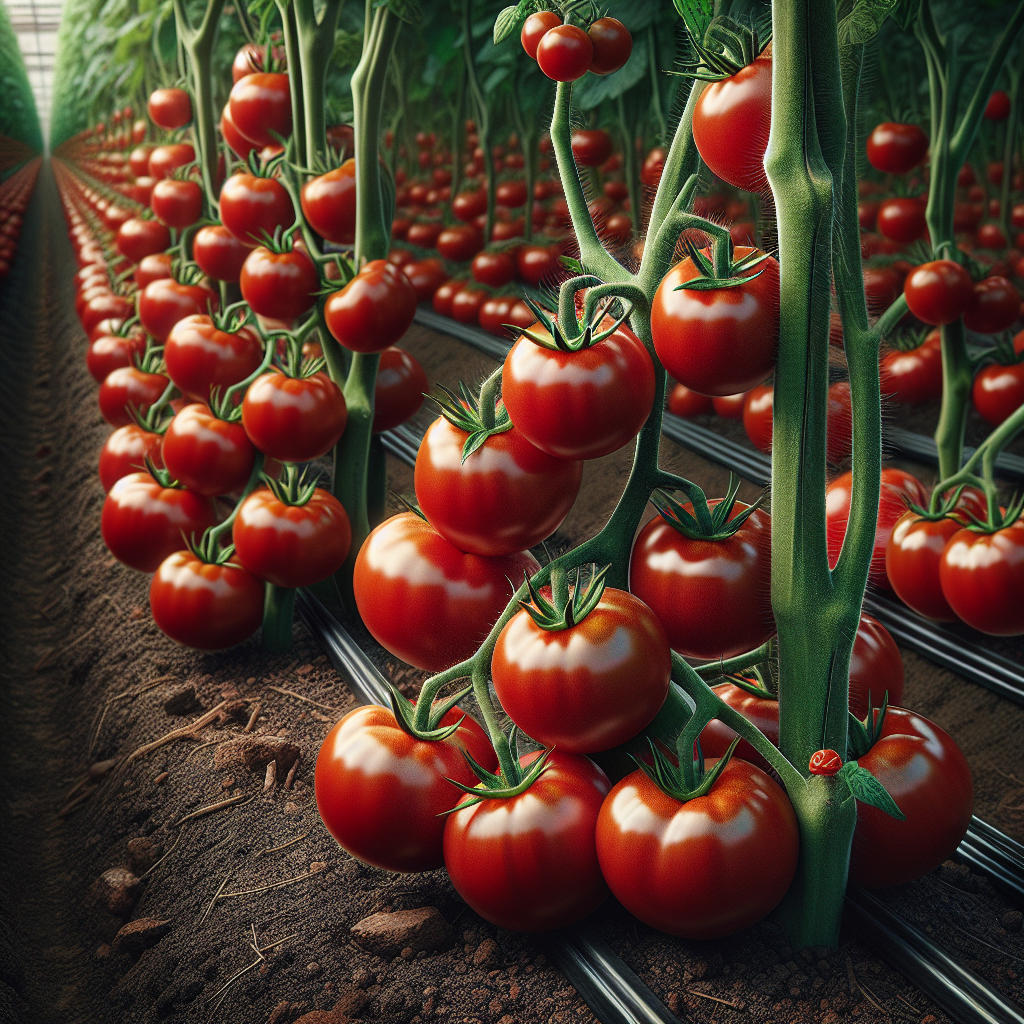
Introduction to Campari Tomato
Campari is a small-to-medium slicing tomato often marketed as a “cocktail tomato,” occupying the niche between cherry and standard round tomatoes. Fruits are typically golf-ball sized, deep red, thin-skinned, juicy, and notably less acidic in perception than many commodity types, yet still bright enough to taste complex rather than bland. Commercially, Campari gained popularity because it ships better than many delicate sweet tomatoes while still delivering premium eating quality, especially when harvested close to full color.
In practical production terms, this variety is valued for uniformity, attractive cluster presentation, and high consumer acceptance in fresh markets. It is commonly grown in greenhouses and high tunnels, but field culture is also possible where the season is long and warm. Gardeners who enjoy the flavor profile of truss tomatoes but want something larger than a cherry should consider it one of the most rewarding fresh-eating cultivars. For broader species-level context, see our Tomato guide.
Compared with large beefsteak classes, Campari tends to set more consistently under good management and ripens earlier, though it is less forgiving of erratic irrigation because its thin skin can crack after sudden water surges. Its flavor is at its best when plants receive abundant light, moderate nitrogen, and even soil moisture throughout fruit fill.
Botanical Profile of Campari Tomato
This cultivar belongs to the nightshade family, Solanaceae, and is the domesticated species Solanum lycopersicum. Most Campari strains sold to growers are indeterminate or vigorous semi-indeterminate greenhouse types, meaning they continue vegetative growth while flowering and fruiting over an extended season. In protected systems, vines commonly exceed 1.8 to 2.5 meters if trained vertically; in open-field gardens they may still reach 1.5 meters or more depending on fertility and climate.
Leaves are compound, softly pubescent, and strongly aromatic when handled due to glandular trichomes. Flowers are yellow, self-fertile, and borne in clusters. Pollination is usually adequate outdoors with wind and bee vibration, but greenhouse growers often improve fruit set using electric pollinators, bumblebees, or gentle truss shaking during midmorning when pollen is dry and viable.
Fruit characteristics are what distinguish Campari from many other market classes. Fruits usually weigh about 30 to 60 grams, though some strains run larger. Skin is thin but not as fragile as many cherry tomatoes. The locular gel is abundant, flesh is tender, and the sugar-acid balance is a major selling point. Brix can be notably good under high-light, moderate-stress finishing conditions, but overwatering near harvest often dilutes flavor.
Morphologically, Campari differs from plum types such as Roma and from many large slicing cultivars by maintaining a round to slightly flattened globe shape with consistent size across clusters. The plant’s vigor means canopy management matters: excessive vegetative growth can shade trusses, delay coloring, and reduce air movement. Like other tomatoes, roots are capable of forming adventitious tissue along buried stems, which is why deep planting often improves establishment.
Soil, pH, and Climate Requirements for Campari Tomato
This crop thrives in deep, friable, well-drained loam rich in stable organic matter. Ideal soil texture is sandy loam to loam with enough fine material to hold moisture but enough pore space to prevent waterlogging. Heavy clay can work if raised beds, gypsum where appropriate, and repeated organic matter additions improve structure. In compacted soil, root growth stalls, oxygen declines, and the plant becomes more vulnerable to blossom-end rot, root disease, and irregular fruit sizing.
Target soil pH is 6.2 to 6.8, with 6.4 to 6.6 being especially comfortable for nutrient availability. At pH below 5.8, phosphorus becomes less available and manganese toxicity can become an issue in some soils. Above pH 7.2, iron, manganese, and zinc deficiencies become more common, often showing up as interveinal chlorosis on newer leaves. A pre-plant soil test is strongly recommended. Tomatoes are moderately heavy feeders, but they respond poorly to fertility guesswork.
Before planting, incorporate 5 to 8 cm of finished compost into the top 20 to 30 cm of soil unless phosphorus is already excessive. A starting nutrient profile for productive garden soil often includes moderate nitrogen, ample phosphorus for root establishment, and especially sufficient potassium and calcium for fruit quality. Excessive raw manure is a mistake: it can drive rank vegetative growth, elevate salinity, and increase disease risk.
Temperature is critical. Campari performs best when daytime temperatures range from 21 to 29°C and nighttime temperatures from 16 to 21°C. Fruit set declines when daytime highs persist above 32 to 35°C or when nighttime temperatures remain above about 24°C, because pollen viability drops. Cool nights below 13°C also slow growth and can impair pollination. Frost kills plants, and even chilling conditions can cause purpling, stunting, and delayed flowering.
Full sun is essential. Outdoors, provide at least 8 hours of direct light; 10 or more is better for concentrated sugars and strong color development. In humid climates, good air movement is almost as important as sunlight because dense canopies stay wet longer and favor Early Blight and septoria.
Steady soil moisture is one of the most important quality factors. Aim for soil that remains evenly moist at roughly 60 to 80% of field capacity in the active root zone rather than cycling between soggy and dusty. Practically, the top 2 to 3 cm may dry slightly between irrigations, but the soil at 8 to 15 cm deep should feel cool and lightly moist, not saturated. Signs of underwatering include midday wilting that persists into evening, curled leaves with a dull gray-green cast, blossom drop, and small fruit. Signs of overwatering include constantly wet soil, lower-leaf yellowing, edema-like blistering, soft lush growth, reduced flavor, and in severe cases a sour anaerobic smell from the root zone.
Step-by-Step Planting & Propagation
Campari tomatoes are propagated almost exclusively from seed or purchased transplants. Saving seed from hybrid Campari strains is possible but will not reliably reproduce the same fruit quality, size, or plant habit, so commercial and serious home growers usually start with fresh seed each season.
Start seed 5 to 8 weeks before the last expected frost. Sow in sterile propagation mix at 0.5 to 1 cm depth. Keep the medium at 24 to 28°C for germination. Most seed emerges in 5 to 8 days under warm, even conditions.
Once seedlings emerge, give intense light immediately. Provide 14 to 16 hours of bright supplemental light indoors or place in a high-light greenhouse bench. Leggy seedlings result from warm temperatures and inadequate light.
After cotyledons expand, reduce temperatures slightly to about 18 to 22°C by day and 16 to 18°C by night to build stocky transplants. Water enough to keep the medium evenly moist but never saturated.
Pot up at the first true-leaf stage into larger cells or pots. Bury stems slightly deeper if seedlings are stretched. Begin light feeding with a balanced transplant fertilizer at quarter to half strength.
Harden plants for 7 to 10 days before transplanting. Gradually increase outdoor exposure to wind, sunlight, and cooler nights, but do not expose them to temperatures below about 10 to 12°C for extended periods.
Transplant only after frost danger has passed and soil temperatures are consistently above 15°C. Cold soil delays root growth and leaves transplants vulnerable to disease.
Plant deeply. Remove lower leaves and bury up to one-half to two-thirds of the stem if the transplant is tall. Adventitious roots will form along the buried stem, improving anchorage and water uptake.
Space according to training system. For staked and pruned plants, use about 45 to 60 cm between plants and 90 to 120 cm between rows. In cages with less pruning, allow 60 to 75 cm between plants. In greenhouse single-leader systems, closer spacing may be used depending on cultivar vigor and climate control.
Install support at planting time. Stakes, strings, Florida weave, or strong cages all work, but waiting until plants sprawl risks root damage later.
Mulch after the soil has warmed. Organic mulch 5 to 8 cm thick reduces splash-borne disease, buffers moisture swings, and suppresses weeds. Black plastic mulch is especially useful in cool regions for earlier growth.
Grafting onto disease-resistant rootstocks can be worthwhile in high-value or protected production, especially where soilborne diseases, nematodes, or salinity are recurring issues. Grafted plants often show stronger vigor and prolonged production, though they require stricter pruning.
Care & Maintenance regimes for Campari Tomato
Successful Campari production depends on balancing vegetative growth with steady fruiting. Overfeeding nitrogen creates large dark-green plants with delayed ripening and diluted flavor; underfeeding causes pale foliage, weak truss development, and undersized fruit.
Irrigate deeply and consistently. Most established outdoor plants need approximately 2.5 to 4 cm of water per week from rainfall plus irrigation, but that number rises in sandy soils, containers, high tunnels, and hot windy weather. During peak fruit load, a mature plant in warm conditions may need irrigation every 1 to 3 days depending on soil type. Drip irrigation is preferred because it keeps foliage dry and delivers moisture directly to the root zone. The goal is uniformity: a sudden heavy irrigation after drought often causes radial cracking and flavor dilution.
A practical schedule is to water when the top few centimeters have dried but before plants show stress. In containers, irrigate when the upper 2 to 3 cm are dry and the pot still retains some weight. In field beds, probe the soil 10 to 15 cm deep. If it is dry at that depth, irrigate thoroughly.
Fertilization should be staged. At transplanting, use a starter solution with phosphorus and modest nitrogen. Once plants begin active vegetative growth, shift to balanced feeding. When flowering and fruiting intensify, prioritize potassium and calcium while keeping nitrogen moderate. Many growers use a ratio roughly near 1:1:1 early, then move toward something closer to 1:0.5:1.5 during heavy fruiting, depending on soil reserves and fertigation practices. Calcium must be continuously available in the root zone; blossom-end rot is rarely a true calcium absence in the fruit itself alone, but rather a transport problem triggered by uneven moisture, excess ammonium, salinity, or root stress.
Pruning depends on the system. Indeterminate Campari usually performs best when trained to one or two leaders. Remove suckers below the first flower truss early, then decide whether to maintain one main stem or allow one strong secondary stem. Weekly sucker removal prevents large wounds and wasted carbohydrate allocation. Also remove lower leaves gradually as fruit matures to improve airflow and reduce soil splash. Never strip too aggressively; leaves power sugar production.
Support is non-negotiable. Truss-bearing fruit can snap stems if left unsupported. In greenhouse systems, plants are commonly clipped to vertical strings and lowered as they grow. In gardens, sturdy stakes at least 1.8 meters tall or reinforced cages are preferred. Tie loosely with soft material to avoid stem girdling.
Pollination management matters in protected culture. If flowers open but fruit set is poor, gently shake support strings or flower trusses every few days during late morning. Excess humidity can make pollen sticky and non-shedding; very low humidity can dry stigmas excessively.
Weed control should be proactive. Tomatoes compete poorly with early weeds for nitrogen and moisture. Mulch and shallow cultivation are ideal; deep hoeing can sever feeder roots.
For growers interested in refining bed preparation and long-term fertility, this resource on soil health offers useful background.
Pests, Diseases & Organic Management
Campari tomatoes face the same major pest and disease complex as other fresh-market tomatoes, but thin-skinned fruit and dense canopies make prevention especially important.
Common insect pests include Aphids, Whiteflies, Flea Beetles, Hornworms, Tomato Fruitworms, Spider Mites, and Thrips. Aphids and Whiteflies weaken plants and vector viruses. Spider Mites explode in hot, dry conditions and cause stippled bronzing. Hornworms can defoliate quickly. Thrips can scar fruit and transmit disease.
Organic management begins with scouting at least twice weekly. Check undersides of leaves, new growth, flowers, and green fruit. Use yellow sticky cards in tunnels and greenhouses for early detection of Whiteflies and Aphids. Hand-pick Hornworms. A strong water spray can suppress Aphids on sturdy plants. Insecticidal soap works on soft-bodied pests if complete coverage is achieved. Neem-based products may help in rotation, though they should be applied carefully to avoid foliage burn in hot sun. Bacillus thuringiensis var. kurstaki is effective against young caterpillars when ingested. Predatory mites and parasitoids are highly useful in protected systems.
Key diseases include Early Blight, Septoria Leaf Spot, Late Blight, Bacterial Speck, Bacterial Spot, Fusarium Wilt, Verticillium Wilt, and various Root Rots. Viral threats include Tomato Mosaic Virus and Tomato Spotted Wilt Virus. Symptoms differ, but several patterns matter: concentric target-like lesions suggest Early Blight; many tiny circular spots with dark margins and tan centers suggest septoria; sudden water-soaked lesions under cool wet weather may indicate Late Blight.
Organic disease prevention is more effective than rescue. Rotate away from tomatoes and other solanaceous crops for at least 2 to 3 years where feasible. Water at the base, not overhead. Remove infected lower leaves early. Space and prune for airflow. Mulch to reduce splash dispersal. Sanitize tools, especially after handling suspect bacterial or viral infections. Remove and destroy severely diseased plants rather than composting them unless compost temperatures are reliably high.
Copper-based products and biofungicides containing Bacillus species can suppress some foliar diseases when applied preventively. They are less effective after disease is entrenched. In humid climates, begin preventive sprays before symptoms are severe, particularly after periods of repeated rain.
Physiological disorders are also common. Blossom-end rot shows as a dark leathery patch at the blossom end, usually from irregular moisture, rapid vegetative growth, root injury, or salinity stress. Radial cracking often follows sudden irrigation or rain after a dry period. Sunscald occurs when fruit becomes exposed after heavy pruning or leaf disease. Green shoulders can appear under intense heat or nutrient imbalance.
Harvesting, Curing & Optimal Storage
Campari is harvested for fresh use, not cured in the way onions, garlic, or winter squash are cured. The key is harvest stage management to balance flavor, shelf life, and crack resistance.
For maximum eating quality, harvest at full red color or just before full red if the fruit will be sold or transported within a few days. If shipping or holding is necessary, harvest at the breaker to turning stage, when the first visible color change appears but fruit is still firm. Because Campari is prized for flavor, harvesting too green sacrifices much of what makes it desirable.
Use clean shears or twist fruit gently without tearing the cluster if harvesting singles. For truss marketing, harvest full clusters only when most fruits are evenly colored and the rachis remains green and fresh-looking. Pick during the cooler part of the morning after surface moisture has dried.
Handle fruit very gently. Thin skin bruises more easily than thick-walled storage tomatoes. Keep harvested fruit shaded and out of direct sun. Field heat removal is important, but do not chill excessively.
Optimal storage temperature is generally 12 to 18°C for short holding with moderate humidity around 85 to 90%. Avoid refrigeration below about 10°C whenever possible, especially for premium fruit intended for raw eating, because chilling injury degrades flavor, mealiness increases, and aroma volatiles diminish. Fully ripe fruits are best used within several days; breaker-stage fruit can finish ripening at room temperature.
Do not stack deeply in harvest bins. Weight compression causes invisible bruising that later appears as soft patches. Remove cracked or diseased fruit immediately so it does not contaminate sound fruit. Wash only if necessary, and dry thoroughly before packing.
Companion Planting for Campari Tomato
The most useful companions are those that help with pest distraction, pollinator attraction, root-zone efficiency, or spatial compatibility rather than folklore-based claims. Thai Basil is widely valued near tomatoes because its aromatic canopy may help confuse some pests while also fitting well in similar warm-season conditions. Onion and Garlic are frequently paired with tomatoes in diversified beds because they occupy a relatively different rooting and canopy niche and can contribute to a cleaner understory with fewer weeds. Marigold is often recommended in home gardens for beneficial insect support and aesthetic integration, though results against nematodes depend heavily on species and management and should not be overstated.
Good practical companions are low-growing, non-competitive plants that do not heavily shade the tomato root zone. Lettuce can work early in the season before tomato canopy expansion, while basil and alliums are stronger full-season partners. Avoid planting Campari immediately next to crops with similarly heavy disease pressure or intense nutrient competition if airflow will be reduced.
Also avoid companion arrangements that create humidity traps. Dense herbs pressed tightly against the base of a tomato can reduce ventilation and encourage foliar disease. Keep at least modest spacing around the stem base, maintain mulch, and prioritize sanitation over any theoretical companion benefit.
The best companion strategy is really systems design: combine upright trained tomatoes with low or narrow partners, maintain airflow, and choose plants that can be irrigated on similar schedules without forcing either crop into chronic stress.