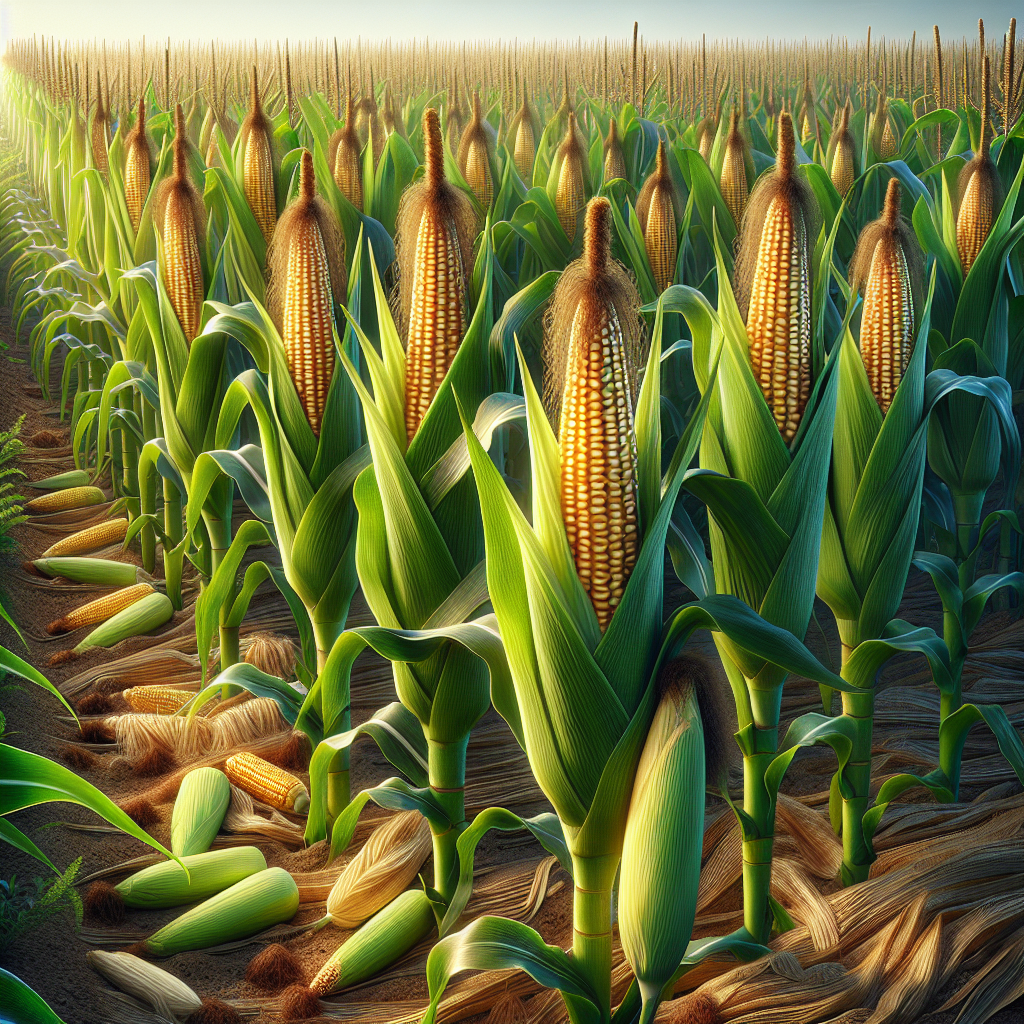
Introduction to Bodacious Sweet Corn
Bodacious is one of the best-known yellow sweet corn cultivars for fresh eating, farm stands, and home gardens because it combines strong sweetness with robust ear size and attractive marketable appearance. In practical terms, growers choose it for its long, well-filled ears, relatively dependable vigor, and kernels that stay tender longer than many old-fashioned standard sweet corns.
This variety is generally classed among sugary enhanced sweet corns, often abbreviated as se types. That matters because sweet corn types differ genetically in how they store sugars and convert them to starch. Standard sugary (su) corn tends to lose sweetness quickly after harvest, while supersweet (sh2) corn can be exceptionally sweet but sometimes less creamy and more demanding in germination under cool soils. Bodacious occupies a middle ground that many growers appreciate: rich flavor, good tenderness, and more forgiving field performance. For growers planning succession plantings, this balance makes it especially valuable where flavor and consistent stand establishment matter as much as raw sugar concentration.
Like all sweet corn, it is wind-pollinated rather than insect-pollinated, so successful production depends heavily on planting geometry and pollen timing. It is not a crop to scatter in a single short row and hope for full ears. Dense pollen shed from tassels must fall onto fresh silk strands, and every silk corresponds to a potential kernel. Incomplete pollination means missing kernels and poor tip fill.
If you want broader species-level background on growth habit and grain biology, see our Corn guide. For broader field fertility principles that directly improve ear fill and sweetness, the ideas in soil health strategies are useful.
Botanical Profile of Bodacious Sweet Corn
Bodacious belongs to the grass family Poaceae and the species Zea mays, one of the most morphologically specialized annual cereal crops in cultivation. Sweet corn is distinct from dent, flint, and flour corns because of recessive genes affecting endosperm sugar metabolism. In sweet corn, sugars accumulate in immature kernels instead of converting rapidly into starch, which is why ears are harvested in the milk stage rather than dried.
Plants are upright annual monocots with fibrous roots, brace roots at lower nodes, a central culm or stalk, long strap-like leaves, and separate male and female flowers on the same plant. The tassel at the top of the plant is the male inflorescence. The ear, developing in leaf axils along the stalk, is the female inflorescence. Silks are elongated styles emerging from each potential kernel site. Each silk must receive pollen for the kernel beneath it to develop.
Bodacious is known for producing large, attractive ears often around 8 inches long under good management, though final size depends strongly on spacing, fertility, and irrigation. Kernel color is a rich yellow, and the eating quality is notably full-bodied rather than thinly sweet. Mature plant height commonly falls in the medium-tall range, frequently around 6 to 7 feet in garden conditions, with some environmental variation. Days to harvest are often in the roughly 75-day range from seeding, but in cooler regions or under stress this may extend closer to 80 or more.
A useful biological nuance for this cultivar is that sugar retention after harvest is better than in many older standard sweet corns, but it is still not a storage crop in the way dry maize is. Once picked, respiration continues and sugars decline, especially in warm conditions. This is why commercial sweet corn is often harvested in the cool of morning and chilled quickly.
Soil, pH, and Climate Requirements for Bodacious Sweet Corn
This crop performs best in deep, well-drained, fertile loam or sandy loam with excellent rooting depth and strong organic matter activity. Ideal soil pH is typically 6.0 to 6.8, with 6.2 to 6.5 especially favorable for nutrient availability. It will tolerate slightly broader conditions, but problems appear quickly in very acidic soils below about pH 5.8, where phosphorus becomes less available and root growth can slow, or in alkaline soils above about pH 7.2, where micronutrient imbalances may show up as interveinal chlorosis and uneven vigor.
Because Bodacious is a heavy feeder, the soil should not merely be loose; it should be nutritionally charged. Sweet corn responds especially strongly to nitrogen, but phosphorus, potassium, sulfur, magnesium, zinc, and boron also influence stand establishment, pollen viability, stalk strength, and ear fill. Before planting, a soil test is the professional standard. In the absence of a test, incorporate 2 to 4 inches of finished compost plus a balanced preplant organic fertilizer, but avoid excessive fresh manure, which can create lush foliage, unstable nitrogen release, and food safety concerns.
Temperature is critical. Seed germinates best when soil temperatures at 2 inches deep are consistently at least 60°F (16°C), with 65 to 86°F (18 to 30°C) giving faster, more uniform emergence. Cold, wet spring soils often lead to patchy stands, seed rot, and weak seedlings. Bodacious is more forgiving than some sh2 supersweets, but it is still a warm-season crop and should not be rushed into chilly ground.
Air temperatures of 70 to 86°F (21 to 30°C) support strong growth. Prolonged heat above 95°F (35°C), especially during tasseling and silking, can reduce pollen viability and dry silks prematurely, causing incomplete kernel set. Conversely, cool weather during early growth slows development and lengthens the crop cycle.
Moisture should be steady rather than excessive. Sweet corn generally needs about 1 to 1.5 inches of water per week, but this figure is too simplistic unless tied to crop stage and soil texture. During vegetative growth, the root zone should stay evenly moist to roughly 6 inches deep. During tasseling, silking, and ear fill, moisture stress is especially damaging. In practical terms, soil at 3 to 4 inches deep should feel cool and slightly damp, forming a weak ball in the hand but not smearing like clay paste. If it is dusty at that depth, stress is already underway. If it remains saturated, smells sour, or leaves yellow from the bottom up while growth stalls, overwatering or poor drainage may be restricting roots.
Full sun is essential. This means a minimum of 8 hours of direct light, with 10 or more preferable for top yields. Shading reduces stalk vigor and sugar production and can increase lodging.
Step-by-Step Planting & Propagation
Propagation is by seed only. Sweet corn does not transplant as well as many vegetables because root disturbance can check growth and delay maturity. Direct sowing is the professional approach.
Prepare the bed thoroughly. Remove perennial weeds, break up compaction, and form a fine but not powdery seedbed. Corn roots benefit from loose topsoil and penetrable subsoil, so broadforking or subsoiling compacted ground before planting is worthwhile.
Wait for warm soil. Check soil temperature in the morning at seeding depth. Do not plant into cold mud merely because the calendar says spring.
Plant in blocks, not single rows. A minimum block of 4 short rows is far better than 1 long row for pollination. For home-scale production, blocks of 4 x 8 feet or larger work well.
Sow seed 1 to 1.5 inches deep in moist soil. In lighter sandy soils or warmer late plantings, 1.5 to 2 inches can be acceptable. In heavy soils, stay shallower to avoid crusting and poor emergence.
Space seeds about 8 to 12 inches apart within rows, with rows 30 to 36 inches apart. Tighter spacing increases plant population but may reduce ear size if fertility and irrigation are inadequate. For premium fresh-market ears, many growers favor around 10 to 12 inches in-row spacing.
Thin if needed once seedlings are several inches tall. Keep the most vigorous, upright plants. Avoid late thinning that disturbs neighboring roots.
Use succession sowing for prolonged harvest. Plant every 10 to 14 days for 3 to 4 rounds, adjusted for your frost-free season.
Isolate from other corn types if seed purity or eating quality is a concern. Sweet corn can cross-pollinate with field corn, popcorn, and different sweet corn genetic classes. Isolation by distance, timing, or physical barrier reduces kernel quality issues in future saved seed, though most growers of Bodacious buy fresh seed annually.
Mark planting dates carefully. Harvest timing in sweet corn is narrow, so accurate records matter.
Seedlings usually emerge in 5 to 10 days under warm conditions. Patchy emergence often signals cool soil, seed predation, crusting, or inconsistent moisture. If crusting is common, a light organic mulch can be applied only after seedlings are established and soil has warmed.
Care & Maintenance regimes for Bodacious Sweet Corn
Once established, Bodacious rewards attentive management. The goal is uninterrupted growth. Sweet corn that pauses from nutrient shortage, weed pressure, or water stress often never fully recovers in yield.
Nitrogen management is central. Corn has a high demand for available nitrogen, especially from the rapid vegetative stage through tassel initiation. A common organic strategy is to apply part of the fertility preplant and side-dress when plants reach 12 to 18 inches tall, then again just before tasseling if soils are light or rainfall is heavy. Signs of nitrogen deficiency start as pale green color and yellowing of older lower leaves, often along the midrib in a V-shaped pattern. Excess nitrogen, however, can create overly lush, dark green plants prone to delayed maturity and lodging.
Watering should be deep and rhythmic. During early growth, aim to moisten the root zone to 6 inches. As plants enlarge, the active root zone may extend 12 inches or more, and irrigation should wet this deeper profile. Drip irrigation or slow furrow irrigation is preferable to frequent shallow sprinkling. During tasseling and silking, do not allow the top 4 to 6 inches of soil to dry out completely. Even a few days of drought at this stage can lead to poor pollination, blank spots on ears, and stunted kernel fill. Leaf rolling by midday can be a stress signal; if leaves remain tightly rolled in early morning, the crop is significantly moisture-stressed.
Weed control is most important in the first 4 to 6 weeks. Corn is a poor competitor when young. Keep rows clean with shallow cultivation, being careful not to sever surface roots. Mulch can help once soil is warm and plants are tall enough, but avoid thick mulch immediately after sowing in cool climates because it may slow soil warming.
Hilling soil lightly around the base when plants are 12 to 18 inches tall can improve anchorage and support brace root formation. This is particularly useful in windy sites. Lodging risk increases with excessive nitrogen, storms, waterlogged soils, or shallow rooting from frequent light irrigation.
Because Bodacious is wind-pollinated, monitor tassel and silk timing. Ideally, fresh green silks should be emerging as pollen is actively shedding. If drought or nutrient stress delays silking relative to tasseling, pollination suffers. Under backyard conditions, gently shaking stalks in the morning during pollen shed can slightly improve pollination in still air, though healthy block planting is usually sufficient.
Pests, Diseases & Organic Management
The most common insect pests include corn earworm, fall armyworm, cutworms, corn rootworm in some regions, flea beetles on seedlings, and birds or raccoons near harvest. corn earworm is often the most frustrating pest for fresh-market quality because larvae feed at ear tips after moths lay eggs on fresh silks. Organic management relies on timing and persistence: monitor silk stage closely, use mineral oil or Bacillus thuringiensis applications to silk channels where appropriate and legal in your area, and harvest promptly once ears mature.
cutworms attack young seedlings at the base, often severing plants overnight. Preventive strategies include avoiding planting into freshly incorporated sod, using collars in small gardens, and cultivating lightly before planting to disrupt larvae. fall armyworm can skeletonize whorls and contaminate ears; inspect the whorl stage for frass and feeding damage.
Mammal pressure can be severe. raccoons often begin feeding just before peak harvest, when ears are sweetest. Electric fencing is one of the few consistently reliable controls in small farms and gardens.
Major diseases include common rust, northern corn leaf blight, Stewart's wilt, smut, damping-off in cool wet soils, and assorted stalk rots under stress. Organic disease management starts with avoidance rather than rescue.
Use crop rotation of at least 2 to 3 years away from corn and other grasses where disease history is significant. Promote airflow with proper spacing and weed control. Avoid overhead irrigation late in the day if foliar diseases are active. Prevent prolonged leaf wetness when possible.
smut appears as swollen gray galls on ears, tassels, or stalks. Remove and destroy galls before they rupture if you want to limit spore spread. northern corn leaf blight causes elongated gray-green lesions that expand and reduce photosynthetic area. Rust appears as cinnamon-brown pustules on leaves, often intensifying in humid conditions. Plants under balanced fertility and steady moisture generally tolerate moderate pressure better than stressed stands.
Seedling diseases such as Pythium and Fusarium become more likely in cold, wet soil. This is another reason not to sow too early. Good drainage, warm soil, and fresh seed are the best preventives.
Harvesting, Curing & Optimal Storage
Sweet corn is harvested at the milk stage, not cured like dry grain corn. For Bodacious, that usually means roughly 18 to 24 days after silk emergence, though weather influences speed. The silks will have turned brown and dry, husks remain green, and ears feel full to the tip when gently squeezed. A test kernel, punctured with a fingernail, should release a milky sap. Clear watery fluid means too early; thick doughy contents mean too late.
Harvest in the cool of early morning if possible, when field heat is low and sugar loss is slower. Grasp the ear, twist downward, and snap cleanly from the stalk without tearing the plant excessively. Do not delay picking mature ears, because sugars convert to starch rapidly, especially under warm conditions.
Unlike onions, garlic, or winter squash, there is no curing phase for sweet corn. The quality goal is immediate cooling. Place harvested ears in shade at once, then refrigerate or hydrocool quickly. The faster the temperature drops, the better the sweetness and texture are preserved. Ideal storage is near 32°F (0°C) with very high relative humidity, around 95 to 98 percent. Under these conditions, quality may remain acceptable for several days, but flavor is always best as fresh as possible.
For household storage, keep ears unshucked in the refrigerator to reduce moisture loss. If preserving, blanch kernels or whole ears before freezing. Fresh sweet corn left at room temperature can lose eating quality in a matter of hours, particularly in hot summer weather.
Watch for overmaturity. Kernels become firmer, less juicy, and more starchy, while ear tips may dry and sweetness declines. In market production, staggered sowings and daily field checks during harvest week are far more effective than relying on calendar estimates alone.
Companion Planting for Bodacious Sweet Corn
The classic ecological partnership is corn with climbing beans and squash, where corn provides support, beans contribute nitrogen cycling, and squash shades the soil. In modern production, this system works best when spacing and vigor are carefully managed so corn is not overwhelmed early. Peas and beans are often discussed in nitrogen-support roles, but they should not create excessive competition at the base of young corn plants.
Among the most practical companions are Squash, which can suppress weeds and moderate soil temperature once corn is established, and Nasturtium, which may help attract beneficial insects while adding floral diversity around the patch. Clover can function as a living mulch in wider systems, though it is better suited to managed alleyways or post-establishment undersowing than direct competition in a small bed.
When using companions, timing matters more than theory. Let corn establish first, especially Bodacious, which must maintain uninterrupted early growth for strong ear development. If companion species shade seedlings, compete aggressively for nitrogen, or interfere with air movement, they become liabilities instead of allies. The best companions for this crop are therefore low-growing, manageable, and placed with pollination, harvest access, and irrigation in mind rather than planted indiscriminately.