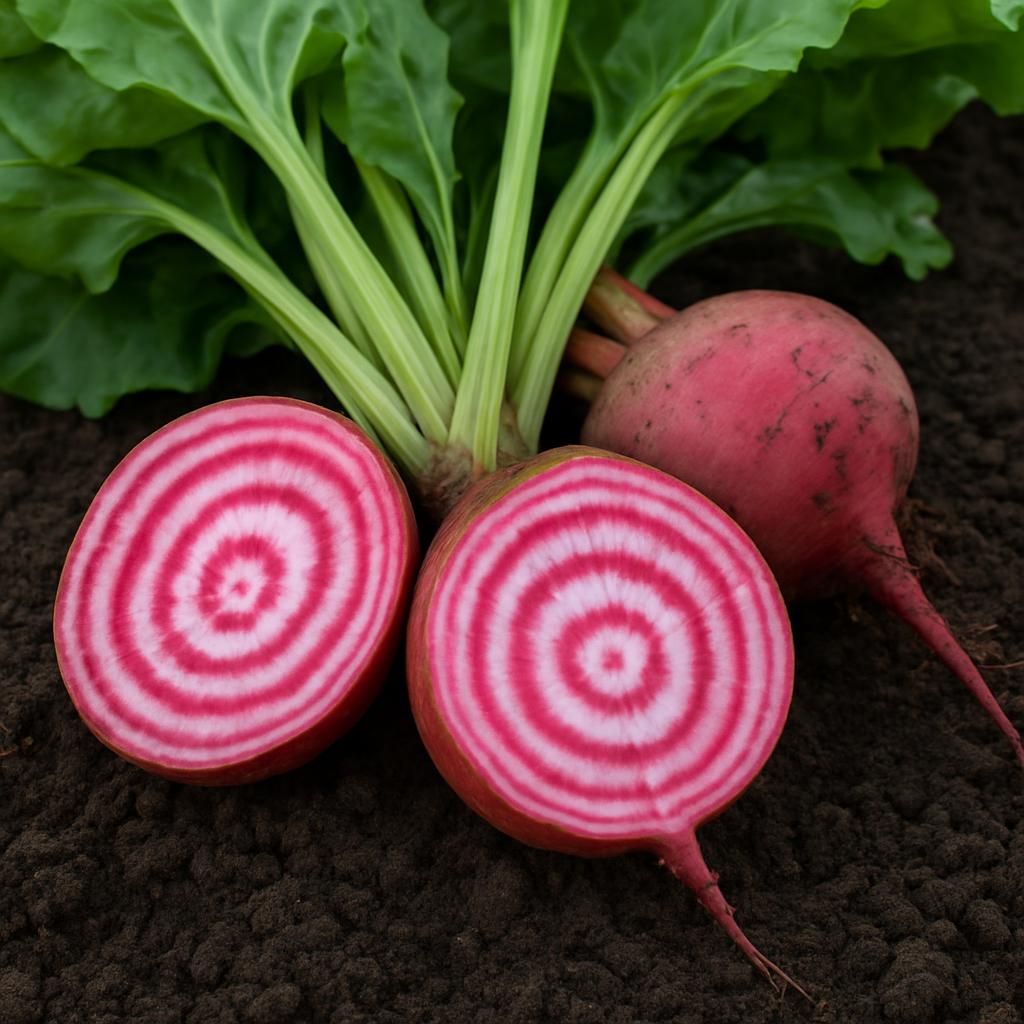
Introduction to Beet (Chioggia - Candy Stripe)
Chioggia beets, also called candy stripe beets, are an Italian heirloom variety of Beet distinguished by their vivid alternating pink and white rings when sliced. This striking appearance, combined with their sweet, mild flavor, has made them a favorite among chefs and home cooks. Beyond their visual appeal, these beets offer high nutritional value with substantial amounts of folate, manganese, potassium, and dietary fiber. The greens are equally valuable and can be harvested young for salads or allowed to mature for sautéing. Chioggia beets mature relatively quickly, typically within 50-65 days, and perform well in both home gardens and commercial small-farm settings. Their cold tolerance allows for early spring and fall plantings, extending the harvest window in temperate climates.
Botanical Profile of Beet (Chioggia - Candy Stripe)
Chioggia beets belong to the Amaranthaceae family and are botanically classified as Beta vulgaris subsp. vulgaris 'Chioggia'. Like other beets, they are biennial plants typically grown as annuals for their edible roots. The plant produces a swollen taproot that stores sugars and nutrients, with the characteristic candy-stripe pattern developing as concentric rings of vascular tissue and parenchyma. The foliage consists of broad, glossy green leaves with prominent red or pink veins and petioles. Flowers are small, greenish, and wind-pollinated, though most gardeners remove flower stalks to encourage root development. The seeds are actually seed clusters (glomerules) containing multiple embryos, which can result in several seedlings emerging from a single seedball.
Soil, pH, and Climate Requirements for Beet (Chioggia - Candy Stripe)
Chioggia beets thrive in well-drained, fertile loam soils with consistent moisture. They prefer full sun but tolerate partial shade in warmer climates. The crop is sensitive to soil compaction and performs best when sown directly into loose, friable beds. Avoid heavy clay soils unless heavily amended with organic matter. Beets are moderately salt-tolerant and prefer cool temperatures between 50-65°F (10-18°C) for optimal root development. High temperatures above 80°F (27°C) can cause woody or bitter roots.
| Parameter | Ideal Range | Notes |
|---|---|---|
| Soil Type | Loamy, well-drained | Sandy loam preferred; avoid compaction |
| Soil pH | 6.0-7.5 | Slightly acidic to neutral |
| Temperature (Day) | 60-70°F (15-21°C) | Cool season crop |
| Temperature (Night) | 45-55°F (7-13°C) | Tolerates light frost |
| Sun Exposure | Full sun (6-8 hours) | Partial shade in hot climates |
| Soil Moisture | Consistent, 1 inch per week | Avoid waterlogging |
| Spacing | 2-3 inches between plants | Rows 12-18 inches apart |
| Planting Depth | ½-1 inch | Direct sow preferred |
Step-by-Step Planting & Propagation
- Prepare the bed by loosening soil to at least 8-10 inches deep and incorporating 2-3 inches of well-aged compost. Remove rocks and debris that could cause root forking.
- Sow seeds directly outdoors 2-4 weeks before the last spring frost or 6-8 weeks before the first fall frost. In mild winter areas, plant in late summer for winter harvest.
- Plant seed clusters ½-1 inch deep and 1-2 inches apart in rows spaced 12-18 inches apart. Thin seedlings to 2-3 inches once they reach 2 inches tall.
- Keep the seedbed evenly moist until germination, which typically occurs in 5-10 days. Use row covers to protect young seedlings from pests and temperature fluctuations.
- For continuous harvest, sow successive plantings every 2-3 weeks throughout the cool season.
Care & Maintenance regimes for Beet (Chioggia - Candy Stripe)
Consistent moisture is critical for tender roots. Mulch with straw or shredded leaves to retain soil moisture and suppress weeds. Side-dress with a balanced organic fertilizer or compost tea once plants reach 4-6 inches tall. Avoid high-nitrogen fertilizers that promote leafy growth at the expense of roots. Hand-weed carefully to prevent disturbing shallow roots. Monitor for signs of nutrient deficiency such as yellowing leaves (nitrogen) or purple foliage (phosphorus).
| Task | Frequency / Timing | Details |
|---|---|---|
| Watering | 1 inch per week; more in heat | Deep, infrequent watering; keep even |
| Fertilizer | At 4-6 inches tall and mid-season | Balanced organic (5-5-5) or compost tea |
| Mulching | After thinning | 2-3 inches organic mulch to retain moisture |
| Weeding | Weekly until canopy closes | Hand-weed gently around roots |
| Thinning | Once at 2 inches tall | Space plants 2-3 inches apart |
| Pest Scouting | Weekly | Check undersides of leaves for aphids |
Pests, Diseases & Organic Management
Common pests include Aphids, flea beetles, cutworms, and slugs and snails. Use floating row covers early in the season and apply organic controls such as neem oil or insecticidal soap for aphids. Handpick larger pests and use beer traps or diatomaceous earth for slugs. Diseases such as leaf spot diseases, powdery mildew, and root rot can affect beets, especially in poorly drained soils. Practice crop rotation, avoid overhead watering, and remove infected debris to reduce disease pressure. Beneficial insects like lady beetles and lacewings help control aphid populations naturally.
Harvesting, Curing & Optimal Storage
Harvest Chioggia beets when roots reach 2-3 inches in diameter, typically 50-65 days after sowing. Gently loosen soil around the base and pull upward to avoid breaking roots. The greens can be harvested throughout the season by removing outer leaves, leaving the plant to continue root development. For storage, cut greens 1 inch above the crown and store roots in perforated plastic bags in the refrigerator for up to 2 weeks. For longer storage, layer roots in damp sand or sawdust in a cool root cellar (32-40°F / 0-4°C) with high humidity. Do not wash roots before storage; brush off excess soil instead.
Companion Planting for Beet (Chioggia - Candy Stripe)
Chioggia beets pair well with Onion, Garlic, Lettuce, Cabbage, and Bush beans. Onions and garlic help deter pests such as aphids and flea beetles. Lettuce provides light shade and ground cover that helps retain moisture. Avoid planting near Pole beans which may compete for nutrients. Beets also benefit from being planted near Carrot and Radish as they have similar growing requirements and do not compete heavily for space. Nasturtium can be sown nearby as a trap crop for aphids. For more ideas on organic pairings, see Summer Companion Planting: 10 Organic Pairings to Boost Small Farm Resilience.