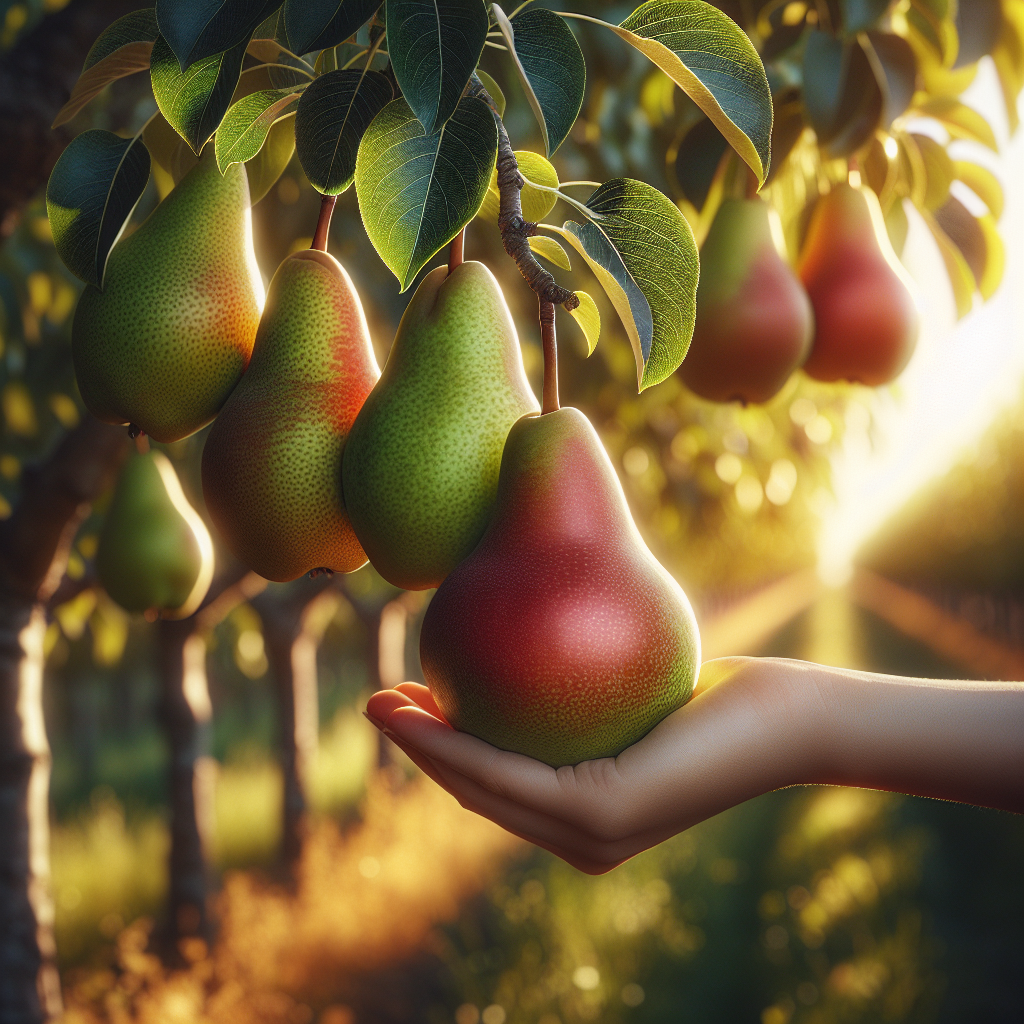
Introduction to Anjou Pear
One of the most important late-season European pears, this cultivar is prized for its versatility, long postharvest life, and reliable cropping under well-managed temperate conditions. The name “Anjou” is often associated with the French region of Anjou, but the cultivar widely grown today was developed and distributed through 19th-century European nursery trade and later became a cornerstone of North American pear production, especially in the Pacific Northwest.
Unlike pears that become buttery and highly aromatic very quickly, Anjou is known for a dense, fine-grained flesh that holds quality for extended periods in cold storage. Green Anjou remains green even when ripe, so external color is not a reliable maturity indicator; ripeness is judged mainly by stem-end pressure and internal starch-to-sugar conversion. Red Anjou is essentially a sport of Green Anjou and behaves similarly in orchard management, though color development is influenced by sunlight exposure and canopy openness.
For growers, its appeal lies in a combination of strong market acceptance, good shipping quality, and broad culinary usefulness. Fruit can be eaten fresh, poached, baked, sliced into salads, or processed. Orchardists selecting this cultivar should, however, understand that it is not a low-input tree: it needs pollination planning, disciplined pruning, careful nitrogen management, and disease vigilance, particularly where spring rainfall favors fire blight and scab.
For broader context on European pear culture, see Pear.
Botanical Profile of Anjou Pear
This cultivar belongs to the Rosaceae family, genus Pyrus, species Pyrus communis, the common European pear. It is typically grafted onto clonal or seedling rootstocks rather than grown on its own roots, because rootstock choice strongly influences vigor, anchorage, disease tolerance, soil adaptation, and final tree size.
Tree habit is moderately vigorous, upright to spreading with age, and capable of producing dense interior wood if left unpruned. Fruiting occurs mainly on spurs borne on two-year and older wood, which means annual pruning must preserve productive spur systems rather than remove them indiscriminately. Anjou tends to bear regularly when balanced well, but overcropping can reduce fruit size and suppress return bloom the following year.
Leaves are oval, glossy green, and finely serrated. Blossoms are white, five-petaled, and borne in clusters during spring. Bloom timing is generally mid-season among European pears, making it compatible with several pollinizer cultivars such as Bartlett and Bosc, provided overlap is confirmed in the local climate. Flowers are insect-pollinated, primarily by honeybees and native pollinators, but pear pollen can be less attractive to bees than some other tree fruits, so pollinator density matters.
Fruit is characteristically short-necked or nearly neckless, egg-shaped, and medium to large. Skin is smooth and thin with numerous lenticels. Flesh is white to cream, dense when first harvested, and develops a smoother, juicier texture after chilling and controlled ripening. Soluble solids commonly range around 11–14% at harvest or ripening depending on site, crop load, irrigation, and season.
Green Anjou is the standard form, while Red Anjou offers identical general horticultural behavior with red skin pigmentation due to anthocyanin expression. Because color in Red Anjou is partly light-dependent, overly shaded canopies can produce dull fruit and weaker market presentation.
Soil, pH, and Climate Requirements for Anjou Pear
This cultivar performs best in deep, well-drained loam or sandy loam with moderate water-holding capacity and good internal aeration. Ideal effective rooting depth is at least 90–120 cm. Heavy clay can work only if drainage is improved, because pears tolerate wet feet poorly during active growth. Waterlogged soil reduces oxygen in the root zone, suppresses feeder root function, predisposes trees to root diseases, and frequently leads to pale foliage, weak shoot extension, and undersized fruit.
Target soil pH is 6.2 to 7.0, with acceptable production generally possible from about 6.0 to 7.5. Below pH 5.8, aluminum and manganese availability may rise while calcium, magnesium, and phosphorus efficiency decline. Above pH 7.5, iron chlorosis becomes more likely, especially on calcareous soils; symptoms include interveinal yellowing on young leaves while veins remain green. Before planting, conduct a full soil test for pH, cation exchange capacity, organic matter, phosphorus, potassium, calcium, magnesium, boron, and salinity.
Organic matter around 3–5% is highly beneficial. It improves moisture buffering, aggregation, microbial activity, and nutrient retention. However, avoid creating a narrow “rich pocket” in the planting hole with heavy compost if the surrounding soil remains dense; roots may circle in the amended zone instead of penetrating outward.
Climatically, Anjou is a cool-temperate fruit tree that needs winter chilling to break dormancy and synchronize bloom. Practical chilling needs are often estimated in the broad range of 600–900 chill hours below 7.2°C, though local performance varies by rootstock and region. It is best suited to USDA zones roughly 5–8, depending on rootstock and site.
The ideal orchard climate has cold winters sufficient for dormancy, a frost-safe bloom period, warm but not excessively hot summers, and low to moderate humidity during late spring and summer. Excessive heat can reduce fruit finish, increase sunburn risk, and accelerate water stress. Prolonged spring wetness increases pressure from fungal diseases and fire blight. Pears generally flower early enough that frost pockets are risky; avoid valley bottoms where cold air settles.
Good air drainage is essential. A gentle slope with full sun exposure, especially morning sun, helps dry foliage quickly and reduces disease pressure. Wind exposure should be moderated rather than extreme: strong winds can reduce pollinator activity, scar fruit, and break brittle young scaffold branches under heavy crop load.
Irrigation water quality also matters. Electrical conductivity should ideally remain low; saline water causes marginal leaf burn, reduced shoot growth, and poor fruit sizing over time. Sodium-heavy water can also degrade soil structure.
Step-by-Step Planting & Propagation
Commercially and in serious home orchards, this cultivar is established almost exclusively as a grafted tree. Propagation by seed is unsuitable because seedlings do not come true to type and may take many years to fruit. If propagating yourself, dormant scionwood from healthy, virus-free mother trees is whip-and-tongue grafted or chip-budded onto compatible rootstocks. Rootstock selection should be made first, because it determines vigor and site adaptation. Quince rootstocks can impart dwarfing in some pear systems, though compatibility may require interstems; many growers prefer pear rootstocks for broader adaptability and anchorage.
Plant dormant bare-root trees in late winter to early spring, as soon as the soil is workable but before bud break. In milder climates, late autumn planting can succeed if soil remains unfrozen and drainage is excellent.
- Choose a site with at least 8 hours of direct sun, strong air drainage, and no history of chronic standing water.
- Remove perennial weeds in a circle at least 1–1.5 meters wide. Grass competition in the establishment years can dramatically reduce trunk growth.
- Test soil in advance and incorporate needed lime, gypsum, or base nutrients across the broader planting area rather than only the hole.
- Dig a hole only as deep as the root system but two to three times as wide. The final planting depth should keep the graft union 5–10 cm above finished soil level to prevent scion rooting.
- Prune broken roots cleanly, spread roots radially, and backfill with native soil. Do not pack excessively; lightly firm to eliminate large air pockets.
- Water immediately with enough volume to settle soil fully around roots. For a new bare-root tree, 10–20 liters is often appropriate depending on soil texture.
- Install a stake if the rootstock or site requires support. Ties should be flexible and checked regularly to avoid girdling.
- Head the tree at planting if needed to establish scaffold height, following the intended training system.
- Apply 5–8 cm of mulch over the root zone, but keep it 10–15 cm away from the trunk to prevent collar rot and rodent shelter.
- Plant a compatible pollinizer nearby if one is not already present. Many Anjou plantings rely on interplanted pollen sources and managed bee hives.
Spacing depends on rootstock and training. Standard trees may require 6–8 meters between trees and 7–9 meters between rows. Semi-dwarf systems may be planted at 4–5 meters within row. High-density systems demand more trellis support, more pruning precision, and careful rootstock selection.
If planting more than one cultivar for pollination, ensure overlapping bloom and adequate bee movement. One pollinizer tree for every 8–10 trees can work in small orchards, while commercial blocks often use systematic pollinizer rows or grafted pollinizer limbs.
Care & Maintenance regimes for Anjou Pear
The first three years determine future structure and productivity. Train young trees to a central leader or modified central leader system. Select 3–5 well-spaced scaffold branches with wide crotch angles of roughly 45–60 degrees. Narrow crotches are weak and prone to splitting under fruit load. Limb spreaders or tying can improve branch angle early.
Pruning is usually done during dormancy, with summer touch-up where vigor is excessive. Remove dead, diseased, crossing, and strongly upright interior shoots. The objective is a canopy that admits light into all fruiting zones. Poor light penetration leads to weak spur renewal, lower flower bud formation, and poor fruit color in Red Anjou. Avoid overpruning, which can trigger excessive watersprout growth and delay cropping.
Irrigation should maintain consistent but not saturated soil moisture. During establishment, the top 20–30 cm of soil should remain evenly moist. In mature orchards, moisture should be maintained through the main feeder-root zone, often 30–60 cm deep. As a practical benchmark, irrigate when tensiometers in loam read roughly 25–40 centibars in the active root zone; on sandy soils, thresholds are lower and irrigations more frequent. Drought stress during cell division shortly after bloom reduces final fruit size. Water stress later in summer can cause hard, undersized fruit, premature leaf drop, and reduced return bloom.
Signs of underwatering include dull, inward-curling leaves, reduced shoot extension, fruit that stops sizing, and dry soil below mulch. Signs of overwatering include persistently wet soil, sour smell in the root zone, chlorotic leaves, weak limp growth despite wet ground, trunk collar darkening, and sudden root decline. Do not rely on surface appearance alone; dig or probe to root depth.
Nutrient management should be based on leaf analysis and soil testing, not guesswork. Excess nitrogen is especially dangerous in pears because it promotes lush, highly susceptible growth that attracts fire blight and delays fruit maturity. Young nonbearing trees may need modest nitrogen to build framework, but mature bearing Anjou trees often require only restrained annual inputs. A general target is steady shoot growth, not rampant growth: roughly 20–30 cm annual extension on bearing trees is often adequate, though this varies by system.
Boron is particularly important for pears because deficiency can impair flowering, pollen tube growth, fruit set, and internal fruit quality. However, boron has a narrow safety margin, so apply only based on analysis. Calcium supports firmness and storage quality, though unlike apples, foliar calcium programs are not always standard in all pear blocks.
Fruit thinning is critical. Pears often set heavily, and clusters should be reduced after natural drop so remaining fruit are spaced around 15–20 cm apart along branches, usually leaving one fruit per cluster. Proper thinning increases size, improves shape, reduces limb breakage, and supports next year’s bloom.
Weed control should keep a vegetation-free strip under the canopy, especially in the first years. Living groundcovers can be maintained between rows to reduce erosion and improve trafficability, but they should not compete directly at the tree line. For improving orchard soil structure and biodiversity, general principles in soil health strategies are useful when adapted to perennial fruit systems.
White trunk guards or diluted interior white latex paint on young trunks can reduce southwest injury and sunscald in cold-winter regions. In areas with heavy crop load, support branches or conduct careful thinning to prevent splitting.
Pests, Diseases & Organic Management
The most serious disease concern in many pear-growing regions is fire blight, caused by Erwinia amylovora. It enters through blossoms or wounds and rapidly blackens shoots, causing the classic “shepherd’s crook” symptom at shoot tips. Warm, humid weather during bloom sharply increases risk. Organic management depends on sanitation, balanced nitrogen, pruning out strikes 20–30 cm below visible symptoms during dry weather, disinfecting tools between cuts where risk is high, and avoiding heavy summer pruning that stimulates succulent regrowth. Blossoms and cankers should be monitored closely each spring.
pear scab, caused by Venturia pirina, produces olive to black lesions on leaves and fruit, often cracking the skin and reducing marketability. Good airflow, sanitation of fallen leaves, and organic-approved protectant fungicides such as sulfur or copper-based materials, timed carefully, are central tools. Copper can also help suppress bacterial diseases, but rates and timing matter because excessive use may russet fruit or injure foliage.
cedar-pear rust appears as bright orange lesions when juniper hosts are nearby. Removing nearby alternate hosts can reduce pressure, though this is not always practical. Fabraea leaf spot and sooty blotch/flyspeck may also occur in humid climates.
Insects of concern include codling moth, pear psylla, aphids, scale insects, mites, and plum curculio in some regions. pear psylla is especially problematic because nymphs excrete honeydew that leads to sooty mold, fruit russeting, and general tree stress. Dormant oil applications can suppress overwintering eggs and scale. Encouraging beneficial insects and avoiding unnecessary broad-spectrum materials helps keep psylla, aphids, and mites more manageable.
codling moth larvae tunnel into fruit, causing internal feeding damage and frass at entry points. Organic management typically combines sanitation of dropped fruit, trunk banding in some systems, mating disruption where scale justifies it, and well-timed biological or organic insecticides.
Birds can peck ripening fruit, though this is often less severe than in cherries. Rodents may chew bark in winter, especially where mulch touches trunks. Keep mulch pulled back and use guards where needed.
The backbone of organic management is prevention: resistant or tolerant rootstock where appropriate, open-canopy pruning, clean orchard floor management, balanced fertility, monitoring traps, and prompt removal of diseased tissue. Once a heavily infected, overgrown pear block develops chronic blight and psylla problems, recovery is far more difficult than prevention.
Harvesting, Curing & Optimal Storage
This cultivar should be harvested mature but unripe. Tree-ripened European pears often become mealy or break down internally, so professional handling relies on picking at physiological maturity and finishing ripening after harvest. For Green Anjou, external green color stays largely unchanged, so harvest timing depends on several indicators: days from full bloom, ease of fruit separation when lifted and twisted, background maturity charts, firmness tests, and soluble solids trends.
Fruit should detach with the stem intact when lifted upward and rolled slightly. If it requires hard pulling, it is probably immature. Commercial harvest firmness often falls in a measured range depending on destination market and storage length, but for practical growers, fruit should still feel firm and crisp, not soft.
Harvest gently into padded containers. Pear skin bruises more easily than many growers realize, and pressure damage may only appear after storage. Never drop fruit into bins. Harvest during cool morning conditions if possible, but avoid picking when fruit is wet for long-storage lots.
After harvest, pears benefit from prompt cooling. Remove field heat quickly to around 0 to 1°C for long storage, with relative humidity around 90–95% to minimize shrivel. Under these conditions, Anjou can store for several months and is among the best keepers of the European pears. Too-low humidity causes skin dehydration and weight loss; free moisture and poor ventilation encourage decay.
Some lots require chilling exposure before they will ripen properly. After storage, fruit is typically conditioned at room temperature until the neck yields gently to thumb pressure near the stem. This “check the neck” method is more reliable than judging skin color. Properly ripened Anjou has juicy, smooth flesh and a mild, sweet flavor with subtle citrus-spice notes.
Cull any fruit with punctures, decay, scab cracking, codling moth injury, or deep bruising before storage. Even a few compromised pears can increase ethylene and disease spread in a storage lot. For short home storage, a perforated plastic bag in a refrigerator crisper helps maintain humidity while allowing some gas exchange.
Companion Planting for Anjou Pear
In orchard systems, companion planting is most useful when it serves one of three functions: pollinator support, beneficial insect habitat, or low-competition groundcover. The best companions are usually not heavy feeders placed directly at the trunk, but species arranged in strips or rings outside the immediate root collar zone.
Thyme is one of the best low-growing companions for pear trees in well-drained sites. It attracts pollinators when flowering, tolerates leaner soils, and forms a modest groundcover that does not usually create dense, trunk-touching biomass. It also helps reduce splash on bare soil if established in patches beyond the trunk flare.
Yarrow is valuable for attracting predatory wasps, hoverflies, and other beneficial insects that help suppress aphids and similar pests. Its deep roots can aid soil structure, but it should be managed so it does not form an unmanaged, highly competitive clump directly against the tree base.
Clover is widely used in orchard alleys as a nitrogen-fixing living cover and pollinator resource. The key is placement and mowing. Keep clover out of the immediate young-tree root zone during establishment, because it can compete for water. In mature orchards, mown clover alleyways can improve soil biology and trafficability.
Garlic is often used in diversified orchards at the drip line or in nearby beds rather than right at the trunk. While it is not a cure-all pest repellent, its strong scent and upright growth make it a practical, low-space understory crop in mixed plantings. It is especially useful where growers want a seasonal intercrop without shading the canopy.
Avoid planting aggressive grasses, large thirsty vegetables, or dense perennial shrubs under pears. These increase humidity around the trunk, compete strongly for water and nutrients, and can harbor rodents or interfere with harvest operations. The best companion design for Anjou is usually a clean mulched tree row, beneficial flowering strips nearby, and managed alley covers rather than crowded polyculture directly under the canopy.