Introduction to Venturia pirina
Venturia pirina, the causal agent of pear scab, is a destructive fungal pathogen that ranks among the most significant threats to commercial and backyard pear production worldwide. Unlike its close relative apple scab which affects apple trees, Venturia pirina specifically targets pear trees, leading to substantial yield losses if unmanaged. First identified in Europe, it has spread globally to pear-growing regions in North America, Asia, and Australia, thriving in temperate climates with prolonged leaf wetness.
The fungus overwinters as pseudothecia in fallen leaves and infected debris, releasing ascospores during spring rains to initiate primary infections. Secondary infections from conidia exacerbate the disease throughout the growing season. Economic impacts are profound: scabbed fruits are unmarketable, deformed, and prone to secondary rots, often reducing harvestable yields by 50-80% in severe epidemics. For growers, understanding Venturia pirina's biology is crucial for implementing integrated management. This guide equips farmers, orchardists, and hobbyists with diagnostic tools, lifecycle knowledge, organic treatments, and prevention strategies. Learn how to identify early symptoms, disrupt the disease cycle, and protect your pear crops effectively. For more on small farm disease management, check this insightful blog on spring pest patrol.
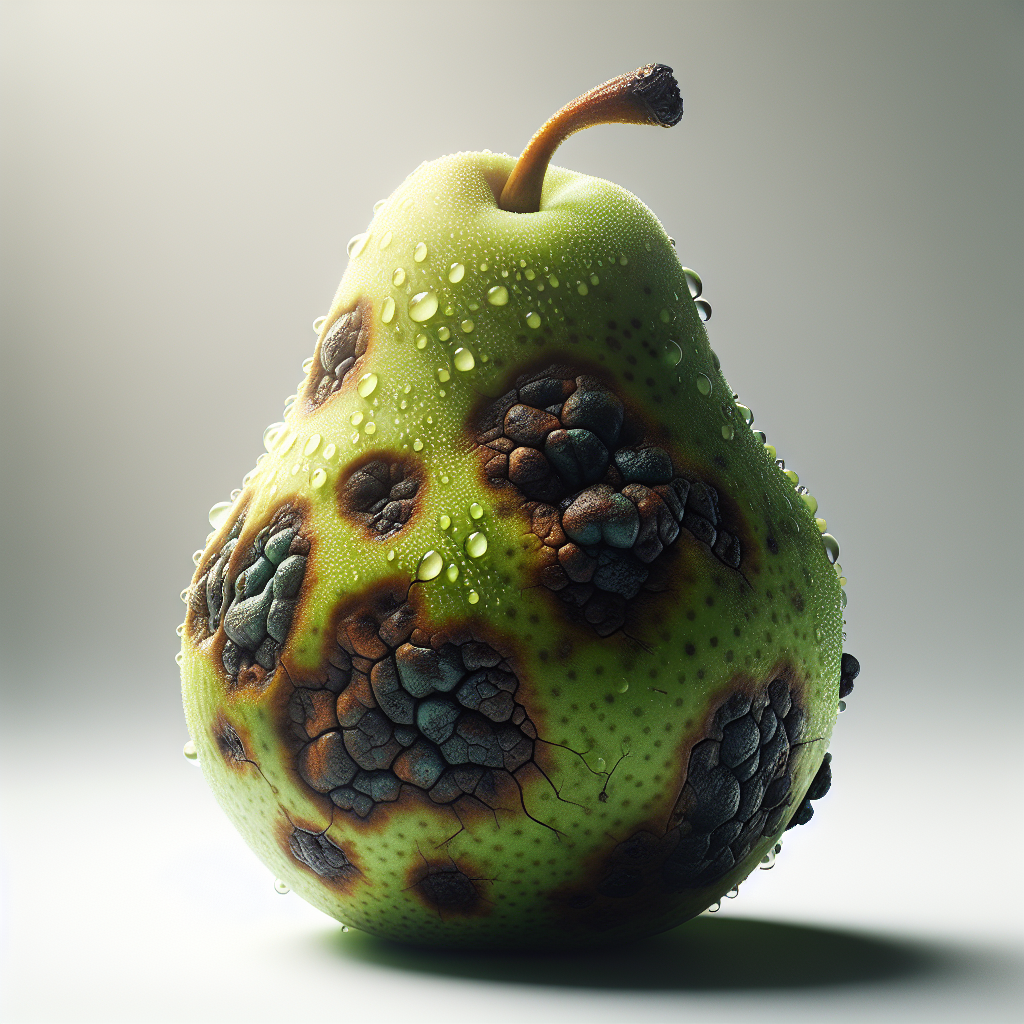
Pear scab manifests as olive-green to black velvety spots that crack and cork over time, compromising tree vigor and fruit quality. Susceptible varieties like Bartlett Pear and Bosc Pear suffer most, while resistant cultivars offer partial protection. Climate change, with increased rainfall events, heightens risks, making proactive strategies essential. This comprehensive resource draws from decades of botanical and agricultural research to deliver practical, field-tested advice.
Identifying Symptoms & Damage
Accurate diagnosis of Venturia pirina begins with recognizing its distinctive symptoms across pear tree tissues. On leaves, initial signs appear as small, olive-green spots (1-2 mm) on the upper surface, often near veins, 10-20 days after petal fall. These lesions expand to 5-10 mm, developing a velvety fungal spore mass (conidia) in humid conditions, turning black and corky as they age. Heavily infected leaves yellow, curl, shrivel, and defoliate prematurely, weakening trees and reducing photosynthesis by up to 40%.
Fruit symptoms are most economically damaging: scab lesions start as dark, circular spots at the calyx end or stem cavity, rapidly expanding into raised, corky areas that split open, inviting Botrytis or other rots. Severely scabbed pears become misshapen, cracked, and unmarketable, with russeting covering 20-50% of the surface in bad cases. Young fruits may abort entirely. Twigs and buds show elliptical black lesions, leading to dieback and reduced bud break the following spring.
Microscopic confirmation involves observing multicellular ascospores (11-17 x 5-7 μm) from pseudothecia or banana-shaped conidia under a 400x lens. Differentiate from powdery mildew (white powdery growth) or leaf spot diseases (smaller, zonate spots). Damage assessment: scout 100 leaves/fruits per tree, rating incidence (percent affected) and severity (lesion coverage). Thresholds for action: >5% leaf infection or >10% fruit scab pre-harvest. Early detection via weekly inspections from green tip stage prevents epidemics.
Lifecycle and Progression of Venturia pirina
Venturia pirina's lifecycle is hemicyclic, with sexual (ascospore) and asexual (conidial) stages driving polycyclic epidemics. Overwintering pseudothecia mature in leaf litter from autumn, releasing ascospores during spring rains (10-20°C, >9 hours wetness) from pink bud to petal fall—primary inoculum for 70-90% of infections. Ascospores germinate on wet tissues within 6-12 hours, penetrating via stomata or wounds, forming appressoria.
Mycelium colonizes subcuticularly, producing conidia in 14-21 days under optimal conditions (15-20°C, 95% RH). Conidia splash-disperse up to 100m in rain, fueling 10-15 secondary cycles through summer. Maturation pseudothecia begins on senescing leaves by late summer, completing the cycle. Progression: primary infections (April-May) → secondary cycles (May-August) → overwintering (September-November). Disease gradients follow wetness duration: 6+ hours for ascospores, 4+ for conidia.
Epidemics peak in moderate summers with frequent showers; dry spells slow spread. Pseudothecia require 800-1200 chill hours below 10°C for maturation. Understanding this enables precise timing of controls, targeting ascospore release (tracked via spore traps or powdery mildew models adapted for scab).
Environmental Triggers & Risk Factors
Venturia pirina thrives in cool, humid environments mimicking its native European habitats. Key triggers: leaf wetness >6 hours at 10-20°C during ascospore period (bud swell to petal fall), with optimal infection at 15°C and 48-hour wetness. Rainfall (>10mm/event) disperses ascospores/conidia; high RH (>90%) extends infection windows. Temperatures >25°C inhibit sporulation; prolonged droughts limit epidemics.
Risk factors include dense canopies reducing airflow (e.g., unpruned Anjou Pear orchards), heavy nitrogen fertilization promoting succulent growth, and susceptible varieties like Bartlett Pear. Overwintering inoculum builds in undecomposed litter (>20% infected leaves). New plantings near old orchards face bridge infections. Climate variability—erratic springs with wet spells—amplifies risks, as seen in Pacific Northwest outbreaks. Soil pH >7 reduces calcium uptake, weakening resistance. Monitor via weather stations for accumulated wetness hours (e.g., >200 hours post-bud swell signals high risk).
Organic Control & Treatment Plans
Organic management of Venturia pirina emphasizes cultural, biological, and approved fungicides in an IPM framework. Sanitation: Rake and shred fallen leaves post-harvest (reduce inoculum 80-90%), mulch heavily, or disk into soil for decomposition. Flail mowing at high speed destroys pseudothecia.
Cultural Practices: Prune for open canopies (20-30% light penetration), space trees 4-6m, avoid excess N. Irrigate low-volume to minimize wetting (>2 hours/day risky).
Biologicals: Apply Bacillus subtilis (e.g., Serenade) or Trichoderma harzianum at green tip, repeating 7-10 days through petal fall—suppresses 40-60%. Compost teas with compost extracts boost antagonism.
Organic Fungicides: Sulfur (80% wettable, 5-10 kg/ha) from delayed dormancy to 2nd cover (4-7 day intervals, 70-85% control). Copper (e.g., Bordeaux mix, 2-3 kg/ha) pre-bloom only (phytotoxic post-bloom). Potassium bicarbonate (2-3 kg/ha) for mid-season. Rotate to prevent resistance.
Treatment Timeline: Dormant: urea (5%) for leaf breakdown. Green tip: biologicals/copper. Ascospore period: sulfur every 7 days or wetness-based. Post-petal fall: bicarbonate. Scout weekly; treat if >2% incidence. Resistance breeding (e.g., Harrow Sweet) + organics yield 85% control. Avoid aphids flare-ups from sulfur.
Preventing Venturia pirina in the Future
Long-term prevention integrates resistant varieties, site selection, and monitoring. Plant scab-resistant pears like Harrow Delight, Moonglow, or Seckel over Bartlett. Site orchards on slopes with good air drainage, avoiding low frost pockets. Soil test annually; maintain Ca >1000 ppm via gypsum.
Monitoring: Install ascospore traps (burlap bands) or use apps for wetness models. Threshold: 50 ascospores/cm²/week → spray. Annual risk maps from extension services guide planning.
Orchard Renewal: Rotate to 20% resistant stock yearly. Cover crops (e.g., clover) suppress splash via soil splash barriers. Post-harvest: urea + lime sulfur burns residues. Eradicate wild pear hosts within 1km. Future-proof with climate-resilient rootstocks and AI-driven forecasts for wetness events.
Crops Most Affected by Venturia pirina
Venturia pirina primarily targets pear (Pyrus communis), with all commercial cultivars susceptible to varying degrees. European pears like Bartlett Pear, Bosc Pear, and Anjou Pear suffer highest losses (up to 90% defoliation). Asian pears (Pyrus serotina) show tolerance but infections occur. Wild pears and rootstocks (e.g., OHxF) host inoculum. No significant impact on apple, quince, or medlar despite family proximity. Global hotspots: Pacific NW USA, Italy, China—$100M+ annual losses.