Introduction to cedar-pear rust
Cedar-pear rust, scientifically known as Gymnosporangium clavipes, represents one of the most destructive fungal diseases affecting pear orchards across North America. This heteroecious rust fungus requires two host plants to complete its complex lifecycle: members of the juniper family, primarily Eastern red cedar (Juniperus virginiana) and various pear species (Pyrus spp.), including both European and Asian cultivars. First identified in the early 20th century, cedar-pear rust has become a persistent challenge for commercial growers, backyard orchardists, and nursery operators, leading to premature leaf drop, deformed fruits, and weakened trees that are more susceptible to secondary infections.
The disease thrives in the humid, temperate climates of the Midwest, Northeast, and Pacific Northwest, where overlapping ranges of cedar and pear create ideal conditions for spore dispersal. In severe outbreaks, yield losses can exceed 50% in susceptible varieties, with deformed 'spongy' pears rendering fruit unmarketable. Understanding cedar-pear rust is crucial for sustainable pear production, as it demands an integrated approach combining cultural, biological, and chemical strategies. This guide provides professional-grade diagnostic tools, lifecycle insights, and proven management protocols to protect your orchard from this insidious pathogen. Early detection and proactive prevention are key to minimizing economic impact, especially as climate variability extends the rust's active season.
Identifying Symptoms & Damage
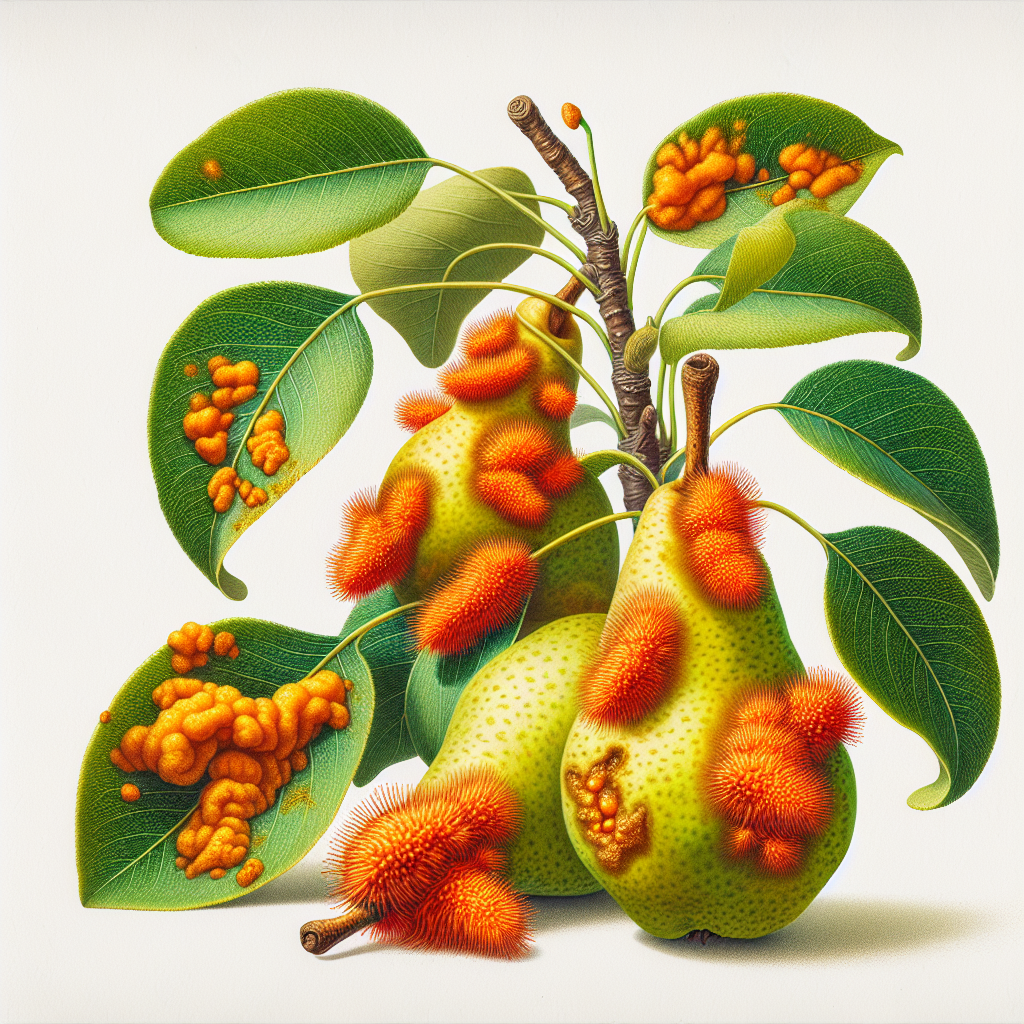
Accurate diagnosis of cedar-pear rust begins with recognizing its hallmark symptoms on pear foliage and fruit. The disease announces itself in early spring with small, yellow-orange spots (aecia) on the upper surfaces of young leaves, typically 1/8 to 1/4 inch in diameter. These spots enlarge rapidly, developing cup-shaped structures filled with sticky, orange spores that rupture the leaf surface, often accompanied by a faint chlorotic halo.
As infection progresses into late spring and summer, elongated, finger-like 'horns' or tendrils emerge from these aecia, protruding up to 2-3 inches and releasing millions of infectious aeciospores. Leaves turn yellow then brown, leading to 50-100% defoliation by midsummer. On fruits, symptoms appear as reddish-brown lesions that expand into velvety orange patches, causing spongy deformation, cracking, and premature drop. Severely affected pears develop hard, woody galls on twigs, which serve as overwintering sites for the fungus.
Damage extends beyond aesthetics: defoliation reduces photosynthesis by up to 70%, stunting tree growth and compromising next season's bud set. Fruit quality plummets, with market losses averaging $5,000-$20,000 per acre in commercial settings. Differentiate from similar diseases like fire blight (oozing cankers, shoot dieback) or powdery mildew (white powdery coating, no horns). Use a hand lens to confirm aecial cups with basidiospores, or submit samples to local extension services for PCR confirmation. Regular scouting from bud break through petal fall is essential for timely intervention.
Lifecycle and Progression of cedar-pear rust
The cedar-pear rust lifecycle exemplifies fungal adaptation, spanning two years across alternating hosts. It overwinters as dormant telial galls on cedar branches, swelling in early spring (March-April) under moist, 50-70°F conditions. These galls produce teliospores that germinate into basidiospores, carried by wind up to 10 miles to infect nearby pear trees.
On pears, basidiospores penetrate young tissues within 4-6 hours of wetness, incubating 10-14 days before aecia form. Aeciospores mature by May-June, releasing in wet weather to reinfect cedars, forming new galls by fall. The cycle repeats annually, with peak spore release coinciding with pear bloom. Progression accelerates in high humidity (>85% RH) and moderate temperatures (60-75°F), with free moisture on leaves extending infection windows.
Understanding this progression allows precise timing: monitor cedar galls for swelling (telial stage), scout pears at green tip (basidiospore infection), and prune galls post-spore release. The fungus survives winters in galls up to 3 years old, emphasizing the need for host removal. In mixed landscapes, apple trees may show minor symptoms, but pears bear the brunt.
Environmental Triggers & Risk Factors
Cedar-pear rust epidemics hinge on specific environmental cues and management lapses. Primary triggers include prolonged leaf wetness (8+ hours) during spring, favoring basidiospore germination, and summer rains (>0.1 inch) dispersing aeciospores. Temperatures between 55-75°F optimize infection, with disease severity doubling per 10% humidity increase.
Risk factors amplify outbreaks: proximity to wild cedars (<500 yards) accounts for 80% of infections, as spores travel miles. Susceptible varieties like Bartlett and Bosc suffer 90% defoliation, versus 20% in resistant Anjou. Poor air circulation in dense plantings traps moisture, while excessive nitrogen promotes succulent growth. Overcrowded orchards, irrigation splash, and nearby rosemary or juniper ornamentals exacerbate spread.
Climate change extends seasons, with warmer springs advancing gall swelling by 1-2 weeks. Soil pH >7.0 stresses pears, indirectly boosting susceptibility. Assess risk via spore traps or weather models predicting infection periods.
Organic Control & Treatment Plans
Organic management targets lifecycle disruption without synthetics. Cultural Controls (Priority 1): Remove all cedar galls within 1/2 mile radius by pruning 12 inches below galls and destroying (burn/compost hot). Plant rust-resistant pears like Harrow Sweet, Moonglow, or Orient. Space trees 25-30 ft for airflow; avoid overhead irrigation.
Biological Agents: Apply compost teas with Bacillus subtilis or Trichoderma spp. at green tip and petal fall to outcompete rust. Neem oil (0.5-1%) suppresses aeciospores; repeat every 7-10 days during wet periods. Sulfur-based fungicides (e.g., potassium bicarbonate) at 3-5 lbs/acre provide 70-80% control when timed to 80% humidity forecasts.
Integrated Plan: Scout weekly; prune infected branches >6 inches; mulch to retain moisture without splash. For Why Companion Planting Feels Like Guesswork for Small Farms - And How AI Makes It Foolproof, interplant garlic or marigolds to deter spores. Monitor via apps for hyper-local weather. Success rates exceed 85% with consistent execution.
Preventing cedar-pear rust in the Future
Long-term prevention builds resilient orchards. Select certified rust-resistant rootstocks (OHxF 87, PyBus 1) and scions at planting. Establish 1-mile cedar-free zones; partner with neighbors for community removal programs. Annual spring pruning removes 95% of galls; apply horticultural oil dormant sprays to smother overwintering structures.
Enhance tree vigor with balanced nutrition (N-P-K 10-10-10, 0.5 lb/tree/year) and pH 6.2-6.8 soils. Use reflective mulches to disrupt spore settling. For rust-free propagation, hot-water treat scions (125°F, 20 min). Rotate fungicide modes of action; integrate cover crops like clover to improve soil health. Annual resistance monitoring prevents rusts adaptation. With these, incidence drops below 5% indefinitely.
Crops Most Affected by cedar-pear rust
Pear trees (Pyrus communis, P. pyrifolia) suffer most, with European cultivars (Bartlett, Bosc, D'Anjou) highly susceptible and Asian pears moderately so. Apple varieties like Gala show occasional leaf spots but rarely economic loss. Junipers (Juniperus virginiana, J. scopulorum) host galls without mortality. Hawthorn (Crataegus spp.) and quince (Cydonia) experience minor infections. Commercial pears lose $100M+ annually; ornamentals require vigilant scouting.