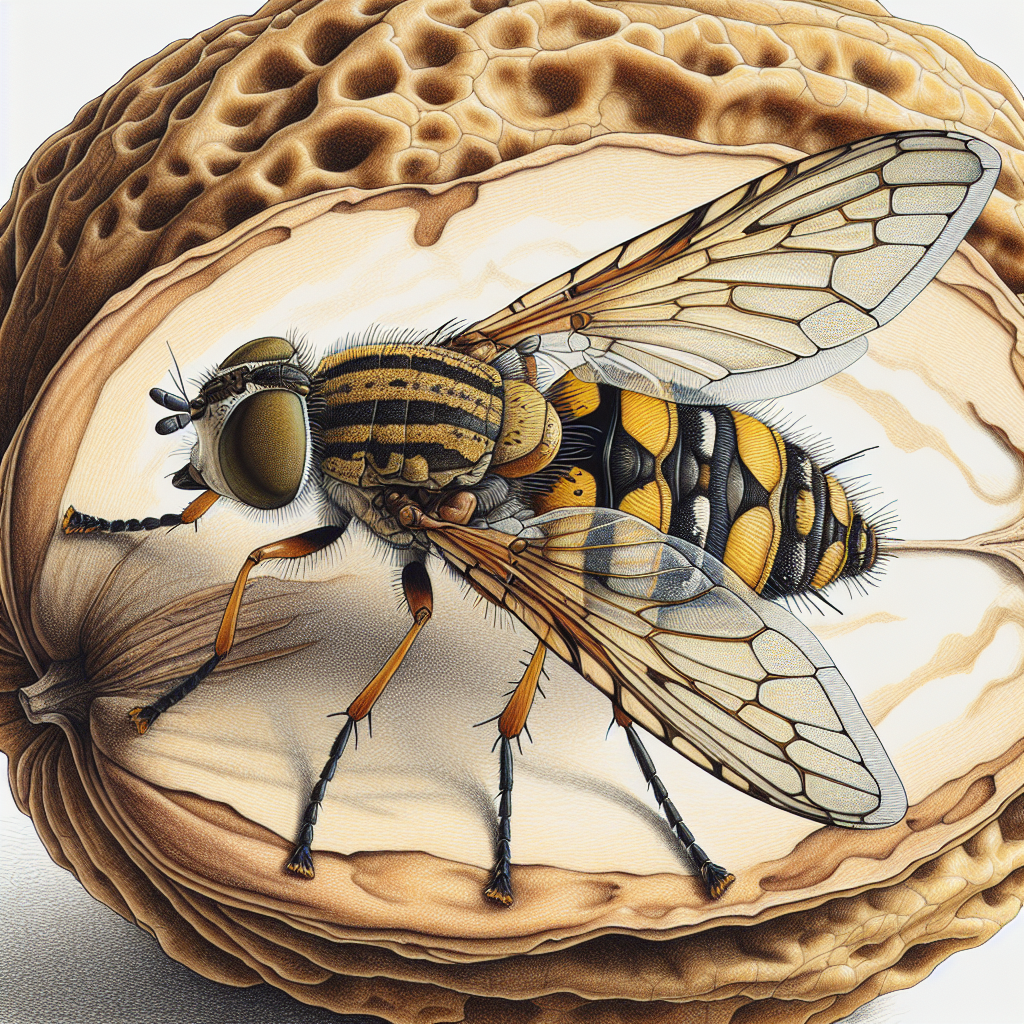
Introduction to Walnut husk fly
The walnut husk fly, scientifically known as Rhagoletis completa, stands as one of the most notorious pests in walnut orchards worldwide, particularly devastating to commercial and backyard growers of Walnut (crop) trees. Native to North America, this tephritid fruit fly has adapted to exploit the soft, ripening husks of walnuts, turning what should be a bountiful harvest into a mess of stained, wormy nuts unfit for market. Adults are small, about 1/3 inch long, with distinctive yellow-banded abdomens and wings marked by four zig-zag bands, making them recognizable during their flight period from mid-July to October in most regions.
This pest's impact extends beyond direct feeding; larvae tunnel through husks, creating entry points for fungal pathogens and accelerating fruit drop. In severe infestations, up to 90% of the crop can be rendered unsellable, leading to significant economic losses estimated in millions annually for walnut-producing areas like California, the Pacific Northwest, and parts of Europe where it's been introduced. Understanding its biology is crucial for timely intervention. Unlike codling moth, which targets the nut kernel, walnut husk fly focuses on the husk, but both can compound damage in mixed orchards. Growers must scout diligently as populations build over seasons without controls. For more on integrated pest management timing, check this insightful Spring Pest Patrol: Organic AI Strategies to Shield Your Crops from Common Invaders. Early detection via yellow sticky traps hung in canopies can catch emergences before oviposition ramps up.
Identifying Symptoms & Damage
Spotting walnut husk fly damage starts with visual cues on the husk. The hallmark sign is the presence of a characteristic 'sting'—a small, dimpled puncture mark where the female's ovipositor pierced the husk to deposit eggs. These stings often appear as tiny, reddish-brown spots clustered on the husk surface, especially near the stem end. Within 3-5 days, eggs hatch, and larvae begin feeding, causing husks to darken, soften, and exude a reddish-brown sap that stains the shell black.
Advanced damage manifests as premature husk split or drop, with infested nuts falling early and showing internal larval tunnels filled with frass. Cut open a suspect husk, and you'll find creamy-white maggots, up to 8mm long, wriggling inside. Shells blacken completely, making nuts inedible and worthless for processing. Differentiate from walnut blight, which causes dark lesions on husks and twigs without maggots, or mechanical damage lacking the puncture pattern. Yield losses occur not just from drop but quality downgrade; even low infestations (5-10%) trigger rejections at packing houses.
Secondary signs include clusters of adult flies around infested trees, attracted to ripening fruit volatiles. Monitor ground litter for pupae—small, brown, seed-like cases where larvae overwinter. In heavy attacks, husks may rot entirely, fostering sooty mold growth on sticky exudates. Regular inspections post-hull split reveal the extent; shake branches over white sheets to dislodge adults for confirmation.
Lifecycle and Progression of Walnut husk fly
The walnut husk fly completes one generation per year, with its lifecycle tightly synced to walnut development. Overwintering pupae in soil near host trees break dormancy in response to heat units (around 1,400-1,700 degree-days base 50°F from January 1). Adults emerge in late summer, typically July-August, coinciding with husk softening (hull crack stage).
Females mate soon after emergence and seek out green-to-yellowing husks, using keen chemosensory detection. Each can lay 50-100 eggs over 2-4 weeks, piercing husks with a serrated ovipositor. Eggs (1mm, white) hatch in 2-4 days into legless larvae that burrow inward, feeding on husk parenchyma for 2-4 weeks. Mature larvae (7-9mm) exit via husk slits, drop to soil, and pupate 1-5 inches deep, entering diapause until next season.
Progression hinges on temperature; cooler areas see later emergence, while heat accelerates it. Peak flight occurs over 4-6 weeks, with traps capturing 1-2 flies per tree signaling action threshold. Unlike olive fruit fly, which has multiple broods, this univoltine nature allows targeted controls. Pupal survival exceeds 70% without disruption, perpetuating infestations.
Environmental Triggers & Risk Factors
Walnut husk fly thrives in warm, arid climates ideal for walnuts, with temperatures above 70°F triggering adult activity. Key triggers include husk softening (moisture from irrigation or rain), which emits kairomones attracting gravid females. Drought stress weakens trees, making husks softer and more susceptible; conversely, excessive humidity post-sting promotes secondary hull rot.
Risk factors encompass proximity to infested orchards—adults disperse up to 1/4 mile—or wild Chandler Walnut stands. Poor sanitation leaves pupae undisturbed, while delayed harvest prolongs exposure. Susceptible varieties like thin-husked English Walnut suffer most. Windless, sunny days boost flight; neglect scouting in edges amplifies invasion. Climate change extends flight windows, heightening risks in marginal areas.
Organic Control & Treatment Plans
Organic management emphasizes prevention and biological disruption. Deploy yellow sticky traps baited with ammonium carbonate by early July, aiming for 2-4 per tree; remove when catching >1 fly/week. Protein hydrolysate sprays enhance lure efficacy. Sanitation is paramount: harvest promptly, destroy cull nuts via shredding or deep burial to kill pupae.
Biological agents include parasitic wasps (Aganaspis pelleranoi) and predators like spiders; encourage via cover crops. Kaolin clay (Surround WP) creates a protective film on husks, deterring oviposition—apply at hull split, reapply post-rain. Neem oil or spinosad targets adults/larvae; time for dusk sprays to spare pollinators. GF-120 bait stations with spinosad lure and kill adults effectively, reducing populations 70-90%. Rotate tactics to avoid resistance. For soil pupae, till lightly in fall, though minimal tillage preserves soil health. Combine with husk fly monitoring for IPM success.
Treatment timeline: Traps at bloom end; baits/clay at hull crack; sanitation post-harvest. Threshold: 0.1-1 fly/trap/day prompts action. Success metrics show 80% reduction with integrated organics.
Preventing Walnut husk fly in the Future
Long-term prevention builds resilient systems. Plant resistant varieties like late-maturing Hartley Walnut or hybrids with thick husks. Establish buffer zones with non-hosts like almond. Calendar-based trap removal by October starves emergers.
Soil solarization in off-season kills pupae; cover orchard strips with clear plastic July-September. Encourage natural enemies via yarrow and marigold borders. Early harvest (pre-full maturity) evades peak oviposition. Monitor degree-days via weather stations for precise timing. Quarantine new plantings; inspect for pupae. Annual audits track progress; zero tolerance in young orchards prevents buildup.
Crops Most Affected by Walnut husk fly
Primarily walnut, especially English and Chandler varieties, but also attacks butternut and occasionally pecan husks. Commercial orchards bear the brunt, with thin-skinned cultivars most vulnerable. Wild black walnuts serve as reservoirs. No significant impact on Hass Avocado or apple, but co-occurrence with navel orangeworm worsens issues in mixed nut plantings.