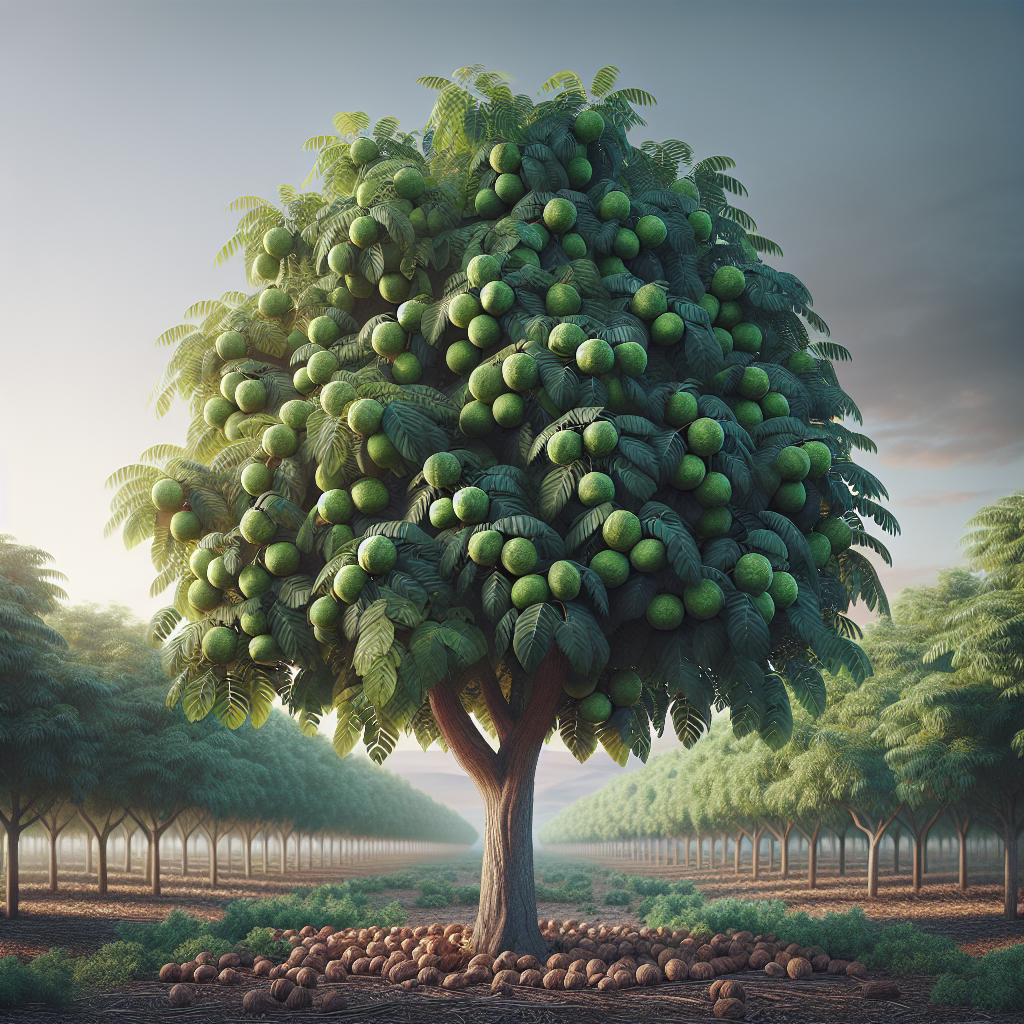
Introduction to Walnut (Hartley)
Developed in California and long regarded as one of the benchmark commercial English walnut cultivars, Hartley earned its reputation through nut quality, shell strength, and broad market acceptance. It belongs to the Persian or English walnut species, Juglans regia, not the black walnut group. Hartley became especially important in traditional walnut-growing districts because it combines attractive, relatively large nuts with a strong shell seal and good eating quality.
This is not a forgiving tree for poor sites. It performs best where winters provide enough chilling for regular dormancy release, spring frost risk is manageable, summers are warm but not brutally desiccating, and soils are deep enough to support a large root system. Mature trees become substantial, and once established they can remain productive for decades. That long lifespan makes early decisions about location, drainage, spacing, rootstock, and pollination far more important than they are for short-lived fruit crops.
Hartley is often described as a mid- to late-leafing cultivar relative to some older walnuts, which can be helpful in regions with occasional spring frost. It also tends to produce a good-quality kernel with light color when orchard nutrition, irrigation, and harvest timing are well managed. Growers comparing production systems may also review another major cultivar for context in the Chandler Walnut guide.
From a management standpoint, Hartley is best suited to growers who can think in orchard timelines rather than vegetable timelines. The first years are about root establishment, canopy architecture, and trunk protection; later years are about balancing vegetative growth with fruiting wood, maintaining tree health, and preserving kernel quality at harvest.
Botanical Profile of Walnut (Hartley)
Hartley is a deciduous broadleaf tree in the Juglandaceae family. Like other English walnuts, it develops a strong central trunk when trained correctly, with a broad, rounded crown as it matures. Unpruned mature trees can become very large, commonly reaching 12-18 m in height and similar spread under favorable conditions, though commercial orchards often restrict canopy size through spacing and pruning strategy.
Leaves are alternate, pinnately compound, and aromatic when crushed. Each leaf usually carries 5-9 leaflets, though leaflet count can vary with vigor and growing conditions. The foliage emerges after winter dormancy and is sensitive to severe late frost during leaf expansion and flowering.
Walnuts are monoecious: male and female flowers occur separately on the same tree. Male flowers form as pendulous catkins on older wood, while female flowers appear near shoot terminals on current season growth. Hartley may exhibit some degree of dichogamy, meaning pollen shed and female flower receptivity do not perfectly overlap. In practical terms, even though a tree bears both flower sexes, orchard performance improves when pollinizer cultivars with compatible bloom timing are present.
Fruit is technically a drupe-like nut enclosed in a green husk. As nuts mature, the husk splits and the shell inside hardens fully. Hartley is especially known for a relatively large nut, good shell seal, and a kernel that can be bright and flavorful if harvest is timely and drying is controlled. Shell texture and shape are generally market-friendly, making the cultivar useful for in-shell trade where appearance matters.
A notable botanical nuance in walnut culture is the presence of juglone, an allelopathic compound produced by walnuts and concentrated in roots, husks, and leaves. Juglone can suppress sensitive plants growing in the root zone. This does not make the soil sterile, but it strongly influences understory crop choice and companion planting strategy.
Soil, pH, and Climate Requirements for Walnut (Hartley)
Hartley demands deep, well-drained soil more than almost any other single factor. The ideal rooting profile is at least 1.5-2 m deep, friable, and free of hardpan, perched water tables, and prolonged saturation. Trees can survive in shallower soils, but growth, anchorage, drought resilience, and long-term yield usually suffer.
Best texture is a deep loam, sandy loam, or silt loam with high internal drainage and moderate water-holding capacity. Heavy clay can work only if it is structured, deep, and never remains waterlogged after rain or irrigation. Standing water for even 24-48 hours during active growth can damage fine roots and predispose the tree to crown and root diseases. If you dig a test pit and water remains in the hole the next day, the site is marginal at best.
The preferred soil pH range is approximately 6.5-7.5. Trees can tolerate slightly outside this band, but nutrient efficiency declines as conditions move too acidic or too alkaline. At low pH, calcium availability may be limited and aluminum toxicity can begin to interfere with root performance. At high pH, zinc, iron, and manganese deficiencies are more common. Hartley is particularly sensitive to micronutrient imbalance in calcareous soils, often showing interveinal chlorosis and weak shoot growth if deficiencies are ignored.
Organic matter should be present but not used as a substitute for mineral soil depth. A target of 2-4% organic matter in orchard topsoil is often favorable. Excessively rich, shallow amended planting holes can create a bathtub effect, where water accumulates around roots instead of moving through the native soil profile.
Climate should be temperate, with clear winter dormancy and a warm growing season. Hartley generally performs best where winter chilling is adequate and summers are dry to moderately dry during nut maturation. Persistent summer humidity increases disease pressure, especially Walnut blight and foliar diseases. Ideal growing areas often have cool winters, mild springs, hot but not scorching summers, and low rainfall near harvest.
Walnuts are vulnerable to spring frost during bloom and early leaf-out. Temperatures around -1 to -2°C during sensitive floral stages can injure female flowers and reduce set. Severe freezes after bud break can also kill expanding shoots. Avoid frost pockets, low basins, and blocked air-drainage sites.
Heat matters too. Sustained extreme heat above 38-40°C, especially with hot dry wind and insufficient soil moisture, can cause sunburn, shriveled kernels, poor fill, and canopy stress. Young trunks are especially vulnerable to southwest injury and sunscald.
For orchard floor and soil resilience, many walnut growers use cover crops to improve infiltration and aggregation; a general soil-building framework is discussed in this soil health article.
Step-by-Step Planting & Propagation
Commercially, Hartley is almost always propagated by grafting or budding onto a suitable rootstock rather than grown from seed. Seedling-grown trees are genetically variable and will not reliably reproduce Hartley nut quality, bearing habit, or vigor. For professional results, buy certified nursery stock with a healthy graft union, straight trunk, and no root spiraling.
Choose the site carefully. Select a full-sun location with at least 8 hours of direct light daily, excellent air drainage, and no seasonal waterlogging. Because mature Hartley trees are large, standard spacing may range from roughly 9 x 9 m to 10 x 10 m, depending on soil vigor, irrigation system, rootstock, and whether mechanical harvest is planned.
Test soil before planting. A full laboratory test should include pH, cation balance, organic matter, salinity, boron, zinc, and sodium hazard if irrigation water quality is uncertain. Electrical conductivity should be low to moderate; walnuts are not among the most salt-tolerant orchard trees.
Rip or subsoil if needed. If hardpan is present, deep ripping before orchard establishment is far more effective than trying to correct compaction after planting. Perform ripping when soil moisture is suitable for shattering rather than smearing.
Prepare the planting hole properly. Dig only as deep as the root system and 2-3 times as wide. Do not plant too deep. The graft union should remain well above soil level, and the original nursery soil line should match the finished grade.
Inspect roots before setting. Remove broken roots cleanly. If containerized, tease apart circling roots. If bare-root, keep roots moist and shaded until planting. Never allow roots to dry in wind or sun.
Backfill mainly with native soil. Avoid filling the hole with highly amended compost-rich media. Light incorporation of well-finished organic matter across a broad area is acceptable, but the root system should transition naturally into native soil.
Water in thoroughly. Apply enough water immediately after planting to settle soil around roots and eliminate air pockets. For a newly planted tree, this may be 20-40 liters depending on soil texture and root volume.
Stake if necessary. In windy sites, use a flexible stake system for the first year. Secure the trunk loosely to avoid girdling and promote trunk taper.
Protect the trunk. White tree guards or diluted white latex trunk paint can reduce sunburn and rodent damage. This is especially important in hot interior climates.
Plan pollination. Hartley benefits from compatible pollinizers in the orchard. Even where some self-overlap occurs, cross-pollination usually improves set consistency.
Propagation by bench grafting or field budding is specialized and usually left to nurseries. Patch budding and whip-and-tongue grafting can work with walnuts, but success depends on exact timing, temperature, and sanitation. Walnut tissues bleed sap readily, so poor timing sharply reduces take rates.
Care & Maintenance regimes for Walnut (Hartley)
During the establishment years, priority one is root expansion. Priority two is structure. Priority three is controlled vigor, not maximum top growth. Young Hartley trees should be trained to a strong framework, commonly with a modified central leader system in traditional orchards.
Irrigation: Hartley needs steady moisture but not saturated conditions. In active growth, aim to keep the main root zone consistently moist to field capacity and then allow moderate drawdown before the next irrigation. In loam soils, this often means irrigating when the upper 30-60 cm has lost roughly 35-45% of available water, rather than waiting for severe drought stress. Young trees may need watering 1-3 times weekly in warm weather depending on emitter output and soil type. Mature trees under drip or microsprinkler systems need deep, less frequent applications sized to evapotranspiration demand.
Signs of underwatering include dull or folded leaves during the hottest part of the day that do not recover by evening, reduced shoot extension, small nuts, poor kernel fill, and early hull split irregularity. Signs of overwatering include persistently wet soil beyond 15-20 cm depth, yellowing foliage without clear nutrient cause, weak pale shoot growth, algae or sour smell near emitters, and root disease symptoms such as dieback from the top of the canopy downward.
In practical terms, the soil should feel cool and moist but still aerated. If you squeeze a loam sample from 20-30 cm depth and it forms a weak ball that crumbles with pressure, moisture is often near a good irrigation threshold. If water glistens or the sample smears heavily, the zone is too wet.
Fertilization: Walnuts are substantial nutrient users, especially nitrogen, potassium, zinc, and boron. Young non-bearing trees should receive moderate nitrogen to promote scaffold development, but avoid late-season excess that encourages tender growth prone to winter injury. Mature bearing trees often receive split nitrogen applications beginning after leaf-out and adjusted according to leaf analysis. Excess nitrogen can worsen blight susceptibility, create rank vegetative growth, and reduce kernel quality.
Leaf tissue analysis in midsummer is one of the best ways to manage walnut nutrition professionally. Zinc deficiency commonly shows as small, narrow leaves and short internodes; boron deficiency can impair fruit set and nut development; potassium shortage may reduce nut fill and increase marginal leaf scorch under load.
Mulching and floor management: Maintain a weed-free strip around young trees at least 1-1.5 m wide. Weeds compete strongly for water and nitrogen. Organic mulch can help moderate soil temperature and reduce evaporation, but keep it away from direct trunk contact. In established orchards, managed sod or cover crops between rows improve trafficability and infiltration.
Pruning: Train young trees for strong crotch angles and evenly spaced scaffold limbs. Remove narrow-angled shoots likely to split under crop load. Mature walnut pruning is usually conservative. Over-pruning stimulates water sprouts and delays bearing. Focus on removing dead wood, crossing branches, shaded interior clutter, and low limbs that interfere with equipment. Major pruning is typically done during dormancy or carefully timed periods that reduce disease risk.
Crop load and bearing: Hartley can be productive, but annual balance matters. Tree stress during nut fill reduces kernel plumpness and light color. Keep irrigation and potassium adequate from shell hardening through kernel development.
Pests, Diseases & Organic Management
Walnut blight, caused by Xanthomonas arboricola pv. juglandis, is one of the most important diseases in English walnut production. It attacks flowers, shoots, leaves, and nuts, especially during wet spring weather. Symptoms include black lesions on young tissues and dark, sunken nut infections that ruin marketability. Organic management relies heavily on prevention: open canopies, avoidance of excess nitrogen, sanitation, and carefully timed copper-based sprays where permitted and appropriate.
Anthracnose and other foliar diseases can cause spotting and premature defoliation in humid climates. Good air movement, orchard sanitation, and water management are essential. Avoid overhead irrigation during periods favorable to leaf wetness.
Crown gall may appear at the crown or roots as rough tumorous growths, often entering through wounds. Prevent it by buying clean nursery stock, avoiding mechanical injury, and not planting susceptible trees where Crown gall has been severe.
Phytophthora root and crown rots are strongly associated with saturated soil. No spray program can compensate for chronic poor drainage. If Hartley declines in wet soils, drainage correction is more effective than repeated rescue treatments.
Codling moth can infest walnuts similarly to pome fruits, with larvae entering nuts and damaging kernels. Monitoring with pheromone traps is essential. Organic suppression may include mating disruption, timely granulosis virus products where labeled, sanitation, and support for predator populations.
Walnut husk fly is another serious pest in many regions. Adults lay eggs in husks; maggots feed in the green hull, causing blackened, sticky husks that are difficult to remove and may stain shells. Yellow sticky traps, orchard sanitation, prompt harvest, and baited organic sprays such as spinosad formulations where allowed can reduce populations.
Aphids, Mites, Scale insects, and Caterpillars may also appear. Broad-spectrum pesticide use often destabilizes orchard ecology by killing natural enemies. A better organic strategy is monitoring first, then using threshold-based intervention, horticultural oils during correct windows, and habitat support for beneficial insects.
Bird and squirrel damage can become significant close to harvest. Clean orchard floors, rapid pickup, and exclusion or deterrence measures may be necessary in smaller plantings.
Harvesting, Curing & Optimal Storage
Hartley walnuts are harvested when kernels are mature and hulls begin to split naturally. Timing is critical. Harvest too early and kernels may be poorly filled, darker, rubbery, or hard to separate cleanly from internal membranes. Harvest too late and hull breakdown, insect damage, mold risk, and shell staining increase.
A practical harvest signal is when a significant portion of nuts on the tree show hull split and the packing tissue between kernel and shell has matured. In commercial systems, trees are shaken mechanically; in smaller orchards, limbs may be gently jarred and nuts collected from clean tarps or a well-maintained orchard floor.
Remove hulls promptly after harvest, ideally within 24 hours. Delayed hulling encourages staining, off-flavors, and mold growth. Wash only if necessary and dry immediately afterward.
For curing, spread nuts in a single layer in a shaded, well-ventilated area with moving air. Ideal drying temperatures are warm but not high enough to cook kernel oils; generally, keeping drying air below about 38-43°C helps preserve flavor and color. Properly dried walnuts reach about 8% kernel moisture for safe storage. At this point, kernels are crisp rather than rubbery, and the internal partition tissues are dry.
Do not store walnuts in thick piles while still warm from drying, as condensation and hot spots can trigger mold. In-shell nuts store best in cool, dry, rodent-proof conditions. For medium-term storage, temperatures near 0-10°C with low to moderate humidity are excellent. Shelled kernels are more vulnerable because their oils oxidize quickly; refrigerate or freeze them in airtight containers for longest life.
Rancidity is accelerated by heat, oxygen, light, and residual moisture. If kernels smell paint-like, bitter, or stale, oxidation has advanced. Premium Hartley quality depends as much on postharvest handling as on orchard management.
Companion Planting for Walnut (Hartley)
Because walnut roots and leaf litter influence neighboring plants through shade, root competition, and juglone release, companion planting under or near Hartley must be deliberate. The best companions are not necessarily high-value crops; they are plants that tolerate partial shade, moderate root competition, and walnut chemistry while improving soil cover, biodiversity, and orchard function.
Clover is one of the most useful companions in alleyways or outer root zones. It helps protect soil, supports pollinators when allowed to bloom, contributes biologically fixed nitrogen in mixed swards, and reduces erosion. It should not be allowed to compete aggressively with newly planted trees right at the trunk.
Yarrow is a strong insectary species that attracts parasitic wasps and predatory insects while tolerating leaner orchard soils. It is especially valuable in borders, pollinator strips, or low-competition zones rather than directly against the trunk.
Thyme works well in hot, drier margins where a low-growing aromatic groundcover is desired. It can reduce bare-soil exposure and offers nectar resources for beneficial insects.
In wider orchard systems, Garlic may be used in peripheral zones as a short-season understory or border crop, but it should not be packed densely inside the main feeder-root zone of young trees. Under Hartley, avoid highly juglone-sensitive plants and any companion that requires constant surface irrigation, because wet crowns and persistently damp topsoil can increase disease risk for the walnut.
The most successful companion strategy for Hartley is usually functional rather than ornamental: maintain a managed understory, keep a weed-free zone around the trunk, support beneficial insects, improve infiltration, and avoid crops that demand heavy cultivation close to the root system.