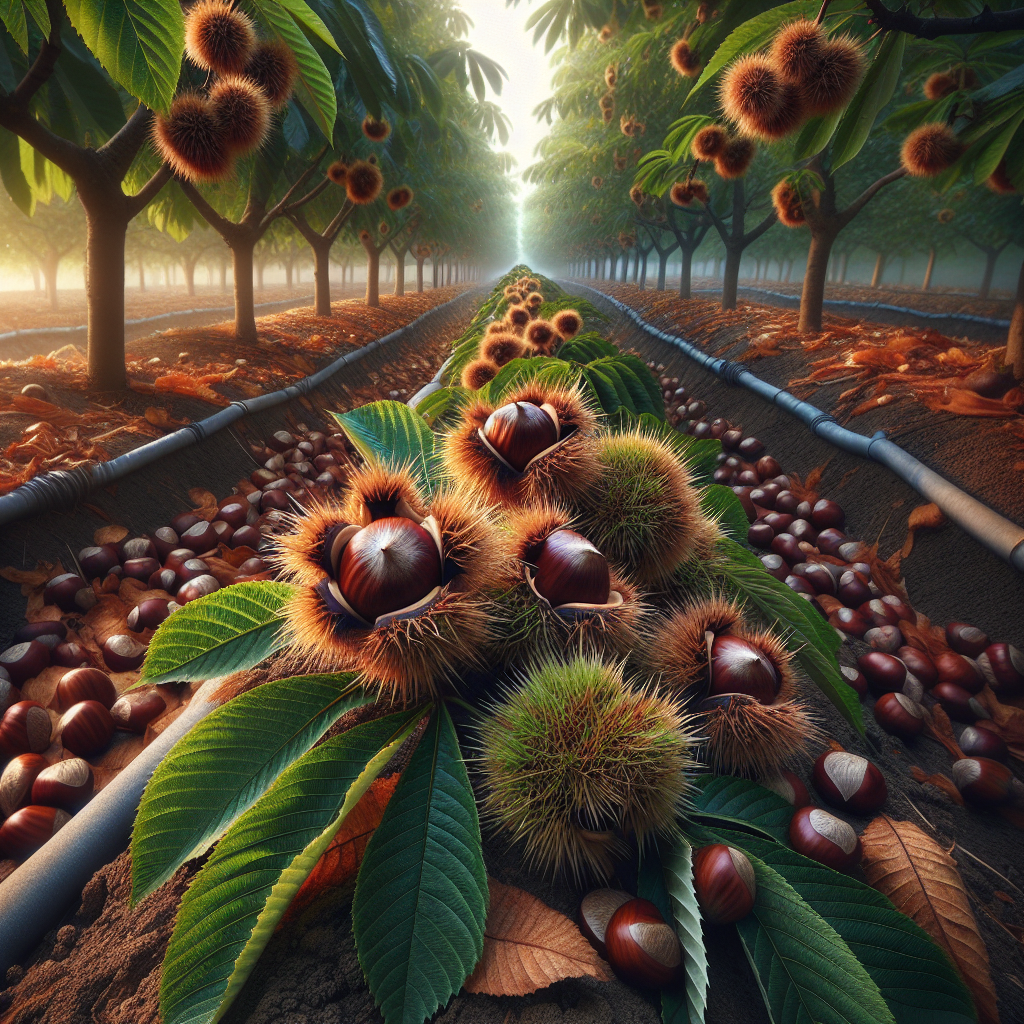
Introduction to Chestnut
Chestnut refers to several species in the genus Castanea, most notably European chestnut (Castanea sativa), Chinese chestnut (C. mollissima), Japanese chestnut (C. crenata), and American chestnut (C. dentata). For growers, chestnut occupies a unique niche between orchard fruit and tree nut production: the nuts are high in carbohydrates rather than oil, the trees can become substantial landscape specimens, and mature orchards can remain productive for decades.
Historically, chestnuts were a staple food in parts of Europe, the Caucasus, China, Korea, and eastern North America. In many mountain regions they were sometimes called the “bread tree” because dried chestnuts could be milled into flour. In the United States, the American chestnut once dominated vast forest ecosystems before Chestnut blight transformed the species from a canopy giant into a restoration focus. Modern growers typically rely on Chinese chestnut or interspecific hybrids because of better disease tolerance, especially against blight.
From a production standpoint, chestnut rewards patience. It is not an annual crop and not a quick orchard investment. However, once established, well-managed trees can begin bearing in as little as 3 to 7 years depending on rootstock, species, and propagation method, with commercial yields increasing steadily as the canopy matures. Compared with many other tree crops, chestnut is often easier to process after harvest because the nuts are generally collected from the ground soon after drop, then sorted, cured, and refrigerated.
The crop is best suited to temperate regions with warm summers, sufficient winter chilling, and soils that drain quickly. Poor drainage is one of the fastest ways to lose young trees. Good cultivar selection is equally critical: a chestnut orchard planted without pollinizer compatibility, blight tolerance, or climate adaptation in mind may survive but underperform badly. For growers interested in diversified nut systems, chestnut pairs well conceptually with other temperate tree crops such as walnut, though its soil and moisture preferences differ in important ways.
Botanical Profile of Chestnut
The genus Castanea belongs to the family Fagaceae, the same family as oak and beech. Chestnut trees are deciduous, producing long, serrated leaves, catkins for flowering, and spiny burs containing the nuts. Each bur usually contains one to three nuts depending on species and pollination quality. The edible portion is the seed kernel, enclosed in a glossy brown shell and a lighter inner pellicle that can be difficult to remove in some cultivars.
Tree form varies by species. Chinese chestnut tends to be broader, lower, and more spreading, often reaching 12 to 18 meters in orchard settings. European and American chestnuts can become taller and more upright, with American chestnut historically reaching exceptional forest height. Japanese chestnut often contributes precocity and large nut size in breeding programs, but can be less cold-hardy depending on selection.
Flowering biology matters greatly. Chestnut is monoecious, meaning male and female flowers occur on the same tree, but many cultivars are effectively self-incompatible or produce poor self-set. Male flowers are borne in conspicuous catkins; female flowers are small and located near the base of some catkins. Wind is the main pollination mechanism, so orchard design should allow compatible pollen flow. Planting a single isolated tree often results in sparse nut production even if the tree appears healthy and flowers heavily.
Root systems are generally deep-seeking when soil structure allows, but chestnut also produces a wide network of feeder roots in the upper soil profile. This makes the tree relatively drought-resilient after establishment compared with shallow-rooted species, yet still sensitive to prolonged waterlogging. Young trees in particular need aerated root zones because low oxygen around roots predisposes them to rot and poor growth.
Chestnut phenology follows a temperate rhythm: winter dormancy, spring bud break, summer flowering, late summer to autumn nut fill, and autumn drop. Timing depends on species and climate. Late spring frost can damage expanding shoots and flowers, particularly in low-lying frost pockets. Some Chinese chestnut cultivars leaf out later than European types, which can help avoid frost injury.
Key species distinctions for growers include:
- C. mollissima (Chinese chestnut): best all-around choice in many blight-prone regions; moderate tree size; good disease tolerance; variable nut size and flavor by cultivar.
- C. sativa (European chestnut): excellent nut quality and traditional culinary use; often more susceptible to blight and some canker issues; prefers classic Mediterranean-type chestnut zones.
- C. crenata (Japanese chestnut): large nuts and early bearing in some cultivars; useful in hybridization; can be more sensitive to severe winter cold.
- C. dentata (American chestnut): unmatched timber form and ecological value; highly susceptible to Chestnut blight unless grown as resistant hybrid lines.
Soil, pH, and Climate Requirements for Chestnut
Chestnut performs best in deep, well-drained, moderately fertile soils with a distinctly acidic reaction. The ideal pH is usually 5.0 to 6.5, with 5.5 to 6.2 being a particularly strong target range for most orchard situations. Above roughly pH 6.8, chestnut may begin to show micronutrient imbalance, slower growth, and poor vigor, especially where free calcium is present. Alkaline or calcareous soils are often a limiting factor. If soil pH is 7.2 or higher and contains visible lime, chestnut is usually a poor choice unless extensive site modification is feasible.
Texture matters as much as chemistry. Sandy loam, loam, gravelly loam, or decomposed forest-derived soils are ideal because they combine drainage with enough moisture-holding capacity to sustain summer growth. Heavy clay is risky unless planted on raised berms or slopes with excellent internal drainage. A simple practical test: after a heavy rain, water should not remain standing within the root zone for more than 24 hours. If the planting hole acts like a basin and stays saturated for several days, the site is unsuitable without major drainage work.
Organic matter should be moderate, not excessive and swampy. A target of 3% to 6% soil organic matter is generally favorable. Chestnut appreciates biologically active soil, but not compacted or constantly wet soil. Compaction layers should be corrected before planting by subsoiling or ripping, especially in former pasture or equipment-trafficked ground.
Climate requirements are temperate. Most chestnut plantings perform best where winters provide adequate chilling and summers are warm but not brutally arid without irrigation. Typical production zones include USDA zones 5 through 9 depending on species and cultivar. Chinese chestnut handles cold winters well and is often reliable into zone 5, while European chestnut is best in milder temperate climates. Chestnut generally prefers annual precipitation of 700 to 1200 mm if well distributed, or supplemental irrigation where summers are dry.
Heat is necessary for nut filling, but extreme summer heat combined with drought can reduce kernel size and increase blank nuts. During active growth and nut development, ideal average temperatures are often in the 18 to 28°C range. Winter lows below -25°C can injure some cultivars, especially Japanese and European types. Conversely, subtropical areas with insufficient chilling may produce erratic flowering and weak dormancy release.
Topography can improve success. Gentle slopes are often superior to flat bottoms because they improve air drainage and reduce frost risk. North- or east-facing slopes can help in hot inland climates by lowering heat stress, while south-facing slopes may benefit cooler regions. Avoid frost pockets, high water tables, and exposed ridge tops with desiccating winter winds.
If you are improving orchard ground before planting, focus on deep drainage, pH adjustment only within the acidic target range, and long-term organic matter management. For broader site-building strategies, see soil health tips.
Step-by-Step Planting & Propagation
Start with cultivar and pollination planning before buying trees. Plant at least two compatible cultivars with overlapping bloom. In commercial blocks, 10% to 20% pollinizer trees is common, though many growers alternate rows or interplant every third tree depending on the cultivar mix and harvest logistics.
Propagation method strongly influences time to bearing. Seedling trees are genetically variable and may take longer to fruit, but they can be useful as rootstocks or for restoration projects. Grafted trees provide known nut quality, growth habit, disease tolerance, and harvest timing. For orchard production, grafted or otherwise clonal nursery stock is usually preferable.
To grow from seed:
- Collect sound nuts immediately after fall drop.
- Float-test and discard obvious empties, though note this is not perfectly reliable.
- Keep nuts moist, not wet, in slightly damp peat, sawdust, or vermiculite.
- Stratify at 1 to 4°C for roughly 60 to 90 days.
- Protect from rodents during storage.
- Plant in deep containers or nursery beds once radicles begin to emerge.
Chestnut seed should never be allowed to dry out completely. Unlike many dry nuts, chestnuts are recalcitrant seeds with limited desiccation tolerance. Drying below safe internal moisture can kill the embryo.
To plant nursery trees:
- Prepare the site several months ahead if possible by controlling perennial weeds and correcting drainage.
- Plant in late fall after leaf drop in mild climates or in early spring before bud break in colder climates.
- Dig a hole wide enough to spread roots naturally, but not excessively deep.
- Set the tree so the root collar remains at or slightly above finished soil grade.
- Backfill with native soil rather than a rich pocket mix that can create a bathtub effect.
- Water thoroughly to settle soil around roots.
- Mulch with 5 to 10 cm of wood chips or leaf mold, keeping mulch 10 to 15 cm away from the trunk.
- Install tree shelters or guards where deer, rabbits, or sunscald are concerns.
Spacing depends on species vigor and management style. For broad Chinese chestnut types, 9 x 9 m to 12 x 12 m spacing is common. More intensive systems may begin tighter, such as 7 x 9 m, with planned thinning later. European chestnut on vigorous root systems may need generous spacing for long-term canopy development.
After planting, prune minimally. Remove broken roots or damaged shoots, but do not over-prune at establishment. The goal in the first two years is strong root establishment and central framework development, not aggressive top shaping.
Grafting is commonly done by whip-and-tongue, bark graft, or modified cleft methods using dormant scion wood. Chestnut can be somewhat more finicky to graft than apple or pear because of sap flow timing and susceptibility to desiccation. Scions must be healthy, dormant, and well matched to actively growing rootstock at the proper stage.
Care & Maintenance regimes for Chestnut
The establishment phase determines long-term orchard performance. During the first 2 to 4 years, weed control around the tree is one of the highest-return practices. Maintain a vegetation-free strip at least 1 to 1.5 meters around each young tree. Grass competition significantly reduces caliper growth and delays bearing.
Water management should be precise. Chestnut prefers evenly moist but aerated soil. During establishment, aim to moisten the root zone to a depth of 20 to 30 cm, then allow the upper few centimeters to dry slightly before the next irrigation. In practical terms, the soil should feel cool and lightly moist at hand depth, never sticky and airless for long periods. Young trees often need 15 to 25 liters per irrigation once or twice weekly in moderate weather, more on sandy soils and less on heavier soils. Mature bearing trees may require deep irrigation during prolonged dry periods, especially from flowering through kernel fill.
Signs of underwatering include dull, curled, or marginally scorched leaves, premature burr drop, small nuts, and poor shoot extension. Signs of overwatering include yellowing leaves despite wet soil, weak limp growth, blackened fine roots, sour-smelling soil, and sudden decline during warm weather. Persistent saturation is far more dangerous than mild short-term dryness.
Nutrient management should be based on soil and leaf analysis rather than guesswork. Chestnut is not a heavy feeder compared with many fruit crops, and overfertilization can stimulate excessive vegetative growth at the expense of structure and hardiness. Nitrogen is usually the main driver of early growth. For young trees, modest split applications in spring are safer than large doses. Mature orchards often benefit from annual or biennial tissue testing to monitor nitrogen, potassium, boron, zinc, and magnesium.
Typical deficiency symptoms include:
- Nitrogen: pale leaves and weak shoot growth.
- Potassium: marginal leaf scorch and poor nut filling.
- Boron: poor pollination, malformed burs, internal nut disorders in some cases.
- Magnesium: interveinal chlorosis on older leaves, especially in acidic sandy soils.
Pruning chestnut is generally lighter than for many fruit trees. Train young trees to a central leader or modified central leader with well-spaced scaffold branches. Remove narrow crotches, crossing limbs, and low branches that obstruct mowing or harvest. Once bearing begins, pruning should focus on light penetration, structural safety, and removal of dead or diseased wood. Heavy annual pruning can trigger vigorous watersprout growth and delay stable production.
Mulching supports moisture moderation and microbial activity, but keep organic mulch pulled back from the trunk to reduce collar rot and rodent damage. In rodent-prone areas, monitor guards and mulch depth carefully through winter.
Pollination management is often overlooked. Even with multiple cultivars planted, weather during bloom can affect set. Very wet flowering periods may reduce pollen movement, while severe heat or drought can affect flower viability. In small orchards, confirm that pollinizer trees actually bloom at the same time as the main cultivar rather than assuming species compatibility guarantees overlap.
Bearing management includes timely harvest sanitation and minimizing branch breakage. In heavy crop years, some cultivars may need support or corrective pruning if scaffold angles are poor. Alternate bearing can occur, though generally less dramatically than in some fruit trees when nutrition and water are balanced.
Pests, Diseases & Organic Management
Chestnut blight, caused by Cryphonectria parasitica, is the most historically significant disease of chestnut. It enters through wounds and causes sunken orange-brown cankers that girdle stems. American chestnut is highly susceptible, while Chinese chestnut shows useful resistance rather than complete immunity. The most important organic management strategy is cultivar choice. Start with resistant species or hybrids, avoid wounding trunks, remove severely infected material, and disinfect pruning tools between trees when disease is suspected.
Phytophthora root rot is another major threat, especially on poorly drained sites. Trees may show reduced vigor, leaf yellowing, dieback, and eventual collapse. Prevention is overwhelmingly more effective than treatment. Plant only in well-drained soil, avoid overirrigation, and never bury the graft union or crown. Raised berm planting can help on marginal soils, but it does not fully compensate for a high water table.
Ink disease, various cankers, and Leaf spot fungi can also occur depending on region. Good air movement, sanitation, and balanced fertility reduce severity. Excess nitrogen and dense shaded canopies often increase disease pressure.
Common insect pests include Chestnut weevils, Gall wasps, Aphids, Japanese beetles in some regions, and Caterpillars. Weevils are especially important because larvae develop inside nuts, reducing quality and storage life. Organic management includes prompt collection of dropped nuts every 1 to 2 days during harvest, orchard floor sanitation, encouraging poultry in some systems after harvest, and destroying infested nuts. Hot water treatment is used by some growers postharvest, but temperature and timing must be precise to avoid damaging kernels.
Chestnut gall wasp can deform shoots and reduce vigor by inducing galls on buds and leaves. Monitoring and use of resistant cultivars are key. In severe regions, regional biocontrol programs may be important.
Wildlife pressure is often as serious as insect pressure. Deer browse young shoots, rabbits girdle trunks, squirrels and crows steal nuts, and wild pigs can devastate orchard floors where present. Fencing, trunk guards, and rapid harvest are often essential components of organic chestnut production.
Integrated organic management priorities should be:
- Resistant cultivar selection.
- Excellent drainage and sanitation.
- Weed control without trunk injury.
- Rapid harvest of fallen nuts.
- Wildlife exclusion.
- Regular scouting from spring through harvest.
Harvesting, Curing & Optimal Storage
Chestnuts are typically harvested when burs split naturally and nuts fall to the ground, usually in early to mid-autumn depending on species, cultivar, and climate. Do not rely on calendar date alone. Mature nuts have full brown shell color, detach cleanly, and drop readily. Immature nuts are smaller, often poorly filled, and store badly.
Harvest should be frequent. In warm weather, collect every day if possible; every 2 to 3 days is the outer limit for high-quality fresh market nuts. Nuts left on warm, damp ground are more vulnerable to mold, weevil infestation, animal predation, and internal quality loss. Wear heavy gloves when handling burs, or use foot pressure and collection tools to separate nuts safely.
After harvest, sort immediately. Remove cracked, lightweight, moldy, insect-damaged, or obviously undersized nuts. Float testing can help identify some poor-quality nuts, but it should not replace visual grading because some good nuts may float and some poor nuts may sink.
Curing chestnut is different from curing oily nuts such as walnut or pecan. The goal is not hard drying to shelf-stable low moisture, but stabilization and flavor improvement while retaining kernel quality. Fresh chestnuts are physiologically active and can lose sweetness or mold if handled poorly. Hold them cool and humid after harvest. A common approach is to pre-cool quickly, then store at 0 to 2°C with high relative humidity around 85% to 90%. At these conditions, quality can hold for several weeks to a few months depending on cultivar and sanitation.
If chestnuts are stored too dry, kernels shrivel. If stored too warm, respiration increases, molds develop, and sprouting may begin. Ideal storage conditions feel counterintuitive to growers used to dry-storage nuts: chestnut is closer to storing fresh produce than storing almonds.
Some growers cure for several days to one week in cool conditions before sale to allow starch-to-sugar conversion and improved eating quality, but prolonged room-temperature holding is risky. For long-term preservation, chestnuts can be peeled and frozen, or dried under controlled conditions for flour production. Drying for flour should be gentle enough to avoid scorching and preserve sweetness.
Quality indicators at sale include glossy shell, full weight for size, clean hilum area, no rattling kernel, no mold odor, and minimal internal pellicle darkening. Market timing also matters: chestnuts are highly seasonal and often command premium prices when delivered fresh and clean during autumn demand peaks.
Companion Planting for Chestnut
Companion planting around chestnut works best when interpreted as orchard floor management rather than close interplanting with aggressive species. Young chestnuts dislike competition near the trunk, so the immediate root zone should remain weed-free. Beyond that zone, beneficial understory plants can improve pollinator support, erosion control, nutrient cycling, and predator habitat.
Useful companions include low-growing legumes such as white clover in alleyways, provided it is kept away from the trunk and managed so it does not create excessive rodent habitat. Clover can contribute nitrogen cycling and improve trafficability. Deep-rooted flowering herbs such as yarrow, chicory, and certain native asters can support beneficial insects and loosen soil structure in the wider orchard matrix. Dynamic accumulators are often overpromised, but diverse perennial groundcovers do help stabilize the system when well managed.
Avoid highly competitive shrubs, vigorous vines, and dense perennial mats directly under the canopy of young trees. Chestnut roots need moisture and oxygen, and dense understories can intercept both water and fertilizer. Also avoid companion species that host major overlapping pests or create humid, poorly ventilated conditions around trunks.
In larger agroforestry systems, chestnut is often paired with rotational grazing, mushrooms on woody residues, or pollinator strips on row middles. Grazing must be carefully timed so livestock do not compact wet soil, browse bark, or damage surface roots. Poultry can be useful for postharvest cleanup in some settings if stocking density is controlled.
A practical companion planting pattern is: keep a clean mulched circle around each tree, maintain a mowed mixed sward in alleys, and establish flowering strips at row margins rather than directly at trunks. This design supports biodiversity without sacrificing tree establishment or harvest efficiency. For more mixed-species understory ideas, see companion planting guide.
Well-designed chestnut systems balance competition and cooperation. The best companions are those that protect soil, attract beneficial insects, and fit harvest logistics while respecting the tree’s strong need for drainage, light, and low competition during its formative years.