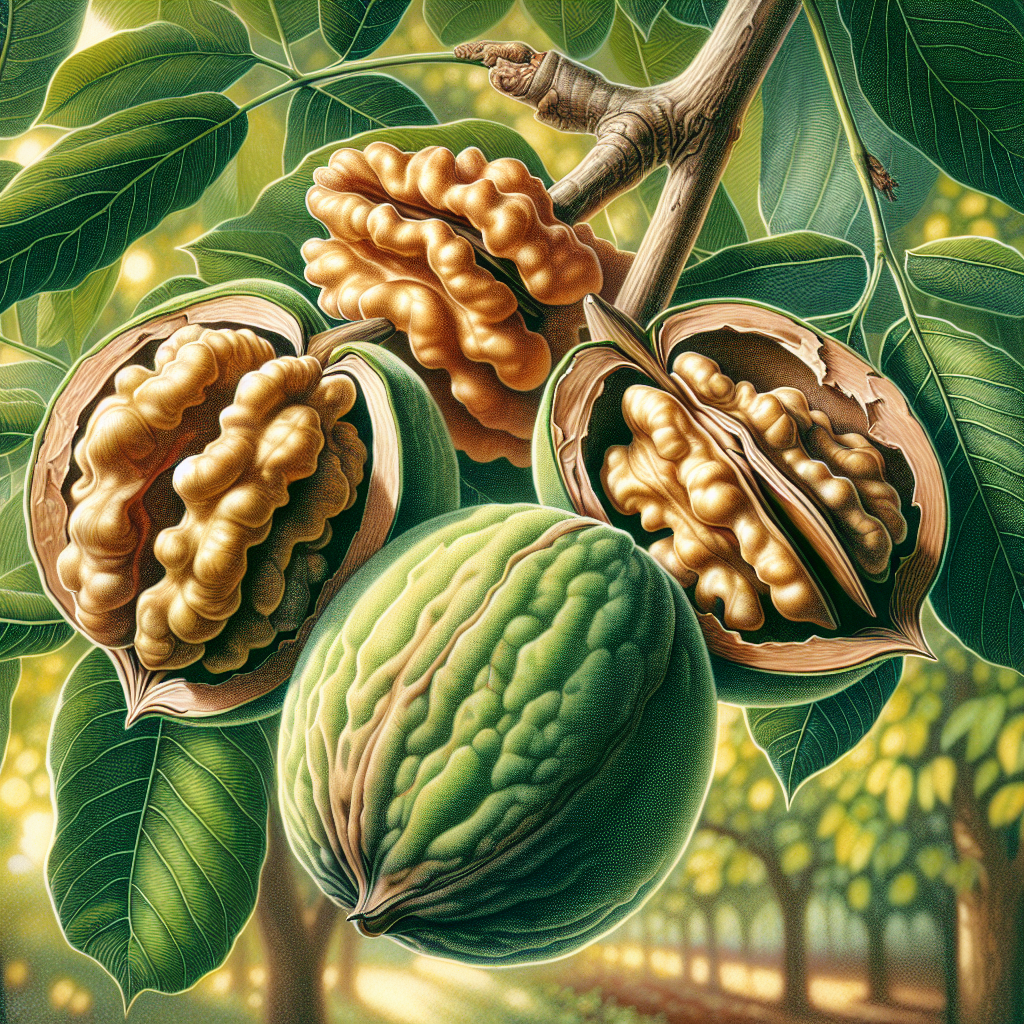
Introduction to Chandler Walnut
Chandler Walnut (Juglans regia 'Chandler') stands out as one of the premier commercial walnut varieties in modern orchards, particularly in California and similar regions. Released by the University of California in 1974, this late-budding cultivar was specifically bred for its exceptional yield potential, large nut size, and superior shell seal that minimizes kernel shrivel during storage. Farmers appreciate Chandler for its precocious bearing—beginning production in just 3-4 years on good rootstocks—and its ability to deliver 10,000-15,000 pounds per acre at maturity under optimal management.
What sets Chandler apart from traditional varieties like English Walnut is its delayed leafing, which dodges spring frosts and reduces susceptibility to walnut blight (Xanthomonas arboricola pv. juglandis). The nuts feature light-colored kernels with high recovery rates (50-55%) and excellent quality for export markets. However, success with Chandler demands precise site selection, irrigation, and pest scouting, as neglect can lead to alternate bearing or disease issues. This deep-dive guide equips growers with proven, professional-grade strategies to maximize returns from Chandler Walnut orchards. For broader insights on orchard profitability, check this blog post on farm zoning.
Botanical Profile of Chandler Walnut
Chandler Walnut is a deciduous, monoecious tree in the Juglandaceae family, growing to 40-60 feet tall with a spreading canopy up to 50 feet wide at maturity. It exhibits vigorous upright growth with compound pinnate leaves emerging late (mid-April in USDA zones 7-9), a trait bred from its parentage of Payne and Sassano selections. The tree produces male catkins (6-12 inches long) and female flowers in axillary buds, with pollination typically occurring in May.
Nuts develop from pistillate flowers, maturing in late October to November—among the latest of walnut varieties, allowing extended growing seasons. Each nut weighs 15-18 grams, with thin shells (easy crackout) enclosing plump, golden kernels rich in omega-3 fatty acids (up to 60% oil content). Root systems are deep and extensive, with taproots penetrating 10-20 feet, making Chandler drought-tolerant once established but sensitive to waterlogging. Grafted onto Paradox (Juglans hindsii x J. regia) rootstock, it resists oak root fungus (Armillaria) better than seedling roots. Bloom type is protandrous (male flowers shed pollen before female receptivity), requiring compatible pollinizers like Howard or Tulare nearby.
Soil, pH, and Climate Requirements for Chandler Walnut
Chandler Walnuts demand deep, fertile, well-drained loamy soils with at least 4-6 feet of uncontaminated profile to support their extensive roots. Avoid heavy clays or poorly drained sites prone to Phytophthora root rot; ideal textures are sandy loam to silt loam with 1-2% slopes for frost drainage. Soil pH should range 6.0-7.5, with levels below 5.8 causing zinc/manganese deficiencies—correct via dolomitic lime applications at 2-4 tons/acre.
Climate-wise, Chandler excels in USDA zones 7b-9b with 700-1000 chill hours (below 45°F), Mediterranean patterns of cool, wet winters and hot, dry summers. It tolerates winter lows to 10°F but suffers from spring frosts below 28°F on early-leafing years. Heat units (above 50°F) needed for maturity: 2800-3200. Annual rainfall of 25-40 inches suffices if supplemented by drip irrigation (35-45 inches total water/season). High humidity (>70% during nut maturity) risks husk fly and fungal issues; elevation 100-2000 feet optimizes quality. Test soils pre-planting for nematodes like root-knot nematodes and pathogens.
Step-by-Step Planting & Propagation
Site Preparation (Fall prior): Deep rip to 4-5 feet, incorporate 20-40 tons/acre composted manure or green waste, and fumigate if nematode/pratylenchus levels exceed thresholds. Install drip lines 2 feet from future trunks.
Propagation: Chandler is not true-to-type from seed; propagate via T-budding or whip-grafting onto Paradox rootstock in spring (March-May). Nursery trees should be 1-2 years old, 5/8-1 inch caliper, 4-5 feet tall.
Planting (Dormant season, Dec-Feb): Space 20-24 feet x 24-30 feet (80-100 trees/acre). Dig holes 3x root ball width, stake firmly. Orient graft union 6-8 inches above soil. Mulch basins with 4-6 inches wood chips, irrigate to field capacity.
Year 1 Training: Head to 30-36 inches at planting, select 5-7 scaffold branches at 24-30 inches. Prune annually in summer to open center, removing watersprouts.
Pollinizer Integration: Plant 1 Howard or Franquette per 20-30 Chandlers, as they overlap bloom periods.
Care & Maintenance regimes for Chandler Walnut
Irrigation: Drip deliver 30-50 gallons/tree/week from May-Oct, stressing lightly in July for kernel quality. Monitor tensionometers at 2-4 feet depth (<20 cb).
Fertilization: Annual soil/leaf analysis guides apps. Nitrogen: 100-200 lbs/acre split (hullset, mid-summer). Phosphorus/potassium per soil test; foliar zinc/boron at pink bud.
Pruning: Dormant thin to vase shape, summer hedge to 16-18 feet height for harvest efficiency. Remove deadwood annually.
Weed Control: Mulch + pre-emergents (simazine); mow alleys.
Frost Protection: Wind machines or microsprinklers if site prone.
Monitor for alternate bearing via girdle or foliar GA3 (20 ppm at hullsplit).
Pests, Diseases & Organic Management
Key Pests: Walnut husk fly (bait sprays spinosad); codling moth (mating disruption + BT); walnut aphid (neem oil, ladybugs). Scout weekly, use degree-day models.
Diseases: Walnut blight—copper sprays at 80% budbreak; Phytophthora crown rot (mound grafts, phosphites). Avoid overhead water.
Organic Strategies: Kaolin clay for husk fly/codling; compost teas for aphids; cover crops (clover) suppress nematodes. Beneficials: predatory mites, trichogramma wasps. For more on organic pest control, see Spring Pest Patrol blog. Rotate with peas pre-plant.
Harvesting, Curing & Optimal Storage
Harvest late Oct-Nov when 90% hulls split and specific gravity >1.05. Shake trees mechanically (daily post-hullsplit), sweep nuts, clean via aspirators. Dry to 8% moisture in aerated bins (95-100°F, 25% RH, 7-10 days). Store kernels at 2-4°C, <5% MC, vacuum-sealed (shelf life 12-24 months). Reject stained lots; grade for light amber max.
Companion Planting for Chandler Walnut
Chandler's allelopathic juglone limits understory, but select companions mitigate. Shallow-rooted Thai Basil or marigold deter nematodes/aphids. Clover fixes N, suppresses weeds without competing. Avoid potato or tomato due to blight vectors. Interplant young orchards with peas or annual legumes for soil building. Learn more via Companion Planting blog.