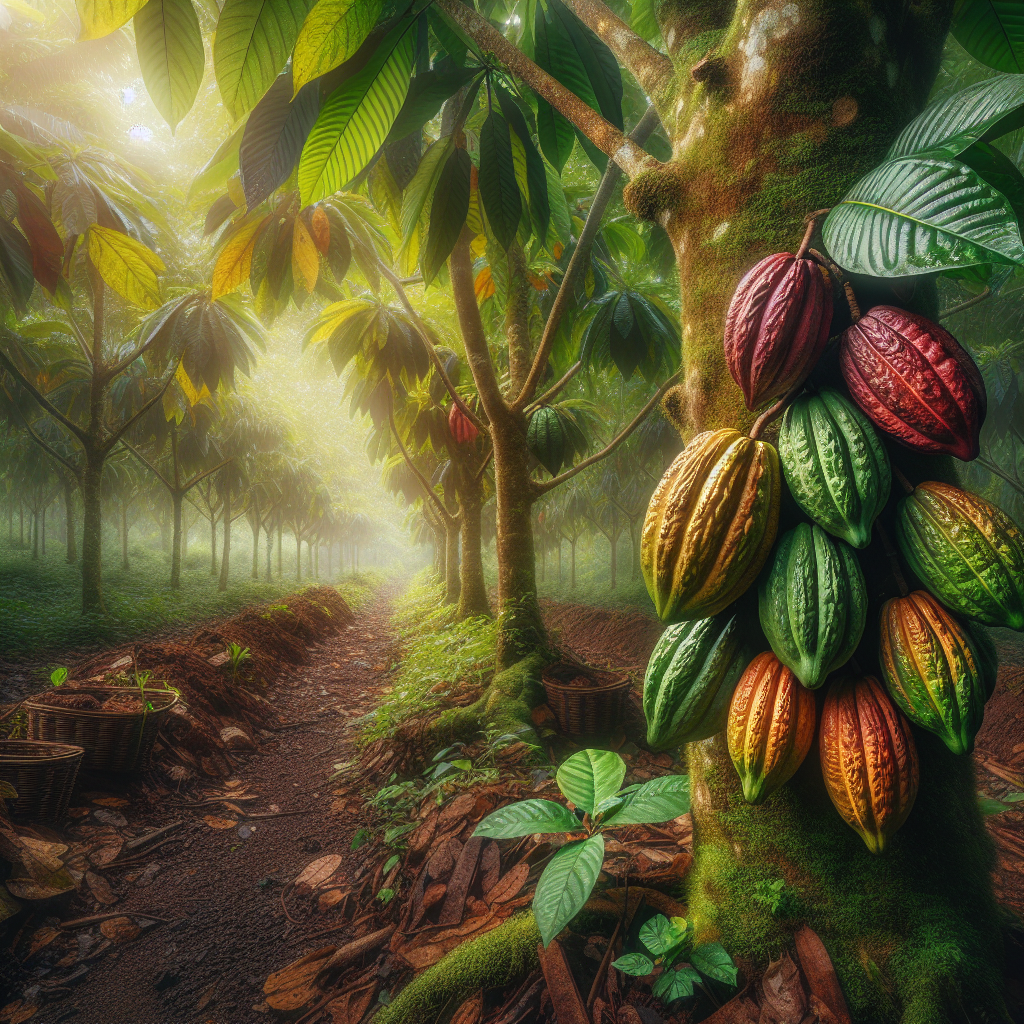
Introduction to Trinitario Cacao
Regarded as one of the world’s most important fine-flavor cacao groups, this cacao type occupies a middle ground between the delicate, highly aromatic Criollo lineage and the more vigorous, productive Amelonado and Upper Amazon-derived Forastero types. Historically, Trinitario emerged after devastating disease and weather events in Trinidad in the 18th century, when surviving Criollo trees hybridized with introduced Forastero material. The result was not a single uniform cultivar but a broad genetic family showing substantial variation in pod color, bean size, flavor profile, canopy architecture, and disease response.
For growers, that genetic diversity is both an advantage and a management challenge. Well-selected Trinitario planting material can produce beans with floral, fruity, nutty, caramel, spice, and red-fruit notes that make them highly sought after by premium chocolate makers. At the same time, performance depends heavily on clone selection, site suitability, pollination conditions, shade regulation, and disease pressure. Compared with bulk Cacao systems grown for commodity markets, premium Trinitario production usually rewards more careful harvest timing, stricter fermentation discipline, and better postharvest segregation.
In the field, Trinitario typically performs best in diversified tropical systems rather than exposed monocultures. It thrives under moderated light, high humidity, warm temperatures, stable soil moisture, and excellent organic matter turnover. When managed well, trees begin light bearing in 2.5 to 4 years from grafted stock, somewhat later from seedlings, and can remain productive for decades.
Botanical Profile of Trinitario Cacao
This crop belongs to the family Malvaceae, formerly placed in Sterculiaceae, and shares the species designation Theobroma cacao. Like all cacao, it is a small evergreen understory tree adapted to humid tropical forests. Mature height under cultivation commonly ranges from 3 to 8 meters depending on rootstock, clone vigor, pruning system, and shade intensity, though unmanaged trees can grow taller.
The species shows cauliflory, meaning flowers and pods are borne directly on the trunk and older scaffold branches. This is a critical trait for management because pruning must preserve productive cushion tissue where flowers repeatedly emerge. Flowers are small, pinkish-white to pale cream, and structurally complex. Natural pollination is often low, mostly performed by tiny ceratopogonid midges, so humid leaf litter, shaded microclimates, and nearby decomposing organic matter strongly affect fruit set.
A typical cacao tree passes through a juvenile orthotropic stem phase and then forms a jorquette, a whorl of fan branches that creates the main canopy framework. Productive management usually aims to establish the first jorquette at about 1.2 to 1.5 meters above ground to facilitate harvest and pruning.
Trinitario types vary more than many growers expect. Pods may be ridged or smoother, elongated or melon-shaped, green turning yellow, or red turning orange. Beans are usually larger and more flavorful than many bulk Forastero types, with cotyledon color ranging from pale to purple depending on parentage. Compared with Criollo Cacao, Trinitario generally offers higher yield potential and stronger resilience, though fine-flavor quality remains highly dependent on clone and postharvest handling.
Root systems are shallow to moderately deep, with the largest concentration of feeder roots often in the top 20 to 30 cm of soil, especially where mulch and organic matter are abundant. This makes the tree very responsive to surface mulching, but also sensitive to drought, compaction, and standing water.
Soil, pH, and Climate Requirements for Trinitario Cacao
This crop is highly site-sensitive. Ideal soils are deep, friable, well-structured loams or clay loams with high organic matter, strong biological activity, and excellent drainage. Effective rooting depth should be at least 1.2 meters, and preferably more, because seasonal water stress becomes severe on shallow soils. Avoid hardpans, lateritic sealing, and compacted subsoil layers that restrict drainage or root penetration.
The preferred soil pH is 5.5 to 6.8. Trees can survive outside this range, but nutrient efficiency declines. Below pH 5.2, aluminum and manganese toxicity risks increase and calcium, magnesium, and phosphorus availability often fall. Above pH 7.0, micronutrient lock-up, especially iron and zinc, becomes more common. If soil is strongly acidic, use finely ground agricultural lime or dolomite based on laboratory analysis, incorporated several months before planting. If pH is too high, heavy organic matter incorporation and acid-forming nutrient programs are safer than aggressive acidification attempts.
Drainage is non-negotiable. Trinitario cacao likes continuously moist soil, not saturated soil. A practical target is to maintain root-zone moisture near field capacity without prolonged anaerobic conditions. In the top 15 to 20 cm, soil should feel cool and slightly moist when squeezed, forming a weak ball that breaks apart with light pressure. Warning signs of overwatering include yellowing leaves with green veins, limp new flush despite wet soil, blackened feeder roots, sour-smelling planting holes, mossy surface sealing, and increased incidence of Phytophthora pod rot. Underwatering typically shows as dull leaf color, downward leaf folding by midday, hardened dry mulch, increased cherelle wilt, and premature pod drop.
Rainfall requirements are generally 1,500 to 2,500 mm annually, well distributed. Short dry periods can be tolerated if mulch is deep and supplemental irrigation is available, but prolonged drought sharply reduces flowering, fruit set, and bean fill. Areas with a dry season longer than 3 months usually need irrigation and heavier shade management.
Ideal temperatures range from 21 to 32°C. Growth slows below 18°C, and sustained exposure below 15°C causes physiological stress. Temperatures above 34°C, especially under low humidity and strong wind, can scorch young leaves, desiccate flowers, and reduce pollinator activity. Relative humidity of 70 to 90% is favorable. Wind protection is essential because strong winds tear leaves, destabilize shallow roots, reduce boundary humidity, and can scar pods.
Light management is one of the most important professional decisions. Young trees usually need 40 to 60% shade, while bearing trees often perform best at roughly 20 to 35% filtered shade depending on cloud cover, elevation, and water supply. Too much shade reduces flowering and increases black pod pressure; too little shade causes heat stress, stem sunscald, and excessive soil moisture loss. Well-designed shade systems are central to long-term productivity. For broader agroforestry fertility principles, see soil health strategies.
Step-by-Step Planting & Propagation
Commercially, the best results come from elite clonal material propagated by grafting, budding, or rooted cuttings rather than unselected seed. Seedling Trinitario populations are genetically variable, which can be useful for breeding or local adaptation but creates inconsistency in yield and flavor.
Select planting material carefully. Use disease-screened, high-performing local clones or regionally proven selections. Evaluate yield, bean size, flavor marketability, black pod tolerance, Vascular-streak dieback risk if relevant, and canopy vigor.
Raise seedlings only from fresh seed if needed. Cacao seed loses viability quickly and should usually be sown within 5 to 7 days of extraction. Remove mucilage gently, sow in sterile, well-drained media, and maintain 50 to 70% shade. Germination is commonly rapid, within 1 to 3 weeks.
Prepare nursery stock. Polybags around 20 x 30 cm are common. Use a medium such as 40% topsoil, 30% well-decomposed compost, 20% sand, and 10% rice hulls or other aeration material. Avoid fresh manure. Seedlings are ready for field planting at 4 to 6 months when stems are sturdy and root spiraling is minimal.
Establish temporary and permanent shade before planting. Temporary shade can come from fast-growing species or intercropped Banana, which reduces heat stress and gives quick early shelter. Permanent shade trees should be in place early enough that the cacao does not face full sun during establishment.
Prepare the field. Clear aggressively competitive weeds but retain useful organic biomass. Dig planting holes about 45 x 45 x 45 cm, larger on poor soils. Refill with topsoil mixed with 5 to 10 kg of fully matured compost. Do not bury raw organic matter at the base where it can ferment.
Spacing. Common spacing is 3 x 3 m, 3 x 2.5 m, or 4 x 3 m depending on clone vigor, pruning system, and shade design. In intensive systems, higher density may be used initially with later thinning. Agroforestry systems may require more flexible geometry.
Plant at the onset of reliable rains. Set the root ball so the nursery soil line matches field soil level. Planting too deep encourages collar problems. Water immediately after transplanting and mulch thickly, keeping mulch 10 cm away from the trunk.
Train the young tree. Remove chupons emerging below the intended jorquette. Select 3 to 5 well-placed fan branches once the jorquette forms. Eliminate weak, crossing, or crowded framework branches early.
For vegetative propagation, patch budding and side grafting onto vigorous seedling rootstocks are widely used. Scion wood should be healthy, semi-hard, and true to type. Maintain high humidity after grafting but avoid free water on union points.
Care & Maintenance regimes for Trinitario Cacao
The first three years determine the structure and lifetime productivity of the planting. Weed competition must be controlled continuously because young cacao is a poor competitor. Maintain a 0.75 to 1.0 meter weed-free circle around each tree, ideally through mulch, shallow hand weeding, or low-disturbance hoeing rather than deep cultivation that damages feeder roots.
Mulching should be heavy and regular. A 5 to 10 cm layer of leaf litter, chopped prunings, composted husks, or other disease-free organic material moderates soil temperature, buffers moisture fluctuations, and supports midge habitat. In very wet climates, keep mulch slightly thinner near the trunk collar to reduce rot risk.
Irrigation should aim to keep the active root zone evenly moist down to roughly 20 to 30 cm, especially during flowering and pod filling. Young trees often need 10 to 20 liters per tree two to three times weekly in dry periods, while mature trees may require 25 to 60 liters depending on canopy size, evapotranspiration, and soil texture. Sandy soils need smaller, more frequent applications; clay loams need slower, less frequent irrigation. Tensiometers are useful: readings around 10 to 25 centibars in loam are generally favorable, while persistent readings above 35 to 45 centibars indicate moisture stress. Avoid daily shallow watering, which encourages surface rooting and instability.
Nutrition should be based on leaf and soil analysis, but general principles are clear. Nitrogen drives vegetative flush and canopy recovery; phosphorus supports root establishment and flowering; potassium is critical for pod fill, disease resilience, and overall bean quality; calcium and magnesium support structural growth and photosynthetic function. Sulfur, boron, zinc, and iron can also limit performance.
A practical program for young trees may include 100 to 200 g of a balanced NPK blend split into 4 to 6 doses annually in year one, increasing progressively with age. Mature bearing trees commonly need the equivalent of 300 to 800 g nitrogen, 40 to 120 g phosphorus, and 400 to 1,000 g potassium per tree annually depending on yield target, rainfall, and soil reserves. In organic systems, this may be delivered through compost, poultry manure that is fully cured, oilseed meals, rock phosphate, sulfate of potash magnesia, and repeated biomass mulching. Where husks are disease-free, composted cacao pod husks can recycle substantial potassium.
Pruning is continuous, not occasional. Remove chupons, dead wood, diseased cushion tissue, crossing branches, and excess interior shade. Annual or semiannual structural pruning should maintain an open but protected canopy with good airflow and accessible pod-bearing wood. Heavily shaded interiors encourage black pod and mealybug problems. Severe pruning should be staged to avoid sunburn and production collapse.
Shade regulation must be adjusted seasonally. In dry hot periods, preserve more canopy cover. In persistently wet periods, reduce excessive shade to improve air movement and light penetration. The goal is dappled light, not darkness.
Flowering and fruit set in cacao naturally involve heavy losses. Cherelle wilt, the abortion of young pods, is normal to a degree. Excessive wilt signals imbalance: drought, nutrient shortage, poor pollination, overbearing, root stress, or sudden shade changes.
Pests, Diseases & Organic Management
The most economically important disease in many cacao regions is black pod, most often caused by Phytophthora palmivora or related species. Early symptoms include small brown lesions on pods that rapidly enlarge, often turning dark brown to black with pale sporulation under humid conditions. Management depends on sanitation: harvest ripe pods promptly, remove infected pods weekly, prune for airflow, avoid water splash, regulate shade, and keep pods off the ground. Organic copper products may help where permitted, but hygiene and canopy control are the foundation.
Witches’ broom, caused by Moniliophthora perniciosa, is devastating where present in the Americas. It causes swollen shoots, abnormal broom-like growth, cushion proliferation, and malformed pods. frosty pod rot (Moniliophthora roreri) can also be catastrophic, producing powdery sporulation on infected pods. In both diseases, resistant clones, relentless removal of infected tissue, frequent harvesting, and strict quarantine are essential.
Vascular-streak dieback may occur in some humid Asian production zones, especially under dense shade and prolonged leaf wetness. Symptoms include chlorotic leaf flush, branch dieback, and vascular streaking. Improve airflow, reduce excess shade, and remove affected wood well below symptoms.
Common insect pests include mirids or capsids, mealybugs, scale insects, aphids, cocoa pod borers, and stem borers depending on region. Mirid feeding causes cankers, lesions, and cherelle damage. mealybugs and scales weaken trees and may foster sooty mold. Pod borers damage beans directly and predispose pods to rot.
Organic management should be integrated rather than product-driven:
- Maintain moderate shade, not dense shade.
- Encourage beneficial insects with flowering margins where feasible.
- Prune and sanitize weekly during peak disease periods.
- Remove and destroy heavily infested or diseased pods.
- Use sticky barriers or trunk hygiene where ant-mealybug associations are severe.
- Apply neem-based materials, insecticidal soaps, or horticultural oils only with good coverage and careful timing to avoid phytotoxicity on tender flush.
- Avoid excessive nitrogen, which can produce soft, pest-prone growth.
Rodents, squirrels, monkeys, and birds may also damage ripening pods. In premium plantings, regular harvest rounds, habitat edge management, physical barriers, and coordinated trapping programs are often necessary.
Harvesting, Curing & Optimal Storage
Harvest maturity is determined by pod color break, sound, and calendar familiarity with the clone. Green pods often turn yellow; red pods may turn orange or crimson. Immature harvest reduces sugar in the pulp, leading to weak fermentation and flat flavor. Overripe pods may begin internal germination or insect attack.
Use a sharp knife, secateur, or specialized cacao hook to cut pods without tearing the cushion tissue. Never yank pods off by hand; repeated cushion damage reduces future flowering. Main harvests are often every 2 to 4 weeks, but in high-value systems weekly picking is preferable to reduce disease carryover and maintain fermentation uniformity.
After harvest, pods are usually opened within 5 days, ideally sooner. Sort out diseased, germinated, flat, or damaged pods. Healthy wet beans should be fermented in boxes, heaps, or baskets depending on scale. Trinitario often develops best flavor with 4 to 6 days of fermentation, though some lots benefit from 5 to 7 depending on bean size, pulp volume, and ambient temperature. Turn fermenting mass after 48 hours, then every 24 to 48 hours as needed. Target mass temperatures often rise to about 45 to 50°C. Under-fermented beans remain slaty and bitter; over-fermented beans can become mold-prone, excessively acidic, or structurally weak.
Drying should reduce moisture to about 6.5 to 7.5%. Above 8%, mold risk rises sharply; below about 6%, beans become brittle and may suffer quality loss. Sun drying on raised tables or clean mats is preferred when weather allows, with gradual drying over 5 to 10 days. Avoid direct scorching on very hot surfaces. Final beans should feel firm, produce a crisp internal snap when cut, and show even brown internal color with minimal slate.
Store dried beans in clean jute sacks or food-grade breathable packaging in a cool, dry, odor-free room at relative humidity below about 65%. Keep sacks off the floor and away from walls. Cacao beans absorb odors readily, so never store near fuel, soap, spices, smoke, or agrochemicals. In humid regions, dehumidified storage is often justified for fine-flavor lots.
Companion Planting for Trinitario Cacao
The best companion plants are those that support shade regulation, soil cover, biodiversity, and diversified income without creating excessive root competition or dense disease-conducive humidity.
Banana is one of the most useful early companions. It establishes quickly, provides temporary shade, reduces wind speed, contributes mulch through chopped pseudostems and leaves, and can generate early cash flow before cacao reaches meaningful production. Space it so that it shelters young trees without causing chronic overcrowding.
Vanilla can fit into well-managed cacao agroforestry where humidity is high and support trees are present. It offers a high-value understory crop, but it requires attentive disease management and hand pollination in many production systems. It should be added only after the main cacao architecture and shade system are stable.
Coconut serves as a useful upper-canopy component in some coastal and lowland tropical systems. It can provide filtered overhead light and long-term vertical layering, but spacing must be generous so cacao does not become too dry or nutrient-deprived beneath it.
Black Pepper may be integrated on dedicated support trees at plot edges or in mixed spice systems. It adds value and biodiversity, though airflow must remain good and disease monitoring must be strict. Avoid overcomplicating young cacao blocks; companion species should support the plantation, not compete with it.
The most successful Trinitario systems usually combine temporary shade, permanent canopy management, thick mulch, and a small number of compatible companion crops chosen for structure and economics rather than novelty.