Introduction to Vanilla
Native to Mesoamerica and first cultivated by Indigenous peoples of eastern Mexico, vanilla became globally important after its flavor chemistry and curing methods spread through colonial trade routes. The crop most widely grown for commercial production is Vanilla planifolia, although V. × tahitensis and V. pompona are also used in specialty markets. Unlike many spice crops, vanilla is not valued at harvest simply for a fresh fruit; its signature aroma develops only after a carefully managed curing process that converts glucovanillin and related precursors into vanillin and a broad bouquet of secondary compounds.
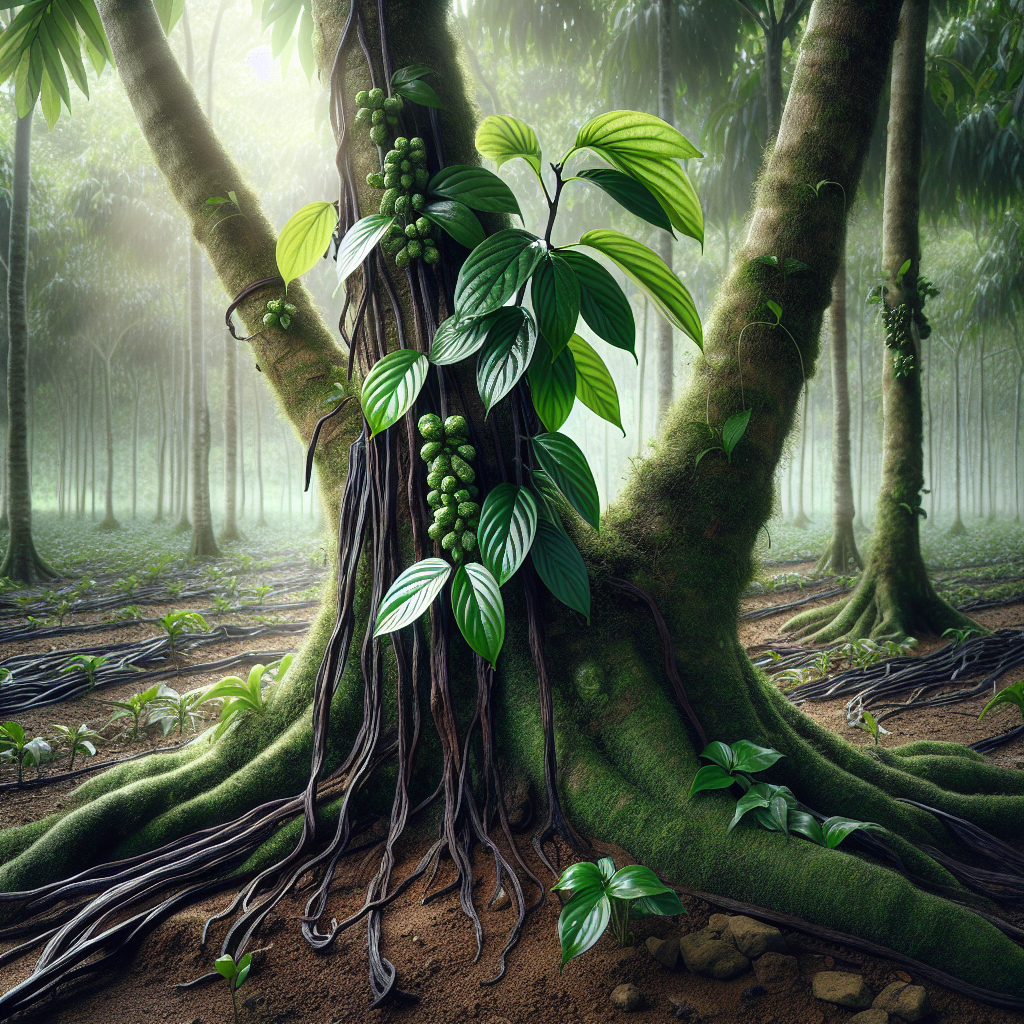
Vanilla is botanically unusual because it is an orchid, but agronomically it behaves like a perennial tropical vine. It produces long, succulent stems with aerial roots at the nodes, and these roots cling to living or dead supports while also absorbing atmospheric moisture. In commercial production, the crop is often trained on live tutor trees or trellises under partial shade. The economics of the crop are shaped by two biological constraints: flowers open for only a short period, often for a single morning, and natural pollinators are absent in most producing regions, making hand pollination essential. For growers, success depends on mastering microclimate control, vine training, pollination timing, disease prevention, and postharvest curing discipline.
Botanical Profile of Vanilla
Vanilla planifolia belongs to the family Orchidaceae. It is a monopodial climbing orchid with fleshy green stems that can exceed 10 meters if left unmanaged, though commercial growers usually keep productive vine length much shorter for ease of pollination and harvest. Leaves are thick, oblong to elliptic, and somewhat succulent, reflecting the plant’s adaptation to humid forest margins where water availability is steady but drainage is rapid. Each node can produce an aerial root that anchors the vine and helps regulate moisture uptake.
Inflorescences arise from mature nodes, usually on vines that are at least 2-3 years old and physiologically mature. Flowers are pale greenish-yellow to cream, waxy, and short-lived. Individual racemes may carry many buds, but not all are typically pollinated because overloading the vine can reduce bean quality and weaken the plant. A well-managed vine may support several inflorescences in a season, but the number retained should match vine vigor and nutrition.
The fruit is technically a capsule, though growers call it a bean or pod. It is long, narrow, and green at maturity, typically 15-25 cm in V. planifolia, though length varies with genotype, pollination success, and growing conditions. Fresh pods have very little of the familiar vanilla aroma. That aroma develops during curing, when enzymatic reactions and controlled dehydration reshape the pod’s chemistry.
Commercially, growers should distinguish among the main cultivated vanilla types. V. planifolia is the standard Bourbon- or Madagascar-type vanilla with high vanillin potential and broad market acceptance. V. × tahitensis often has a more floral, anisic profile and shorter, plumper pods. V. pompona can produce large pods but is less widely traded in mainstream markets. For most growers aiming at recognized spice markets, V. planifolia remains the benchmark. In mixed tropical spice systems, vanilla is sometimes integrated with crops such as Black Pepper, since both benefit from support structures, filtered light, and careful humidity management, though their disease profiles differ.
Soil, pH, and Climate Requirements for Vanilla
Vanilla performs best in warm, humid tropical climates with daytime temperatures of 24-32°C and nighttime temperatures generally above 18°C. Growth slows noticeably below about 20°C, and chilling injury becomes increasingly likely when temperatures fall under 10-12°C. Frost is lethal. Relative humidity between 70% and 90% is ideal, especially during active vegetative growth and flowering initiation, but humidity must be balanced with air circulation to prevent fungal outbreaks.
The crop prefers filtered shade rather than full sun. In natural habitat, vanilla grows as an understory-edge climber where light is bright but diffused. Commercial targets are commonly 30-50% shade, though this varies with latitude, cloud cover, and humidity. Too much shade produces lush vegetative growth but poor flowering and weak carbohydrate accumulation. Too much sun causes leaf yellowing, scorching, shortened internodes, stem dehydration, and reduced floral retention. A practical indicator is leaf color: healthy vanilla under correct light is medium green. Dark, overly soft foliage often indicates excessive shade; pale yellow-green foliage with sunburn patches suggests excessive light.
The root environment is as important as the air climate. Vanilla does not thrive in heavy mineral soils that stay wet. It prefers an airy, organic-rich, fast-draining substrate with high porosity and strong biological activity. In field systems, growers often create raised organic mounds or trenches enriched with leaf mold, composted bark, coconut husk fiber, coarse forest litter, and well-decomposed manure. In protected systems, mixes may include coarse compost, coconut coir, pine bark, charcoal fragments, and loamy topsoil in modest proportion. The goal is a substrate that remains evenly moist but never stagnant.
An ideal root-zone pH is slightly acidic, around 6.0-7.0, with best performance often reported near 6.2-6.8. Strong acidity below 5.5 can reduce nutrient balance and microbial activity, while alkaline conditions above 7.5 may limit micronutrient uptake, especially iron and manganese. Because vanilla roots are relatively sensitive, pH corrections should be gradual. Dolomitic lime may be used cautiously in acidic systems, while elemental sulfur or acidic organic matter can help nudge pH downward in alkaline substrates.
Soil moisture management should be precise. The substrate should feel cool and lightly moist at 3-5 cm depth but never sour-smelling or saturated. In practical terms, if a handful of medium compresses into a wet clump that drips, it is too wet. If it feels dusty or hydrophobic and aerial roots shrivel, it is too dry. Chronic overwatering is among the most common causes of stem rot and root loss. Warning signs include translucent or blackening stem bases, mushy roots, sour odor in the mulch layer, and yellowing leaves despite adequate fertilization. Mild water stress, by contrast, shows as wrinkled stems, limp leaves, slowed growth, and poor flower retention.
Annual rainfall of 1,500-3,000 mm is suitable if drainage is excellent and dry intervals allow some maturation stimulus. Where rainfall is excessive and persistent, raised beds, wider plant spacing, and strong canopy ventilation become essential. In drier climates, misting or irrigation may be needed, but water should be delivered in a way that supports humidity without leaving stems constantly wet overnight. For broader principles on building resilient organic growing media and root-zone fertility, see soil health tips.
Step-by-Step Planting & Propagation
Propagation is almost always vegetative, using stem cuttings rather than seed. Seed propagation is impractical for commercial growers because orchid seeds require specialized symbiotic or sterile culture conditions, and seedlings are highly variable. Clonal cuttings preserve desirable yield and flavor traits.
Select mother vines from healthy, disease-free, highly productive plAnts with good bean length and strong aroma after curing. Cuttings are typically 60-120 cm long, though some growers use longer sections for faster establishment. Each cutting should have multiple nodes, intact leaves if possible, and no signs of rot, sunscald, or viral mottling.
After cutting, allow the basal end to dry and callus in shade for 1-3 days. This reduces infection risk. Before planting, some growers dip the cut end in a biological fungicide such as Trichoderma-based inoculant or a mild organic antiseptic preparation. Avoid burying too much of the stem; vanilla is not a deep-rooted crop.
Choose a support system before planting. Live tutor trees are traditional and can create an ideal microclimate if managed correctly. Suitable support trees should have light, manageable canopies, non-invasive roots, and bark texture that allows vine attachment. Trellises, posts with shade netting, or rough poles are used in protected cultivation. Supports should allow vines to climb, loop, and later hang slightly, as bending mature vines often helps trigger flowering.
Prepare planting pits or mounds with loose organic matter. A practical field planting method is to place the basal 2-3 nodes lightly in contact with the substrate or mulch, not deeply buried, and tie the upper vine loosely to the support. Spacing depends on system intensity, but 1.5-2.5 m between plAnts and 2-3 m between rows is common in field production. In shade houses, higher density may be possible if air movement is excellent.
Plant at the start of a humid but not waterlogged period, often early rainy season or just after the most intense rains have passed. If conditions are too dry, cuttings may desiccate before rooting. If too wet, rots can set in before establishment.
During the first 2-3 months, keep the substrate consistently moist and the ambient humidity high. New roots should emerge from nodes contacting mulch or support surfaces. Do not force rapid growth with strong nitrogen inputs during this stage; tender tissues are more vulnerable to disease. Once the vine is established and has climbed to the desired height, gently loop or lower portions of it back down. This practice increases accessible flowering nodes and keeps the plant within management range.
Care & Maintenance regimes for Vanilla
Vanilla requires disciplined, year-round management rather than occasional care. The crop moves through establishment, vegetative expansion, flowering, pod fill, and postharvest recovery, and each phase calls for different emphasis.
Irrigation should mimic a humid forest rhythm: steady moisture with excellent drainage. During active vegetative growth, irrigate whenever the top few centimeters of the organic layer begin to dry but before the root zone becomes dry throughout. In practical terms, this may mean light irrigation 2-4 times per week in dry weather, less during humid rainy periods. Mature vines benefit from slightly reduced watering for a short period before flowering in some climates, followed by resumed moisture as buds develop, but severe stress should be avoided. Water early in the day so foliage and stem surfaces dry before evening.
Mulching is highly beneficial. Use coarse leaf litter, chopped coconut husk, composted bark, or similar materials to maintain root-zone humidity and moderate temperature. Keep mulch loose and airy, and avoid piling it tightly against stem bases. A collapsed, anaerobic mulch layer invites fungal pathogens.
Nutrient management should be moderate and balanced. Vanilla does not respond well to heavy, salt-based fertilization. Overfeeding, especially with nitrogen, can produce rank vegetative growth with reduced flowering and greater disease susceptibility. A professional program often relies on well-matured compost, vermicompost, compost tea, fish hydrolysate in diluted form, seaweed extracts, and modest mineral supplementation where deficiencies are confirmed. A rough annual strategy is to favor nitrogen lightly during vegetative build-up, then increase potassium and calcium availability as flowering and pod development approach. Magnesium, boron, and zinc can be important in systems with repeated cropping and leaching.
Visual diagnosis matters. Nitrogen deficiency appears as generalized pale green foliage and reduced internode extension. Potassium deficiency may show as weak growth, poor flower retention, and marginal leaf stress. Calcium deficiency can contribute to weak tissue integrity. However, because root stress can mimic nutrient deficiency, substrate condition should be checked before increasing fertilizer.
Pruning and training are central to productivity. Allowing vines to climb indefinitely creates inaccessible flowers and excessive shade. Productive management involves guiding vines up the support, then bending or looping them downward once they reach the target height. Flowering often occurs on mature, slightly stressed, hanging sections. Remove clearly diseased, broken, or excessively congested growth. Use sanitized tools, and avoid pruning during very wet periods unless necessary.
Pollination is the most skilled routine task. In most regions, vanilla flowers must be hand pollinated on the morning they open, ideally before midday while stigma receptivity is high. Using a thin splinter, grass stem, or similar tool, lift the rostellum and press the anther onto the stigma. Experienced workers can pollinate hundreds of flowers per day, but restraint is essential: over-pollinating weak vines leads to small pods and vine exhaustion. On young or moderate vines, only a limited number of flowers per inflorescence should be pollinated, commonly 5-10 depending on vigor.
Shade management should be adjusted seasonally. Dense rainy-season shade may need thinning to improve airflow and disease suppression. In hotter, drier months, some extra shade can protect vines from heat stress. Good airflow is critical; leaves should not remain continuously wet in stagnant air.
Pests, Diseases & Organic Management
Vanilla’s biggest production risks are usually diseases rather than insect pests. Because the crop is succulent and grown in humid conditions, rots can spread rapidly if sanitation and drainage are neglected.
Stem and root rot, often associated with Fusarium, Phytophthora, or other opportunistic fungi and oomycetes, is the most serious problem. Symptoms include yellowing leaves, localized stem softening, blackened lesions at nodes, root collapse, and sudden wilt of vine sections. The first defense is prevention: use clean planting material, fast-draining organic media, raised beds, careful irrigation, and strong air circulation. Remove infected tissue well beyond visible lesions and destroy it away from the growing area. Disinfect tools between cuts. Biological controls such as Trichoderma spp. can help suppress pathogen build-up in the root zone.
Anthracnose and other Leaf spot diseases appear as dark, expanding lesions on leaves and stems, often worse in warm wet weather. Avoid overhead irrigation late in the day, reduce canopy congestion, and prune to improve ventilation. Organic copper products may be used cautiously where permitted, but repeated heavy use can disrupt beneficial biology and accumulate in soils. Botanical extracts and microbial foliar protectAnts are often best used preventively rather than curatively.
Snails and Slugs can damage tender roots, shoots, and flowers, especially in heavily mulched humid systems. Use traps, hand collection, habitat reduction around support bases, and barriers where practical. Ants may not directly damage vanilla severely, but they can protect sap-sucking pests.
Mealybugs, Scale insects, and Mites occasionally become problematic, especially in shade houses or drought-stressed plantings. Mealybugs and scales weaken vines by extracting sap and may encourage Sooty mold. Control with strong sanitation, pruning of infested sections, release or conservation of beneficial insects, and targeted applications of insecticidal soap or horticultural oil, making sure sprays do not scorch foliage under high heat.
Rodents can damage ripening pods, particularly where mulch and shade provide shelter. Sanitation, exclusion, and habitat management are important near curing and production areas.
A robust organic management plan combines clean propagation stock, moderated nutrition, careful water control, biological inoculAnts, mulch hygiene, and rapid removal of infected plant parts. Once systemic decline is advanced in a vine, replacement is often more effective than trying to rescue severely compromised tissue.
Harvesting, Curing & Optimal Storage
Vanilla pods are usually ready 8-9 months after pollination, though timing varies with climate and cultivar. Harvest maturity is critical. Pods should be fully developed, firm, and beginning to show a slight yellowing at the blossom end or along the distal portion, but they should not split on the vine. Premature harvest results in lower flavor potential and lighter beans. Overripe pods may split, lose value, and become more susceptible to mold.
Harvest with clean hands or sanitized clippers, handling pods gently to avoid bruising. Keep harvested material shaded and cool until curing begins. Never leave pods in sealed, hot containers, where sweating and microbial spoilage can start uncontrollably.
Curing is what transforms green vanilla into a marketable spice. Although methods vary by region, the classic sequence involves killing, sweating, slow drying, and conditioning.
Killing stops vegetative life and initiates enzymatic reactions. This is often done by brief hot-water immersion, commonly around 63-65°C for a few minutes depending on pod size and maturity. Excessive heat damages quality; insufficient heat leads to uneven curing.
Sweating follows immediately. Pods are wrapped in cloth or blankets and held warm so enzymes act within the tissues. During this stage, pods turn brown and begin developing aroma. Daily cycles of warming and wrapping may continue for several days to over a week depending on method.
Drying then reduces moisture gradually. Pods are alternately exposed to controlled sun or ambient warmth and then rewrapped or stacked to equalize moisture. The goal is not rapid desiccation but progressive dehydration without case-hardening. Finished beans typically reach about 25-35% moisture, depending on market preference. Well-cured beans are supple, dark brown to black, oily-looking, and aromatic, not brittle.
Conditioning is the final maturation stage. Beans are bundled and stored in closed boxes or lined containers for several weeks to months so aroma compounds harmonize. During storage, inspect regularly for mold. Any bean showing fuzzy growth, sour odor, or sticky decomposition should be removed immediately.
Optimal long-term storage requires cool, stable temperatures, moderate humidity, darkness, and breathable but protective packaging. Vacuum sealing is not always ideal for freshly cured beans because residual moisture can create condensation problems. Food-grade parchment wrapping inside sealed tins or glass jars, with periodic inspection, is common. Avoid refrigeration if it causes condensation cycles. Properly cured and stored vanilla can retain high quality for many months or longer.
Companion Planting for Vanilla
Vanilla is less about classic vegetable-style companion planting and more about designing a compatible agroforestry microclimate. The best companions are support species and neighboring crops that help regulate shade, humidity, litter production, and wind exposure without becoming overly competitive.
Live support trees should have manageable canopies, moderate growth, and roots that do not aggressively strip moisture from the mulch zone. Leguminous trees can be useful where they provide light dappled shade and contribute leaf litter, but they must be pruned to prevent excessive shading. In mixed tropical systems, coconut, gliricidia, erythrina, and selected fruit trees may serve as structural companions if spacing and pruning are disciplined.
Good companion species for the understory or nearby rows are those that help conserve humidity while not crowding the vanilla root zone. Low, non-invasive groundcovers can reduce splash-borne disease and protect organic matter, but they should not trap stagnant moisture against vine bases. Aromatic herbs are usually less relevant in dense tropical vanilla systems than mulch-producing plAnts and canopy managers.
Avoid companions that host similar moisture-loving pathogens, produce dense unventilated shade, or require frequent disruptive cultivation around the root zone. Large feeders planted too close may outcompete vanilla for water and nutrients. Bananas can be useful as temporary shade and humidity moderators in some systems, but they must be managed so their leaf litter and water demands do not create rot-prone conditions; for broader management principles, see the Banana guide.
The most successful vanilla companion strategy is ecological rather than simplistic: combine a prunable support layer, an airy organic mulch layer, moderated shade, and enough biodiversity to stabilize the microclimate without sacrificing airflow. In that setting, vanilla vines produce stronger roots, more reliable flowering wood, and better-quality beans.