Introduction to Cacao
Native to the humid tropical forests of the Americas, cacao is one of the world’s most culturally and economically important perennial crops. The species name, Theobroma cacao, means “food of the gods,” reflecting the long history of cacao use among Indigenous civilizations of Mesoamerica and northern South America. Today, it is cultivated widely in West Africa, Latin America, Southeast Asia, and other equatorial zones where temperatures remain warm year-round and rainfall is generous.
Cacao is not a crop for harsh exposure or neglect. In commercial and serious smallholder systems, success depends on imitating the forest edge and lower canopy environment where the tree evolved. Young plants need filtered light, protection from wind, consistently moist but aerated soil, and abundant organic matter. Mature trees remain sensitive to drought, waterlogging, low humidity, and abrupt temperature swings. High yields come from balancing vegetative growth, floral production, pollination, nutrition, and disease control rather than from any single input.
The crop is especially interesting because production quality begins long before fermentation. Genetics, shade level, mineral balance, harvest timing, and pod sanitation all influence bean size, flavor potential, and susceptibility to disease. Farmers producing fine-flavor cacao often focus on cultivar selection, careful harvesting, and postharvest discipline as much as orchard establishment.
Botanical Profile of Cacao
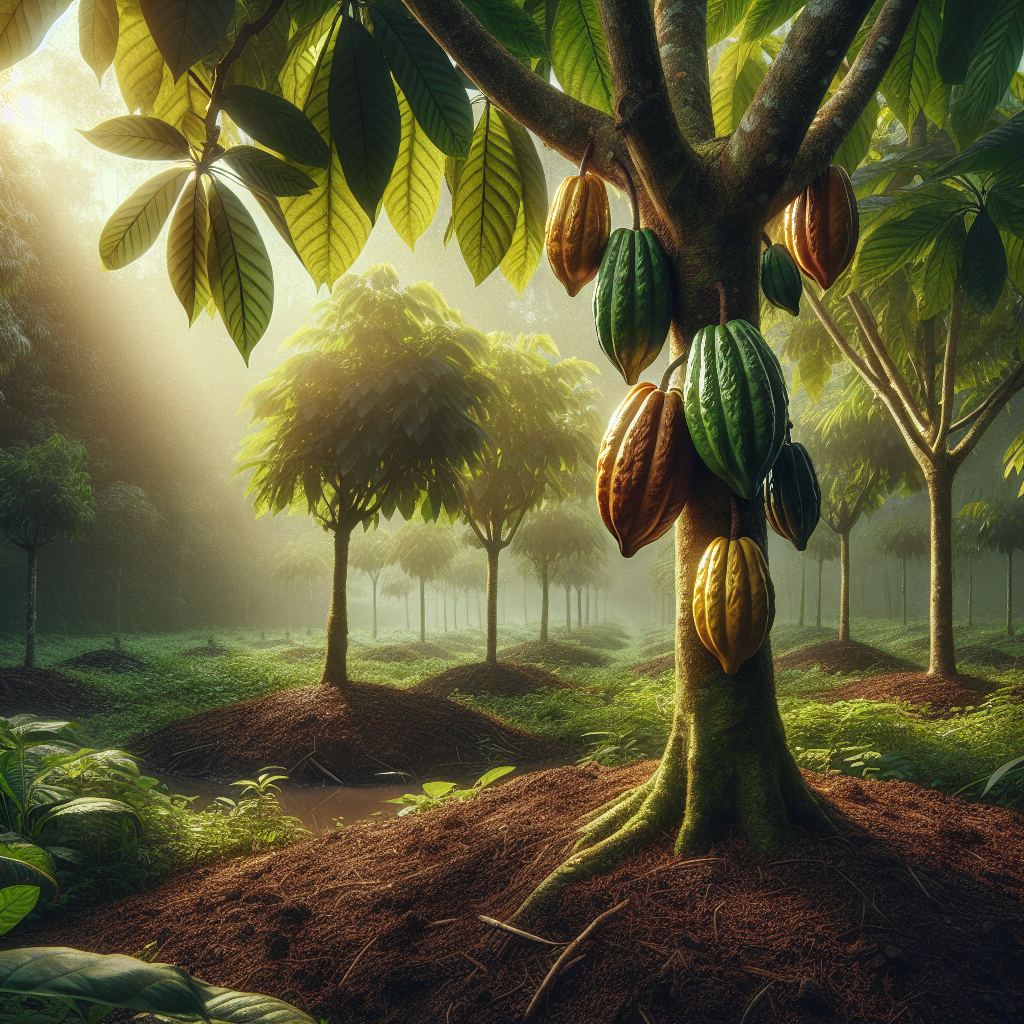
Cacao belongs to the family Malvaceae. It is a small evergreen tree that typically reaches 4 to 8 meters in managed plantations, though it can grow taller if left unpruned. One of its most distinctive botanical features is cauliflory: flowers and pods form directly on the trunk and major scaffold branches rather than at shoot tips.
The root system consists of a central taproot when grown from seed, plus a dense network of lateral feeder roots concentrated in the upper soil layers, usually the top 20 to 30 centimeters where oxygen and organic matter are highest. This shallow feeding habit explains why mulching, surface organic inputs, and careful moisture management are so important.
Leaves are large, glossy, and initially soft and often reddish or bronze during flushes. Young leaves are vulnerable to sunburn and desiccation. Cacao growth often occurs in rhythmic flushes, followed by resting periods. A key architectural stage is the formation of the “jorquette,” the first branching fan where the trunk stops vertical extension and forms 3 to 5 main scaffold branches. Good early training at this stage determines future canopy balance and harvest accessibility.
Flowers are small, pinkish-white to pale, and produced in large numbers, but only a tiny fraction develop into pods. Natural pollination is carried out mainly by tiny midges, especially in moist, shaded environments rich in leaf litter and organic debris. Low pollinator populations can significantly reduce fruit set.
Pods vary widely by genetic group and cultivar. They may be smooth or deeply ridged, elongated or oval, and green, yellow, orange, red, or purple when immature or ripe depending on genotype. Each pod usually contains 20 to 50 seeds embedded in sweet, mucilaginous pulp.
The broad traditional genetic groups are Criollo, Forastero, and Trinitario, though modern breeding includes many more population structures and selected clones. Criollo types are often prized for delicate flavor but can be lower yielding and more disease-sensitive. Forastero types, especially Amazonian materials, are generally more vigorous and productive. Trinitario types combine traits from both and are common in fine-flavor systems. In modern production, named clones and selected hybrid seed gardens often outperform old landraces in yield and disease resilience.
Soil, pH, and Climate Requirements for Cacao
Cacao performs best in deep, fertile, well-structured soils with excellent drainage and strong organic matter cycling. The ideal profile is at least 1.2 to 1.5 meters deep, allowing good rooting and moisture buffering through short dry periods. A loam to clay loam is generally best, provided it is friable and not compacted. Sandy soils can work if heavily amended with organic matter and irrigated carefully, but they dry too quickly in many tropical environments. Heavy clays are acceptable only if internal drainage is good and the site never remains saturated for long after rain.
The preferred soil pH range is roughly 5.5 to 7.0, with 6.0 to 6.5 often considered ideal for nutrient availability and root health. Below pH 5.0, aluminum and manganese toxicity can suppress root growth and reduce phosphorus uptake. Above pH 7.2, micronutrient lock-up, especially iron and zinc, may cause chlorosis. If liming is required, it should be done gradually and incorporated before planting; large, abrupt pH shifts around established trees are less desirable.
Drainage is critical. Cacao roots need moisture, but they also need oxygen. Waterlogged conditions for even a few days can trigger root decline, leaf yellowing, flower drop, and vulnerability to Phytophthora diseases. A good field test is to dig a hole 50 to 60 centimeters deep, fill it with water, and observe drainage. If water remains after 24 hours in a non-rain event, drainage improvements such as raised beds, contour drains, or ditching may be necessary.
Climatically, cacao is a true humid tropical crop. Optimal mean temperature is about 21 to 32°C, with 24 to 28°C being highly favorable. Growth slows below 18°C, and damage may occur with prolonged exposure below 15°C. High temperatures above 34 to 36°C can be tolerated only if humidity is high, root-zone moisture is adequate, and shade moderates leaf heat load.
Rainfall of 1,500 to 2,500 millimeters annually, preferably well distributed, supports reliable production. Short dry periods can be tolerated, but drought longer than 2 to 3 months without irrigation often reduces flushing, flowering, cherelle survival, and bean fill. Relative humidity of 70 to 100% suits cacao, but excessive stagnant humidity in crowded canopies increases disease pressure. The ideal is humid air with steady airflow.
Shade is not optional during establishment. Young cacao commonly performs best under 40 to 60% shade in the first 1 to 2 years. As trees mature, shade can be reduced to around 20 to 40% depending on cultivar, fertility, rainfall, and disease pressure. In wetter, disease-prone regions, too much shade can increase black pod and Stem canker; in hotter or drier zones, more overhead protection improves survival and yield stability. Agroforestry associations with species such as banana are common; compare systems used with Banana.
Wind protection is essential. Persistent wind increases evapotranspiration, tears leaves, reduces pollinator activity, and can deform young trees. Use windbreaks or nurse rows wherever exposure is significant.
Step-by-Step Planting & Propagation
Cacao can be established from seed, grafted plants, rooted cuttings, or budded clones. Seedlings are common and inexpensive, but they are genetically variable unless produced from controlled hybrid seed gardens. Clonal plants offer uniformity in yield, pod characteristics, and disease response, which is especially valuable in commercial orchards and fine-flavor blocks.
Step 1: Select site and design the shade system first. Before cacao arrives, establish permanent and temporary shade. Temporary shade may include banana, plantain, or fast-growing legumes. Permanent shade trees should be spaced and pruned so they protect the orchard without creating deep gloom. The best systems are planned at least one season in advance.
Step 2: Prepare the land with minimal soil degradation. Remove aggressive perennial weeds, conserve topsoil, and avoid complete exposure of the site to direct sun if possible. On slopes, use contour planting and erosion barriers. In compacted soils, rip or subsoil before planting, not after the orchard is established.
Step 3: Dig planting holes large enough to loosen the root zone. A common standard is 40 x 40 x 40 centimeters, though poorer soils may justify larger holes. Mix the excavated topsoil with 5 to 10 kilograms of well-decomposed compost, not fresh manure. If soil tests indicate deficiencies, incorporate rock phosphate or other recommended amendments before planting.
Step 4: Raise or source quality nursery plants. Seed for rootstocks or direct seedlings should be taken only from fully ripe, healthy pods. Cacao seed loses viability rapidly and is best sown within days, not weeks. Sow in polybags or root trainers filled with fertile, well-drained media rich in organic matter. Shade nursery plants at about 50 to 70% and harden gradually before transplanting. Grafting onto vigorous rootstocks is common where elite clones are used.
Step 5: Plant at the right seasonal window. Transplant at the start of the rainy season or when irrigation is reliable. Typical spacing ranges from 3 x 3 meters to 4 x 4 meters depending on vigor, shade level, mechanization, and pruning style. Dense plantings can accelerate early production but require stricter canopy control.
Step 6: Transplant carefully. Water nursery bags beforehand. Remove the bag without disturbing the root ball. Plant at the same depth as in the nursery; burying the collar invites stem diseases. Firm soil gently, water immediately, and mulch around the tree while keeping mulch 10 to 15 centimeters away from the stem.
Step 7: Protect young plants. Use temporary shade screens if field shade is insufficient. Install stakes if wind is an issue. Replace dead plants quickly, ideally within the same rainy season, to maintain uniform stand development.
For vegetative propagation, orthotropic shoots are preferred when the goal is a tree-like growth habit. Plagiotropic material may root, but it can produce abnormal architecture if not managed correctly. In professional nurseries, clonal propagation requires strict mother block sanitation to avoid spreading latent disease.
Care & Maintenance regimes for Cacao
Water management is the central discipline in cacao culture. The soil should remain evenly moist, never powder-dry and never stagnant. As a practical target, the upper 15 to 20 centimeters of soil should feel cool and slightly moist when pressed, while deeper layers remain moist but aerated. In established orchards, moisture tension in the main root zone should generally avoid extremes; prolonged readings equivalent to severe deficit cause cherelle wilt, flower abortion, and reduced bean size. Drip or micro-sprinkler irrigation is preferred where dry periods occur.
Signs of underwatering include limp young leaves during the hottest part of the day that fail to recover by evening, reduced flushing, heavy cherelle wilt, smaller pods, and premature leaf yellowing or drop. Signs of overwatering include yellowing lower leaves, sour-smelling soil, blackened feeder roots, fungal growth at the collar, and persistent wetness more than 24 hours after rain or irrigation.
Mulching is highly beneficial. Apply 5 to 10 centimeters of coarse organic mulch such as leaf litter, chopped prunings, composted husks, or straw in a broad ring beneath the canopy, but never touching the trunk. Mulch buffers soil temperature, conserves moisture, suppresses weeds, and feeds soil organisms.
Nutrition should be based on soil and leaf analysis, but general principles are clear. Young trees need balanced nitrogen for canopy development, phosphorus for roots, potassium for stress tolerance, calcium and magnesium for tissue quality, and boron and zinc in small but important amounts. Bearing trees have a high potassium demand because pod production exports substantial K. Splitting fertilizer into 3 to 6 applications per year is better than applying large doses at once, especially in high-rainfall regions where leaching is severe.
Organic and regenerative systems often use compost, vermicast, fermented plant extracts, rock minerals, and regular mulch recycling. These can be very effective, but nutrient budgeting still matters. Heavy fruiting without potassium replacement leads to poor bean fill and weak trees. Deficiency clues include pale, small foliage for nitrogen, interveinal chlorosis for magnesium, marginal scorch and reduced pod filling for potassium, and distorted new growth or poor fruit set for boron-related imbalance.
Pruning begins early. Maintain a straight trunk to the desired jorquette height, usually around 1 to 1.5 meters depending on management style. Remove chupons, the vigorous upright shoots that arise from the trunk and major branches, unless one is needed to replace lost structure. On mature trees, prune to open the canopy, improve light distribution, reduce disease humidity, and keep pods within reach. Remove dead, crossing, or diseased wood promptly. Major pruning is often timed for the drier part of the year to lower infection risk.
Weed management should be gentle around roots. Avoid deep hoeing or repeated trunk injury. Keep a weed-free ring around young trees, but maintain beneficial ground cover between rows to reduce erosion and improve soil life. Shade-tolerant legumes are especially useful. For wider orchard resilience, many growers apply principles similar to those described in soil health strategies.
Pollination support is often overlooked. Because cacao relies heavily on tiny midges, maintaining damp organic matter, low-disturbance habitat, and a diverse understory can improve fruit set. Overly sanitized orchards may have fewer pollinators than biologically rich ones.
Pests, Diseases & Organic Management
Cacao faces some of the most serious disease pressures of any tropical tree crop, so integrated management is indispensable. Prevention is far more effective than rescue treatments.
Black pod disease, commonly caused by Phytophthora palmivora and related species, is among the most destructive problems. Symptoms begin as small dark lesions on pods that rapidly expand, often covering the entire pod with brown to black rot. In humid conditions, whitish sporulation may appear. Management includes frequent harvesting, removing infected pods from the field, improving drainage, reducing excessive shade, pruning for airflow, and keeping pod clusters from resting in persistently wet conditions. In organic systems, copper-based sprays may be used where permitted, but sanitation is the foundation.
Witches’ broom, caused by Moniliophthora perniciosa, produces abnormal swollen shoots, cushion brooms, and deformed pods in affected regions, especially parts of Latin America. Frosty pod rot, caused by Moniliophthora roreri, infects pods and can destroy production rapidly where established. These diseases demand aggressive removal of infected material, resistant cultivars, and strict orchard monitoring.
Stem canker may follow pod or bark infections, especially in poorly drained, shaded, or wounded trees. Remove diseased bark where appropriate, disinfect tools, improve site conditions, and avoid injuries from machetes and equipment.
Common insect pests include Mirids or Capsids, Mealybugs, Aphids, Borers, and Rodents that attack pods. Mirid feeding creates lesions on shoots and pods and can weaken trees severely. Organic management includes regular scouting, habitat for beneficial insects, pruning infested material, maintaining balanced nutrition, and using approved biopesticides such as neem-based products when pressure is high. Mealybugs also matter because they can be tended by ants; controlling ant populations around trees can reduce secondary outbreaks.
Rats and Squirrels may damage ripe pods. Good field hygiene, timely harvest, trapping, and reducing refuge habitats near storage areas help. Birds are usually minor direct pests but may spread some pathogens mechanically.
A sound organic management program includes weekly to biweekly scouting in wet weather, removal of all diseased pods, frequent harvests, sanitation pruning, mulch management that supports soil life without creating stem contact, and strong drainage. Always disinfect pruning tools between diseased trees. Planting resistant or tolerant clones is one of the most cost-effective long-term decisions a grower can make.
Harvesting, Curing & Optimal Storage
Cacao does not ripen uniformly across a plantation, so harvesting is selective and repeated. Pods are ready when they reach cultivar-specific mature color and sound slightly hollow when tapped. Depending on genotype, green pods may turn yellow, and red or purple pods may become orange or yellowish. Calendar age from pollination varies, but many pods mature around 5 to 6 months after fruit set.
Harvest only fully mature pods. Immature pods contain underdeveloped beans with lower sugar and poorer fermentation potential. Overripe pods may begin internal germination or become more vulnerable to disease and pest damage. Use a sharp knife, secateur, or specialized harvesting hook to cut pods without tearing the flower cushion, since rough harvesting reduces future bearing at that site.
After harvest, pod breaking is typically done within a few days, often sooner in humid climates. Exclude diseased, rotten, or germinated pods from fermentation batches. Healthy wet beans are removed carefully and collected in clean containers. The white pulp surrounding the beans is essential to fermentation.
Fermentation is what transforms bitter, astringent seeds into marketable cocoa. Most quality cacao is fermented for 5 to 7 days, though duration varies with bean size, temperature, pulp content, and desired flavor profile. Wooden box fermentation is standard for larger lots; heaps covered with banana leaves can work for smaller farms. Turn the mass after 48 hours, then every 24 to 48 hours as needed to aerate and ensure uniform microbial succession. Proper fermentation should raise internal mass temperature to roughly 45 to 50°C. Under-fermented beans remain slaty and bitter; over-fermented beans may become fragile, mold-prone, or flat in flavor.
Drying should begin immediately after fermentation. The target moisture content for storage is generally about 6.5 to 7.5%. Sun drying on raised trays or mats is traditional and effective if weather allows, but beans must be protected from rain and excessive smoke contamination. Artificial dryers can be used in wet regions, provided temperatures are controlled. Drying too fast can trap internal acidity; drying too slowly promotes mold growth.
Well-dried beans should feel crisp externally, with cotyledons brittle enough to cut cleanly. Store only clean, dry beans in breathable sacks such as jute, in a cool, dry, odor-free room with good ventilation and pallets off the floor. Relative humidity in storage should be low enough to prevent moisture reabsorption. Cacao beans readily absorb odors, so never store them near fuels, spices, chemicals, or onions. Poor storage can undo excellent field and fermentation work.
Companion Planting for Cacao
Cacao is exceptionally well suited to companion planting because it is naturally an understory tree. The best companions serve one or more clear functions: temporary shade, permanent moderated canopy, nitrogen fixation, mulch production, erosion control, pollinator support, or secondary farm income.
Banana and plantain are classic temporary companions. They establish quickly, cast usable shade, generate biomass, and can provide interim income before cacao reaches full production. Their leaf litter also helps maintain humidity and organic matter, though spacing and pruning must prevent excessive dampness around cacao stems.
Nitrogen-fixing trees such as Inga, Gliricidia sepium, Erythrina, and some Albizia species are widely used in cacao agroforestry. These species can be pollarded regularly to provide mulch and regulate shade. The best nurse trees are those with manageable root competition and pruning response. Deep-rooted support trees are often preferable to shallow, aggressive competitors.
Ground-level companions should be chosen cautiously. The goal is living cover, not root congestion. Low legumes and non-climbing covers can protect soil, reduce erosion, and stimulate biological activity. Avoid species that become woody, host major cacao pests, or create impenetrable humidity near trunks.
Cacao also performs well in diversified tropical systems with coconut, fruit trees, timber trees, and spices when spacing and canopy architecture are carefully managed. Overstory should be dynamic, not static. If shade trees become too dense, cacao yield and disease pressure suffer. If they are removed too aggressively, sun scorch and drought stress follow.
An ideal companion plan changes over time: heavier temporary shade in years 0 to 2, moderated mixed shade in years 3 to 5, and a mature agroforestry balance thereafter. The most productive systems are actively managed rather than left to close over. In practical terms, companion planting for cacao is really canopy engineering, soil building, and farm risk diversification combined into one system.