Introduction to Moniliophthora roreri
Moniliophthora roreri, widely recognized as frosty pod rot or monilia pod rot, stands as one of the most destructive diseases threatening cacao production worldwide. First identified in Colombia in the early 20th century, this hemibiotrophic fungus has spread across Central and South America, parts of West Africa, and Southeast Asia, devastating smallholder farms and commercial plantations alike. The pathogen targets developing cacao pods, rendering them inedible through rot and sporulation, often resulting in crop losses exceeding 50% without intervention.
Cacao, the cornerstone of the global chocolate industry valued at over $100 billion annually, faces existential threats from M. roreri due to its polycyclic nature and efficient spore dispersal via wind and rain. Unlike its relative Moniliophthora perniciosa (witch's broom disease), frosty pod rot focuses exclusively on pods, but its rapid progression can wipe out entire harvests. Early detection and integrated management are critical, as chemical controls are limited in organic systems. This definitive guide equips farmers, agronomists, and researchers with practical, evidence-based strategies drawn from decades of field trials in endemic regions like Ecuador, Peru, and Brazil.
Understanding M. roreri's biology is key to mitigation. The fungus thrives in humid, warm conditions typical of cacao's understory habitat, exploiting wounds and natural openings on pods. Economic impacts are profound: in Colombia alone, annual losses reach millions of dollars, forcing shifts to alternative crops or fallowing. By mastering diagnostics and organic controls, producers can sustain yields and profitability. For small farms struggling with disease identification, tools like AI-powered plant diagnostics can accelerate response times, as explored in Why Misidentifying Plants Costs Small Farms Thousands - And How AI Camera Diagnosis Fixes It Fast.
Identifying Symptoms & Damage
Frosty pod rot manifests in distinct phases, enabling precise diagnosis even for novice scouts. Initial symptoms appear 10-14 days post-infection on young, green pods (cherelles) as small, water-soaked lesions at the pod's stem end or stigmatic pole. These spots expand rapidly into irregular brown necrotic areas, often with a faint yellowish halo, measuring 1-5 cm within days.
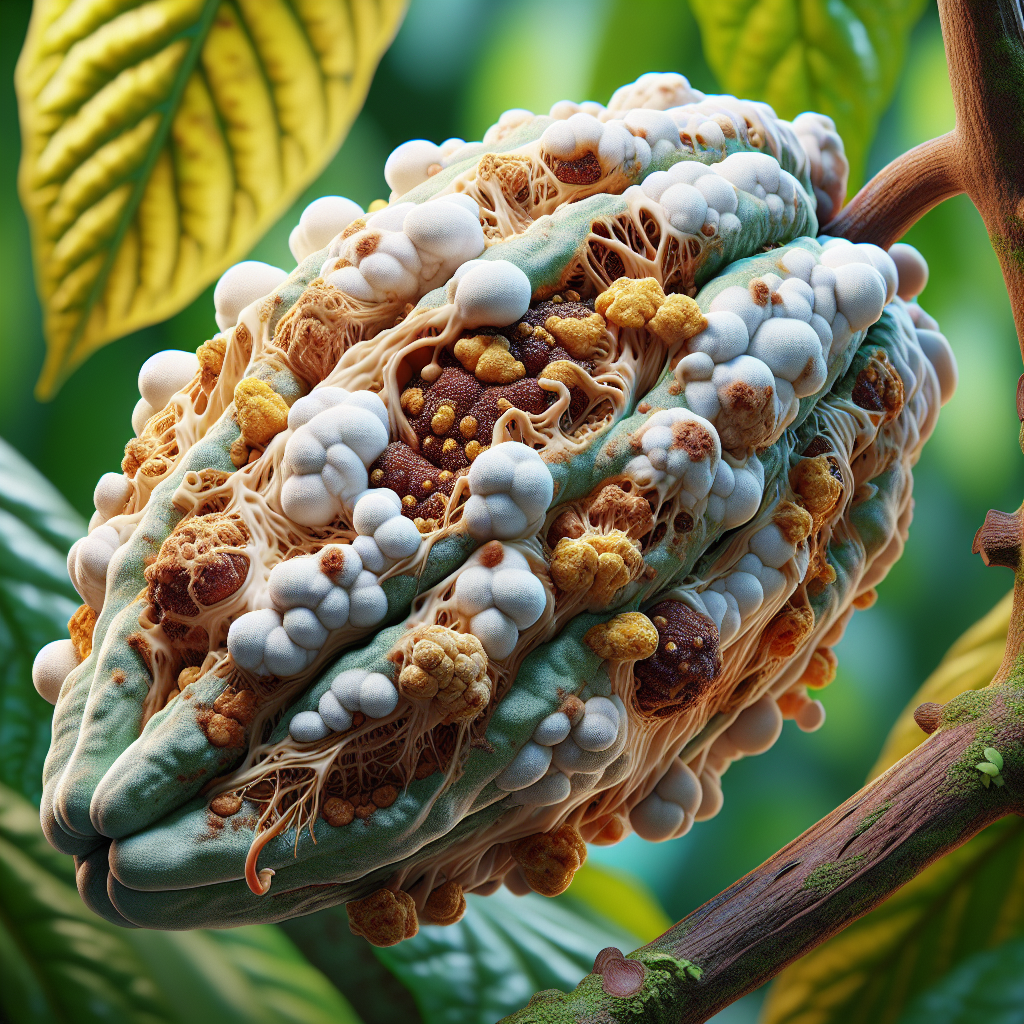
As the disease progresses, infected tissues develop a characteristic white, cottony mycelial growth—hence 'frosty'—covering up to 70% of the pod surface. Sporodochia (spore-producing structures) emerge as yellowish cushions, turning olive-green and releasing powdery basidiospores. Mature pods exhibit internal brown rot, with beans clumped and coated in fungal mass, emitting a fermented odor. Premature pod drop is common, with 80-90% abscission in severe cases.
Damage assessment reveals pod deformation, cracking, and blackening, rendering beans unsuitable for fermentation or processing. Yield impacts vary: light infections reduce bean quality by 20-30%, while epidemics cause total pod loss. Differentiate from Phytophthora pod rot by the absence of sporangia and presence of dry, mummified pods versus Phytophthora's watery ooze. Secondary symptoms include branch dieback from repeated defoliation and reduced tree vigor over seasons.
Field diagnostics involve slicing pods lengthwise: healthy beans are plump and white; infected ones are shrunken, discolored, and moldy. Use a 10x hand lens to confirm monilioid conidia (club-shaped, 8-12 μm). Quantitative scouting: count infected pods per 100-tree sample; >10% incidence warrants action. Economic thresholds: control if >5% pod surface affected in 20% of pods.
Lifecycle and Progression of Moniliophthora roreri
M. roreri's lifecycle is polycyclic, with 20-40 infection cycles per season, fueling explosive epidemics. The pathogen overwinters as dormant mycelium in mummified pods on trees or ground debris. Primary inoculum arises from basidiocarps (small mushrooms) forming on dry pods during dry spells, releasing wind-dispersed basidiospores (8-10 μm) that germinate on pod surfaces within 4-6 hours of moisture.
Infection requires free water and temperatures of 20-30°C. Hyphae penetrate via wounds, stomata, or lenticels, establishing a biotrophic phase lasting 7-10 days. Transition to necrotrophy triggers tissue necrosis and sporodochia formation by day 14. Conidia (asexual spores) eject forcibly, splashing up to 50 cm via rain, initiating secondary cycles every 10-14 days.
Progression peaks during wet seasons (rainfall >2000 mm/year), with latent periods shortening from 21 days at 18°C to 9 days at 28°C. Pod susceptibility peaks at 2-4 months post-pollination, coinciding with rapid expansion. Dispersal: 70% local (<100 m) via wind/rain, 30% regional via human/insect vectors. Disease gradients follow exponential curves, with foci expanding 10-fold monthly without sanitation.
Environmental Triggers & Risk Factors
Optimal conditions for M. roreri epidemics include high humidity (>80% RH), temperatures 22-28°C, and prolonged leaf wetness (>12 hours). Rainfall >150 mm/month correlates with 90% pod infection rates. Dense canopies in shaded cacao plantations trap moisture, elevating microclimate RH to 95%, while poor ventilation exacerbates spread.
Risk factors: susceptible varieties like Forastero cacao (90% vulnerability) versus tolerant Trinitario hybrids (40%). High pod density (>2000/ha) and overlapping phenology amplify inoculum. Farm practices like overhead irrigation or flooding increase splash dispersal. Soil nutrient imbalances, especially potassium deficiency, weaken pod resistance. Proximity to infected farms (<1 km) poses 80% introduction risk via wind. Climate change extends wet seasons, boosting overwintering survival by 25%.
Organic Control & Treatment Plans
Organic management hinges on integrated approaches yielding 60-80% control. Sanitation (60% efficacy): Harvest and destroy all infected pods weekly, burying >50 cm deep or incinerating. This reduces inoculum by 85% within 3 months. Cultural practices: Prune lower branches for airflow, thin pods to <1500/ha, and apply 20-40 kg N/ha balanced fertilizers to boost defenses.
Biological controls: Trichoderma asperellum (10^9 spores/L) sprays reduce incidence by 50%; apply biweekly during wet periods. Bacillus subtilis strains suppress sporulation via antibiosis. Companion planting with Gliricidia provides shade and mulch, cutting humidity by 15%. Neem oil (5 ml/L) + copper oxychloride (1 kg/ha) rotations limit conidia germination without residues.
Resistant varieties: Deploy hybrids like CCN-51 (70% resistance) or TSH-1188, interplanted at 20% to dilute inoculum. Treatment timeline: Scout weekly; at 5% incidence, initiate sanitation + biofungicide. Monitor via pod traps (10/ha). Rotate interventions to prevent resistance. Field trials in Ecuador show 75% yield recovery with IPM versus 20% untreated.
Preventing Moniliophthora roreri in the Future
Prevention emphasizes exclusion and resilience. Quarantine new plantings, sourcing virus-indexed budwood from certified nurseries. Establish 500 m buffer zones around farms. Annual dry-season pod cleanup removes 95% overwintering sites. Promote agroforestry with windbreaks to curb spore drift.
Long-term: Breed for polygenic resistance via marker-assisted selection; UFSCAR hybrids show <10% infection. Soil solarization (6 weeks summer) kills ground inoculum. Farmer training via apps enhances scouting accuracy. Monitor via weather stations: alert at >80% RH + 25°C. Diversify with intercrops like banana to buffer losses. Global strategies include CIAT's bioagent banks and regional forecasting networks, reducing farm-level risk by 40%.
Crops Most Affected by Moniliophthora roreri
Moniliophthora roreri is highly host-specific, primarily targeting Theobroma cacao (cacao) varieties including Forastero, Trinitario, and Criollo types. No commercial infections reported on other crops like mango, avocado, or banana, though experimental inoculations on related Malvaceae show minor susceptibility. Wild hosts include Theobroma bicolor and Herrania spp., serving as reservoirs near plantations. Cacao represents 100% of economic impact, with 5-7 million ha under threat globally.