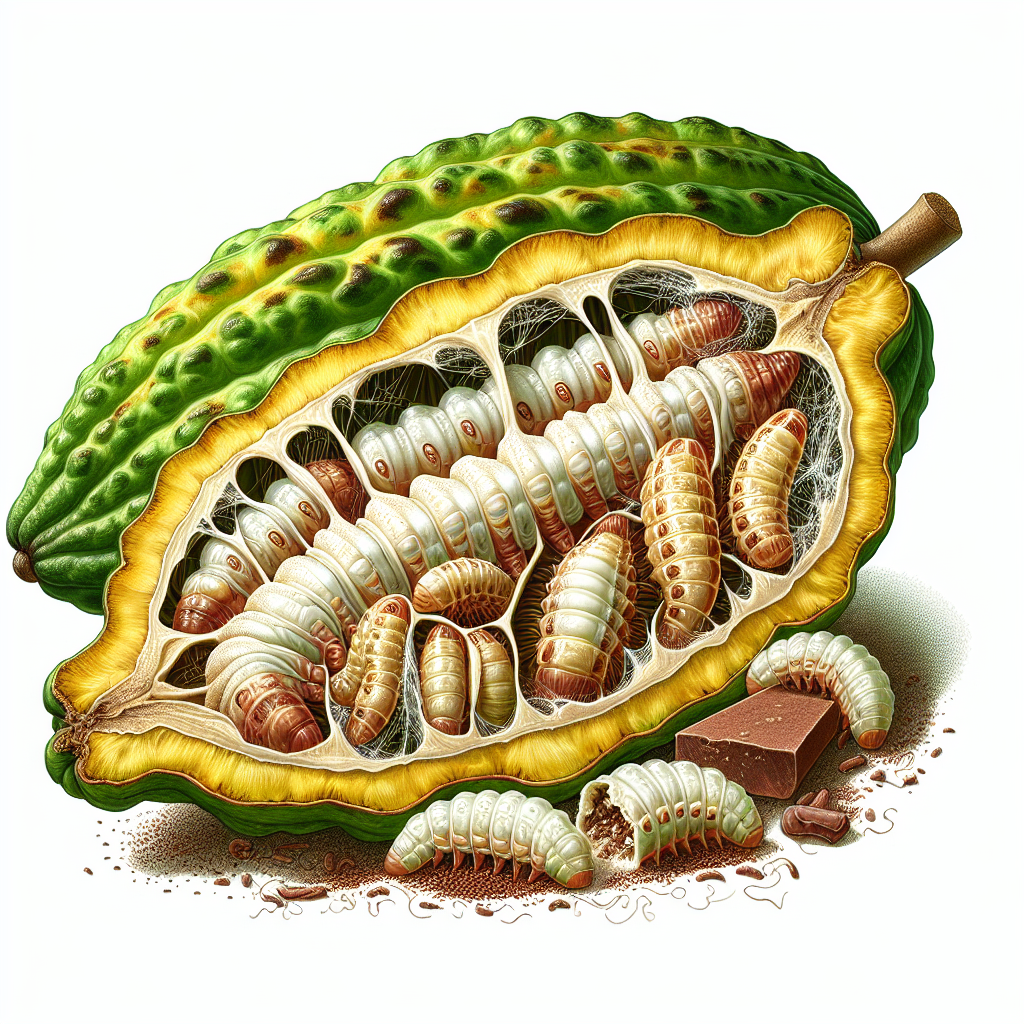
Introduction to cocoa pod borers
Cocoa pod borers (Conopomorpha cramerella) represent one of the most destructive pests in cacao production, causing significant economic losses in tropical regions worldwide. Native to Southeast Asia, this moth species has spread to major Cacao (crop) growing areas including West Africa, South America, and the Pacific Islands. Adult moths lay eggs on young pods, and the resulting larvae tunnel into the pod, feeding on pulp and beans, leading to premature ripening, pod abortion, and moldy or unusable beans.
Farmers often detect infestations too late, as initial damage is internal and invisible. Yield losses can exceed 50% in unmanaged orchards, impacting the global chocolate supply chain. Early identification and integrated pest management (IPM) are crucial for sustainable cacao farming. This guide equips growers with professional diagnostics, lifecycle knowledge, and actionable strategies to minimize damage while prioritizing organic methods.
Understanding the pest's biology is key to control. Unlike surface feeders like aphids, cocoa pod borers exploit the pod's protective husk, making chemical penetration challenging. Success relies on prevention, biological controls, and vigilant scouting.
Identifying Symptoms & Damage
Diagnosing cocoa pod borer infestations requires keen observation of both external and internal pod signs. Early symptoms include small, entry holes (1-2 mm) on the pod surface, often near the stalk attachment, surrounded by frass (insect waste) resembling fine sawdust. Affected pods may show uneven ripening, turning yellow prematurely while healthy pods remain green.
Cut open suspicious pods to reveal the diagnostic hallmark: creamy-white to pinkish larvae (up to 12 mm long) tunneling through the pulp, leaving empty locules and damaged beans coated in frass and secondary fungal growth. Heavily infested pods split open, exuding sticky pulp and emitting a fermented odor. Beans inside become hollow, discolored, or webbed with silk.
Differentiate from other pests like capsule borers by the characteristic 'sawdust' frass and serpentine tunnels. Unlike mealybugs, no waxy secretions appear. Damage severity scales with infestation: light (5-10% pods affected), moderate (20-40%), severe (>50%). Scout weekly during peak podding (rainy season), checking 100 pods per hectare. Use a pod borer index: (infested pods / total pods) x 100. Thresholds for action: >10% in young pods.
Secondary effects include fungal invasions like black pod rot, exacerbating losses. Harvested infested beans lead to poor fermentation, off-flavors, and rejection at processing plants.
Lifecycle and Progression of cocoa pod borers
The cocoa pod borer completes 6-10 generations per year in optimal tropical conditions (25-30°C, 70-90% humidity). Adults are tiny, silver-gray moths (7-9 mm wingspan) with fringed wings, active at dusk. Females lay 100-200 eggs singly on tender pod tissue over 3-5 days, preferring pods 5-12 weeks old.
Eggs hatch in 3-5 days into larvae that immediately bore in, molting four times over 12-20 days. Mature larvae exit via chewing an oval hole, spin a cocoon on the pod or nearby bark, and pupate for 7-10 days. Total cycle: 25-40 days. Overwintering occurs as diapausing pupae in old pods or soil.
Progression aligns with pod flushes: peak larval activity 4-8 weeks post-pollination. Multiple overlapping generations complicate timing sprays. Monitor with pheromone traps (1-2 per hectare) to track adult flights, correlating with pod susceptibility. Lifecycle accelerates in humid microclimates, doubling populations.
Environmental Triggers & Risk Factors
Cocoa pod borers thrive in warm, humid tropics (20-32°C, >80% RH), with outbreaks triggered by prolonged rainy seasons extending pod availability. High pod density (>2,000 pods/ha) and continuous flowering (evergreen cacao) provide constant food sources, unlike seasonal crops like mango.
Risk factors include dense planting (<3m spacing), poor pruning leading to shaded understories, and neglected sanitation (unharvested old pods). Windbreaks harboring alternative hosts like rambutan amplify spread. Nutrient imbalances, especially nitrogen excess, promote tender flushes attractive to oviposition. Soil moisture >60% favors pupal survival.
Climate change exacerbates risks: warmer nights boost generations, erratic rains synchronize peaks with harvests. Monoculture cacao plantations suffer most; intercropping with banana or shade trees dilutes pressure. Scout high-risk zones: pod clusters near forest edges.
Organic Control & Treatment Plans
Organic management emphasizes IPM, integrating cultural, biological, and mechanical tactics. No single silver bullet exists; layered defenses achieve 70-90% control.
Cultural Controls: Prune for open canopies (20-30% light penetration), harvest all pods biweekly (even undersized), and destroy infested debris by burial or chipping. Remove 'rat-damaged' pods promptly, as they attract females. Intercrop with repellents like marigold or neem trees.
Biological Controls: Release Trichogramma wasps (500-1000/ha weekly) to parasitize eggs. Apply Bacillus thuringiensis (Bt) kurstaki (2-5 g/L) to young pods every 10-14 days; larvae ingest it while feeding externally. Conserve predators like ants and birds via habitat strips. For more on organic pest strategies, see Spring Pest Patrol: Organic AI Strategies to Shield Your Crops from Common Invaders.
Mechanical/Biopesticides: Wrap pods >10 cm with plastic collars or kaolin clay barriers post-fruit set. Neem oil (3-5 ml/L) or Beauveria bassiana (10^9 spores/ml) sprays target larvae and adults; apply evenings, 3x at 7-day intervals. Pheromone traps disrupt mating (4-6/ha).
Treatment Plan: Week 1: Scout, prune, trap. Week 2-4: Bt + neem rotations. Monitor; reapply if >10% infestation. Rotate modes to prevent resistance.
Preventing cocoa pod borers in the Future
Prevention outperforms cure through resilient systems. Plant resistant varieties like TSH clones or ICS hybrids, spacing 3x3m. Time plantings to avoid peak moth flights (use traps for cues). Mulch with pod husks to deter pupae.
Sanitation is paramount: zero tolerance for dropped pods. Erect 2m bird perches and bat boxes for natural predation. Annual soil solarization (clear plastic, 6 weeks dry season) kills pupae. Monitor via app-scouting grids.
Long-term: Diversify with coffee understory, fostering biodiversity. Educate communities for area-wide management, reducing reinfestation. Resistant rootstocks and marker-assisted breeding promise durable gains.
Crops Most Affected by cocoa pod borers
Primarily Cacao (crop), especially Forastero and Trinitario varieties in humid lowlands. Minor hosts include rambutan, lychee, and durian; rarely vanilla pods. No significant impact on other tropicals like avocado or papaya. Global hotspots: Indonesia (50% losses), Ghana, Papua New Guinea.