Introduction to black pod
Black pod disease represents one of the most destructive threats to cacao production worldwide, capable of annihilating up to 90% of a farm's yield in severe outbreaks. Caused predominantly by the oomycete pathogens Phytophthora megakarya in West Africa and Phytophthora palmivora in other tropical regions, this disease targets the cacao pods, turning them black and rotten from the inside out. Phytophthora palmivora is a key culprit, thriving in warm, humid conditions that mimic the cacao tree's native rainforest habitat.
First identified in the early 20th century, black pod has since spread to major cacao-growing areas including Ghana, Côte d'Ivoire, Nigeria, Brazil, and Indonesia, where it causes annual losses exceeding $1 billion. The disease not only destroys mature pods but also infects young cherelles (immature pods), stems, and leaves, weakening trees and reducing overall plantation vigor. For smallholder farmers, who produce 80% of global cacao, black pod is a perennial nightmare, often tipping precarious livelihoods into poverty.
Understanding black pod's biology is crucial for effective management. Unlike true fungi, Phytophthora species are water molds that produce zoospores—motile spores that swim through water films on plant surfaces to initiate infection. This guide equips farmers, agronomists, and researchers with definitive diagnostic tools, lifecycle insights, organic control strategies, and long-term prevention plans to combat this foe.
Identifying Symptoms & Damage
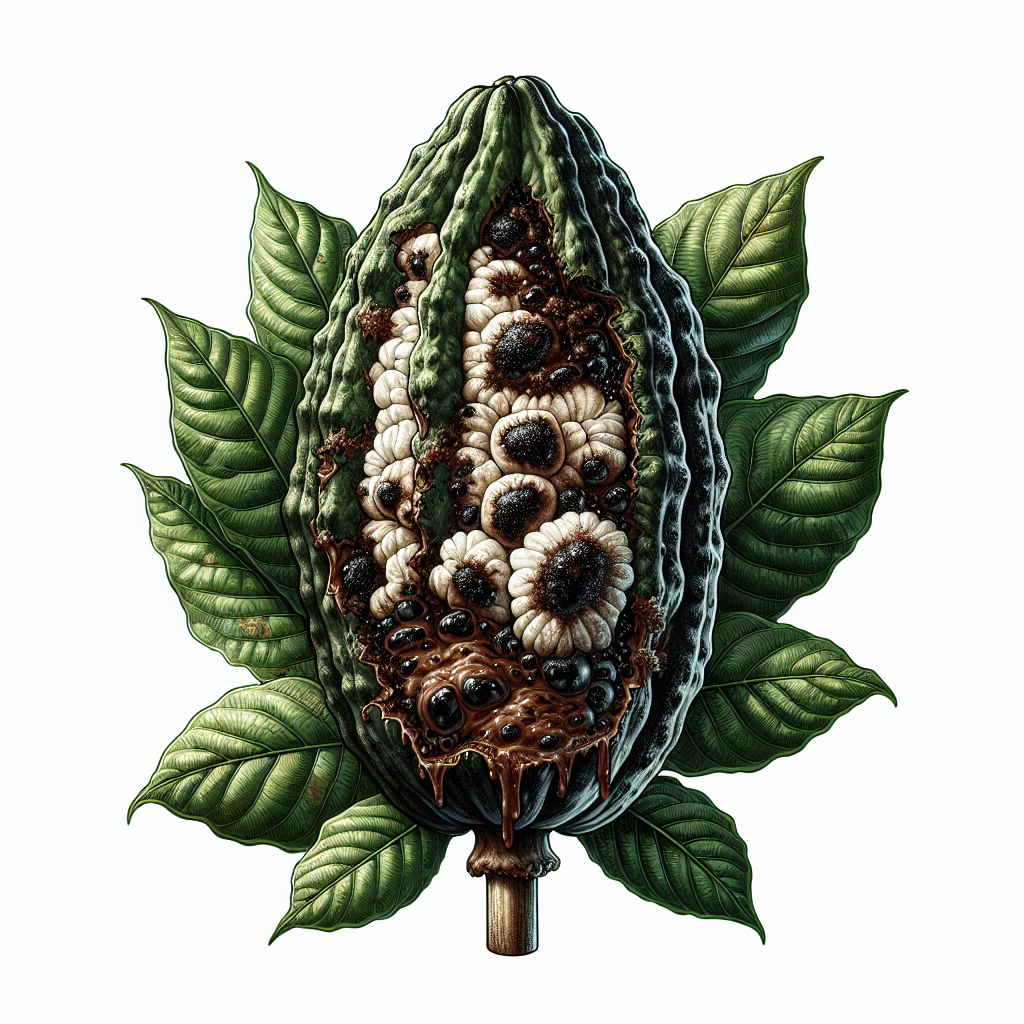
Early detection is the cornerstone of black pod management. Initial symptoms appear as small, dark-green to brown lesions on pod surfaces, often near the attachment point or wounds. These spots expand rapidly into sunken, black lesions covered in white, fluffy sporangia under humid conditions, giving a characteristic 'moldy' appearance.
Advanced infection leads to pod rot, where the husk turns uniformly black, and internal beans become discolored, shrunken, and infested with mycelium. Severely affected pods may ooze a brown liquid and emit a foul, fermented odor. Cherelles exhibit 'cherelle wilt,' blackening and dropping prematurely, while mature pods mummify on the tree.
Damage extends beyond pods: stem cankers (cankers) girdle branches, causing dieback, and leaf infections manifest as dark blotches with yellow halos. Yield losses range from 20-30% in mild cases to total crop failure in epidemics. Economic impact includes not just lost beans but also reduced tree longevity and increased harvesting costs due to labor-intensive pod removal.
Differential diagnosis is essential. Distinguish black pod from anthracnose, which produces pink spore masses, or insect damage like capsule borers. Lab confirmation via sporangia microscopy or PCR testing confirms Phytophthora. Scout weekly during rainy seasons, focusing on lower canopy and dense foliage.
Lifecycle and Progression of black pod
Phytophthora's lifecycle is finely tuned to wet tropical climates. Primary inoculum survives in mummified pods, soil, and infected plant debris as thick-walled chlamydospores or oospores. Rain triggers sporangia production on these sources; caducous sporangia detach and release zoospores in water.
Zoospores encyst and germinate on pod surfaces within 2-6 hours at 25-30°C, penetrating via wounds or stomata. Mycelium colonizes tissues in 24-48 hours, producing secondary sporangia for polycyclic spread. A single lesion can produce millions of sporangia daily, splashing up to 1 meter via rain.
Disease progression accelerates post-rain: incubation 36-72 hours, symptom expression in 4-7 days. Peak epidemics occur 4-6 weeks after prolonged rains (>50mm/week). In P. megakarya strains, internal pod rot precedes external symptoms, complicating detection.
Understanding this cycle informs timing: remove inoculum before rains, disrupt zoospore dispersal with canopy drying. Long-term, soil populations persist years, necessitating integrated management.
Environmental Triggers & Risk Factors
Black pod epidemics hinge on the Phytophthora trifecta: susceptible host, virulent pathogen, and conducive environment. Optimal conditions: 22-28°C temperatures, relative humidity >90%, and leaf wetness >8 hours daily. Heavy rains (>100mm/month) splash-disperse sporangia, while poor drainage fosters soil inoculum.
Risk factors include dense planting (<3m spacing), inadequate pruning leading to closed canopies, and low farm elevation (<500m) with high rainfall. Susceptible varieties like Trinitario and Nacional heighten vulnerability; older trees (>15 years) suffer more cankers.
Soil factors: acidic clays (pH<5.5) retain moisture, promoting zoospore activity. Nutrient imbalances, especially potassium deficiency, weaken pod resistance. Proximity to infected farms accelerates spread via wind-driven rain or contaminated tools/human feet.
Climate change exacerbates risks with intensified wet seasons. Why 80% of Small Farms Battle Weather Disasters - And How Hyper-Local AI Forecasts Can Save Your Harvest highlights predictive tools for preempting outbreaks.
Organic Control & Treatment Plans
Organic management integrates cultural, biological, and approved botanical controls, avoiding synthetic fungicides. Core strategy: sanitation—harvest and destroy all diseased pods weekly, burying >1m deep or incinerating to eliminate 70-80% inoculum.
Biologicals shine: Trichoderma spp. and Bacillus subtilis antagonize Phytophthora via mycoparasitism and antibiosis. Apply Trichoderma harzianum (5kg/ha in 500L water) as pod spray every 14 days during rains, achieving 50-60% control.
Botanicals: copper-based (e.g., Bordeaux mixture, 1-1-100) at 2-3kg/ha weekly, but rotate to prevent resistance. Neem oil (5ml/L) + garlic extract disrupts zoospores. Phosphonate sprays (potassium phosphite, 3-5L/ha) boost plant defenses via SAR induction.
Treatment plan:
- Week 1: Prune canopy (30% light penetration), apply copper.
- Ongoing: Weekly scouting/removal, Trichoderma biweekly.
- High risk: Phosphonate + neem alternate sprays.
Integrated with cacao varietal resistance (e.g., CCN-51) and mulching for soil suppression. Trials show 40-70% yield protection.
Preventing black pod in the Future
Prevention builds resilient systems. Select resistant hybrids like PAZ 1-4 or IMC-60; intercropping with shade trees (Gliricidia) reduces humidity by 20%. Maintain 3-4m spacing, annual pruning for open canopies (airflow >1m/s).
Drainage: form ridges/collectors, avoiding waterlogging. Soil amendments: lime to pH 6.0-6.5, add 200g/tree potassium annually. Mulch with cocoa husks (10cm) suppresses soil splash.
Quarantine new plantings, sterilize tools (1% bleach). Monitor via disease calendars, intervening at 5% incidence. Long-term breeding for durable resistance, coupled with Soil Health Mastery: 5 Proven Strategies for Small Farms to Build Fertile Ground Without Breaking the Bank, fortifies farms.
Crops Most Affected by black pod
Cacao (Theobroma cacao) is the primary victim, with all varieties susceptible but hybrids varying in tolerance. Forastero Cacao, dominant in Africa (70% production), suffers most from P. megakarya; Trinitario Cacao and Criollo Cacao face P. palmivora in Latin America.
Secondary hosts: papaya, durian, avocado, black pepper, and citrus, where Phytophthora causes fruit rots or root rots. In mixed farms, cacao-black pepper proximity risks spillover. Focus prevention on cacao, as it's the economic driver.