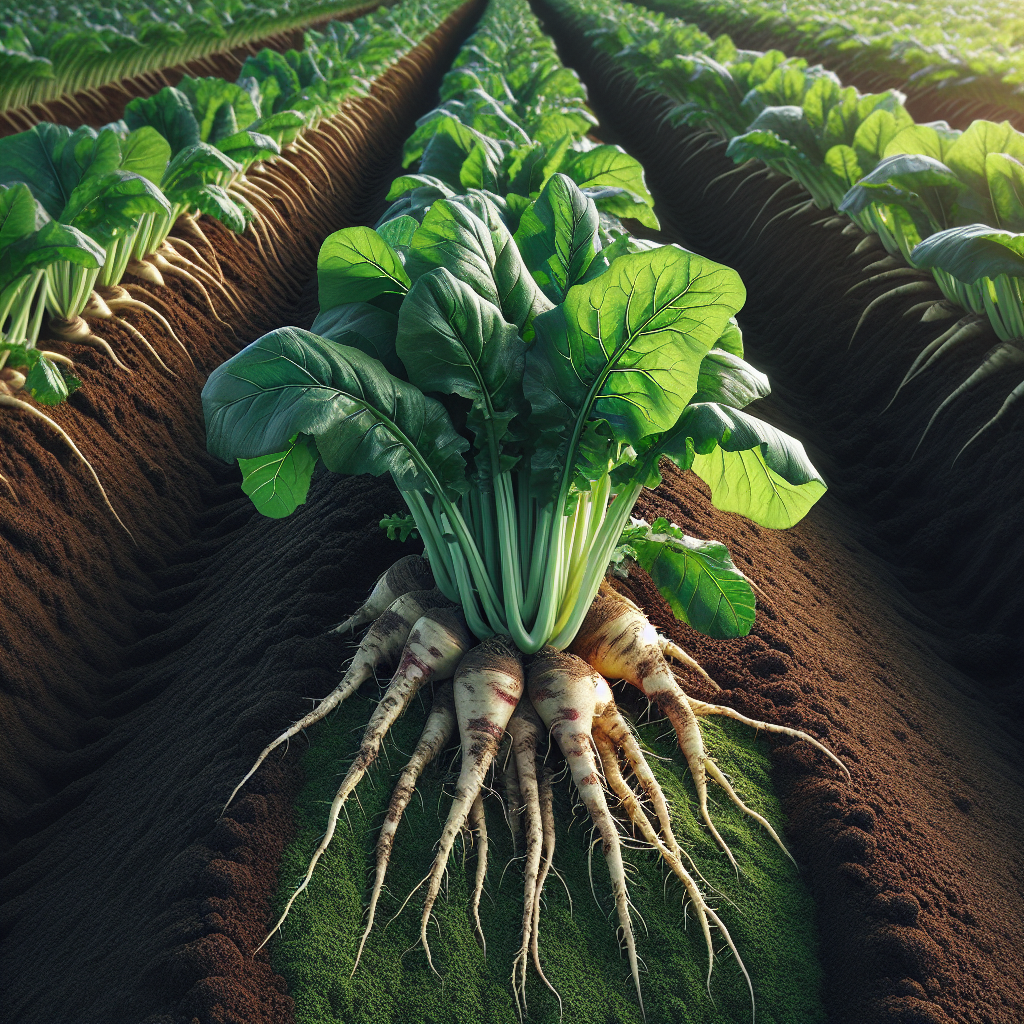
Introduction to Sugar Beet
A specialized form of beet developed for sugar extraction, this crop differs substantially from table beet despite belonging to the same species complex. Modern sugar beet production began in Europe when plant breeders selected white, conical-rooted beets with progressively higher sucrose content, eventually creating a crop capable of competing with cane sugar in temperate regions. Today it is a major industrial and farm crop in temperate climates, valued for both root tonnage and sugar percentage.
For growers, success is not defined by root size alone. A massive root with low sugar concentration, excessive sodium uptake, or severe crown regrowth can be less valuable than a slightly smaller root with high extractable sugar. That means management should aim for steady early establishment, uninterrupted leaf canopy development, balanced nitrogen, excellent weed control in the first 8 to 10 weeks, and uniform soil moisture through the bulking phase. Unlike garden beet types grown for direct fresh consumption, sugar beet is selected for white flesh, high sucrose accumulation, and efficient processing quality.
This crop also has value beyond sugar. Beet tops and processing byproducts can be fed to livestock, while pulp is widely used as a palatable energy feed. In diversified rotations, sugar beet can help break cereal disease cycles and contributes a deep taproot that explores compacted subsoil layers when conditions permit. Growers familiar with common beet types will recognize the rosette growth habit, but sugar beet requires more exact stand establishment and nutrient discipline to reach its commercial potential.
Botanical Profile of Sugar Beet
This crop belongs to the Amaranthaceae family and is botanically classified as Beta vulgaris subsp. vulgaris var. altissima. It is a biennial by life cycle, though it is usually cultivated as an annual for root harvest during the first growing season. In year one, the plant forms a low rosette of broad leaves and enlarges its taproot into a sugar-storing organ. If exposed to sufficient cold followed by long days, it may vernalize and bolt in the second season, sending up a flowering stalk and diverting sugars away from the root.
The root consists of three main zones: the crown at the top where leaves attach, the neck below the crown, and the true root extending downward. Sugar concentration tends to be lower in the crown than in the mid-root region, which is why over-topping at harvest reduces tonnage, but under-topping can leave more impurities in the delivered product. Leaves are upright to semi-erect, often bright to dark green depending on cultivar and fertility, with a waxy surface that helps moderate moisture loss.
Sugar beet seed sold commercially is usually processed seed rather than raw multigerm seed balls. Historically, beet fruits were multigerm clusters producing several seedlings from one unit, requiring laborious thinning. Monogerm seed technology transformed production by allowing precision drilling and more uniform stands. Many commercial cultivars also carry tolerance or resistance traits to rhizomania, cercospora leaf spot, or nematodes, and variety choice should reflect local disease pressure rather than relying on yield claims alone.
Physiologically, sucrose accumulation depends on active photosynthesis and efficient translocation to the root. Anything that reduces healthy leaf area during midsummer to early autumn, such as leaf spot, nutrient deficiency, waterlogging, or hail injury, lowers final sugar yield. Conversely, excessive late nitrogen can keep the crop too vegetative, delaying maturity and increasing impurities like amino nitrogen, potassium, and sodium in the juice.
Soil, pH, and Climate Requirements for Sugar Beet
Deep, friable, stone-free soil is one of the strongest predictors of success. The crop performs best in silt loam, loam, or sandy loam with excellent internal drainage and enough fine structure to hold moisture without becoming sticky or anaerobic. Heavy clays can produce high yields if well structured, but they raise the risk of crusting, compaction, forked roots, difficult lifting, and storage losses. Very shallow, gravelly soils reduce root uniformity and often depress sugar accumulation because plants face repeated moisture stress.
Optimal pH is generally 6.5 to 8.0, with best performance often seen around 6.8 to 7.5. The crop tolerates mildly alkaline conditions better than many vegetables, but strongly acidic soils should be corrected well ahead of planting. When soil pH drops below about 6.2, nutrient availability becomes less balanced and risks from manganese toxicity, poor calcium status, and restricted root growth increase. Liming should be based on a soil test and incorporated months before sowing for full effect.
Sugar beet has a relatively high boron requirement and a strong response to balanced potassium, phosphorus, magnesium, sodium, and sulfur depending on soil reserves. It is also notably sensitive to salinity during germination and seedling establishment, despite moderate tolerance once established. Avoid fields with saline crusting or irrigation water with high electrical conductivity unless local experience confirms acceptable performance.
Climate matters at every stage. Germination begins in cool soils, but emergence is fastest when soil temperatures are around 10 to 18°C. Young plants tolerate light frosts once hardened, yet severe freezing after emergence can damage stands. Ideal growing conditions include a cool to mild spring for establishment, warm sunny summer conditions for canopy formation, and a relatively cool late season to enhance sugar concentration. Daytime temperatures of 18 to 26°C support strong growth; prolonged heat above 30°C can reduce net photosynthesis and intensify moisture stress.
The crop needs a long growing season, commonly 150 to 200 days depending on region and cultivar. It is best suited to temperate climates with moderate summer heat and reliable moisture. In very humid climates, foliar disease pressure can become a defining limitation. In arid production areas, high yields are possible under irrigation, but precise water management is essential. For broader fertility planning principles, see soil health tips.
Step-by-Step Planting & Propagation
This crop is propagated by seed and is almost always direct-sown. Transplanting is rarely practical because root deformation, transplant shock, and higher labor costs reduce both yield and processing quality.
Start by choosing a field with low weed pressure and no recent history of severe rhizomania, root rot, or cyst nematode problems. Avoid planting after crops that leave deep ruts or severe compaction. A fine, firm seedbed is critical. The ideal seedbed has small aggregates at the surface for seed-to-soil contact, with enough firmness underneath that a boot heel leaves only a shallow imprint. Over-powdered seedbeds can crust after rain, while cloddy seedbeds create uneven emergence.
Apply pre-plant fertilizer according to soil test results. Phosphorus is often banded or incorporated before sowing, while nitrogen should be managed conservatively to avoid excess vegetative growth later. Boron deficiency should be corrected where tests or field history indicate risk. Fresh manure immediately before planting is usually unwise because it can increase weed pressure, create nutrient imbalances, and stimulate misshapen roots if not fully decomposed.
Sow as early as field conditions allow in spring, once the soil is workable and not prone to smearing. Earlier sowing usually improves yield potential by extending the season, but planting into cold, waterlogged soil invites poor emergence and damping issues. Seed depth is typically 2 to 3 cm in moist, well-prepared soils, slightly deeper in drying sandy ground but rarely beyond 4 cm. Uniform depth matters more than chasing moisture too aggressively.
Row spacing commonly ranges from 45 to 55 cm in mechanized systems, with within-row spacing adjusted to achieve a final stand of roughly 80,000 to 120,000 plants per hectare depending on cultivar, irrigation, and yield target. In smaller plantings, spacing of 45 to 50 cm between rows and 15 to 20 cm between plants produces well-formed roots. Precision drilling is preferred because skips reduce yield and doubles increase competition, resulting in smaller, less uniform roots.
After sowing, monitor for crusting. A hard surface crust after rain can trap seedlings below ground, leading to corkscrewed hypocotyls and patchy stands. In severe cases, a very shallow mechanical crust break may be required, but timing must be exact to avoid shearing emerging plants.
Emergence usually occurs within 7 to 21 days, depending on soil temperature and moisture. Once seedlings reach the 2- to 4-leaf stage, assess stand density. In small-scale plantings using non-precision seed, thin early so the surviving plants do not become elongated or root-bound by overcrowding. Delayed thinning leads to competition that permanently reduces root size and uniformity.
Care & Maintenance regimes for Sugar Beet
Early growth is the most management-sensitive phase. Sugar beet seedlings are poor weed competitors until the canopy expands, so the first 6 to 10 weeks after emergence are critical. Fields must remain nearly weed-free during this period. Mechanical inter-row cultivation can be effective once rows are visible, but it should be shallow to avoid root pruning and moisture loss. Hand hoeing or precision cultivation is often necessary in small plantings.
Irrigation should maintain consistent moisture without saturating the root zone. A practical target is to keep soil moisture at roughly 60 to 80% of field capacity through active growth, avoiding repeated swings from dry stress to saturation. During germination, the top 3 to 5 cm of soil must remain evenly moist. If this layer dries after seed imbibition, seedlings can die before emergence. During midseason root bulking, moisture deficits reduce leaf area duration and sugar accumulation; however, waterlogged soil is equally damaging because oxygen deprivation impairs root respiration and invites rot.
Visible signs of underwatering include dull, bluish-green foliage, midday wilting that persists into evening, slowed new leaf production, and cracking in lighter soils. Chronic drought often leads to smaller roots with higher fiber and lower total sugar yield. Signs of overwatering include pale foliage despite adequate fertility, sour or anaerobic soil odor, yellowing lower leaves, algal growth on the surface, and soft root tissues. Repeated over-irrigation also leaches nitrogen and boron, increasing deficiency risk while promoting foliar disease.
Nutrient management should prioritize balance over maximum application. Nitrogen is essential early for canopy formation, but excess nitrogen after canopy closure or late in the season dilutes sucrose concentration and raises processing impurities. Many growers split nitrogen, applying a modest starter amount and the remainder early in vegetative growth, with little to none applied late unless deficiency is confirmed. Phosphorus supports root development and early vigor, potassium aids water regulation and sugar transport, and magnesium sustains photosynthesis. Boron is especially important for meristem health and root integrity; deficiency can cause blackened internal tissues, crown disorders, and cracked roots.
Leaf tissue analysis can be valuable where high yields are targeted. Deficiency symptoms can be subtle: nitrogen deficiency causes general pale green leaves and reduced vigor; potassium deficiency may appear as leaf edge scorch on older leaves; magnesium deficiency often shows interveinal chlorosis; boron deficiency can distort young leaves and damage the growing point.
Remove volunteer beets and bolters promptly. Bolting plants redirect energy to seed stalks, lowering sugar yield and complicating harvest. They can also host disease and create weed beet problems in subsequent crops. Flower stalks should be cut or pulled before seed set.
In regions with significant wind exposure, maintain good surface structure and avoid over-dry, powdery seedbeds that encourage blowing soil. Young beet seedlings are vulnerable to sandblasting, which can shred cotyledons and delay stand establishment.
Pests, Diseases & Organic Management
A healthy crop begins with rotation, sanitation, resistant varieties, and strong early growth. Sugar beet is vulnerable to a range of pests and diseases that vary by region, so local scouting and identification are indispensable.
Common early pests include flea beetles, cutworms, wireworms, seedcorn maggots, and springtails in cold, wet soils. Flea beetle feeding creates small shot holes in cotyledons and first true leaves; severe pressure can kill young plants before they establish. cutworms sever seedlings at or near the soil line, often in patches. wireworms feed below ground, hollowing or piercing roots and reducing stand density. Organic management relies on crop rotation, stale seedbeds, residue management, beneficial habitat, and frequent scouting. Lightweight row covers can help in very small plantings until seedlings are robust, though they are not practical at field scale.
Later in the season, aphids can vector virus diseases, while beet leafminers, armyworms, and various caterpillars may reduce canopy area. Encourage natural enemies such as lady beetles, lacewings, hoverflies, and parasitic wasps by maintaining plant diversity nearby and avoiding broad-spectrum insecticides unless absolutely necessary.
Among diseases, cercospora leaf spot is one of the most destructive in humid or warm late-season conditions. It begins as small circular lesions with ash-gray centers and reddish-brown margins, eventually causing heavy defoliation. Repeated leaf loss forces the plant to regrow foliage, consuming stored root sugars and reducing recoverable sucrose. powdery mildew, rust, downy mildew, damping-off, rhizomania, and root rots caused by Rhizoctonia or Aphanomyces may also occur.
Organic disease suppression depends first on prevention. Rotate out of beets and closely related crops for at least 3 to 4 years, longer where soilborne diseases are serious. Use resistant or tolerant cultivars where available. Improve air movement with proper spacing, avoid overhead irrigation late in the day, and prevent prolonged leaf wetness. Remove cull piles and volunteer hosts. In small-scale systems, approved copper or biological products may offer partial protection against foliar disease, but they are supplements, not substitutes, for resistant genetics and rotation.
Nematodes, especially beet cyst nematode in some regions, can seriously limit yield. Infested plants often appear stunted, patchy, and nutrient-deficient even with adequate fertilizer. Confirm with soil or root testing rather than guessing, because symptoms mimic drought and nutrient stress. Long rotations, resistant varieties, and non-host cover crops are the main tools.
Harvesting, Curing & Optimal Storage
Harvest timing is a balance between root tonnage, sugar concentration, field conditions, and storage capacity. Sugar accumulation typically increases as the season progresses, especially during cool, sunny autumn weather. However, delaying too long can expose the crop to frost injury, soil compaction from wet harvest conditions, or increased disease losses.
Roots are ready when they have reached typical varietal size, leaves begin to age naturally, and sugar tests or local harvest windows indicate maturity. In commercial systems, roots are lifted mechanically and topped to remove leaf crowns. In smaller plantings, loosen soil deeply with a fork or undercutter and pull carefully to avoid snapping the root tip or bruising the body. Any cut, puncture, or abrasion increases respiration and storage rot risk.
Top removal must be precise. Remove leaf blades and the upper crown tissue where green petiole bases attach, but do not cut deeply into the white root. Over-topping wastes yield; under-topping leaves high-impurity crown tissue that reduces processing quality. If roots are intended for feed or short-term storage, precision is less critical than for factory delivery, but clean topping still improves keeping quality.
Sugar beet is not cured in the same way as sweet potato or winter squash. Instead, it benefits from careful handling and rapid cooling. After harvest, keep roots shaded and out of direct sun. Field heat increases respiration, and every unnecessary hour in warm conditions burns sugar reserves. Remove excess soil if dry and loose, but do not wash roots intended for storage unless they will be used quickly.
Optimal storage is just above freezing, ideally around 0 to 2°C, with high relative humidity of about 90 to 95% and good ventilation. At these conditions, roots lose moisture slowly and respiration remains low. Temperatures below freezing can damage cell membranes, causing internal breakdown after thawing. Temperatures too high, especially above 5°C, accelerate sugar loss and fungal growth. Stored piles should be protected from rain penetration and monitored for hotspots, condensation, or foul odors that signal breakdown.
For short-term farm storage, roots can be held in cool sheds, clamps, or well-managed piles with insulation and ventilation adapted to local climate. Avoid piling damaged, diseased, or muddy roots with sound ones. Sort out soft roots, those with black lesions, and any with strong off-odors. Even small pockets of rot can spread rapidly through a pile.
Companion Planting for Sugar Beet
In broadacre production, companion planting is better understood as rotational and ecological pairing rather than dense mixed cropping. Because sugar beet needs open space, excellent light, and efficient mechanical weeding, intercropping directly within the row is usually counterproductive. The most useful companions are plants that support pest regulation, pollinators nearby, wind buffering, or soil improvement before or after the beet crop.
Good rotational partners include cereals, legumes, and certain alliums, provided disease cycles and herbicide carryover are considered. Small grains can leave a relatively clean field for beet establishment, while legumes in the previous season may improve soil structure and contribute residual nitrogen, though nitrogen credits should be conservative to avoid excess fertility. In garden-scale systems, onions and garlic can be compatible nearby because they occupy a different root zone and may help diversify pest pressure.
Avoid placing sugar beet next to tall, aggressively shading crops that reduce light interception, especially during the canopy-building phase. Also avoid repeated planting near spinach, chard, or table beet year after year, since they are closely related and can share pests and diseases. Brassicas can fit in rotation, but if clubroot management or heavy residue is an issue, timing should be planned carefully.
Flowering strips on field margins can improve biological control by supporting hoverflies, parasitoids, and predatory insects that help suppress aphids and caterpillars. Suitable companions in adjacent habitat include dill, alyssum, yarrow, phacelia, and other insectary species chosen for local adaptation. The key is to keep these support plantings on margins or dedicated strips rather than in the beet stand itself.
As a final principle, the best companion system for this crop is one that preserves a fine seedbed, minimizes early weed competition, breaks disease cycles for several years, and leaves the field structurally sound for lifting in autumn. In that sense, companion planning for sugar beet begins long before sowing and continues after harvest through residue management, cover cropping, and disciplined rotation.