Definitive Diagnostic and Management Guide for Rhizomania
Introduction to rhizomania
Rhizomania, derived from the Greek words 'rhiza' (root) and 'mania' (madness), perfectly describes the chaotic, excessive root proliferation characteristic of this pernicious disease. First identified in Italy in the 1950s, rhizomania has since spread globally, becoming one of the most economically damaging pathogens in sugar beet production. Caused by the Beet necrotic yellow vein virus (BNYVV) (BNYVV), a member of the genus Benyvirus, the disease is obligately transmitted by the soilborne chytridiomycete-like protozoan Polymyxa betae.
This vector encysts within beet roots, releasing zoospores that carry virions, ensuring long-term persistence in soil for decades. Globally, rhizomania inflicts annual losses exceeding $100 million, with susceptible varieties suffering 50-80% yield reductions and drastic declines in sugar content. In heavily infested fields, root weight can plummet by 70%, rendering harvests uneconomical.
Understanding rhizomania's biology is crucial for growers. The virus targets vascular tissues, disrupting nutrient and water transport while inducing hyperplastic root growth. Symptoms manifest 6-8 weeks post-emergence, progressing rapidly under optimal conditions. Early detection via diagnostic tools like ELISA or PCR is essential, as no curative treatments exist. This guide equips agricultural professionals with science-backed strategies for identification, management, and prevention, drawing from decades of international research by institutions like the Institute of Sugar Beet Research (IFZ) in Germany and USDA-ARS.
For small farms optimizing operations, integrating AI-driven soil monitoring can revolutionize rhizomania management—check out this insightful blog post on why misidentifying plants costs small farms thousands.
Identifying Symptoms & Damage
Rhizomania's hallmark is a distinctive symptom triad: stunted foliage, root proliferation, and internal root necrosis. Above-ground, plants exhibit upright, yellowing leaves with brittle texture, contrasting the floppy chlorosis of Fusarium wilt. Severely affected plants reach only 20-30% of normal height, with shortened internodes and narrow leaves forming a 'dagger-like' rosette.
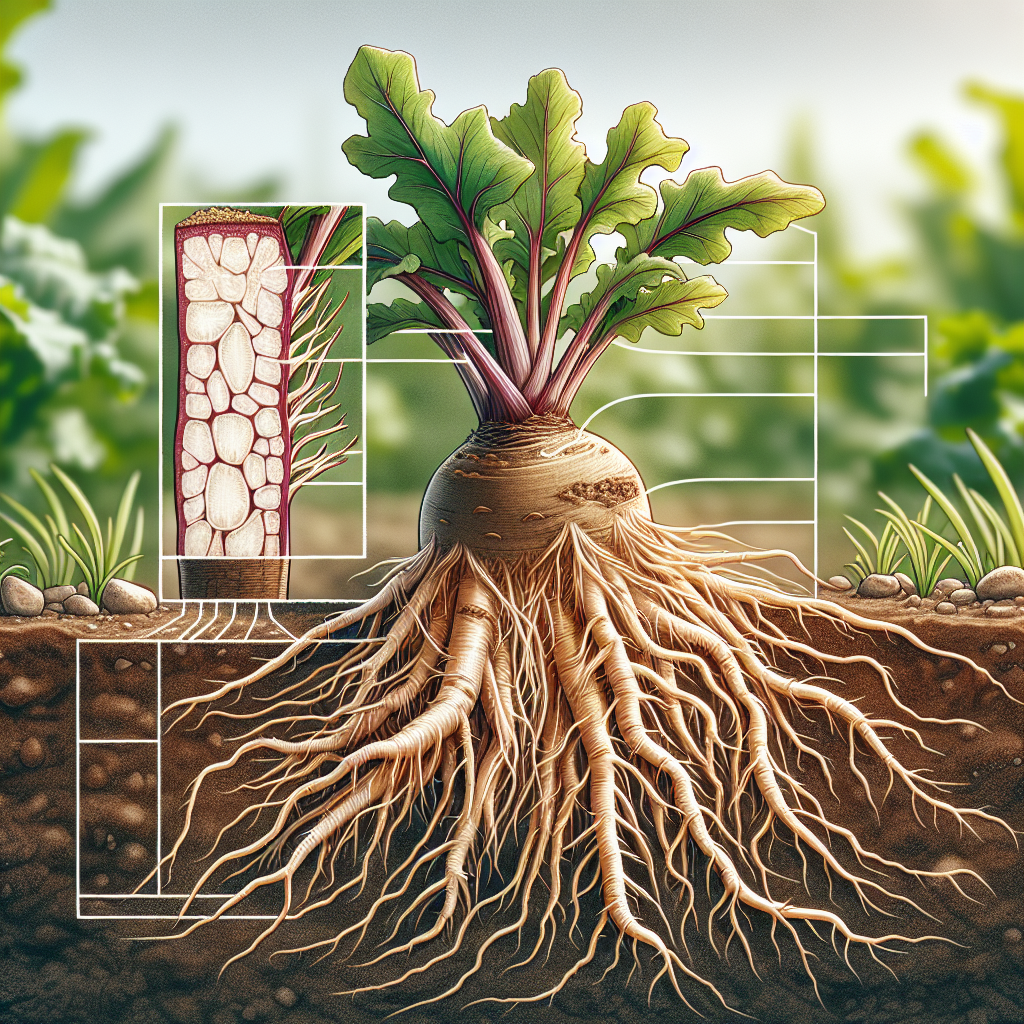
Excavate roots for confirmation: healthy sugar beet taproots are smooth and bulbous; rhizomania roots display 'bearded' proliferation—dozens of thin, lateral roots resembling a witch's broom. Cross-section reveals rusty-brown necrotic rings in vascular tissue, especially at the root crown. Advanced cases show blackened, granular decay.
Yield impacts are catastrophic. In trials across Europe, infested fields averaged 25-40 t/ha versus 70-80 t/ha in clean soil, with sucrose content dropping 2-4 percentage points. Quality deteriorates as roots become fibrous and misshapen, unfit for processing. Secondary effects include increased root-knot nematodes susceptibility and predisposition to storage rots like Pythium.
Differential diagnosis is critical:
| Symptom | Rhizomania | Fusarium Yellows | Rhizoctonia Root Rot |
|---|---|---|---|
| Foliage | Upright, yellow | Floppy, yellow | Wilted, collapsed |
| Roots | Proliferated, necrotic rings | Girdled, pink | Brown, sunken lesions |
| Soil temp | 15-25°C optimal | >20°C | Cool, wet |
Field scouting at 8-10 leaf stage, combined with soil tests for P. betae zoospores (baiting assays), ensures accurate diagnosis. PCR confirms BNYVV strains A-F, with pathotype IV most virulent.
Lifecycle and Progression of rhizomania
Rhizomania's polycyclic lifecycle hinges on Polymyxa betae's complex biology. Resting spores survive 10-20+ years in soil, germinating when beet roots exude stimulants. Zoospores encyst on root hairs, inject BNYVV, and replicate within syncytia—giant cells formed by host plasmodesmata.
Virus multiplies systemically, peaking 4-6 weeks post-infection. Infected roots release viruliferous zoospores, spreading within fields via irrigation or rain splash. P. betae thrives in neutral-alkaline soils (pH 6.5-8.0), with peak activity at 15-25°C and moist conditions.
Disease progression unfolds in phases:
- Incubation (2-4 weeks): Asymptomatic root colonization.
- Vegetative (4-8 weeks): Foliar stunting, root branching.
- Maturity (8-12 weeks): Necrosis, yield fixation.
Overwintering occurs via thick-walled sporangia, reactivated by spring moisture. Mixed infections with Rhizoctonia accelerate progression, forming synergistic 'rhizoctonia-rhizomania' complexes.
Environmental Triggers & Risk Factors
Rhizomania epidemics require the 'disease triangle': virulent pathogen, susceptible host, conducive environment. Key triggers:
- Soil moisture: >60% field capacity optimal for zoospore motility; drought suppresses.
- Temperature: 18-22°C ideal; extremes (<10°C or >28°C) inhibit vector.
- pH: 7.0-8.0 favors P. betae; acid soils (<6.0) suppress.
- Texture: Loams and silts retain moisture better than sands.
Risk factors amplify outbreaks:
- Continuous sugar beet monoculture (infestation builds 10x faster).
- Contaminated irrigation water or machinery.
- Susceptible varieties like older monogerm hybrids.
- High clay soils with poor drainage.
Infested fields retain infectivity indefinitely without intervention. Crop rotation with cereals like wheat or corn dilutes inoculum over 3-4 years, though resting spores persist.
Organic Control & Treatment Plans
No chemical cures exist; management emphasizes cultural, biological, and genetic strategies. Core organic plan:
- Resistant Varieties: Deploy Holly, Rysmon, or Crystal hybrids (resistance scores 7-9/9). Partial resistance limits yield loss to <20%.
- Crop Rotation: 3-4 years with non-hosts (potato, grains). Avoid table beets.
- Sanitation: Disinfect tools, rogue infected plants, deep plow (>30cm) to bury inoculum.
- Soil Management: Improve drainage via subsoiling; lime acid soils sparingly. Biofumigants like mustard green manures suppress P. betae.
- Biologicals: Trichoderma viride or Pseudomonas fluorescens seed treatments reduce root colonization by 30-50%.
Integrated plan timeline:
- Pre-plant: Soil test, rotate, select resistant seed.
- At-planting: Seed treatments, wide rows (50cm) for drying.
- Season: Scout weekly, irrigate precisely, avoid overwatering.
- Post-harvest: Chop tops, incorporate residues.
Field trials in the Netherlands showed resistant varieties + rotation yielding 55 t/ha in infested soil versus 15 t/ha susceptible.
Preventing rhizomania in the Future
Proactive prevention trumps reaction:
- Certification: Source virus-indexed, P. betae-free seed.
- Quarantine: Ban movement from infested zones; GPS-track equipment.
- Monitoring: Annual bait tests (sugar beet seedlings in soil samples). Threshold: >10 zoospores/g soil = high risk.
- Precision Ag: Variable-rate seeding favors resistant varieties in hot spots. AI soil mapping predicts infestation.
- Long-term: Breed multigenic resistance; explore RNA interference against BNYVV.
EU directives mandate rhizomania-free zones; US growers leverage Holmer Foundation research for best practices.
Crops Most Affected by rhizomania
Sugar beet (Beta vulgaris subsp. vulgaris) bears 95% of losses, but related crops suffer too:
- Table beets (beet): 30-50% yield loss, cosmetic damage.
- Fodder beets: Stunting reduces forage value.
- Swiss chard: Minor foliar symptoms.
- Wild Beta species: Reservoirs in weedy borders.
Non-hosts (safe rotation): Cereals, brassicas (cabbage), sugar beet alternatives like sorghum. Quinoa (Chenopodium quinoa) shows tolerance in trials.
Strategic rotation: Year 1 sugar beet → Year 2 wheat → Year 3 potato → Year 4 corn. This dilutes inoculum 90% over cycles while maintaining farm profitability.