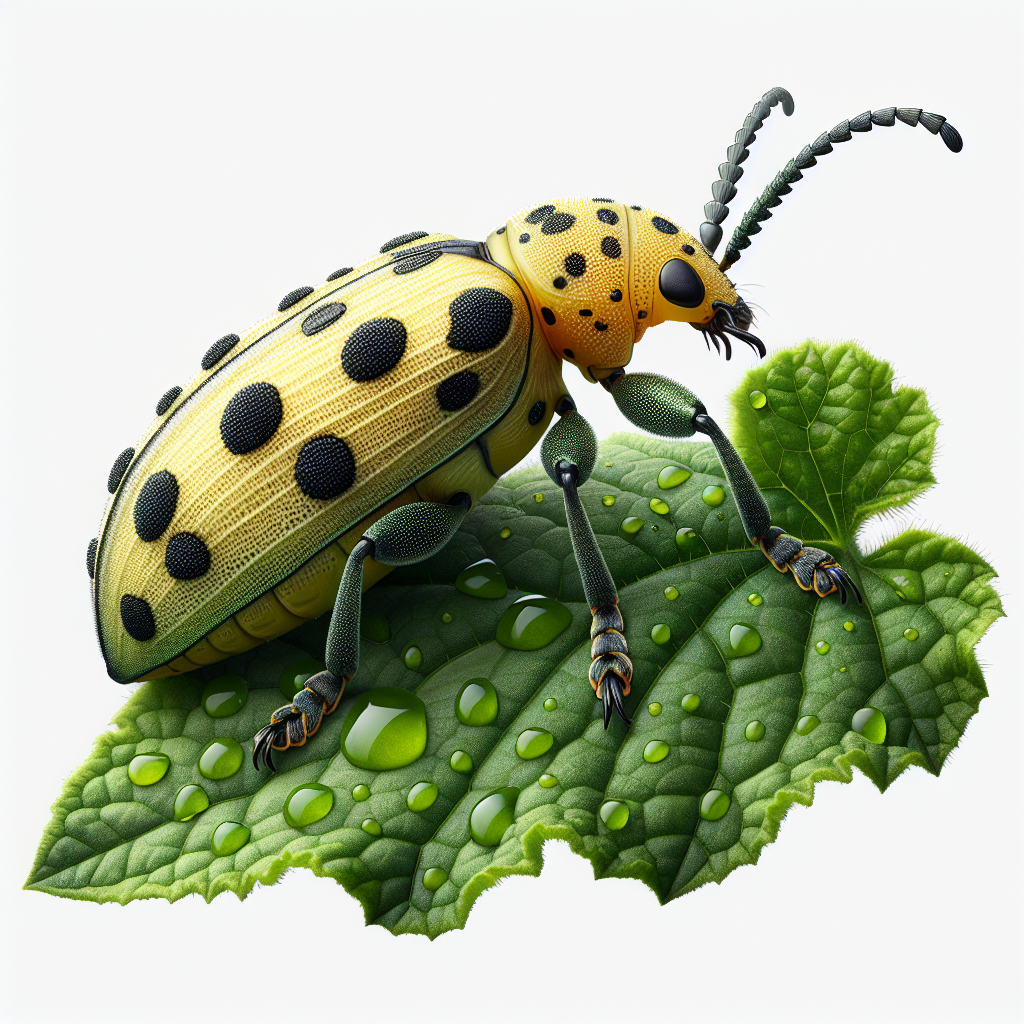
Introduction to Spotted Cucumber Beetle
The spotted cucumber beetle, scientifically known as Diabrotica undecimpunctata, ranks among the most destructive pests in cucurbit production across North America. These beetles inflict both direct and indirect damage: adults chew on foliage, petals, and developing fruits, while larvae feed on roots, weakening seedlings and mature plants alike. More alarmingly, they transmit Bacterial Wilt, a devastating disease caused by Erwinia tracheiphila that clogs vascular tissues, leading to rapid plant collapse. In severe infestations, yield losses can exceed 40-80% in cucumbers, melons, and squash. This guide equips growers with diagnostic tools, lifecycle insights, and proven organic strategies to combat this pest effectively. Early detection and integrated management are key to minimizing economic impact on small farms and commercial operations.
Understanding the beetle's biology is crucial for timing interventions. Native to the U.S. and parts of Mexico, populations surge in warm climates, with multiple generations per season in southern regions. For more on related pests, see our entry on Cucumber Beetles. Adult beetles overwinter in leaf litter and soil, emerging in spring to feed voraciously. Check out this Spring Pest Patrol: Organic AI Strategies to Shield Your Crops from Common Invaders for timely prevention tips.
Identifying Symptoms & Damage
Spot early signs to prevent escalation. Adult spotted cucumber beetles measure 6-7 mm long, with yellow-green elytra marked by 12 distinct black spots—six per wing cover. Males have black-tipped abdomens; females are slightly larger. Larvae are slender, white grubs up to 18 mm, with brown heads and raster patterns on the terminal segment.
Foliar Damage: Look for skeletonized leaves with large holes, especially on cotyledons and young true leaves. Seedlings may be girdled at the soil line, causing wilting. Unlike flea beetles, which create small shot-holes, spotted cucumber beetles leave ragged edges.
Flower and Fruit Injury: Adults clip petals, reducing pollination, and bore into fruits, creating entry points for rot. Scarring appears as pitted, discolored spots on young fruits.
Root Feeding: Larvae tunnel roots, stunting growth and predisposing plants to drought stress. Dig around wilting seedlings to confirm grubs.
Disease Transmission: Wilting vines with blackened, hollow stems signal bacterial wilt—crush a stem and streak bacterial ooze indicates infection. Differentiate from Squash Vine Borer damage, which shows sawdust-like frass at stems.
Scout twice weekly using yellow sticky traps or beat sheets. Thresholds: 1 beetle per plant for seedlings, 5+ for blooms. Use a hand lens for larvae confirmation.
Lifecycle and Progression of Spotted Cucumber Beetle
Mastering the lifecycle enables precise targeting. Adults overwinter in soil or duff, pupating in spring (soil temps >15°C/59°F). Emergence peaks May-June in the North, earlier southward. Females lay 200-800 eggs near cucurbit bases over 4-6 weeks.
Eggs hatch in 7-10 days into root-feeding larvae (stages L1-L3), maturing in 2-4 weeks. Pupae form in soil cocoons for 7-14 days. One to three generations occur annually, with overlap in warm areas.
Progression Timeline:
- Spring (Emergence): Adults feed, mate, oviposit.
- Summer (Larval Peak): Grubs damage roots; new adults appear.
- Fall (Overwinter Prep): Last generation seeks hibernation sites.
Monitor with traps to predict hatches. Lifecycle completes in 40-60 days at 25°C (77°F), accelerating with heat.
Environmental Triggers & Risk Factors
Spotted cucumber beetles thrive in warm, humid conditions (optimum 24-30°C/75-86°F). Risk spikes with:
- Early Plantings: Seedlings coincide with adult emergence.
- Weedy Fields: Prefer pollen-rich weeds like foxtail.
- Monocultures: Cucurbit fields >1 acre amplify pressure.
- Prior Infestations: Soilborne larvae persist.
- Irrigation Practices: Overhead watering disperses adults.
Susceptible companion crops like corn act as bridges. Drought-stressed plants attract more beetles. Southern states see continuous generations; northern areas have discrete broods. Read Why 80% of Small Farms Battle Weather Disasters - And How Hyper-Local AI Forecasts Can Save Your Harvest for climate insights.
Organic Control & Treatment Plans
Prioritize IPM for sustainable control.
Cultural Controls:
- Row covers until bloom (remove for pollination).
- Trap crops: Plant perimeter blue Hubbard squash.
- Crop rotation (2-3 years, non-hosts like onion).
- Tillage buries pupae.
Biological Controls:
- Release parasitic wasps (Celatoria setosa).
- Encourage predators: ground beetles, tachinid flies.
- Apply Bt for larvae (limited efficacy).
Organic Insecticides:
- Neem oil/azadirachtin: Suppresses feeding (apply evenings).
- Pyrethrins + PBO: Contact knockdown (rotate to avoid resistance).
- Kaolin clay (Surround WP): Repels via particle film.
Treatment Plans:
- Scouting/Monitoring: Sticky traps, thresholds.
- Low Infestation: Handpick, row covers.
- Moderate: Neem + kaolin weekly.
- High: Pyrethrins, remove wilted plants.
Avoid broad-spectrum sprays to preserve beneficials like ladybugs predators.
Preventing Spotted Cucumber Beetle in the Future
Prevention beats cure:
- Resistant Varieties: 'County Fair' cucumber, 'Eureka' melon.
- Timing: Delay planting post-emergence.
- Sanitation: Destroy volunteers, till residues.
- Mulches: Straw repels adults.
- Traps: Pheromone or floral lures.
- Intercropping: With nasturtium or marigold.
Soil solarization kills pupae. Monitor adjacent fields. Annual rotation reduces soil populations by 70%.
Crops Most Affected by Spotted Cucumber Beetle
Primarily cucurbits:
- Cucumber (e.g., Marketmore 76)
- Squash (zucchini, butternut)
- Pumpkin
- Watermelon, cantaloupe
Secondary: corn, beans, eggplant. Larvae hit emerging sweet corn. Economic thresholds highest in pickling cucumbers.