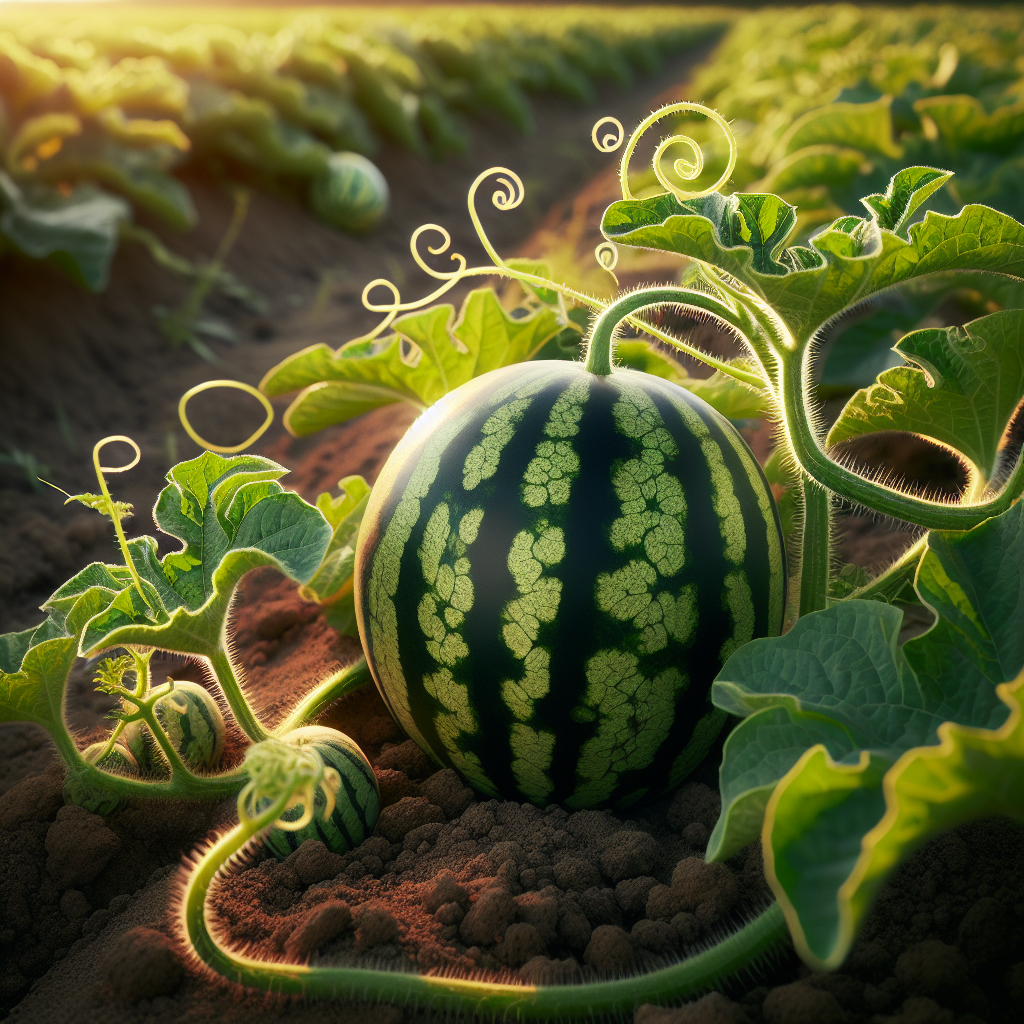
Introduction to Watermelon
A classic summer crop, watermelon is one of the most heat-loving and space-demanding fruits in field and garden production. Native to Africa and domesticated over thousands of years, it has been selected into a remarkably diverse crop group that includes large picnic types, icebox melons, seedless triploids, thin-rinded shipping cultivars, and highly specialized heirlooms with red, yellow, orange, or even cream-colored flesh. Although often treated casually in home gardens, professional-quality watermelon production depends on precise timing, steady soil moisture, strong pollination, balanced fertility, and good canopy and disease management.
Watermelon differs from many vegetable crops because small mistakes early in the season often reduce yield weeks later. Chilling injury at transplanting, erratic watering during fruit fill, excessive nitrogen after flowering, or poor bee activity can all produce bland fruit, misshapen melons, blossom-end issues, hollow heart, or weak vine performance. When managed correctly, however, watermelon is highly rewarding and can deliver excellent yield and flavor in both market gardens and larger farms.
Botanical Profile of Watermelon
Belonging to the family Cucurbitaceae, watermelon is botanically classified as Citrullus lanatus. It is an annual vine with a sprawling growth habit, rough-textured leaves, branched tendrils, and separate male and female flowers on the same plant. This flowering pattern is called monoecious. Male flowers usually appear first and in greater numbers, while female flowers are identified by the small swollen ovary behind the petals that later develops into the fruit.
Roots are relatively wide-spreading but not especially deep compared with some field crops, which is why consistent moisture in the top 20 to 40 cm of soil is so important during establishment and fruit development. The stems are succulent when young, then become tougher and more angular as vines extend. Leaves are deeply lobed, often blue-green to medium green, and provide much of the plant's photosynthetic capacity for fruit sugar accumulation.
Fruit type is technically a pepo, a berry with a thick rind. Rind thickness, flesh firmness, sugar content, and storage life vary significantly by cultivar. Seeded diploid types often have strong flavor and reliable germination under warm conditions. Seedless watermelons are typically triploid hybrids and require more careful germination, warmer soil, and the presence of a pollinizer row of seeded watermelon to set fruit. If you also grow other cucurbits, compare vine behavior and pollination patterns with Cucumber, which shares some management principles but has different fruiting goals and harvest timing.
Typical days to maturity range from 70 to 100 days depending on cultivar class and temperature. Icebox cultivars may mature more quickly and produce fruits of 2 to 6 kg, while large field types may exceed 10 kg and require a longer season. Flesh sweetness is commonly measured in degrees Brix; many premium melons reach 10 to 12 degrees Brix or higher when fully mature and well-grown.
Soil, pH, and Climate Requirements for Watermelon
This crop demands warm conditions from seed germination through ripening. Optimal air temperatures are generally 24 to 32°C during active growth, with best pollination and vine development usually occurring in warm days and mild nights. Growth slows sharply below about 18°C, and chilling damage can occur with prolonged exposure to temperatures under 10°C. Frost will kill plants outright.
Soil temperature is even more critical than air temperature at planting. Direct seeding should usually wait until soil at 5 to 10 cm depth is consistently at least 21°C, with faster and more uniform germination at 24 to 35°C. In cool soil, seed may rot before emergence. Transplants should not be set out until cold stress risk is low and soils are clearly warming.
Watermelon prefers sandy loam or loam soils with excellent drainage, but it can perform well in many textures if compaction is low and waterlogging is avoided. Sandy soils warm quickly and often produce earlier melons, though they require more frequent irrigation. Heavier soils can support vigorous growth but must drain well; standing water around roots for even 24 to 48 hours can trigger root stress, poor nutrient uptake, and disease outbreaks.
An ideal pH range is about 6.0 to 6.8, though the crop can tolerate 5.8 to 7.2 with decent management. Below pH 5.8, calcium and magnesium availability may become limiting and root function often suffers. At high pH, micronutrients such as iron, manganese, and zinc may become less available, producing interveinal chlorosis on younger foliage.
Organic matter should be moderate rather than excessive. A target of roughly 2 to 4% organic matter in mineral soils often supports good structure and water-holding capacity without promoting overly lush, disease-prone growth. Before planting, incorporate fully mature compost rather than fresh manure. Fresh manure can increase salt stress, create nitrogen imbalances, and raise food safety concerns if applied too close to harvest.
For large-fruited cultivars, a pre-plant nutrient program should emphasize phosphorus and potassium according to a soil test. Potassium is especially important for sugar transport, fruit sizing, rind integrity, and overall quality. Excessive nitrogen produces rampant vines, delayed flowering, softer rinds, and reduced sweetness. A useful strategy is to provide modest nitrogen early for canopy establishment, then shift the nutritional balance toward potassium and calcium as flowering and fruit set begin. For broader fertility principles, see soil health strategies.
Step-by-Step Planting & Propagation
Choose a cultivar first based on season length, market preference, and whether you want seeded or seedless fruit. In shorter growing seasons, icebox or early midseason types are usually safest. In hot regions with long summers, larger main-season cultivars can fully develop size and sugar.
Prepare the site 2 to 4 weeks before planting. Remove perennial weeds, loosen compacted ground to at least 25 to 30 cm, and form raised beds if drainage is imperfect. Raised beds improve soil warming, root aeration, and disease control.
Apply base fertility from a soil test. As a general field guide, many growers incorporate phosphorus and potassium before bed formation and reserve part of the nitrogen for side-dressing or fertigation. Avoid applying all nitrogen up front.
Use plastic mulch in cool or short-season climates. Black plastic warms soil, suppresses weeds, keeps fruit cleaner, and reduces evaporative loss. In very hot climates, reflective or lighter mulch may prevent excessive root-zone heating.
Decide between direct seeding and transplants. Direct seeding is common in warm regions because watermelon roots dislike disturbance. Sow 2 to 3 seeds per station, 2.5 to 4 cm deep in warm soil, then thin to the strongest seedling. Transplants are valuable in short seasons but should be started only 2 to 4 weeks before planting out to avoid becoming root-bound.
Use individual cells or biodegradable pots for transplants. Sow one seed per cell. Maintain a germination temperature of 27 to 32°C for best emergence. Seedless triploid types often germinate more erratically and should never be overwatered during sprouting; the medium should be moist but well aerated, not saturated.
Harden transplants carefully for 5 to 7 days. Reduce water slightly and expose plants gradually to outdoor conditions, but do not let them wilt severely. Watermelon transplants are sensitive to shock.
Plant spacing depends on training system and cultivar vigor. In home gardens with sprawling vines, 1.2 to 1.8 m between plants and 2 to 3 m between rows is common. Compact icebox types can be closer. Commercial high-density systems on mulch may use tighter in-row spacing with wider centers for equipment and airflow.
For seedless production, include pollinizers. A common arrangement is one pollinizer for every 2 to 3 rows of triploid plants or one pollinizer plant every few triploid plants depending on the system. Without seeded pollen sources, fruit set will be poor.
Irrigate immediately after planting to settle soil around roots. The goal is uniform moisture in the root zone, not saturation. The top few centimeters may dry between irrigations, but the active root zone should remain evenly moist during establishment.
Care & Maintenance regimes for Watermelon
Successful watermelon care changes with growth stage. During the first 3 weeks after emergence or transplanting, prioritize root establishment and uninterrupted vine growth. Plants should add visible new growth every few days in warm weather. Pale leaves, stalled growth, or repeated midday wilting suggest root stress, cold soil, or uneven irrigation.
Irrigation is the most important ongoing practice. Watermelon needs consistent moisture, especially from flowering through early fruit enlargement, but it is less tolerant of waterlogging than many beginners assume. As a practical target, soil in the upper 20 to 30 cm should feel cool and slightly moist, not muddy. In sandy soils this may require irrigation every 1 to 3 days in hot weather; in loam it may be every 3 to 5 days depending on rainfall and evapotranspiration. Drip irrigation is ideal because it maintains even moisture while keeping foliage dry.
A useful rule is to aim for roughly 60 to 80% of field capacity during active vegetative growth and fruit set. If the soil is constantly saturated, roots become oxygen-starved. Signs of overwatering include yellowing lower leaves despite wet soil, dull blue-green foliage, slowed growth, fruit cracking, and increased root disease. Signs of underwatering include persistent midday wilting that does not recover by evening, small fruit, poor pollination retention, tough rind, and reduced sweetness.
Once fruits approach full size and begin ripening, irrigation should be reduced modestly, not stopped abruptly. Severe late drought can cause sunburned fruit, stalled sugar movement, and vine collapse. But heavy irrigation right before harvest often dilutes flavor and increases splitting risk, especially after a dry period.
Fertilization should be split into phases. Early nitrogen promotes vine and leaf growth, but after the first female flowers appear, excess nitrogen should be avoided. Side-dress or fertigate lightly when vines begin to run, then emphasize potassium-rich feeding during fruit set and sizing. Calcium is important for cell wall integrity, though foliar sprays are not a substitute for correcting soil chemistry and root uptake conditions.
Weed control is essential in the first month because watermelon is not highly competitive before canopy closure. Shallow cultivation is acceptable early, but stop once vines spread widely to avoid root damage. Organic mulches can help, though they do not warm the soil as effectively as plastic and may harbor slugs in wetter climates.
Pollination management is often overlooked. Each female flower is open for a short period, usually one morning. Poor bee activity during bloom can sharply reduce yield. Avoid spraying insecticides when flowers are open, and encourage pollinators by maintaining flowering plants nearby without creating excessive pest reservoirs. Misshapen fruits are often a sign of incomplete pollination.
Pruning is generally unnecessary in field production, but in small gardens limited shaping may help direct vines and improve access. Do not remove too much foliage; leaves are needed to build sugars. Fruit thinning can improve size and quality in some large-fruited cultivars if vines are overloaded.
Pests, Diseases & Organic Management
Watermelon shares many pest and disease pressures with other cucurbits, but timing and severity vary by region. The best organic management strategy is integrated: crop rotation, sanitation, resistant cultivars where available, row covers early in the season, biological balance, and irrigation practices that keep foliage dry.
Common insect pests include striped and Spotted Cucumber Beetles, Aphids, Squash Bugs, Rindworm Caterpillars, Leafminers, and Spider Mites in hot dry conditions. Cucumber beetles are especially important because they feed on seedlings, scar fruit, and can vector Bacterial Wilt in susceptible cucurbits. Use floating row covers immediately after planting to exclude early pests, but remove covers when flowering begins so pollinators can access blooms. Kaolin clay can reduce feeding pressure on young plants, and vacuuming or hand removal may help in small plantings.
Aphids often colonize the underside of leaves and excrete honeydew, which encourages sooty mold. More importantly, they can spread mosaic viruses rapidly. Strong water sprays can knock populations down early, while insecticidal soap works best on soft-bodied insects when coverage is thorough and temperatures are not excessively high.
Major diseases include Fusarium Wilt, Anthracnose, Gummy Stem Blight, Alternaria Leaf Blight, Downy Mildew, Powdery Mildew, and various viral complexes such as Watermelon Mosaic Virus, Zucchini Yellow Mosaic Virus, and Cucumber Mosaic Virus. Fusarium Wilt is particularly difficult because it is soilborne and persists for years. Rotation away from cucurbits for at least 3 to 4 years, use of resistant rootstocks or tolerant cultivars, and well-drained soils are key preventive measures.
Gummy Stem Blight often appears as leaf lesions and stem cankers, especially in warm humid weather. Downy Mildew causes angular yellow lesions and gray-purple sporulation on leaf undersides, while Powdery Mildew appears as white powdery growth, usually later in the season. Good airflow, drip irrigation, prompt removal of diseased residue, and prevention of dense overly succulent growth all help.
For organic foliar disease management, copper products and biological fungicides based on Bacillus species can suppress outbreaks when applied preventively, but they are far more effective when combined with rotation and canopy hygiene. Do not wait until severe infection develops.
Fruit rots and sunscald can also reduce marketability. Keep fruit off persistently wet soil with straw, melon cradles, or plastic mulch. At the same time, avoid stripping too much foliage because exposed fruit may sunburn in intense heat.
Harvesting, Curing & Optimal Storage
Harvest timing has a major effect on sweetness and texture because watermelon does not continue improving after harvest in the way some fruits do. It must be picked fully mature. Unlike cantaloupe, it does not reliably slip from the vine.
Maturity indicators should be used together rather than singly. The ground spot, where the fruit rests on the soil, changes from white or pale green to creamy yellow or butter-yellow on many cultivars. The tendril nearest the fruit stem often dries and turns brown, though this is not perfectly reliable in every variety. The rind becomes duller and more resistant to thumbnail puncture. On striped types, contrast often sharpens. Experienced growers also assess fruit sound, but thumping is inconsistent unless you know the cultivar well.
Harvest in the cool part of the day using a sharp knife or pruners, leaving a short stem attached to reduce stem-end damage. Do not pull fruits from the vine. Handle gently; bruising may not be obvious immediately but shortens storage life and encourages breakdown.
Watermelon is not typically cured in the same sense as onions or winter squash. Instead, the postharvest goal is gentle handling, shade, and rapid movement to appropriate storage conditions. Clean fruit only if necessary, and allow surfaces to dry before packing.
Optimal storage is usually around 10 to 15°C with relative humidity of 85 to 90%. Below about 7°C, chilling injury may develop, especially after several days. Symptoms include pitting, poor flavor, flesh breakdown, and increased decay. Whole watermelons can often store 2 to 3 weeks under good conditions, though shelf life depends heavily on cultivar, maturity, and handling. Cut melons must be refrigerated immediately and used quickly.
For best eating quality, many growers find that fully ripe fruit held briefly at moderate room temperature before serving expresses aroma and sweetness better than fruit served very cold. However, once cut, food safety takes priority and refrigeration is essential.
Companion Planting for Watermelon
Companion planting works best when it is based on function rather than folklore. Watermelon benefits from neighboring plants that attract pollinators, stabilize the soil surface, or repel some pests without competing aggressively for light, root space, or moisture.
Good companions include low-growing flowering herbs and insectary plants positioned at bed edges rather than within the vine zone. Sweet alyssum, dill, cilantro in flower, and certain basil plantings can help support beneficial insects and pollinators. Nasturtiums may attract Aphids away from the main crop in some gardens, though they should be monitored so they do not become a pest reservoir.
Radishes are sometimes used as an early trap crop for flea beetles or as a quick maturing intercrop before vines spread. Bush beans can fit in wider systems if irrigation and fertility are sufficient, though competition must be watched. Sunflowers can support pollinators but should be placed where they will not shade vines.
Avoid pairing watermelon too closely with crops that create heavy root competition or cast dense shade. Large corn blocks can reduce airflow and harbor pests, although some diversified farms use spatially separated succession plantings successfully; if you are planning mixed warm-season blocks, review spacing considerations in our Corn guide. Potatoes and other heavy feeders are generally poor immediate companions because they intensify nutrient and water competition. Keep all cucurbits on a thoughtful rotation to reduce shared disease pressure.
The most effective companion strategy is often border-based: flowering strips for pollinators, mulched paths to reduce dust and weed pressure, and rotational planning that keeps watermelon away from last year's cucurbit ground. This approach supports healthy vines, stronger fruit set, and more consistent harvest quality than crowding many species directly into the same hill.