Introduction to Southern rust
Southern rust, caused by the fungus Puccinia polysora, poses a serious threat to corn production, particularly in tropical and subtropical regions of the United States, Latin America, Africa, and Asia. First identified in the southern U.S. in the early 20th century, this disease has become more prevalent with climate change and intensified corn farming. Unlike common rust, which affects cooler climates, Southern rust thrives in high temperatures and humidity, often arriving via wind-blown spores from southern states or Mexico.
The economic impact is staggering: severe infections can reduce yields by 20-80%, depending on timing and severity. In 2021 alone, Southern rust caused millions in losses across the Corn Belt. Early detection and integrated management are crucial for farmers growing Dent Corn (Yellow Dent), Sweet Corn (Honey Select), or Flint Corn (Indian Corn). This guide provides professional-grade diagnostics, organic treatments, and prevention strategies to safeguard your harvest. For small farms struggling with disease identification, tools like AI-powered apps can revolutionize early detection—check out Why Misidentifying Plants Costs Small Farms Thousands - And How AI Camera Diagnosis Fixes It Fast.
Identifying Symptoms & Damage
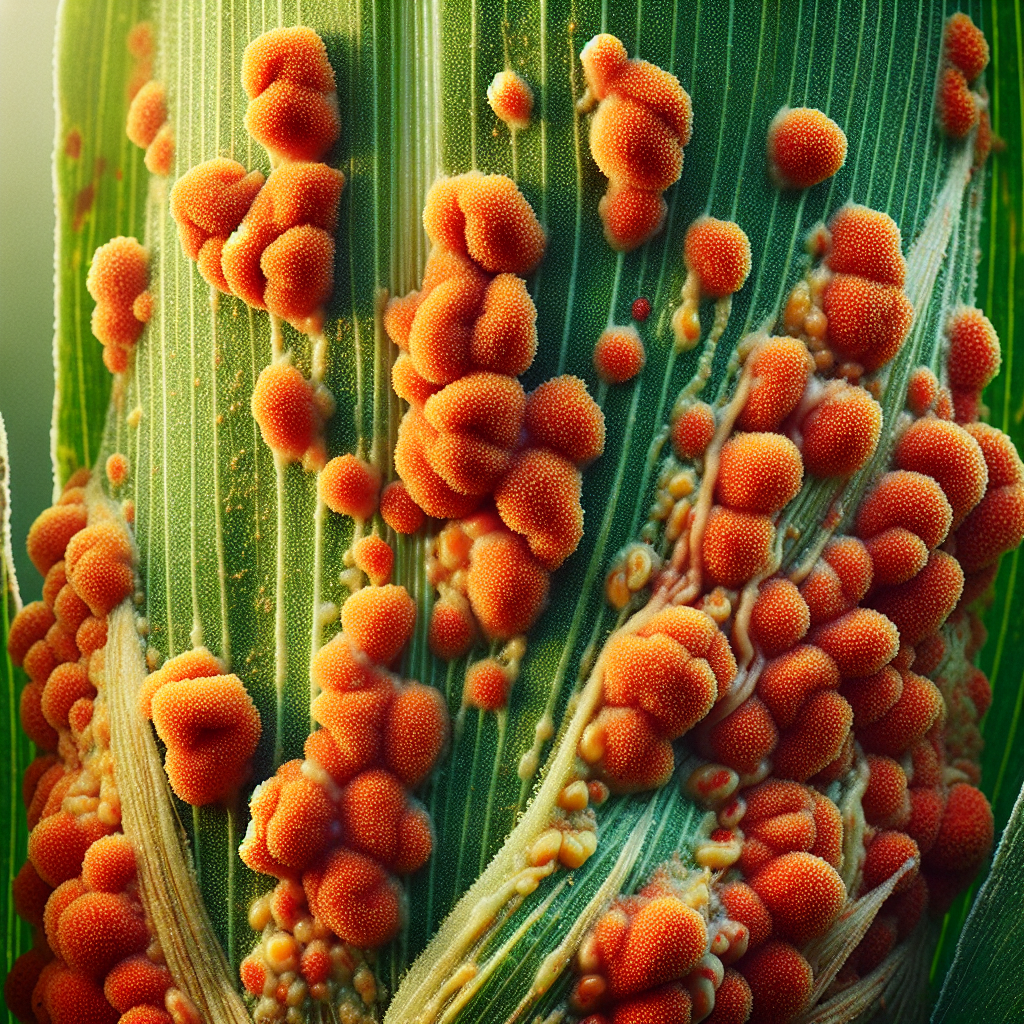
Southern rust is unmistakable once established, but early symptoms mimic nutrient deficiencies or other diseases like gray leaf spot. Initial signs appear as small, circular, chlorotic lesions (1-2 mm) on upper leaf surfaces, often on the upper leaves first. Within 5-7 days, these develop into raised, brick-red to orange pustules filled with urediniospores—the diagnostic hallmark.
Key Diagnostic Features:
- Pustules: Small (0.2-0.5 mm), densely packed, orange-red, erupting from leaf upper surfaces. Spores rub off easily, staining fingers rusty orange.
- Distribution: Predominantly adaxial (upper) leaf surfaces; sparse on abaxial (lower). Unlike common rust, rarely on husks, sheaths, or ears.
- Leaf Damage: Severe infections cause rapid chlorosis, necrosis, and premature defoliation. Leaves turn yellow-brown, with pustules merging into large blighted areas.
- Plant Impact: Upper leaves affected first (VT-R3 growth stages), leading to barren ears, lightweight kernels, and stalk lodging due to weakened structural integrity.
Damage Progression:
- Early (V8-VT): 5-10% leaf area infected → minimal yield loss.
- Mid (R1-R2): 50%+ infection → 20-40% yield reduction.
- Late (R3+): Foliar necrosis → 50-80% losses, poor grain fill.
Differentiate from northern corn leaf blight (gray lesions, no pustules) or Stewart's Wilt (linear lesions). Use a 10x hand lens to confirm uredinia. Scout weekly from tasseling, checking 20-50 plants per field edge and interior.
Lifecycle and Progression of Southern rust
Puccinia polysora is an autoecious, macrocyclic rust with five spore stages, but in corn regions, it primarily cycles via urediniospores. No alternate host like barberry (as in wheat stem rust).
Lifecycle Stages:
- Urediniospores (Primary Infective): Wind-dispersed from southern overwintering sites. Germinate in 4-6 hours at 25-30°C (77-86°F), 95%+ RH. Penetrate via stomata.
- Latent Period: 5-10 days to pustule formation.
- Pustule Rupture: Billions of spores released, spreading 100s of miles.
- Pycnia/Aecia/Telia: Rare in U.S.; teliospores overwinter in debris (southern Florida/Mexico).
Progression in Field:
- Infection starts on lower-mid leaves post-tassel.
- Epidemics build exponentially: 7-day cycle in ideal conditions.
- Spores viable 2-4 weeks; secondary cycles amplify until senescence.
Optimal temp: 27-30°C; min 15°C, max 35°C. Free water (dew) essential for 6+ hours. Dry heat (>35°C) halts spread. In the U.S., spores arrive mid-July via southern jet stream, peaking August-September.
Environmental Triggers & Risk Factors
Southern rust epidemics require the "disease triangle": susceptible host, virulent pathogen, favorable environment.
Key Triggers:
- Temperature: 25-32°C daytime, >20°C nights.
- Humidity: >90% RH, frequent leaf wetness (dew, rain).
- Wind: Disperses spores long-distance.
Risk Factors:
- Hybrids: Susceptible field corn; sweet corn highly vulnerable.
- Planting Date: Late-planted fields (July) overlap peak spore arrival.
- Crop Density: High populations (>32,000/acre) increase humidity.
- Irrigation: Overhead systems prolong leaf wetness.
- Rotation: Continuous corn fields have higher inoculum from debris.
- Regional: Gulf Coast states (FL, GA, AL, TX) scout earliest; Corn Belt (IA, IL, IN) 2-4 weeks later.
Monitor USDA Southern Rust Map weekly. Threshold: 50 pustules/leaf on 50% plants at VT-R1.
Organic Control & Treatment Plans
Organic management emphasizes prevention, but curative options exist for outbreaks. Always rotate with non-hosts like soybeans or wheat.
Cultural Controls:
- Plant resistant hybrids (e.g., Syngenta, Pioneer lines rated 7+).
- Early planting to avoid peak spore times.
- Wide rows, lower densities for airflow.
- Avoid overhead irrigation; use drip.
Organic Treatments:
- Biopesticides: OMRI-listed potassium bicarbonate (MilStop) or sulfur (Kumulus). Apply at first pustules, 7-10 day intervals. Efficacy: 40-60% suppression.
- Neem Oil/Extracts: Azadirachtin disrupts spore germination. 1-2 gal/acre, weekly.
- Bacillus subtilis (Serenade): Competes with rust; apply preventively.
- Copper-Based (e.g., Cueva): Limited efficacy, use early.
Integrated Plan:
- Scout weekly.
- Fungicide at 10-50% severity (upper leaves).
- Reapply after 7-14 days rain.
- Defoliate/dehead severely infected plants.
For small farms, Spring Pest Patrol: Organic AI Strategies to Shield Your Crops from Common Invaders offers tech-enhanced scouting tips.
Preventing Southern rust in the Future
Long-term control breaks the cycle:
Hybrid Selection: Choose resistant varieties; check seed catalogs for Southern rust ratings. Crop Rotation: 2-3 years with sorghum, cotton, or legumes. Residue Management: Till under debris; promote decomposition. Field Sanitation: Destroy volunteer corn. Monitoring Tech: Drones, apps for early detection. Regional Awareness: Join extension networks for alerts.
Forecast Models: Use Integrated Pest Management Pipe for risk maps. Build soil health with cover crops like clover to boost vigor.
Crops Most Affected by Southern rust
Primarily corn (Zea mays), all types:
- Field corn (Dent Corn (Yellow Dent), Flour Corn (Hopi Blue)).
- Sweet corn (Sweet Corn (Honey Select), Peaches and Cream Sweet Corn).
- Popcorn (Popcorn (Orville Redenbacher)).
Minor hosts: Sorghum, sugarcane, wild grasses. No economic impact on soybeans or wheat. Global hotspots: U.S. South/Corn Belt, Brazil, Africa. Yield losses highest in tropical hybrids lacking resistance.