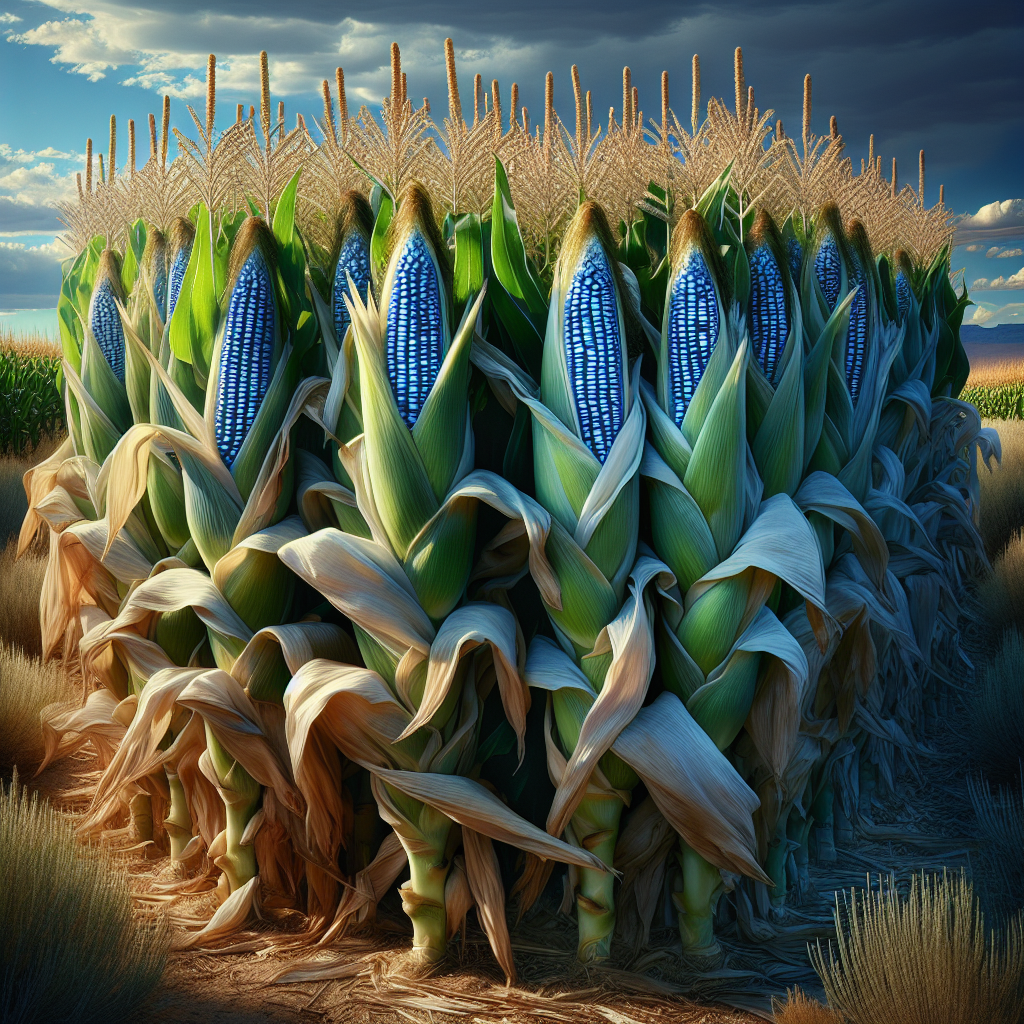
Introduction to Flour Corn (Hopi Blue)
A landrace-type blue flour corn from the American Southwest, this variety is best known for its striking blue to blue-black kernels and its long cultural association with Hopi and other Indigenous dryland farming traditions. It belongs to the flour corn class rather than sweet, dent, or popcorn types, meaning the kernels are dominated by soft starch that grinds very easily into fine meal. That texture is the defining trait growers and millers value most: once fully mature and dry, the grain produces a smooth, absorbent flour ideal for flatbreads, tortillas, porridge, dumplings, and ceremonial foods.
Hopi Blue is especially important to growers interested in resilience. It was selected over generations under arid, high-light, low-humidity conditions, so it often performs better than conventional field corn where rainfall is limited and soils are not especially rich. That does not mean it thrives on neglect; rather, it responds best to deliberate management that respects its adaptation: full sun, warm soil, good drainage, moderate fertility rather than excessive nitrogen, and spacing that allows wind pollination while avoiding rank, overly lush growth.
From an agronomic standpoint, this is a grain crop that should be managed for physiological maturity, kernel dry-down, and seed quality. Growers familiar with corn in general will recognize the same basic plant structure—fibrous roots, upright culms, broad leaves, tassels, and ears—but flour corn demands more attention to isolation, harvest timing, and curing because kernel quality matters more than tenderness. For growers seeking cultural depth, visual appeal, and highly useful home-milled grain, few heirloom corns are more rewarding.
Botanical Profile of Flour Corn (Hopi Blue)
This crop is a warm-season annual grass in the Poaceae family. The species is Zea mays, and flour corns are commonly grouped within forms selected for high soft-starch content. Hopi Blue usually reaches about 5 to 8 feet tall depending on environment, fertility, plant spacing, and water availability. In low-input dryland systems it may remain shorter and sturdier; in irrigated, fertile garden beds it can become taller but sometimes more prone to lodging if overfed with nitrogen.
Plants produce separate male and female flowers on the same plant. The tassel at the top releases pollen, while the ears form lower on the stalk and bear long silks. Each silk corresponds to a potential kernel, and successful ear fill depends on pollen reaching each fresh silk during the pollination window. Poor pollination leads to patchy ears with missing kernels, especially when plantings are too small, arranged in a single long row, or stressed by heat and drought at tasseling.
The kernels are typically dark blue, blue-purple, or nearly black externally, with color intensity influenced by genetics, sunlight, maturity, and some environmental conditions. The pigment comes largely from anthocyanins in the aleurone or outer layers. Internally, the endosperm is soft and floury rather than hard and glassy, which makes the grain easy to grind but also somewhat more susceptible to damage if handled roughly before it is fully dry. Ears are often narrower and more variable than hybrid commercial corns, reflecting heirloom diversity.
Days to maturity generally range from about 95 to 110 days under warm conditions, though cool nights, high elevation, and dryland management may extend the season. Because this is not bred for uniform industrial production, expect some variation in plant height, ear set, and kernel shade. That variability is not a defect; it is part of the genetic breadth that helps traditional varieties adapt across seasons.
Soil, pH, and Climate Requirements for Flour Corn (Hopi Blue)
This crop performs best in full sun with at least 8 hours of direct light daily, and 10 or more is even better in northern regions or high elevations. Temperature drives growth strongly. Seeds germinate reliably when soil temperatures at 2 inches deep are at least 60°F (16°C), but emergence is faster and more uniform at 65 to 75°F (18 to 24°C). Ideal vegetative growth occurs in daytime temperatures around 75 to 90°F (24 to 32°C). Extended cold soils or cool, wet weather after sowing can lead to rotting seed, weak emergence, and seedling diseases.
Well-drained loam or sandy loam is ideal. Hopi Blue tolerates leaner soils better than many modern corns, but that tolerance should not be mistaken for preference. The best stands come from soils with good tilth, moderate organic matter, and enough depth for root exploration. Avoid compacted subsoil, hardpan, and chronically waterlogged ground. Standing water for even 24 to 48 hours can impair root respiration, encourage Damping-off in young plants, and cause yellowing or stunting later in the season.
The preferred pH range is about 6.0 to 7.5, with especially strong performance around 6.2 to 7.0. Below pH 5.8, phosphorus availability can decline and aluminum toxicity may become an issue in some soils; above pH 7.8, iron and zinc deficiencies are more likely, showing as interveinal chlorosis on young leaves. If pH is low, incorporate finely ground agricultural lime several months before planting. If soils are alkaline, avoid overapplying phosphorus and use compost judiciously to improve micronutrient cycling rather than trying to force major pH change in one season.
Moisture management matters most during establishment, rapid vegetative growth, tasseling, silking, and grain fill. In traditional dryland systems, plants survive on low rainfall because of deep rooting, wide spacing, and local adaptation. In gardens and market plots, more consistent yields come from keeping soil moisture in the root zone fairly even. As a practical target, maintain moisture roughly in the upper 40 to 70% of field capacity during early growth and closer to 60 to 80% during tasseling and ear fill. Soil should feel cool and slightly moist 2 to 4 inches down, never sticky and anaerobic. Overwatered plants often show pale leaves, slow growth, and a sour smell in heavy soils; underwatered plants roll their leaves by midday, then later remain rolled into evening if stress is severe.
For broader fertility strategy, a soil-first approach is helpful; see soil health strategies. Moderate fertility is preferable to excess. Very high nitrogen creates lush, dark green growth that can delay maturity, increase lodging, and dilute the dryland character this variety is known for.
Step-by-Step Planting & Propagation
Propagation is by seed only. Do not transplant unless absolutely necessary; corn dislikes root disturbance and usually establishes better when direct-sown.
Select an isolated planting site. Corn cross-pollinates readily with other corn types, including sweet corn, dent corn, popcorn, and ornamental flint corn. If seed purity matters, isolate by at least 800 feet to 1/4 mile from other flowering corn, or stagger planting dates so bloom periods do not overlap. For serious seed saving, greater isolation is better.
Prepare the bed 2 to 3 weeks before sowing. Remove perennial weeds, loosen soil to 8 to 12 inches, and incorporate 1 to 2 inches of finished compost if the soil is low in organic matter. Do not add large amounts of high-nitrogen manure immediately before planting.
Wait for warm soil. Sow after the last frost when the soil is consistently above 60°F. In cool climates, black plastic or stale-bed solar warming for a week can improve early emergence.
Plant in blocks, not single rows. A minimum of 4 short rows is recommended for good wind pollination. Small garden blocks such as 4 rows by 8 to 12 feet are far superior to one 30-foot row.
Sow seed 1 to 1.5 inches deep in medium soil, or up to 2 inches deep in sandy, drying ground. In crust-prone clay, stay closer to 1 inch.
Space seeds 8 to 12 inches apart within rows, with 30 to 36 inches between rows for hand-tended plots. In very dry systems, plants may be spaced wider to reduce competition.
Water after sowing to settle the seed zone. The top 2 inches should remain evenly moist until emergence, which usually takes 5 to 10 days in warm soils.
Thin if needed once seedlings are 4 to 6 inches tall. Keep the strongest plants rather than allowing overcrowding, which reduces ear size and airflow.
A traditional approach is hill planting, especially when integrating a Three Sisters system. In that case, form low mounds 3 to 4 feet apart, plant 4 to 6 corn seeds per hill, then thin to 3 or 4 strong plants. Beans are added after corn reaches 6 to 8 inches, and squash follows shortly after.
For seed saving, choose at least 50 to 100 plants if space allows. Very small populations can lead to inbreeding and gradual loss of vigor. Save seed only from well-filled, disease-free ears on robust plants that mature on time.
Care & Maintenance regimes for Flour Corn (Hopi Blue)
During the first 3 weeks after emergence, the main priorities are weed control and steady moisture. Young corn competes poorly with fast annual weeds. Keep a weed-free band at least 8 to 12 inches around each plant. Shallow hoeing is better than deep cultivation because roots spread widely near the surface.
Watering should be adjusted by growth stage. Seedlings need frequent but lighter irrigation so the root zone does not dry out completely. Once plants are 12 to 18 inches tall, water more deeply and less often to encourage deeper rooting. A practical pattern in garden soil is 1 to 1.5 inches of total water per week early in the season, increasing to 1.5 to 2 inches during tasseling, silking, and early grain fill if rainfall is insufficient. Sandy soils may require splitting irrigation into 2 or 3 smaller applications weekly; clay loams usually need fewer, deeper soakings.
Watch the leaves for stress signals. Slight midday leaf rolling on very hot afternoons can be normal, but leaves should relax by evening. If they remain tightly rolled at sunset, the crop is under meaningful moisture stress. Conversely, if lower leaves yellow while the soil remains constantly wet and plants appear soft or stunted, reduce irrigation and improve drainage.
Nitrogen demand rises sharply once growth accelerates. If soil fertility is modest, side-dress when plants reach knee height with a moderate nitrogen source such as composted poultry manure, blood meal, fish-based fertilizer, or a balanced organic blend. A common target is to provide enough available nitrogen to support steady growth without pushing excessive height. If leaves are pale green and lower foliage yellows prematurely before tasseling, a supplemental feeding may be warranted. If plants are extremely dark green, lush, and floppy, do not feed further.
Mulch can help conserve moisture, especially in dry climates, but it should be applied after the soil has warmed and seedlings are established. A light straw mulch suppresses weeds and reduces surface evaporation. Keep mulch a few inches away from the stalk base to reduce rodent shelter and fungal humidity around the crown.
Because pollination is wind-driven, avoid overhead irrigation during peak pollen shed if possible, particularly in humid climates where wet tassels and silks can interfere with efficient pollen movement. Gentle morning watering at soil level is preferable.
Hilling soil lightly around the base when plants are 12 to 18 inches tall can improve anchorage, especially in windy locations. Brace roots emerging above the soil line are normal and beneficial; they should not be buried too deeply, but modest earthing-up can stabilize plants.
Pests, Diseases & Organic Management
Birds are often the first challenge. Crows, jays, and blackbirds may pull sprouts or peck ears as kernels begin to mature. Protect newly sown areas with row cover until seedlings are well rooted, and use netting or bagging on ripening ears if bird pressure is intense.
Corn earworm can damage tips and introduce molds. Encourage beneficial insects, destroy infested ears promptly, and consider applying Bacillus thuringiensis or a few drops of food-grade mineral oil with Bt to fresh silk channels in small plantings if pressure is severe. Timing matters: treatment must coincide with early silk emergence before larvae tunnel deeply.
Cutworms may sever young seedlings at soil level. Use cardboard collars around stems in high-risk plots and avoid planting immediately into fresh, weedy ground. Wireworms and Seedcorn maggots are more likely in cool, wet soil or where undecomposed organic matter was recently turned under.
Flea beetles and Aphids occasionally colonize stressed plants. Healthy, fast-growing corn usually outgrows light feeding. If Aphids build up on tassels or leaf undersides, strong water sprays and conservation of lady beetles, lacewings, and hoverflies are usually sufficient.
Among diseases, Damping-off affects seedlings in cold, saturated soils. Later in the season, Common rust, Southern rust in warmer regions, Smut, and Fungal ear rots can appear. The best organic prevention measures are spacing for airflow, crop rotation, balanced fertility, careful harvest timing, and avoiding overhead irrigation late in the day. Smut galls should be removed before they rupture if seed cleanliness is a priority. Ear rots are especially important in flour corn because infected grain should never be milled for food if mold is significant.
Watch for Fusarium and Aspergillus risks in hot or humid conditions. Infected ears may show discolored kernels, white to pink mold, or powdery olive-green growth. Any suspect ears should be discarded, not fed or stored. Harvest promptly once grain is mature, and dry ears rapidly to a safe storage moisture.
Raccoons, deer, and rodents can devastate plantings near maturity. Electric fencing is often the most reliable defense against raccoons and deer. Barn storage should be rodent-proof, with sealed bins and no spilled grain nearby.
Harvesting, Curing & Optimal Storage
Unlike sweet corn, this crop is harvested when the ears and kernels are fully mature and dry. The husks usually turn tan to papery brown, stalks begin to dry down, and kernels become hard enough that a fingernail cannot dent them easily. Black layer formation at the kernel base indicates physiological maturity, but safe storage still requires additional field drying or indoor curing.
For best flour quality, wait until ears are mature but do not leave them exposed indefinitely in wet autumn weather. In dry climates, ears may cure well on the stalk. In humid regions, it is often better to harvest as soon as the ears are mature and finish drying under cover. Snap ears cleanly from the stalk on a dry day after dew has evaporated.
Pull back or remove husks and sort immediately. Keep only clean, well-filled, insect-free ears for storage or seed. Any ear with mold, sour odor, severe insect tunneling, or discolored kernels should be culled. Seed ears should come from the healthiest plants and be dried separately from grain intended for food.
Cure ears in a warm, airy location out of direct rain and away from condensation. Ideal curing conditions are roughly 80 to 95°F (27 to 35°C) with active airflow if possible, though room-temperature drying also works if humidity is low. Hang braided husks, spread ears in a single layer on racks, or use mesh bags with good circulation. Drying may take 2 to 6 weeks depending on climate.
For shelling, kernels should be below about 13 to 14% moisture for general storage and closer to 10 to 12% for long-term seed safety in sealed conditions. A practical field test is that kernels feel glass-hard externally, shell cleanly, and break rather than mash under pressure. If using a moisture meter, aim for 12 to 13% before storing grain for food.
Store whole ears or shelled kernels in cool, dark, dry conditions. Food grain keeps best in sealed containers after thorough drying, protected from insects and rodents. Glass jars, metal bins, or food-grade buckets with gasket lids work well. For seed, maintain cool temperatures and low humidity; every reduction in heat and moisture prolongs viability. Avoid grinding into flour until needed, because whole kernels store far longer than meal.
Freshly milled blue corn flour has a richer aroma and better flavor than pre-ground meal. Sift if desired, but many growers prefer whole-grain flour for maximum color, oil, and mineral retention.
Companion Planting for Flour Corn (Hopi Blue)
The classic partnership is the Three Sisters system: corn for vertical structure, pole beans for nitrogen contribution and added yield, and sprawling squash to shade soil and suppress weeds. In a well-managed block, beans or other climbing legumes are introduced only after the corn is strong enough to avoid being pulled down. Squash is planted around the perimeter or between hills once the corn is established, where its broad leaves reduce evaporation and slow weed germination.
Sunflower can also be useful nearby as a pollinator-supporting border and as a visual windbreak marker, though it should not be crowded directly into the corn stand where it may compete for light and water. In larger gardens, low-growing nitrogen-fixing living mulches such as clover can be used between widely spaced rows, but only where moisture is sufficient and competition is carefully managed.
Companion planting should not compromise pollination or airflow. Keep the corn itself in a dense enough block for wind pollination, while companion species occupy edges, hills, or row middles. The best companions are those that help conserve moisture, suppress weeds, and diversify beneficial insect habitat without shading young corn or tangling with it too early.
One caution: avoid placing heavy-feeding tall crops immediately adjacent on the south side of the block, where they can cast shade during key growth stages. Likewise, sprawling cucurbits should be guided so they do not smother small corn seedlings before the stalks harden.