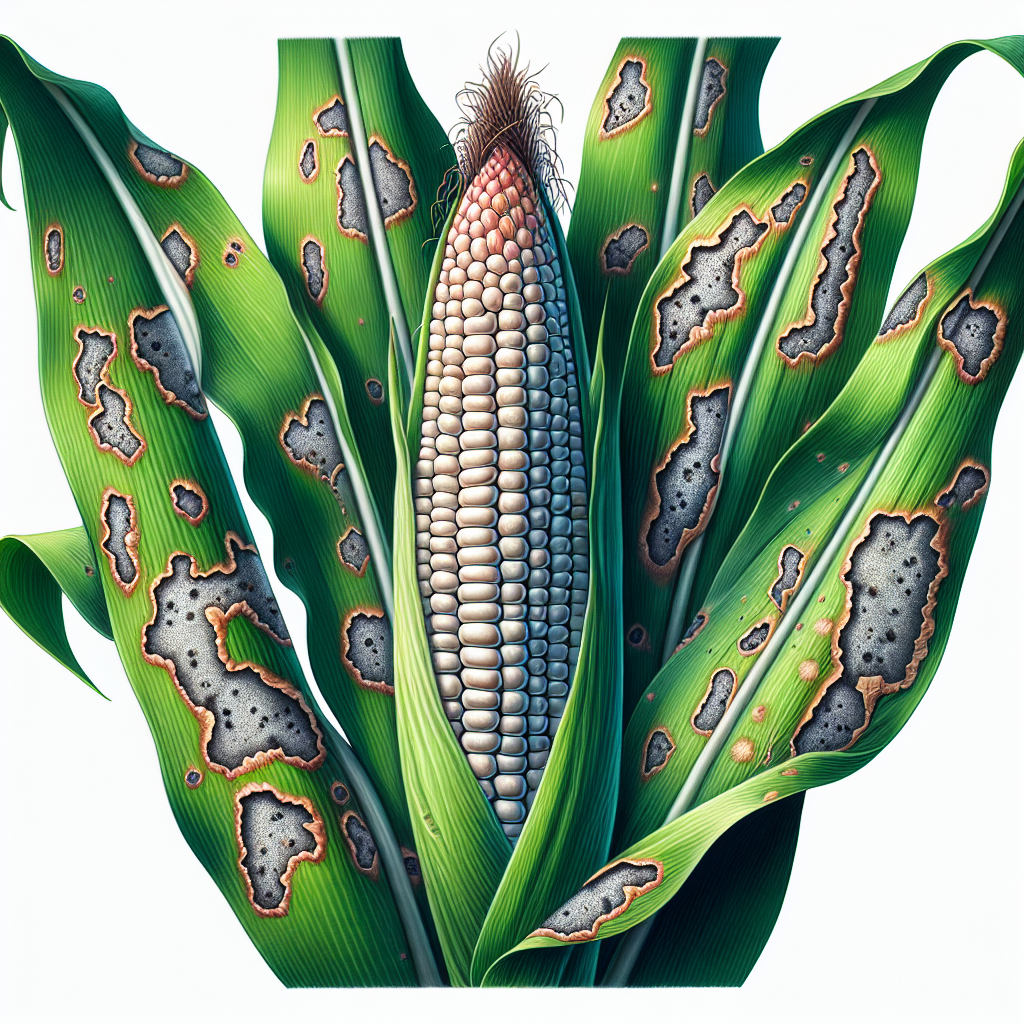
Introduction to Gray leaf spot
Gray leaf spot, caused by the fungus Pyricularia grisea (formerly Magnaporthe grisea), is a serious foliar disease impacting a wide range of crops, particularly warm-season turfgrasses like perennial ryegrass, tall fescue, and bentgrass, as well as major field crops such as corn, rice, and wheat. First identified as a turf disease in the 1990s, it has since become a global concern due to its rapid spread and ability to cause significant yield losses—up to 50% in untreated corn fields and complete stand loss in turf under severe conditions. This guide provides professional-grade diagnostic criteria, lifecycle insights, and proven organic management strategies to help farmers and turf managers protect their crops effectively.
The pathogen produces dark brown to black spores that infect leaves during prolonged leaf wetness, leading to characteristic gray lesions bordered by halos. In agriculture, it often confuses growers with similar leaf spot diseases, but distinct progression patterns set it apart. Early detection is crucial, as unmanaged outbreaks can escalate quickly in humid environments, devastating yields and quality.
Identifying Symptoms & Damage
Symptoms of gray leaf spot begin as small, diamond-shaped or circular spots (1-3 mm) on leaf blades, often appearing on lower leaves first. These spots are tan to brown with a dark border, resembling freckles. As the disease progresses, lesions elongate parallel to the leaf veins, forming narrow, rectangular gray to tan streaks up to 1-2 cm long with dark brown margins. In advanced stages, centers of lesions turn ash-gray and may develop tiny black fruiting bodies (appressoria) visible under magnification.
Damage manifests as rapid blighting, with affected leaves yellowing, withering, and dying from tips downward. In turf, this creates a 'melting out' appearance with thin, bare patches. On corn, lesions coalesce into large blighted areas, reducing photosynthesis and kernel fill, leading to 10-30% yield loss. In rice, it mimics blast disease, causing panicle sterility. Differentiate from Septoria leaf spot by the parallel veinal elongation and gray centers; Alternaria leaf spot lacks the dark borders.
Inspect during morning dew or after rain. Use a 10x hand lens to confirm mycelium and spores. Yield impacts are severe in dense canopies: turf density drops 40-60%, corn silking-stage infections cut yields by 20 bushels/acre. Economic thresholds: 10% leaf area affected in turf; 15% incidence in corn pre-tassel.
Lifecycle and Progression of Gray leaf spot
Pyricularia grisea is a hemibiotrophic fungus completing multiple cycles per season. It overwinters as dormant mycelium or conidia in infected plant debris, surviving 12-18 months in thatch or soil. Primary infection occurs in spring when temperatures reach 25-30°C (77-86°F) with leaf wetness >8-12 hours. Spores (conidia) germinate on wet leaves, forming appressoria that penetrate stomata or cuticles within 4-6 hours.
The latent period is 3-5 days, followed by symptom expression. Each lesion produces 10,000-50,000 conidia over 7-14 days, dispersing via wind, rain splash, or dew up to 1 km. Under optimal conditions (28-32°C, 90-100% RH), 5-10 cycles occur per season, with peak activity mid-summer. In rice, sexual spores (ascospores) from pseudothecia add genetic diversity, prolonging epidemics.
Progression accelerates in dense, nitrogen-fertilized stands: infection starts lower canopy, moves upward, killing 20-50% foliage by harvest. Debris management breaks the cycle, as spores lose viability after 30 days exposed to UV.
Environmental Triggers & Risk Factors
Gray leaf spot thrives in warm, humid tropics/subtropics but adapts to temperate zones with irrigation. Key triggers: temperatures 25-35°C, relative humidity >90%, and leaf wetness periods >10 hours nightly. High nitrogen (>1 lb/1000 sq ft monthly) promotes succulent growth, doubling infection rates. Poor air circulation in dense plantings (e.g., overseeded turf >80% cover) traps moisture, favoring spore germination.
Risk factors include excessive thatch (>0.5 inch), acidic soils (pH <6.0), and overhead irrigation creating 12+ hour wetness. In corn, continuous monoculture and no-till without tillage increase debris inoculum. Susceptible varieties like annual ryegrass or older bentgrass cultivars heighten vulnerability. Climate change extends seasons, with models predicting 20% more outbreaks by 2050 in mid-latitudes. Monitor with weather stations: act when 3-day cumulative wetness >36 hours at >25°C.
Organic Control & Treatment Plans
Organic management emphasizes integrated cultural, biological, and minimal fungicide approaches. Cultural: Mow at optimal heights (turf: 2.5-3.5 inches; avoid <2 inches), remove clippings weekly, and dethatch to <0.25 inches. Apply balanced N (0.5 lb/1000 sq ft biweekly), avoiding excesses. Irrigate deeply but infrequently (1 inch/week early morning) to minimize wetness.
Biological: Introduce antagonistic fungi like Trichoderma virens or Bacillus subtilis (OMRI-listed products: apply 2-4 oz/1000 sq ft every 14 days). Compost teas with Streptomyces spp. suppress via competition. For corn, interplant with suppressives like clover.
Organic Fungicides: Potassium bicarbonate (2-5 lbs/acre, 7-day intervals) disrupts spore germination. Neem oil (0.5-2%) or copper octanoate (OMRI, 12-24 oz/acre) for curative control—rotate to prevent resistance. Hydrogen peroxide blends (e.g., 1:256 dilution) sanitize foliage. Treatment plan: Scout weekly; at 5% incidence, apply biofungicide + cultural; escalate to copper at 15%. Efficacy: 70-85% reduction in trials. See Soil Health Mastery for enhancing microbial resistance.
Preventing Gray leaf spot in the Future
Prevention hinges on resistant cultivars and sanitation. Select resistant grasses: bentgrass 'Crenshaw', ryegrass 'Manhattan 5', corn hybrids with QTL resistance (e.g., 'DKC 62-08'). Rotate crops (grasses out 2 years), till debris to accelerate decomposition. Improve airflow: thin stands to 70% cover, space corn rows 30-36 inches.
Soil amendments: lime to pH 6.2-7.0, add silicon (50 lbs/acre potassium silicate) for cell wall fortification—reduces infection 40%. Mulch with silicon-rich rice hulls. Monitor with apps tracking humidity/temp. Fall clean-up removes 95% inoculum. Long-term: diverse rotations with soybeans break cycles. Annual audits ensure <5% thatch, preventing outbreaks.
Crops Most Affected by Gray leaf spot
Primary hosts: perennial ryegrass (Lolium perenne), tall fescue (Festuca arundinacea), creeping bentgrass (Agrostis stolonifera)—turf losses up to 100% in golf courses. Field crops: corn (Zea mays, 20-50% yield loss), rice (Oryza sativa, rice blast synonym), wheat (Triticum aestivum, minor). Others: barley, millet, sorghum, crabgrass, torpedograss. Turf dominates economic impact ($millions annually in US); field crops suffer in humid tropics. Resistant alternatives: Kentucky bluegrass, bermudagrass.