Introduction to Stewart's Wilt
Stewart's wilt, caused by the bacterium Pantoea stewartii subsp. stewartii (formerly Erwinia stewartii), stands as one of the most destructive diseases targeting corn crops, particularly in the Midwestern United States and other temperate corn-growing regions. First identified in 1897 by Professor Stewart in New York, this vascular wilt disease can lead to severe yield losses of up to 50% or more in susceptible sweet corn varieties under favorable conditions. The pathogen overwinters in flea beetles, its primary vector, making integrated pest management essential for control.
This comprehensive guide provides professional-grade diagnostic criteria, lifecycle insights, environmental risk factors, organic treatment strategies, and long-term prevention tactics. Farmers dealing with Stewart's wilt will find actionable advice to protect their sweet corn fields, dent corn, and other susceptible hybrids. Understanding the interplay between the bacterium, its insect vector, and host susceptibility is key to minimizing economic impact. For small farms, early intervention using Why Misidentifying Plants Costs Small Farms Thousands - And How AI Camera Diagnosis Fixes It Fast can prevent misdiagnosis with look-alike issues like Northern Corn Leaf Blight.
The disease manifests in two primary forms: early-season wilt affecting seedlings and late-season leaf blight on mature plants. Systemic infection leads to water-conducting tissue blockage, resulting in wilting and plant death. Yield impacts are most pronounced in sweet corn destined for fresh market sales, where cosmetic leaf damage reduces marketability. Historical outbreaks, such as those in the 1990s across the Corn Belt, underscore the need for vigilant monitoring.
Identifying Symptoms & Damage
Accurate diagnosis begins with recognizing Stewart's wilt's hallmark symptoms, which appear in distinct phases tied to plant growth stages. Early infection in seedlings (V1-V4 stages) presents as systemic wilt: young plants exhibit pale green to yellow coloring, followed by rapid wilting and collapse. Affected seedlings often show water-soaked lesions at the soil line, progressing to a soft rot. Severely infected plants die without recovery, mimicking seedling damping-off but distinguishable by bacterial ooze under humid conditions.
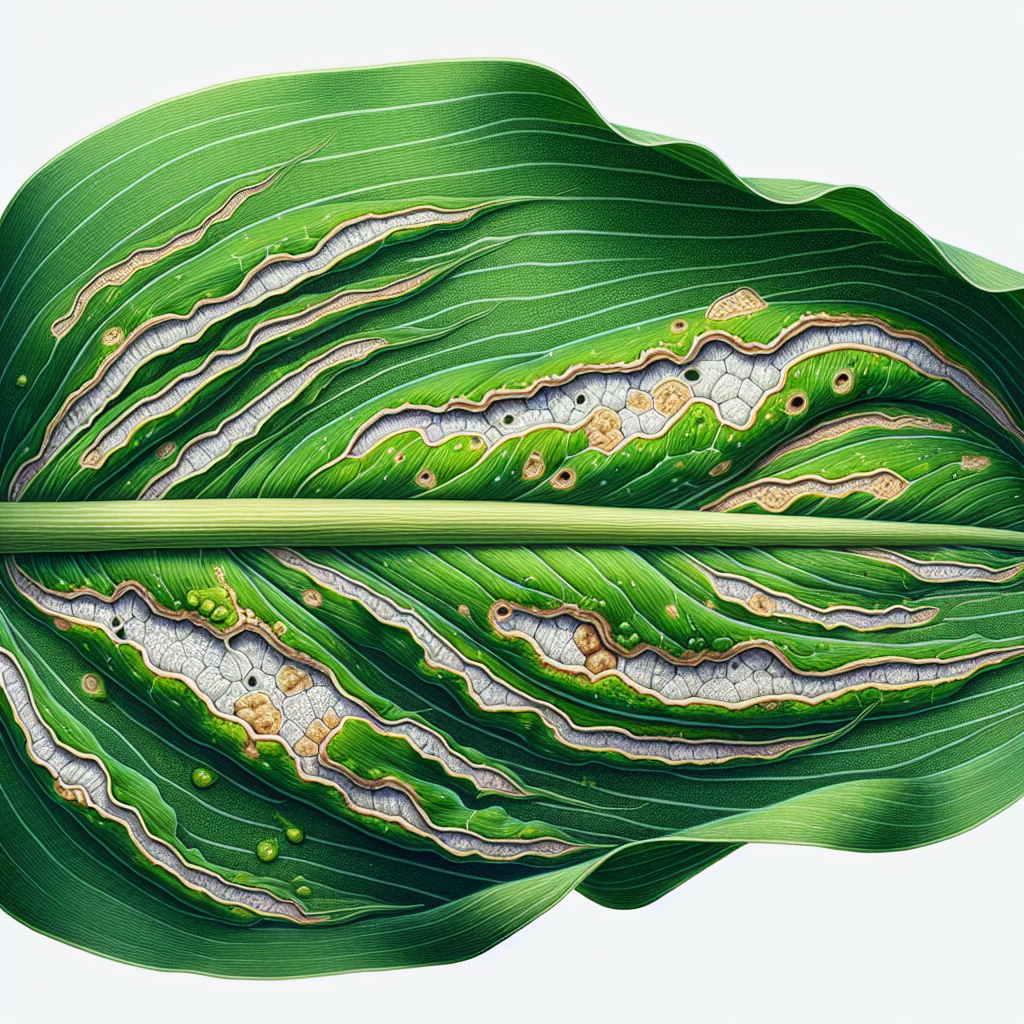
Late-season symptoms dominate in surviving plants, emerging around tasseling (VT stage). Look for linear, grayish-white leaf streaks parallel to veins, often starting at leaf tips or midrib. These lesions expand into long, necrotic blights with wavy margins, sometimes exceeding 1 meter in length. Characteristic "Stewart's lesions" feature tan centers with marginal chlorosis, occasionally showing bacterial exudate as shiny droplets on lesion undersides during wet weather.
Damage assessment reveals yield losses from both direct plant death and reduced photosynthesis in blighted foliage. In sweet corn, ears may develop poor tip fill or kernel abortion due to vascular blockage. Field scouting should focus on lower leaves first, as symptoms migrate upward. Differentiate from gray leaf spot by lesion shape—Stewart's are vein-limited and linear, not rectangular. Use a hand lens to spot bacterial streaming in lesion sap mounted on water slides for lab confirmation. Economic thresholds vary: 10-20% incidence warrants action in commercial fields.
Severe epidemics stunt plants, lodging them due to weakened stalks. Kernel quality suffers from mycotoxin risks if secondary fungi invade. Document symptoms with photos for hybrid selection next season.
Lifecycle and Progression of Stewart's Wilt
The lifecycle of Pantoea stewartii hinges on its flea beetle vector, Chaetocnema pulicaria (corn flea beetle), creating a perennial threat in temperate climates. Bacteria overwinter in beetle gut, Malpighian tubules, and eggs laid in corn debris. Adult beetles emerge in early spring (March-April), feeding on whorl-stage corn and transmitting via contaminated mouthparts. Transmission efficiency peaks at 80% during feeding wounds, with bacteria entering vascular bundles.
Once inside, P. stewartii multiplies in xylem, producing enzymes that degrade cell walls and block water flow. Seedling infections lead to rapid wilt within 7-10 days post-inoculation. Surviving plants enter latency until reproductive stages, when symptoms re-emerge as leaf blights. Bacteria ooze from lesions, contaminating more beetles and splashing to nearby plants during rain.
Beetles complete 2-3 generations per season, with second-generation adults acquiring bacteria from blighted tissues for overwintering. Crop residue harbors low-level inoculum, but flea beetles sustain populations. Disease progression accelerates post-silking, with peak severity by dough stage (R4). Under optimal conditions (25-30°C, high humidity), epidemics build exponentially. Understanding this vector-pathogen cycle informs timing for Corn Earworm and flea beetle controls.
Environmental Triggers & Risk Factors
Stewart's wilt thrives in warm, humid conditions optimal for flea beetle activity and bacterial spread. Temperatures of 24-30°C (75-86°F) with frequent rainfall (>2 inches/week) drive epidemics, especially following mild winters that boost beetle survival. High relative humidity (>85%) promotes ooze formation and leaf wetness periods exceeding 12 hours.
Susceptible hybrids like open-pollinated sweet corn (e.g., Golden Bantam) face highest risk; inbred lines vary 10-90% susceptibility. Continuous corn monoculture exceeds 30% incidence, amplified by nearby sorghum or weed hosts. No-till systems retaining residue elevate inoculum if beetle pressure is high. Early planting into cool soils favors seedling wilt, as weakened plants succumb faster.
Risk mapping integrates flea beetle counts (>5 beetles/plant at V2), hybrid ratings, and weather forecasts. Midwestern hotspots include Illinois, Indiana, and Ohio, where climate shifts extend beetle flight windows. Soil pH extremes (<5.5 or >7.5) stress plants, increasing vulnerability. Scout fields weekly from emergence, using degree-day models (base 50°F) to predict beetle flights.
Organic Control & Treatment Plans
Organic management emphasizes prevention over curative sprays, as no bactericides are OMRI-listed for Stewart's wilt. Deploy resistant hybrids like 'Silver Queen' or 'Incredible' sweet corn, rated HR (highly resistant) by seed companies. Bt corn offers partial protection against secondary lepidopterans but not flea beetles.
Target flea beetles with organic insecticides: spinosad (Entrust) at 0.5-1 oz/A, applied at first whorl stage when 50% plants show feeding scars (silvery halos). Kaolin clay (Surround) barriers deter feeding; apply at 25-50 lb/A pre-infestation. Neem oil disrupts beetle reproduction but requires frequent reapplication (every 7 days).
Cultural tactics include crop rotation with non-hosts like soybeans (2-3 years), residue tillage to 6 inches, and planting after soil warms to 60°F. Companion planting with trap crops like mustard draws beetles away. Biological controls feature nematodes (Steinernema carpocapsae) targeting beetle larvae in soil, applied at 1 billion IJs/A in evenings.
Infected plants: rogue seedlings immediately, flame-kill leaf blight foci. Copper-based products (e.g., Cueva) provide limited suppression via foliar sprays (1-2 gal/A) during wet periods, but efficacy <30%. Integrate with Spring Pest Patrol: Organic AI Strategies to Shield Your Crops from Common Invaders for vector monitoring.
Preventing Stewart's Wilt in the Future
Long-term prevention builds resilient systems via hybrid selection, sanitation, and monitoring. Prioritize Stewart's wilt-rated hybrids: source from certified clean seed (<0.1% infection). Hybrid resistance genes (e.g., from 'Ioana') block bacterial multiplication.
Implement 21-day rotation intervals, avoiding corn after corn. Destroy volunteers and weed hosts like foxtail. Fall tillage buries residue, reducing beetle pupae survival by 70%. Perimeter trap crops (susceptible corn) concentrate beetles for localized treatment.
Scouting protocols: check 20 plants/10 locations weekly, recording incidence. Economic thresholds: treat at 20% seedling wilt or 10% leaf blight. Weather-based advisories predict outbreaks using flea beetle models. Farm records track fields, aiding site-specific management.
Clean equipment between fields prevents mechanical spread. Cover crops like rye suppress beetles pre-planting. For small farms, Soil Health Mastery: 5 Proven Strategies for Small Farms to Build Fertile Ground Without Breaking the Bank enhances vigor against stress.
Crops Most Affected by Stewart's Wilt
Stewart's wilt predominantly targets corn (Zea mays), with sweet corn most economically impacted due to market standards. Field corn hybrids show variable susceptibility; dent types like Yellow Dent tolerate better than popcorn or flint varieties. Sweet corn losses reach 100% in seedlings, 30-50% in blight phase.
Minor hosts include sorghum and Johnsongrass, serving as beetle reservoirs. No significant impacts on wheat, soybeans, or vegetables. Regional focus: U.S. Corn Belt, Ontario, parts of Europe. Resistant varieties mitigate risks across all corn types.