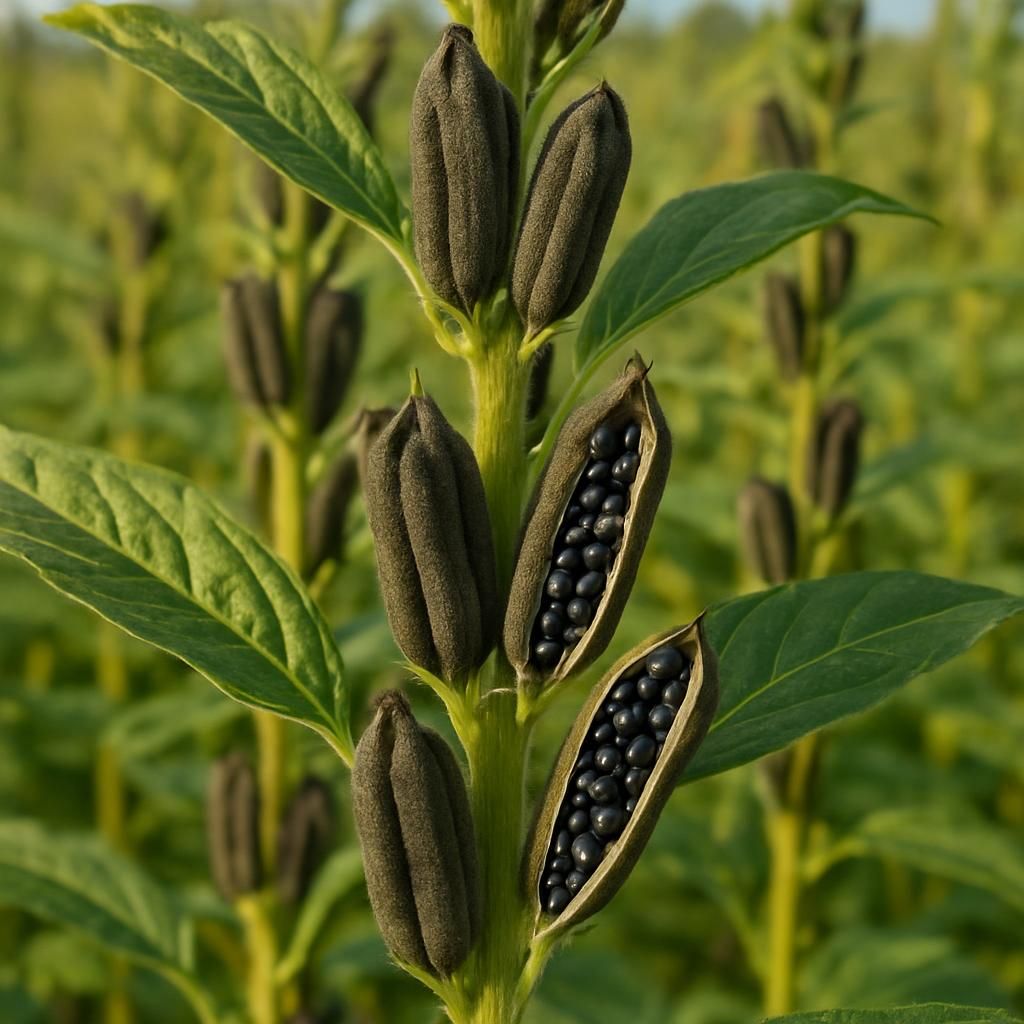
Introduction to Sesame Seed (Black)
Black sesame (Sesamum indicum) is a warm-season annual oilseed crop grown for its small, nutrient-dense seeds that are used in food, oil extraction, and traditional medicine. The black-seeded varieties contain higher levels of lignans and antioxidants compared to white sesame, making them particularly valuable in health-focused markets. Commercial production is concentrated in tropical and subtropical regions where temperatures remain consistently above 20 °C.
Farmers choose black sesame for its drought tolerance, short growth cycle of 90–120 days, and ability to produce on marginal soils when other crops struggle. Global demand for black sesame continues to rise due to its use in premium tahini, confectionery, and functional foods. With proper agronomic practices, yields of 800–1,200 kg/ha of clean seed are achievable under rainfed conditions and up to 1,800 kg/ha with supplemental irrigation.
Botanical Profile of Sesame Seed (Black)
Sesame belongs to the Pedaliaceae family and exhibits an erect, branching growth habit reaching 60–150 cm in height. The leaves are opposite, lanceolate, and vary from entire to deeply lobed depending on cultivar. Small, tubular flowers appear in the leaf axils and range in color from white to pale pink or purple. Each flower produces a dehiscent capsule containing 50–100 tiny seeds.
Black sesame varieties are distinguished by their dark seed coat, which results from higher anthocyanin accumulation. The root system is taprooted with extensive lateral branches that efficiently explore the top 60 cm of soil for moisture and nutrients. Sesame is predominantly self-pollinating, although bees and other insects can increase seed set by 10–15 % in some environments.
Soil, pH, and Climate Requirements for Sesame Seed (Black)
Sesame performs best on light to medium-textured soils with good internal drainage. Heavy clay soils that remain waterlogged reduce germination and increase the incidence of root rot. The crop tolerates a wide pH range but reaches optimum productivity between 5.5 and 8.0.
| Parameter | Ideal Range | Notes |
|---|---|---|
| Soil Type | Sandy loam to loam | Avoid compacted or waterlogged clays |
| Soil pH | 5.5–8.0 | Slightly acidic to mildly alkaline |
| Temperature (day) | 25–35 °C | Minimum germination 18 °C |
| Temperature (night) | 18–25 °C | Frost kills plants at any stage |
| Rainfall | 400–650 mm | Critical during flowering and capsule fill |
| Altitude | 0–1,200 m | Above 1,500 m growth slows significantly |
Step-by-Step Planting & Propagation
- Seed Selection: Choose certified black sesame seed with germination above 85 % and purity above 98 %.
- Land Preparation: Plough to 20–25 cm depth followed by two to three harrowings to create a fine, firm seedbed.
- Sowing Time: Plant when soil temperature at 5 cm depth reaches 20 °C and risk of frost has passed.
- Method: Drill or broadcast at 4–6 kg/ha for row spacing of 30–45 cm and plant spacing of 10–15 cm.
- Depth: Place seeds 2–3 cm deep; deeper placement delays emergence.
- Irrigation: Provide a light pre-sowing irrigation if soil moisture is below 50 % field capacity.
- Thinning: Thin seedlings to final spacing 10–12 days after emergence to avoid overcrowding.
Care & Maintenance regimes for Sesame Seed (Black)
Timely weeding, balanced nutrition, and moisture management are essential for maximizing capsule number and seed weight.
| Growth Stage | Water Schedule | Fertilizer Schedule | Pruning / Other Operations |
|---|---|---|---|
| Pre-sowing | 20–25 mm irrigation if rain insufficient | Incorporate 20 kg N, 40 kg P₂O₅, 20 kg K₂O/ha | Remove weeds; level field |
| Vegetative (0–30 DAS) | 25–30 mm every 10–12 days | Top-dress 20 kg N/ha at 25–30 DAS | First weeding at 15 DAS; second at 30 DAS |
| Flowering (30–60 DAS) | Maintain soil moisture at 60 % FC | Foliar 1 % zinc sulfate if deficiency appears | Avoid deep cultivation after flowering begins |
| Capsule Fill (60–90 DAS) | Reduce frequency; 20 mm at stress signs | No additional N; optional 0.5 % boron spray | Remove any diseased plants |
| Pre-harvest | Withhold irrigation 10–14 days before harvest | — | Monitor for lodging |
Pests, Diseases & Organic Management
Sesame is relatively hardy but can suffer from several insect and disease pressures. Aphids and leafhoppers transmit viral diseases, while capsule borers damage developing seeds. Fungal issues include Alternaria leaf spot, Cercospora leaf spot, charcoal rot, and wilt complexes.
Organic management begins with crop rotation of at least three years and use of certified disease-free seed. Encourage beneficial insects by planting flowering strips of marigold and thai-basil. Apply neem oil (0.3 %) or spinosad for chewing insects at economic threshold levels. For soil-borne diseases, solarize beds or incorporate Trichoderma harzianum at 2.5 kg/ha before sowing. Remove and destroy infected plant debris after harvest to reduce overwintering inoculum.
Harvesting, Curing & Optimal Storage
Black sesame reaches physiological maturity when lower leaves turn yellow and capsules begin to change from green to brown. Harvest when 75–80 % of capsules are mature to minimize shattering losses. Cut plants at ground level early in the morning when dew is present to reduce seed drop.
Bundle plants and stack in shocks or hang in a well-ventilated shed for 7–10 days. Thresh by beating lightly over a clean tarpaulin or use a stationary thresher set at low cylinder speed. Clean seed to remove chaff and immature seeds, then dry to 6–8 % moisture content.
Store cleaned seed in airtight containers or jute bags lined with polyethylene at 10–15 °C and <65 % relative humidity. Monitor regularly for storage beetles and bruchids; diatomaceous earth at 1 kg/tonne provides effective protection without chemical residues.
Companion Planting for Sesame Seed (Black)
Sesame benefits from strategic companions that improve soil fertility, deter pests, or provide physical support. Intercropping with pigeon pea or cowpea supplies atmospheric nitrogen and shades the soil, reducing evaporation. Rows of sorghum or millet planted on field borders act as windbreaks and trap armyworms before they reach sesame.
Planting marigold or nasturtium every 10–15 m within the crop suppresses nematodes and attracts pollinators. Avoid planting near cucumber or squash families that share susceptibility to certain viruses. After sesame harvest, follow with a legume cover crop such as hairy vetch to rebuild soil organic matter and break pest cycles.