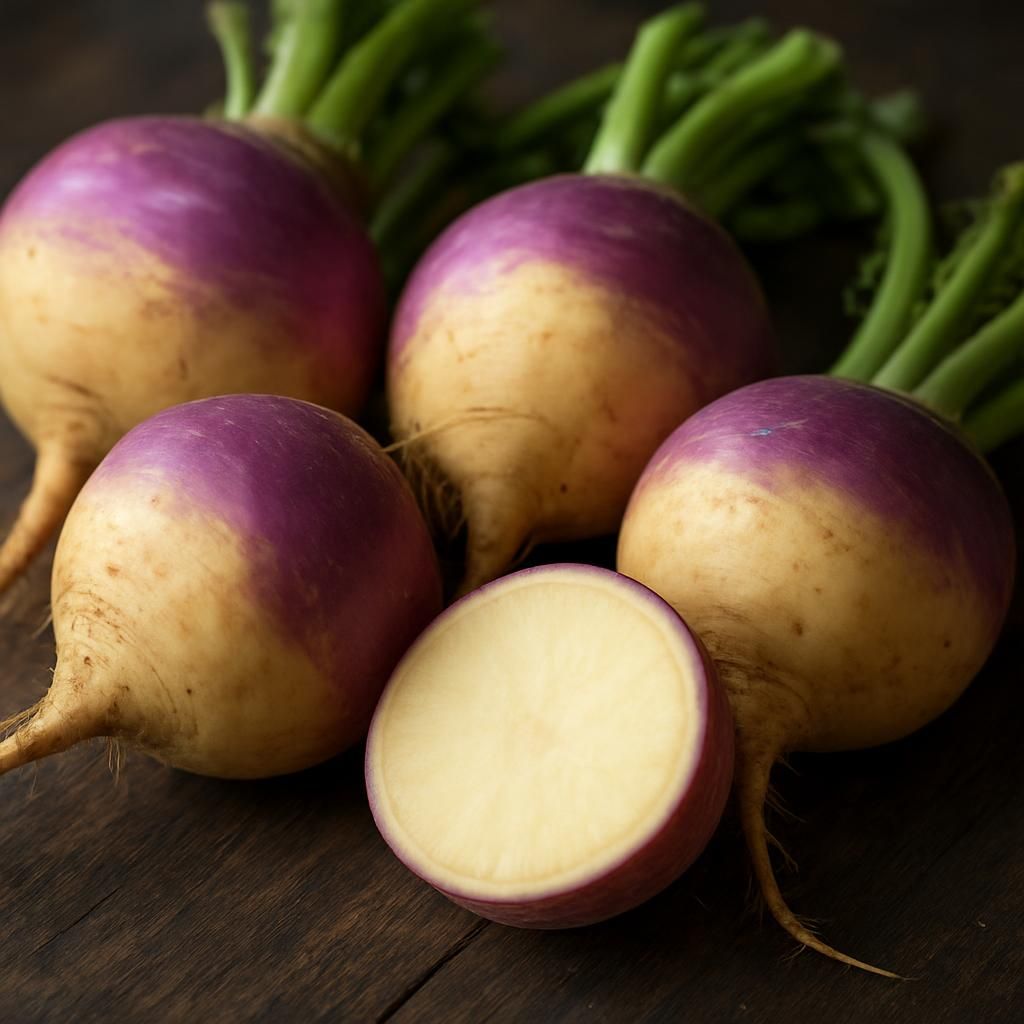
Introduction to Rutabaga (American Purple Top)
Rutabaga (American Purple Top) is a hardy biennial root vegetable developed from a cross between Turnip and cabbage. The cultivar produces globe-shaped roots with distinctive purple shoulders, creamy yellow flesh, and a mild, sweet flavor that improves after light frost exposure. Commercial growers value it for dependable storage life exceeding four months under proper conditions, while home gardeners appreciate its versatility in roasting, mashing, and soups.
The crop originated in Scandinavia and northern Europe before spreading to North America in the 19th century. American Purple Top remains one of the most widely planted rutabaga varieties in temperate regions because of its uniform size, disease resistance, and adaptability to short growing seasons. With proper timing and soil management, yields of 15–25 tons per acre are achievable in well-managed fields.
Botanical Profile of Rutabaga (American Purple Top)
Rutabaga belongs to the Brassicaceae family and is botanically classified as Brassica napus subsp. napobrassica. The plant forms a swollen hypocotyl-root that serves as the edible storage organ. Leaves are glaucous, blue-green, and deeply lobed, emerging in a basal rosette before bolting in the second year.
The American Purple Top cultivar typically reaches 4–6 inches in diameter at maturity and weighs 1.5–3 pounds. Flesh color ranges from pale yellow to deep orange-yellow, with a fine-grained texture that remains firm after cooking. The purple shoulder coloration intensifies with cool temperatures and high light exposure.
Rutabaga is a biennial that requires vernalization (exposure to 35–50 °F for 6–8 weeks) to initiate flowering. Cross-pollination occurs via bees and other insects, making isolation distances of 0.5–1 mile necessary for seed production.
Soil, pH, and Climate Requirements for Rutabaga (American Purple Top)
Rutabaga performs best in well-drained, fertile loamy soils with high organic matter. Heavy clay soils should be amended with compost or raised beds to prevent waterlogging and root deformation.
| Parameter | Ideal Range | Notes |
|---|---|---|
| Soil Type | Sandy loam to loam | Good drainage essential |
| Soil pH | 6.0–6.8 | Avoid acidic soils below 5.8 |
| Organic Matter | 3–5% | Incorporate well-rotted compost |
| Temperature Range | 55–70 °F daytime | Tolerates light frost down to 25 °F |
| Soil Temperature | 50–65 °F at planting | Germination fails above 85 °F |
| Moisture | Consistent, 1 inch/week | Avoid water stress during root enlargement |
The crop requires a cool growing season of 90–110 days. Excessive heat causes woody texture and bitter flavor. In warmer climates, fall planting allows roots to mature during cooler months.
Step-by-Step Planting & Propagation
Site Selection: Choose a location with full sun (minimum 6 hours) and good air circulation. Avoid fields previously planted with brassicas within the last three years to reduce disease pressure.
Soil Preparation: Conduct a soil test and adjust pH with agricultural lime if below 6.0. Incorporate 2–3 inches of compost and a balanced organic fertilizer (NPK 5-5-5 or similar) at 2–3 lbs per 100 sq ft.
Seed Treatment: Use certified disease-free seed. Soak seeds in water for 12 hours or treat with hot water (122 °F for 20 minutes) to reduce seed-borne pathogens.
Direct Sowing: Plant seeds ½ inch deep in rows 18–24 inches apart. Thin seedlings to 6–8 inches within the row once true leaves appear.
Transplanting Option: Start seeds indoors 5–6 weeks before last frost. Harden off seedlings and transplant at the same spacing when they have 3–4 true leaves.
Succession Planting: In regions with long summers, sow every 3–4 weeks until 90 days before first expected frost for continuous harvest.
Care & Maintenance regimes for Rutabaga (American Purple Top)
Consistent moisture and balanced nutrition are critical during the first 60 days after germination when root bulking occurs.
| Task | Schedule | Details |
|---|---|---|
| Irrigation | 1 inch per week, 2–3x | Drip irrigation preferred; mulch to retain moisture |
| Fertilizer (N) | At planting + 4 weeks | Side-dress with ½ lb nitrogen per 100 ft row |
| Fertilizer (P & K) | Pre-plant incorporation | Use rock phosphate and sulfate of potash |
| Weed Control | Weekly until canopy closes | Shallow cultivation; avoid root damage |
| Thinning | 3–4 weeks after emergence | Maintain 6–8 inch spacing |
| Mulching | After thinning | 2–3 inches straw or leaf mulch |
| Pruning | Not required | Remove yellowing leaves only if diseased |
Monitor for magnesium deficiency (interveinal chlorosis) and apply Epsom salts at 1 tbsp per gallon if symptoms appear.
Pests, Diseases & Organic Management
Rutabaga shares many pests with other brassicas. Early detection and integrated management are essential.
Common insect pests include Cabbage worms, flea beetles, cutworms, and root-knot nematodes. Floating row covers provide excellent protection during early growth stages.
Major diseases are clubroot, Alternaria leaf spot, downy mildew, and black rot. Practice 3–4 year crop rotations and use resistant varieties when available. Apply copper-based fungicides or Bacillus subtilis products at first sign of foliar disease.
Organic controls include neem oil for aphids and caterpillars, diatomaceous earth for flea beetles, and beneficial nematodes for soil pests. Maintain field sanitation by removing crop debris after harvest.
Harvesting, Curing & Optimal Storage
Rutabaga reaches harvest maturity 90–110 days after sowing when roots measure 3–5 inches in diameter. Pull or dig roots carefully to avoid bruising. Trim tops to 1 inch and remove fine roots.
Curing is minimal; allow roots to air-dry for 2–4 hours before storage. Ideal storage conditions are 32–38 °F with 90–95% relative humidity. Roots stored in perforated plastic bags or sand-filled bins remain firm for 4–6 months.
Avoid washing before storage. Sort out any damaged or diseased roots to prevent spread. Monitor monthly for soft spots or mold.
Companion Planting for Rutabaga (American Purple Top)
Rutabaga benefits from strategic pairings that improve soil health, deter pests, and maximize space. Compatible companions include Onion, Garlic, Lettuce, and Peas.
Strong-scented herbs such as Thyme and Rosemary help repel cabbage worms and flea beetles. Avoid planting near other brassicas to reduce disease transmission.
Deep-rooted companions like Carrot and Beet can be interplanted in alternate rows for efficient land use. Leguminous cover crops such as Clover or Hairy vetch preceding the crop add nitrogen and improve soil structure.