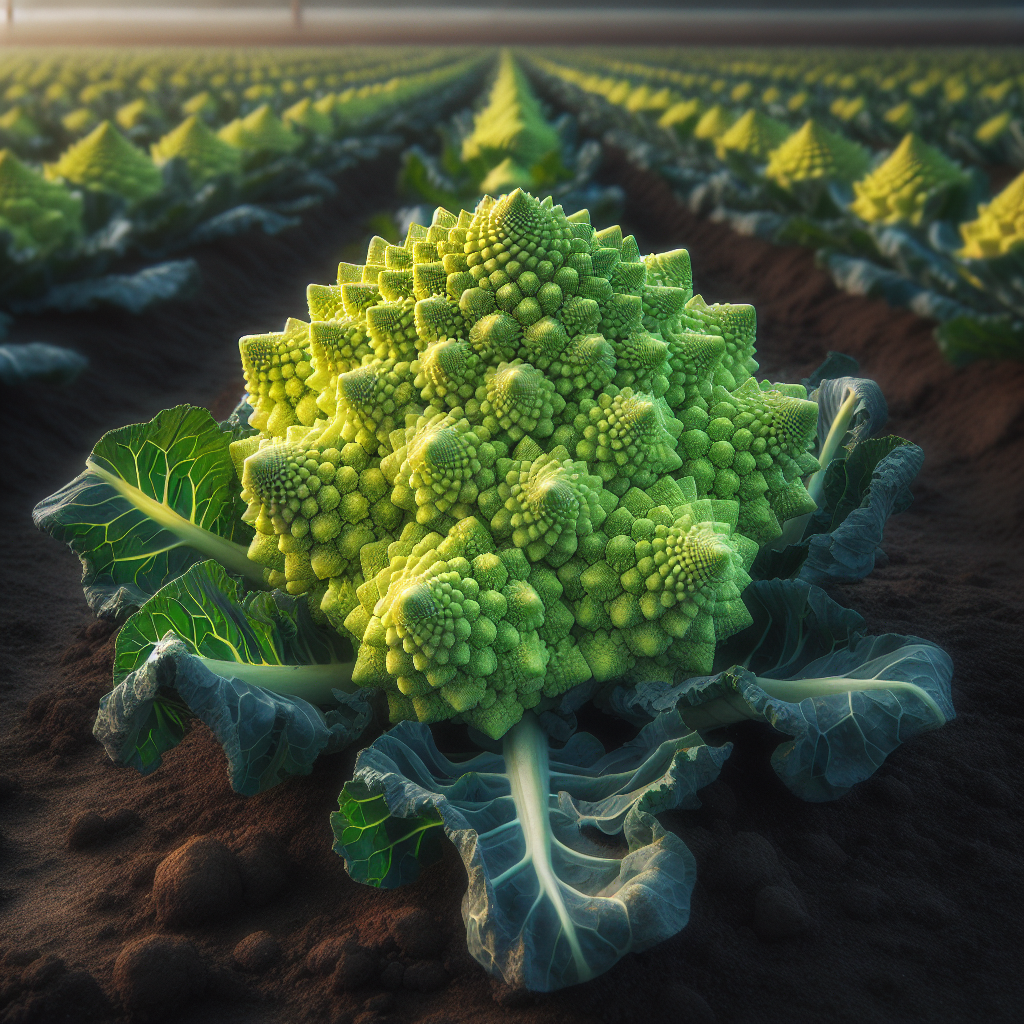
Introduction to Romanesco Cauliflower
A striking Italian heirloom-type brassica, this crop is famous for its lime-green, mathematically patterned curd made of pointed spirals arranged in logarithmic symmetry. It belongs to the same species complex as cabbage, broccoli, kale, and standard Cauliflower, but its market appeal is distinct: growers value it as a premium fresh-market vegetable with exceptional visual appeal and a sweeter, nuttier flavor than many white cauliflowers.
Historically associated with central Italy, especially the Lazio region around Rome, Romanesco has moved from regional curiosity to specialty-market staple. Its appearance is not just ornamental; the head structure reflects a genetic tendency toward repeated meristem formation, giving the crop its self-similar, fractal architecture. From a production standpoint, that beauty comes with a challenge: Romanesco is less forgiving than standard storage vegetables and can lose quality quickly when exposed to heat stress, erratic watering, or excess nitrogen late in development.
Romanesco is best grown as a cool-weather crop in spring or, even better in many regions, as a fall crop maturing in steadily cool conditions. Heat during head initiation often causes loose, ricey, or misshapen heads. Severe cold after establishment can also slow growth dramatically or induce stress responses. For commercial and serious home growers alike, the key principle is consistency: steady growth from transplanting to harvest produces the tightest spirals, best color, and finest flavor. For broader seasonal planning in mixed vegetable systems, see this fall companion planting guide.
Botanical Profile of Romanesco Cauliflower
This crop is classified within Brassicaceae, the mustard family, and more specifically within Brassica oleracea, one of the most morphologically diverse cultivated plant species in agriculture. Romanesco is generally treated horticulturally as a cauliflower type, though some strains show intermediate traits between cauliflower and broccoli. The edible portion is an immature inflorescence meristem, commonly called the curd or head.
Plants typically form a broad rosette of blue-green to gray-green waxy leaves before the central head develops. Mature plant spread often reaches 45-75 cm, with height around 45-70 cm depending on cultivar vigor and soil fertility. Leaves are thick, somewhat glaucous, and protective; in some strains they partially wrap the head, helping reduce sun exposure and preserve the desirable green color.
The head itself is composed of repeating conical florets arranged in spirals, often displaying Fibonacci-like phyllotaxis. Unlike the rounded, compact curd of white cauliflower, Romanesco forms a pointed dome made of many miniature towers. Ideal heads are dense, symmetrical, bright green, and free from fuzziness, separation, browning, or purple discoloration. Head size commonly ranges from 10-20 cm across, though premium marketability depends more on firmness and symmetry than absolute diameter.
Like other brassicas, Romanesco is a biennial by life cycle but grown as an annual for its immature reproductive structure. If left unharvested and vernalized, it can bolt and eventually produce yellow four-petaled flowers typical of the mustard family. Seed production requires isolation from other B. oleracea crops to maintain varietal purity, since cross-pollination with broccoli, cauliflower, cabbage, kale, and related crops can occur.
Rooting is relatively shallow to moderate, with most feeder roots concentrated in the top 20-30 cm of soil. This is agronomically important: the crop is very sensitive to moisture fluctuations, soil crusting, and competition from weeds. Its nutrient demand is high, especially for nitrogen, calcium, boron, and sulfur, but excessive fertility can be as damaging as deficiency if it pushes lush vegetative growth at the expense of head quality.
Soil, pH, and Climate Requirements for Romanesco Cauliflower
The ideal soil is deep, fertile, moisture-retentive yet well-drained, and rich in stable organic matter. Romanesco performs best in loam or sandy loam with excellent tilth and enough fine organic fraction to hold uniform moisture. Heavy clay can produce good yields if raised beds and organic matter improve drainage, but waterlogging sharply increases the risk of root stress, stunting, and disease. Very light sandy soils can work only if irrigation is frequent and fertility is carefully spoon-fed.
Target soil pH is 6.5-7.2. Growth is still possible from roughly 6.2 to 7.5, but the optimal band is slightly acidic to neutral, where calcium availability is good and micronutrient imbalances are minimized. Below pH 6.2, brassicas become more vulnerable to Clubroot and may suffer reduced nutrient uptake. If pH is too low, apply agricultural lime well before planting, ideally several months in advance, because abrupt pH correction at planting is less effective.
Organic matter should ideally be at least 3-5% for field production and often higher in garden beds. Well-finished compost incorporated before planting improves water retention, aggregation, microbial activity, and nutrient buffering. Avoid using fresh manure near planting time, especially for spring crops, because it can cause excessive soluble nitrogen, uneven growth, and elevated disease pressure.
Romanesco is fundamentally a cool-season crop. The best average temperature range for vegetative growth is about 15-21°C, while head initiation and finishing are highest quality at roughly 12-18°C. Prolonged temperatures above 24°C frequently reduce head density and can cause bracting, riciness, or bitterness. Temperatures below about 5°C for extended periods slow growth substantially; hard freezes may injure outer leaves and, if plants are small, compromise development.
In most temperate regions, fall production is more reliable than spring production because the crop matures as temperatures decline rather than rise. Spring crops are possible where summers arrive late, but a sudden hot spell just before head formation can ruin quality. Romanesco also benefits from full sun, ideally 6-8 hours daily, though in hot shoulder-season climates light afternoon shade can reduce stress.
Consistent soil moisture is critical. Aim to keep the root zone evenly moist, roughly comparable to 60-80% of field capacity in agricultural terms: damp and friable, never dusty-dry and never saturated. If you squeeze a handful of soil from the root zone, it should hold together lightly without releasing water. Overwatering signs include persistent surface algae, sour smell, lower leaf yellowing despite adequate fertility, slowed growth, and blackened feeder roots. Underwatering signs include midday wilting that persists into evening, bluish cast to leaves, marginal scorching, small heads, and premature buttoning.
Step-by-Step Planting & Propagation
Romanesco is almost always propagated by seed. Direct sowing is possible in mild climates, but transplant production is preferred because it improves stand uniformity, reduces early pest loss, and makes timing more precise.
Schedule backward from target harvest. Most Romanesco cultivars require about 75-100 days from transplanting, depending on season and strain. Start seeds 4-6 weeks before planned transplanting.
Use a clean seed-starting medium. Sow in trays or modular plugs with a sterile, fine-textured mix. Optimal germination temperature is 18-24°C. Seeds usually emerge in 4-10 days. Cooler temperatures slow emergence; excessive heat can reduce uniformity.
Sow at proper depth. Plant seeds 0.5-1 cm deep. Keep the medium uniformly moist but never waterlogged. Saturated media cause Damping-off and weak roots.
Provide strong light immediately after emergence. Seedlings need bright light and good airflow to prevent stretching. Day temperatures around 16-20°C and nights around 10-14°C produce stocky, resilient transplants.
Fertilize seedlings lightly. Once true leaves appear, feed with a dilute balanced fertilizer at about one-quarter to one-half strength weekly. Avoid pushing seedlings too hard; oversized, root-bound transplants often button or become uneven after planting out.
Harden off for 5-7 days. Gradually expose seedlings to outdoor light, wind, and cooler temperatures. Reduce water slightly, but do not let plants wilt hard.
Transplant at the correct stage. Ideal transplants have 4-6 true leaves, a sturdy stem, and a well-knit root ball not yet circling aggressively. Delayed transplanting is a common cause of undersized heads.
Prepare beds thoroughly. Incorporate mature compost and a balanced preplant fertilizer according to soil test. Brassicas respond well when phosphorus, potassium, sulfur, calcium, and boron are adequate before planting.
Set spacing based on market size. For large heads, plant 45-60 cm apart in rows 60-75 cm apart. Closer spacing increases total yield per area but reduces head size and may increase humidity around foliage.
Plant deeply enough for stability. Set transplants so the root ball is fully covered and the stem base is supported, but do not bury the crown excessively. Water in immediately to settle soil around roots.
Use row cover early if pest pressure is high. Lightweight insect mesh or row cover is highly effective against Flea beetles, imported cabbage worm moths, and cabbage root fly in the establishment phase.
Direct sowing, where used, should place seeds 1-1.5 cm deep in finely prepared soil, then thin to final spacing once seedlings establish. This method works best in mild, stable weather and highly managed market gardens.
Care & Maintenance regimes for Romanesco Cauliflower
Uniform growth is the whole game. Any check in growth from transplant shock, drought, nutrient shortage, crowding, or insect feeding can lead to buttoning, where a tiny premature head forms before the plant has built enough leaf area.
Water deeply and regularly, usually supplying 25-40 mm per week from rain or irrigation, with the higher end needed in sandy soils or windy weather. During rapid head development, many growers aim for the equivalent of about 4-5 liters per plant per week, adjusted for soil type and rainfall. Drip irrigation is strongly preferred because it keeps foliage dry and delivers steady moisture to the root zone. Avoid cycles of saturation and drought; those swings cause coarse texture, reduced sweetness, and split growth patterns.
Mulch with straw, shredded leaves, or compost once the soil has warmed enough for establishment. A 3-5 cm mulch layer helps moderate soil temperature, reduce weed competition, and stabilize moisture. Keep mulch slightly back from the stem to reduce collar rot risk.
Nutrient management should be guided by soil testing, but Romanesco generally benefits from moderate-to-high fertility. Nitrogen should be available steadily, not all at once. A common approach is to apply part before transplanting and side-dress the remainder 3-4 weeks later, then again at early head initiation if growth is pale or slow. Excess nitrogen late in the cycle can create overly leafy plants and looser heads, so stop heavy feeding once heads are clearly forming.
Calcium and boron deserve special attention. Calcium deficiency, often caused by irregular watering rather than low soil calcium alone, can contribute to internal tipburn. Boron deficiency may cause hollow stem, corky tissue, brittle growth, and deformed heads. Because boron has a narrow safety margin, apply only according to soil test recommendations.
Weed control is essential in the first 4-6 weeks after transplanting. Romanesco does not compete strongly with aggressive weeds during establishment. Use shallow cultivation to avoid damaging feeder roots, and combine this with mulching for best results.
In warm spells, monitor heads frequently. If strong sun threatens discoloration or heat injury, outer leaves can be gently tied over the developing head in more exposed strains, though many Romanesco cultivars self-cover adequately. Avoid damaging leaf petioles while doing this.
Common physiological problems include:
- Buttoning: Usually from old transplants, cold shock, root restriction, or nutrient/water stress.
- Riciness: Grainy, fuzzy curd surface caused by heat or overmaturity.
- Leafy/bracted heads: Often linked to heat stress or genetic tendency under poor conditions.
- Purple tinting: Sometimes cold-related anthocyanin expression, usually cosmetic.
- Hollow stem: Associated with rapid growth and boron imbalance.
Crop rotation is mandatory. Do not grow Romanesco or other brassicas in the same ground more than once every 3-4 years where disease pressure exists. This is especially important for Clubroot management.
Pests, Diseases & Organic Management
As a brassica, Romanesco attracts a predictable pest complex. Prevention, monitoring, exclusion, and sanitation are more effective than trying to rescue heavily infested plants later.
Major insect pests include Cabbage worms, Cabbage loopers, Diamondback moth larvae, Flea beetles, Aphids, and Cabbage root maggots. Young plants are especially vulnerable to flea beetle shot-holing and root maggot injury, while developing heads can be contaminated by caterpillar frass.
For organic management, floating row covers used immediately after transplanting are among the best tools. Seal edges thoroughly so moths and flies cannot enter. Remove covers when plants need more space or if overheating becomes a concern. Hand inspection remains important: check leaf undersides weekly for eggs and small larvae.
Bacillus thuringiensis var. kurstaki (Bt) works well on young caterpillars when applied early and repeatedly as needed. Spinosad can also be effective but should be used carefully to reduce harm to non-target insects. Aphids can often be suppressed with strong water sprays, insecticidal soap, or by conserving beneficial insects.
Companion flowers such as Nasturtium and insectary species like Yarrow can help diversify the field edge and support predatory insects, though they are supplements rather than stand-alone controls.
Key diseases include Clubroot, Black rot, Downy mildew, Alternaria leaf spot, Damping-off in seedlings, and Bacterial soft rot after harvest or in wet conditions. Clubroot is among the most serious because spores persist in soil for years. It causes swollen, distorted roots, midday wilt despite moist soil, and severe stunting. Prevent it by rotating away from brassicas, keeping soil pH near neutral or slightly above, and never moving contaminated soil on tools or boots.
Black rot often enters through leaf margins and hydathodes, causing V-shaped yellow lesions progressing inward. It thrives in warm, wet conditions and can be seedborne. Buy high-quality seed, avoid overhead irrigation, and remove infected residues. Downy mildew appears as yellow patches on upper leaf surfaces with grayish growth beneath in cool, humid weather; spacing and airflow are important preventive measures.
Sanitation is critical. Remove crop debris promptly after harvest, control cruciferous weeds that harbor pests and diseases, and compost only if piles reliably heat enough to break down infected tissue. In high-pressure systems, biofumigant cover crops or solarization may help reduce inoculum, but rotation remains the core strategy.
Harvesting, Curing & Optimal Storage
Harvest when heads are fully formed, dense, vividly green, and sharply pointed, before the florets begin to separate. Most marketable heads are cut at 15-20 cm diameter, but exact size depends on cultivar and market. Waiting too long reduces quality quickly: the spirals loosen, texture coarsens, and the head may become ricey or start elongating.
Use a sharp knife and cut the head with 10-15 cm of stem plus several wrapper leaves attached if selling fresh. Those leaves protect the curd during handling and reduce moisture loss. Harvest in the cool of morning whenever possible, especially for direct sales or longer storage.
Romanesco is not cured like onions, garlic, or winter squash. Instead, it should be field-cooled and refrigerated quickly. Remove field heat immediately after harvest by placing heads in shade, then cooling to 0-4°C as soon as possible. High respiration means quality drops fast if produce sits warm after harvest.
Optimal storage conditions are 0-1°C with 95-100% relative humidity. Under these conditions, quality may hold for roughly 1-2 weeks, sometimes slightly longer for perfectly harvested heads. At lower humidity, the curd dehydrates and loses crispness; at warmer temperatures, yellowing, softening, and decay accelerate. Do not store near ethylene-sensitive produce only if mixed storage is unavoidable; while brassicas are not the most sensitive group, mixed produce rooms should still be ventilated to maintain quality.
Wash only if necessary for immediate sale or use. For storage, keeping heads dry on the surface helps limit Bacterial soft rot. Trim damaged outer leaves, but do not over-trim protective wrappers until marketing.
Flavor is best when growth has been steady and harvest occurs in cool weather. Light frost before harvest can improve sweetness in some brassicas, but repeated freezing and thawing damages texture and shortens shelf life.
Companion Planting for Romanesco Cauliflower
The best companions are those that either confuse pests, improve habitat for beneficial insects, or occupy a different rooting and canopy niche without competing aggressively. Aromatic alliums are especially useful around brassicas because their scent may help disrupt pest location by flying insects. Onion and Garlic are among the most practical companions in market gardens because they fit neatly on bed edges and do not create excessive shade.
Low-growing, quick crops can also make efficient use of space during early establishment. Lettuce works well between wider-spaced Romanesco plants early in the season because it matures before the brassica canopy fully expands. This relay use of bed space is particularly effective in intensive gardens.
Flowering insectary plants deserve a place nearby rather than directly crowding the crop. Yarrow and nasturtium can attract beneficial insects and act as distraction or support plants, but keep enough spacing so airflow around Romanesco remains high. Dense, tangled companion plantings that trap humidity often worsen disease risk rather than improve field ecology.
Avoid planting Romanesco next to other heavy-feeding brassicas if your goal is pest reduction; grouping multiple brassicas together can create a stronger visual and chemical target for moths, Aphids, and disease spread. Also avoid letting vigorous companions shade the crop, because uniform light is important for dense, well-colored heads.
In practical rotations, the most successful companion strategy is structured rather than random: edge Romanesco with alliums, use fast salad crops as temporary intercrops, and maintain flowering beneficial strips adjacent to—not smothering—the main bed.