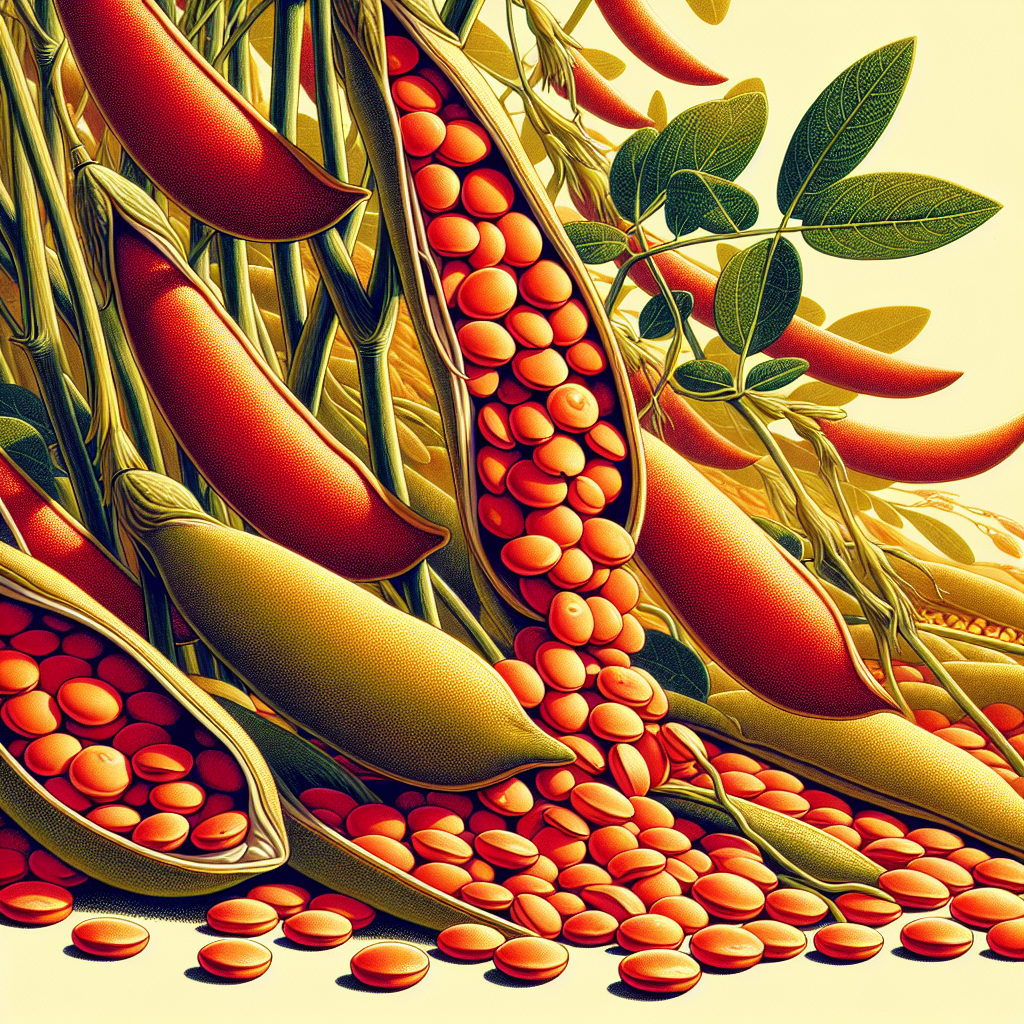
Introduction to Red Lentils
Red lentils (Lens culinaris subsp. culinaris) represent one of the most accessible and rewarding crops for home gardeners, small farms, and commercial growers alike. Unlike their green or brown counterparts, red lentils are split and hulled, resulting in a vibrant coral color that cooks down quickly into creamy dals, soups, and curries without soaking. Originating from the Near East around 13,000 years ago, they've become a global staple, providing essential protein, fiber, iron, and folate in vegan diets worldwide.
This deep-dive growing guide equips you with professional-grade agricultural advice to cultivate red lentils successfully. Whether you're rotating them into a peas plot for soil health or scaling up for market sales, red lentils offer 90-120 day maturity, drought tolerance, and the ability to fix atmospheric nitrogen—improving soil fertility for subsequent crops like wheat or corn. Expect yields of 800-1,500 lbs per acre under optimal conditions, with home gardens producing 1-2 lbs per 10-foot row. Their low input requirements make them ideal for sustainable farming. For more on legume family dynamics, check our detailed Lentils (crop) wiki page.
Key benefits include minimal fertilizer needs due to nitrogen fixation (up to 50-100 lbs N/acre), erosion control on slopes, and cover crop versatility in rotations. Challenges like Ascochyta blight can be managed organically, ensuring clean harvests. Dive in to master this powerhouse pulse.
Botanical Profile of Red Lentils
Red lentils belong to the Fabaceae family, genus Lens, with the botanical name Lens culinaris subsp. culinaris. This cool-season annual legume features a slender, branching stem growing 12-24 inches tall, with compound pinnate leaves bearing 4-7 pairs of small, oblong leaflets. Delicate white, pink, or pale blue flowers emerge in clusters of 1-2 from leaf axils, self-pollinating efficiently.
Pods develop rapidly, maturing to 0.5-0.75 inches long, containing 1-2 flat, biconvex seeds per pod. The signature red lentil seed is small (100-seed weight ~2-3g), scarlet-orange when dehulled, derived from varieties like 'Red Chief' or 'Crimson'. Plants exhibit an indeterminate growth habit, continuing to flower and set pods until moisture stress or senescence halts development.
Root systems form extensive nodules via symbiosis with Rhizobium leguminosarum bv. viciae, fixing nitrogen efficiently in well-aerated soils. Varieties differ in maturity: early types like 'Robin' (85 days) suit short seasons, while 'Redberry' excels in heat. Genetically, red lentils lack the seed coat tannins of whole lentils, enhancing digestibility. For broader legume insights, explore our Chickpeas (crop) wiki.
Soil, pH, and Climate Requirements for Red Lentils
Red lentils thrive in well-drained, loamy sands or silt loams with 1-2% organic matter. Avoid heavy clays prone to waterlogging, which invite root rots like Fusarium. Optimal pH ranges 6.0-7.5; test soil and amend with lime if below 5.8 or sulfur if exceeding 8.0. Incorporate 20-40 lbs P2O5/acre pre-planting, but nitrogen is unnecessary due to fixation—excess N promotes lush foliage over pods.
Climate-wise, cool temperatures (60-75°F daytime) during vegetative growth accelerate maturity, with tolerance to light frosts (-5°F seedling stage). They require 12-18 inches seasonal rainfall, drought-resistant once established via deep taproots (up to 3 feet). Full sun (6+ hours) is essential; partial shade reduces yields 20-30%. In hot climates (>90°F), mulch suppresses weeds and conserves moisture. Rotate with cereals to break pest cycles. Learn soil-building strategies in our Soil Health Mastery blog post.
Incorporate cover crops like clover post-harvest to maintain fertility. Salinity tolerance is moderate (ECe <4 dS/m); irrigate judiciously to prevent root rot.
Step-by-Step Planting & Propagation
Seed Selection & Preparation: Choose certified, disease-free seeds (germination >85%). Inoculate with rhizobial bacteria and treat with biofungicide for damping-off prevention.
Timing: Direct sow 2-4 weeks before last frost (soil >45°F). Summer planting possible in mild winters.
Seedbed Prep: Till to 6-8 inches, firm seedbed. Row spacing 6-12 inches, plant density 20-40 plants/ft².
Sowing: Plant 1-1.5 inches deep, 1-2 inches apart. Cover firmly; roll for contact.
Emergence: 7-14 days. Thin to 4-6 inches if crowded.
Propagation is seed-based; no viable cuttings. For small farms, broadcast at 40-60 lbs/acre. Winter sowing techniques from our Winter Sowing Mastery blog adapt well.
Care & Maintenance regimes for Red Lentils
Irrigate sparingly: 1 inch/week if rainfall <1 inch. Avoid overhead watering to prevent foliar diseases. Weed early—hand-pull or hoe until canopy closes (4-6 weeks). No fertilizers post-emergence; side-dress potassium if deficient.
Scout weekly for nutrient issues: yellowing lower leaves signal sulfur lack. Stake tall varieties in wind-prone areas. Mulch with straw (2-3 inches) for moisture retention and weed suppression. Monitor growth stages: vegetative (0-40 days), flowering (40-60), pod-fill (60-100). Desiccate 10-14 days pre-harvest for dryland uniformity. Integrate into rotations for sustained yields.
Pests, Diseases & Organic Management
Pests: Aphids cluster on tips—blast with water or release ladybugs. Flea beetles skeletonize seedlings; row covers or neem oil. Cutworms sever stems—collar transplants. Armyworms defoliate; BT kurstaki sprays. Pod borers rare but monitor.
Diseases: Ascochyta blight causes spots—rotate, resistant varieties, copper sprays. Root rots (Rhizoctonia, Fusarium) from poor drainage—improve tilth. Powdery mildew—potassium bicarbonate. Seedling damping-off prevented by treated seed.
Organic IPM: Beneficials like predatory wasps, trap crops. See Spring Pest Patrol blog for protocols.
Harvesting, Curing & Optimal Storage
Harvest at 80-90% pod maturity (rattling seeds, 18-25% moisture). Direct combine or swath/reap for small grains. Thresh gently to avoid splits. Dry to 14% moisture in thin layers, aerated bins.
Cure 7-10 days at 70-80°F, 50-60% RH. Store in airtight containers at <13% moisture, 40-60°F. Shelf life 1-2 years; watch for Bruchids. Yields peak with timely harvest.
Companion Planting for Red Lentils
Leverage nitrogen fixation: pair with potato, corn, cucumber. Avoid onion family (allelopathy). Benefits squash growth. Trap crops like marigold deter nematodes. Detailed strategies in Why Companion Planting Feels Like Guesswork blog. Clover as living mulch enhances biodiversity.