Introduction to Pomelo (Chandler)
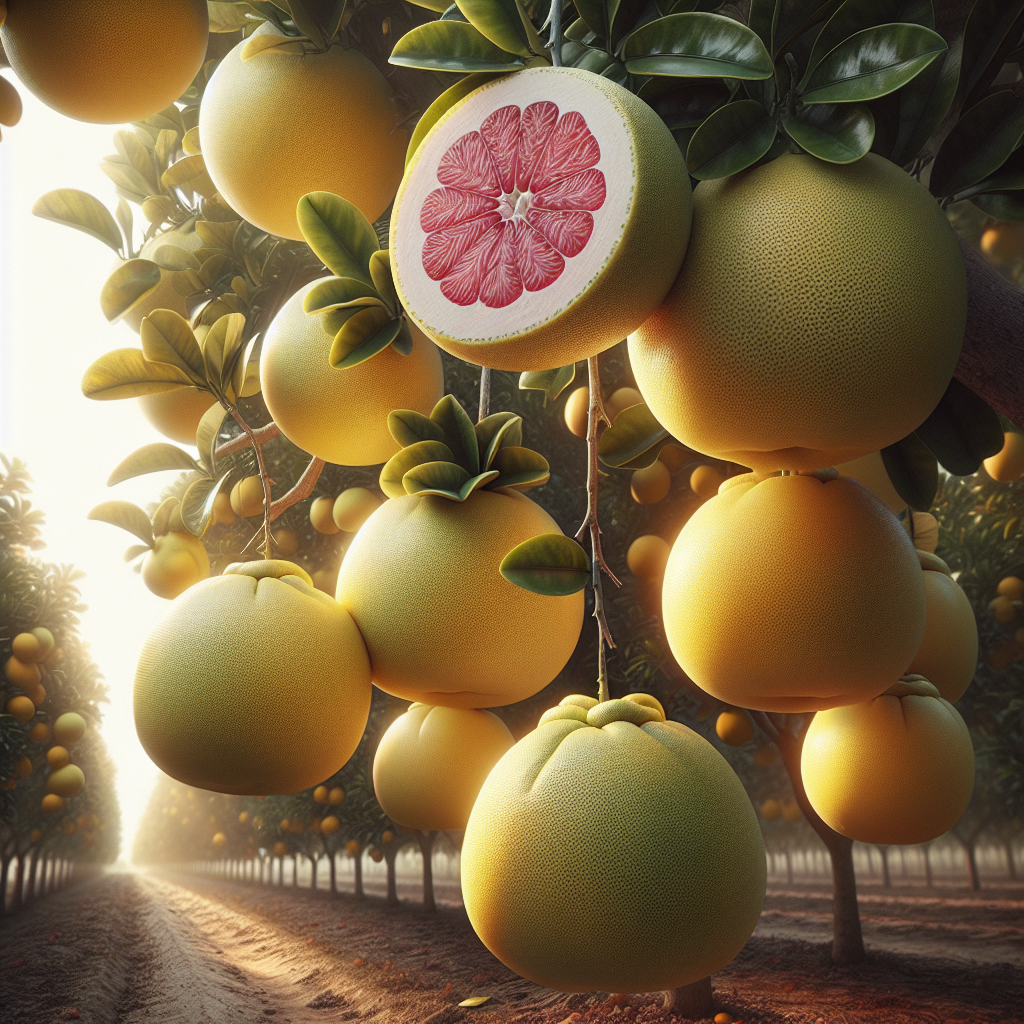
Among pomelos, Chandler is widely regarded as one of the finest dessert cultivars because it combines the dramatic size typical of pomelo with a more approachable eating quality than many older selections. The fruit is usually round to slightly pear-shaped, with a smooth to lightly pebbled rind, pale yellow exterior at maturity, and attractive pink to deep rosy flesh inside. Compared with many white-fleshed pomelos, Chandler tends to be sweeter, juicier, and less sharply bitter, which makes it especially suitable for fresh consumption.
Pomelo is the largest-fruited species within the citrus group and is one of the ancestral citrus types from which grapefruit and several hybrids ultimately derive. Chandler reflects that heritage but should not be confused with grapefruit in management or harvest timing. Fruit often requires a long maturation period on the tree, and flavor improves substantially when the crop is allowed to fully develop under warm days, cool but frost-free nights, and steady late-season moisture.
For growers, Chandler is best thought of as a warm-climate, medium-vigor citrus tree that rewards patience. It is not the fastest-bearing citrus, but once established it can produce heavy crops of impressive fruit. If you already grow other citrus, cultural practices are broadly comparable to Orange, but pomelo generally needs more space, slightly more patience to maturity, and careful crop load management to achieve top fruit size.
Commercially and in serious backyard orchards, Chandler is favored where winter cold is limited and heat accumulation is sufficient to build sugars. The variety also has ornamental value: broad glossy leaves, fragrant white blossoms, and oversized hanging fruit make it visually striking. Its thick rind also gives the fruit better postharvest handling tolerance than some thin-skinned citrus, although poor timing at harvest can still reduce eating quality.
Botanical Profile of Pomelo (Chandler)
This cultivar belongs to the Rutaceae family and the species Citrus maxima, sometimes listed under older taxonomic treatments as Citrus grandis. Trees are evergreen, with a rounded canopy and moderately vigorous branch structure. Mature height commonly ranges from 12 to 20 feet in managed plantings, though trees on vigorous rootstocks in frost-free climates can exceed that if left unpruned. Canopy spread is often similar to height, so crowding is a frequent long-term mistake in mixed orchards.
Leaves are large, leathery, and glossy green, with broadly winged petioles that are more pronounced in pomelo than in many mandarins or sweet oranges. New flush emerges pale green to bronze depending on growing conditions. Thorniness varies by rootstock and age; young shoots may carry stout thorns, while older bearing wood becomes less aggressive.
Flowers are white, waxy, and strongly fragrant, borne singly or in small clusters on shoot tips or leaf axils during spring flush, though some off-season bloom can occur in warm climates. Chandler is generally self-fertile, so a single tree can bear fruit without a second pollinizer. Even so, insect activity improves fruit set consistency. Excessive bloom does not always translate to desirable yield; natural fruit drop is normal and often beneficial because it reduces competition among developing fruit.
Fruit is one of Chandler's defining traits. Individual pomelos commonly weigh 2 to 4 pounds, with exceptional specimens exceeding that. The rind is thick, especially in dry climates or on trees under light crop loads. Flesh is segmented, pink, tender for a pomelo, and usually less resinous than traditional white cultivars. Seeds may be few to moderate depending on pollination environment and nearby citrus.
Root behavior depends heavily on rootstock. On vigorous rootstocks, Chandler develops a deep and wide exploratory root system when soil structure permits, but the majority of feeder roots still concentrate in the upper 8 to 24 inches of soil where oxygen and nutrients are available. That matters for irrigation: shallow frequent watering can create weak surface rooting, while prolonged saturation quickly causes feeder-root decline.
Soil, pH, and Climate Requirements for Pomelo (Chandler)
Deep, well-drained soil is the single most important site requirement. Chandler performs best in sandy loam, loam, or decomposed granitic soils with good internal drainage and moderate water-holding capacity. Heavy clay is not automatically disqualifying, but it must be improved structurally and planted on a berm or mound if water tends to stand longer than 24 hours after rain or irrigation. Citrus roots require oxygen; chronic saturation causes root rot, nutrient lockout, reduced shoot growth, and dull chlorotic foliage.
Ideal soil pH is 6.0 to 7.0, though the tree can tolerate roughly 5.5 to 7.5 with proper nutrient correction. At pH above 7.5, iron, zinc, and manganese deficiencies become common, especially on calcareous soils. Symptoms include interveinal chlorosis on new leaves, reduced flush vigor, and smaller fruit. In low-pH soils below about 5.5, aluminum toxicity and poor calcium availability may restrict root growth. Before planting, run a full soil test for pH, cation exchange, salinity, organic matter, and key macro- and micronutrients.
Salinity tolerance is moderate at best. Chandler is less forgiving than some hardy fruit crops when irrigation water is salty. Electrical conductivity problems first show up as leaf tip burn, marginal scorch, and reduced fruit size. If water quality is questionable, periodic deep leaching may be needed, but only in soils with reliable drainage.
Climatically, Chandler prefers subtropical to warm Mediterranean conditions: hot summers, mild winters, and minimal frost. Optimal mean growing temperatures are around 77 to 90°F (25 to 32°C) during active growth. Vegetative growth slows below about 55°F (13°C). Flowers and tender flush are damaged by freezing conditions, and mature trees can suffer wood injury when temperatures drop into the upper 20s°F (-2 to -3°C), especially if the freeze is prolonged. Young trees are significantly more sensitive.
Heat is important for sugar accumulation, but extreme dry heat above 104°F (40°C), particularly with hot wind, can cause leaf curl, sunburn on exposed fruit, and flower or fruitlet drop. In arid regions, trunks and scaffold limbs should be protected with diluted white interior latex paint or commercial trunk coating to prevent southwest injury.
Full sun is essential. Aim for at least 8 hours of direct sunlight daily. Shaded trees produce sparse bloom, weak shoots, and fruit with lower soluble solids. Air movement is helpful for disease reduction, but planting in wind tunnels is harmful because large fruit can rub, scar, or drop. Windbreaks placed at a distance are often worthwhile.
If you are improving orchard ground before planting, the principles in this soil health article apply especially well to citrus establishment: build structure first, then fertility, rather than trying to fertilize your way out of compacted soil.
Step-by-Step Planting & Propagation
Most Chandler pomelo trees should be established from grafted nursery stock, not seedlings. Seedling pomelos are variable, slower to bear, and may not match the parent in fruit quality. Grafted trees provide predictable performance and rootstock advantages such as soil adaptation, size management, and disease tolerance.
Choose a certified disease-free tree with a straight trunk, healthy dark green foliage, and no girdling roots circling densely inside the container. The graft union should be obvious and positioned several inches above the soil line. Avoid trees with suckers emerging from below the graft, cracked bark near the union, or yellow new leaves that suggest root stress.
Plant in early spring after danger of frost has passed, or in warm winter regions during autumn when soil is still warm and roots can establish before summer heat. Spacing depends on rootstock vigor and pruning intensity, but 15 to 20 feet between trees is a sound baseline for backyard orchards. Commercial high-density plantings may go tighter, but long-term canopy crowding reduces light penetration and increases pest pressure.
- Select the warmest, sunniest site available, ideally with slight air drainage away from frost pockets.
- Test drainage by filling a 12- to 18-inch-deep hole with water. If it remains waterlogged after 24 hours, use a raised mound 12 to 24 inches high and at least 4 feet wide.
- Remove weeds and grass in a circle 3 to 4 feet wide. Turf competition dramatically slows establishment.
- Dig a hole only as deep as the root ball and 2 to 3 times as wide. Planting too deep is a classic citrus failure point.
- Slide the tree from the container and gently loosen only the outer circling roots. Do not bare-root aggressively.
- Set the tree so the top of the root ball sits 1 to 2 inches above surrounding grade to allow for settling.
- Backfill with native soil rather than heavily amended pocket soil. Excess amendment can create a bathtub effect or discourage outward rooting.
- Water thoroughly to settle soil and remove air pockets.
- Build a temporary watering basin around the root zone, but flatten it before the rainy season if drainage is a concern.
- Mulch 2 to 4 inches deep with wood chips or leaf mold, keeping mulch 6 inches away from the trunk.
For propagation, shield budding or T-budding onto compatible citrus rootstocks is standard. Budwood must come from clean, indexed mother material. Grafting is usually done when bark slips easily and temperatures support active cambial growth. Air-layering and cuttings are rarely preferred in commercial practice because own-root trees may be less uniform and slower to establish.
Container culture is possible if a dwarfing rootstock is used and pruning is disciplined, but Chandler is inherently a large-fruited tree, so containers must be substantial. A final container volume of at least 25 to 35 gallons is more realistic than small patio pots.
Care & Maintenance regimes for Pomelo (Chandler)
Irrigation should be deep, regular, and adjusted by season, soil type, and crop stage. During establishment, the goal is to keep the root ball and immediately surrounding soil evenly moist but not saturated. In sandy soil, that may mean watering young trees 2 to 3 times per week in warm weather. In loam, once or twice weekly may suffice. In clay loam, watering intervals may be longer, but each irrigation must be monitored carefully to avoid anaerobic conditions.
A practical moisture target is to keep the upper 6 to 12 inches moist but never continuously soggy. If you squeeze soil from the active root zone and it forms a weak ball that breaks apart easily, moisture is usually acceptable. If water can be pressed out or the soil smells sour, the tree is overwatered. Visual signs of overwatering in Chandler often mimic nutrient deficiency: pale leaves, reduced new flush, leaf drop from the interior, twig dieback, and persistently cool wet soil. Underwatering, by contrast, produces wilted or folded leaves during hot periods, smaller fruit, thickened rind, and premature fruit drop.
Mature trees usually need less frequent but deeper irrigation. A common pattern is every 7 to 14 days in warm weather on loam soils, more often on sand, less often during cool dormant periods. The critical phases are bloom, fruit set, and fruit enlargement. Water stress during early set can sharply reduce yield; stress during enlargement often produces coarse texture and lower juice content.
Fertilization should emphasize nitrogen in split applications, balanced with potassium and supported by calcium, magnesium, sulfur, and trace elements as indicated by testing. Young nonbearing trees may receive 3 to 5 light feedings from spring through midsummer. Mature bearing trees commonly receive 3 main applications: pre-bloom, post-fruit set, and early summer. Avoid heavy late-summer nitrogen in regions with winter cold because it can push tender flush that is freeze sensitive.
As a broad principle, citrus responds better to multiple modest feedings than one heavy dose. Yellowing old leaves may indicate nitrogen deficiency; yellowing young leaves with green veins often points to iron or manganese issues. Foliar micronutrient sprays can correct symptoms quickly, but soil and pH problems must still be addressed.
Pruning is lighter than with many deciduous fruits. Remove dead, diseased, crossing, or weak interior shoots and any rootstock suckers. Maintain a skirt high enough to improve airflow and allow inspection, but do not expose major limbs suddenly to intense sun. The best time for structural pruning is after harvest and after major frost risk. Heavy pruning stimulates vegetative regrowth at the expense of near-term fruiting.
Fruit thinning is usually limited because natural drop does much of the work, but in young heavily setting trees, removing excess fruit prevents limb breakage and improves size. Support overloaded branches if fruit are exceptionally large.
Mulching helps maintain even soil moisture, suppress weeds, and buffer heat. Organic mulch should not be piled against the trunk because trunk moisture encourages crown disorders and rodent injury.
Cold protection for young Chandler trees is essential in marginal zones. Use frost cloth to the ground, soil moisture before freeze nights, and trunk wraps or paint. Avoid plastic touching foliage during freezes.
Pests, Diseases & Organic Management
Chandler pomelo faces the usual citrus pest complex, but fruit size and long hang time make vigilance especially important. Citrus leaf miner attacks tender flush, creating serpentine trails and distorted young leaves. Damage is mostly cosmetic on mature trees but can slow establishment in young plantings. Flush-timed horticultural oil and strong tree nutrition help reduce impact.
Aphids, Soft scales, Mealybugs, and Whiteflies suck sap and excrete honeydew, which leads to sooty mold. Ant management is central because ants protect these pests from predators. Sticky barriers on trunks, sanitation, and habitat for beneficial insects are core organic tactics. Thyme and Yarrow near but not crowded against the drip line can support beneficial insects that suppress sap-feeding pests.
Spider mites become problematic in dusty, hot conditions, especially where broad-spectrum insecticides have reduced predator populations. Symptoms include stippling, bronzing, and leaf drop. Regular canopy rinsing in dry climates, dust reduction on orchard roads, and selective oils can help.
Fruit flies and Rind-feeding caterpillars may be local issues depending on region. Bagging individual fruit is practical only on small trees, but sanitation of dropped and damaged fruit is always worthwhile.
Root rot caused by Phytophthora is among the most serious diseases. It is strongly associated with poor drainage, trunk wetting, and overirrigation. Symptoms include sparse foliage, pale leaves, reduced vigor, gumming near the crown, and feeder root loss. Prevention is vastly more effective than treatment: plant high, keep mulch away from the trunk, and irrigate to depth without constant saturation.
Citrus canker, Greasy spot, Melanose, and Alternaria-related issues may occur in humid regions. Good airflow, pruning for light penetration, clean irrigation practices, and removal of heavily infected material are foundational. Copper products are sometimes used in organic programs where permitted, especially during susceptible flush or fruit development windows.
Nutritional imbalances are often misdiagnosed as disease. Zinc deficiency causes small leaves and rosetting; magnesium deficiency often shows as yellowing on older leaves with a green triangular area near the leaf base. Accurate diagnosis matters before treatment.
In regions where Huanglongbing (citrus greening) and its vector, the Asian citrus psyllid, are present, strict local regulations and clean nursery sourcing are non-negotiable. Organic management alone is not sufficient if infected stock is introduced. Monitoring, removal of infected trees where mandated, and area-wide compliance are essential.
Harvesting, Curing & Optimal Storage
Chandler pomelo is harvested when rind color shifts from deep green to pale greenish-yellow or yellow and fruit reaches full size, but color alone is not enough. Pomelos can look mature before internal flavor is ready. The best indicators are a combination of external color, fruit heft, slight softening compared with immature fruit, and taste testing of representative samples. In many growing regions, harvest falls from late autumn through winter, with fruit capable of holding on the tree for an extended period.
Unlike some citrus, Chandler often improves after full maturity if left hanging under good conditions. However, once fruit becomes overmature, granulation, drying of segments, and loss of brightness can develop. Commercial growers monitor soluble solids, acid balance, and juice content rather than relying on calendar dates alone.
Harvest by clipping fruit with pruners, leaving a short stem nub rather than pulling. Pulling can tear the rind, and punctures from long stems can damage neighboring fruit in storage bins. Handle gently; the rind is thick but not bruise-proof.
Field heat should be removed by placing harvested fruit promptly in shade. Wash only if necessary, and ensure fruit dries fully before storage. A short curing period in a well-ventilated, cool, dry place can help the rind stabilize and minor surface moisture evaporate, but do not treat pomelo like a true curing crop such as onion or sweet potato.
Optimal storage is around 50 to 55°F (10 to 13°C) with relative humidity near 85 to 90%. At warmer room temperatures, fruit may still keep for several weeks because of the thick rind, but weight loss and rind dehydration increase. Temperatures that are too cold can cause chilling injury, especially with prolonged storage below about 45°F (7°C), leading to pitting, off-flavors, and poor texture.
Stored fruit should be inspected weekly and any soft, moldy, or punctured fruit removed. Under good conditions, Chandler pomelo can store for 6 to 10 weeks, sometimes longer, though premium eating quality is best earlier in the storage window.
Companion Planting for Pomelo (Chandler)
Companion planting around Chandler works best when it supports pest regulation, pollinator activity, soil protection, and water management without competing aggressively for root-zone moisture. The key principle is to keep the immediate trunk area clear while using low-growing or shallow-rooted companions outside the first 18 to 24 inches from the trunk on young trees, and outside the trunk flare and mulch-free collar on mature trees.
One of the best orchard-floor companions is Clover. It functions as a living mulch, moderates erosion, provides nectar for beneficial insects, and contributes biologically fixed nitrogen when managed correctly. It should be mowed or suppressed before it becomes too competitive in dry climates.
Yarrow is valuable for attracting hoverflies, parasitic wasps, and predatory insects that help suppress Aphids and scale-associated pests. Its upright but not excessively bulky habit makes it useful in mixed beneficial strips near citrus rows.
Thyme serves as a low, aromatic groundcover in warm, well-drained sites and can help reduce bare-soil heat while drawing pollinators and beneficial insects during bloom. It is especially suitable on berm shoulders or the dry edge of irrigated basins where it will not compete intensely with the tree.
Nasturtium can act as a trap and distraction plant for Aphids in small orchards and also draws pollinators. Because it can sprawl, place it where irrigation patterns and harvest access are not obstructed.
Avoid heavy feeders or dense grasses directly beneath the canopy, especially in young plantings. Companion plants should support the orchard system, not create humidity traps or root competition. In humid climates, maintain enough open space to allow quick drying of fallen petals and surface moisture, reducing fungal pressure.