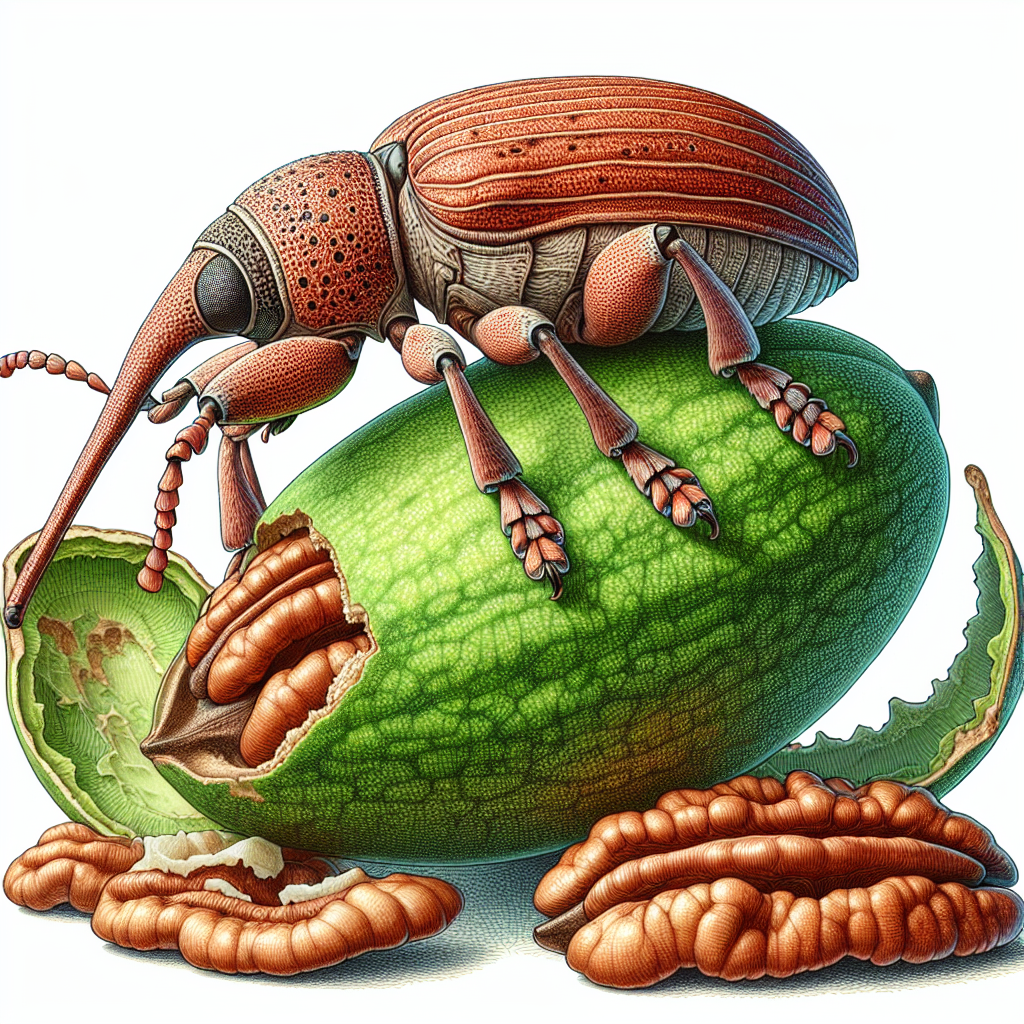
Introduction to Pecan Weevil
The pecan weevil, scientifically known as Curculio caryae, stands as one of the most destructive pests threatening pecan production across the southeastern United States, particularly in states like Georgia, Texas, and Alabama, where pecans are a multi-billion-dollar crop. This native insect targets the developing nuts of Pecan trees, leading to yield losses of up to 50% or more in heavily infested orchards if left unmanaged. As a professional botanist and entomologist specializing in nut crops, I've seen firsthand how this weevil's insidious lifecycle—spanning soil-dwelling larvae to nut-boring adults—can devastate even well-maintained groves.
Pecan weevils are reddish-brown beetles about 1/4 to 1/2 inch long, with distinctive long snouts used for egg-laying punctures. Unlike many pests, they have a multi-year lifecycle, with adults emerging from soil after 1-5 years of dormancy, making long-term soil management crucial. Early detection and integrated pest management (IPM) are key to minimizing damage, as chemical controls alone often fall short due to the pest's cryptic habits. This guide provides definitive diagnostic tools, lifecycle insights, organic treatments, and prevention strategies tailored for commercial growers and small-scale pecan farmers alike. By understanding and disrupting the weevil's biology, producers can safeguard their harvests and sustain orchard health. For broader IPM strategies, check out this Spring Pest Patrol blog post.
Identifying Symptoms & Damage
Diagnosing pecan weevil infestations requires keen observation during the nut development stages, typically from mid-July to October in most growing regions. The most telltale sign is the presence of adult weevils on nuts, shaking or feeding on the shuck (outer green husk). Look for their characteristic feeding punctures: small, circular holes about 1/16 inch in diameter, often with frass (insect waste) around them. These 'exit holes' from larvae are larger, around 1/8 inch, appearing later as infested nuts drop prematurely.
Internal damage is insidious—larvae bore into the kernel, hollowing it out and leaving a sawdust-like frass. Affected nuts may show a 'sour' odor from secondary fungal infections or fail to fill properly, resulting in shriveled, lightweight kernels unfit for market. Shake fallen nuts over a white sheet; if 1-2% contain live larvae, an infestation is active. Differentiate from similar pests like hickory shuckworm by the weevil's snout and soil pupation habit.
Scout systematically: Use a tree shaker or pole to dislodge adults onto beat sheets, or place tube traps filled with 70% alcohol to capture emerging weevils. Damage thresholds vary by cultivar; for varieties like Stuart Pecan, even low populations can cause economic loss due to premium nut quality. Early symptoms include shuck splits with larval 'mudholes'—plugged exit tunnels. In severe cases, entire limbs may show heavy nut drop, mimicking drought stress or pecan scab. Regular monitoring from gel stage (early nut formation) prevents surprises at harvest.
Lifecycle and Progression of Pecan Weevil
Understanding the pecan weevil's complex lifecycle is essential for timing interventions. Adults emerge from soil pupae in late July to September, triggered by soil temperatures above 80°F. These 3/8-inch beetles climb trees, feed on young nuts, and females use their snout to chew egg niches, laying 1-2 eggs per nut. Eggs hatch in 7-10 days into white, legless larvae that tunnel through the shuck into the kernel.
Larvae feed for 4-6 weeks, growing to 3/4 inch, then exit via a characteristic round hole, dropping to the soil on a silken thread or by falling. They burrow 2-8 inches deep, overwinter as pre-pupae, and pupate the following summer. A portion (up to 30%) remain dormant for 2-5 years, creating a prolonged threat. One generation per year, but soil populations build over time.
Progression varies by region: In Georgia, peak emergence aligns with 'dough' stage nuts; in Texas, it may start earlier. Males emerge first, followed by females. Lifecycle completion takes 12-18 months for most, but extended diapause ensures survivors. Disrupt at soil stage for best control—adults are mobile and hard to target. Monitor with soil probes or emergence cages to predict flights.
Environmental Triggers & Risk Factors
Pecan weevil thrives in the humid subtropics of USDA zones 7-9, with sandy loam soils ideal for larval survival. Key triggers include hot, dry summers (85-95°F) prompting adult emergence and nut susceptibility during rapid growth phases. Heavy rainfall post-drop aids larval soil entry but can reduce adult activity.
Risk factors: Infested orchard history—soil weevils persist 10+ years. Proximity to wild hickory or native pecans spreads the pest. Poor sanitation leaves pupae exposed. Drought-stressed trees produce smaller nuts, more prone to infestation. High nitrogen soils boost nut set but attract weevils. Cultivars like Desirable Pecan with thin shells are vulnerable; thick-shelled types resist better.
Climate change exacerbates risks with warmer soils accelerating emergence. Companion pests like black pecan aphids weaken trees, increasing susceptibility. Assess risk via soil cores: >5 pre-pupae per square foot signals action.
Organic Control & Treatment Plans
Organic management emphasizes IPM: monitoring, cultural, biological, and targeted organics. Sanitation first: Harvest promptly and burn or disk dropped nuts to expose larvae to predators. Flood irrigation kills 50-70% soil stages by drowning.
Biologicals: Encourage ground beetles and birds with cover crops like clover. Release nematodes (Steinernema carpocapsae) in late summer for 60-80% larval mortality.
Organic sprays: Kaolin clay (Surround WP) at 25-50 lbs/acre repels adults pre-egg lay. Neem oil or spinosad targets early larvae through shuck punctures. Apply at 10% nut drop threshold, rotating modes to prevent resistance. Bacillus thuringiensis (Bt) has limited efficacy.
Traps: Pyramid traps with ethylene glycol lure adults; place 1 per acre. Shake-trap crops near borders. Soil treatments: Till between rows in winter to disrupt pupae. For severe cases, organic-approved entomopathogenic fungi like Beauveria bassiana.
Integrated plan: Scout weekly from July; treat if >1 weevil/100 nuts. Combine with early harvest. Expect 70-90% control with diligence.
Preventing Pecan Weevil in the Future
Prevention hinges on breaking the soil lifecycle. Orchard hygiene: Deep disk (8-12 inches) annually post-harvest to destroy pre-pupae. Plant weevil-resistant rootstocks or interplant with repellents like garlic. Monitoring tech: Use soil sensors for emergence prediction.
Cultural practices: Maintain vigor with balanced fertility; avoid excess N. Early-maturing cultivars evade peak flights. Quarantine: Inspect nursery stock. Rotate with non-hosts like peanuts. Long-term: Breed resistant varieties like Pawnee.
Annual IPM audits reduce populations 90% in 3-5 years. For more on small-farm pest strategies, explore Soil Health Mastery—healthy soil boosts resilience.
Crops Most Affected by Pecan Weevil
Primarily Pecan (Carya illinoinensis), with commercial cultivars like Stuart, Desirable, and Western Schley most impacted due to thin shells and high value. Native host: Water hickory (Carya aquatica). Rarely, minor damage to walnut or hickory in mixed orchards. No significant impact on annuals like corn or soybeans, but wild edges increase spillover risk. Focus protection on pecan monocultures.