Definitive Diagnostic and Management Guide for Shuck Dieback
Introduction to Shuck Dieback
Shuck dieback represents one of the most challenging diseases confronting pecan growers worldwide, particularly in humid subtropical regions where pecans (Pecan) thrive. This fungal complex, primarily involving Phytophthora cactorum, Botryosphaeria dothidea, and related species, targets the shuck—the outer green husk encasing the maturing pecan nut—leading to rapid tissue necrosis, premature dehiscence, and substantial crop losses. First documented in the early 20th century in the U.S. Southeast, shuck dieback has since spread to major pecan-producing areas in Georgia, Texas, and Mexico, costing producers millions annually in lost revenue.
The disease's insidious nature lies in its ability to remain subclinical until mid-to-late kernel fill stages, when shucks suddenly turn from vibrant green to shriveled brown-black. Unlike pecan scab, which primarily affects the shell, shuck dieback focuses on the husk, though secondary infections can compromise nut quality. Understanding its etiology is crucial: while Phytophthora thrives in wet soils and splash-dispersed zoospores, Botryosphaeria exploits drought-stressed trees via airborne conidia. Integrated management is essential, blending sanitation, irrigation control, and targeted organics to safeguard yields. This guide equips growers with diagnostic precision and actionable strategies to combat shuck dieback effectively.
Identifying Symptoms & Damage
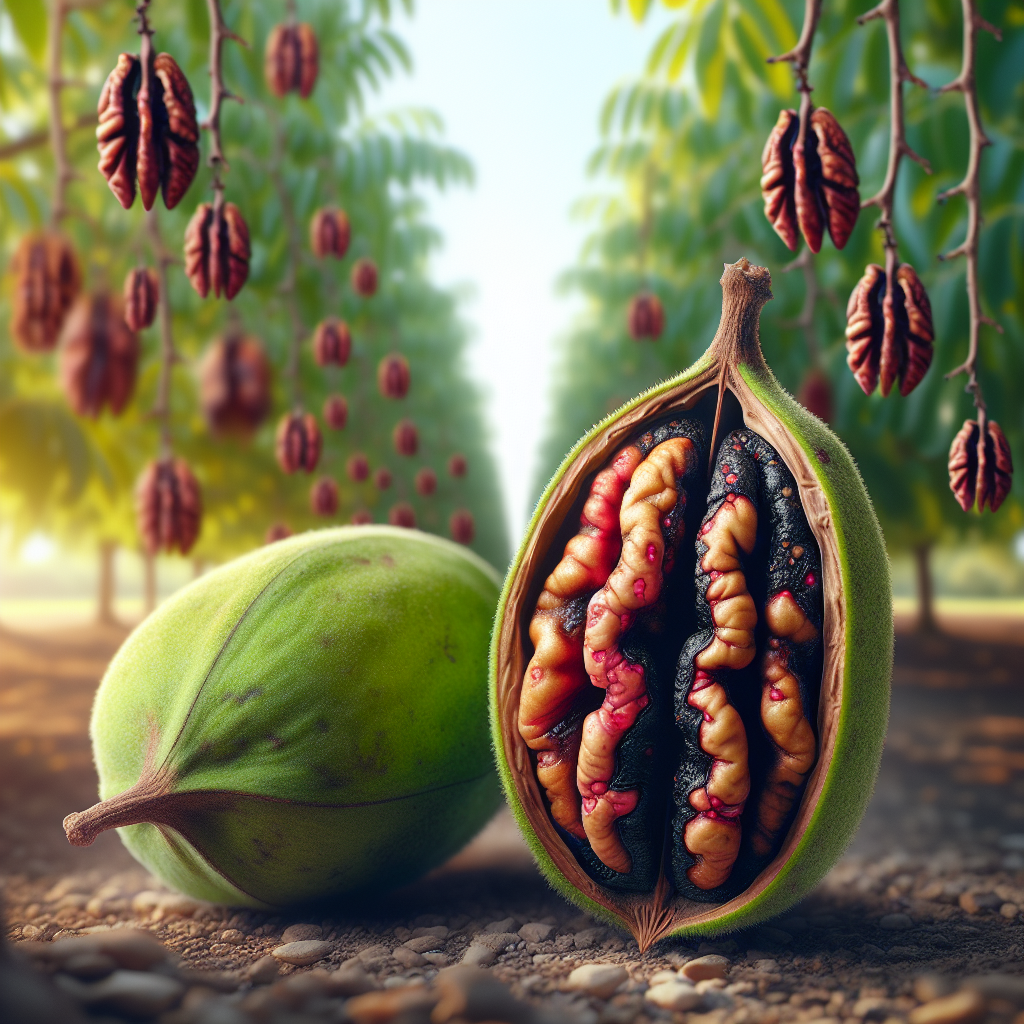
Early detection hinges on vigilant scouting during nut development (July-September in most regions). Initial symptoms appear as small, water-soaked lesions on the shuck's lower suture line or calyx end, often following rain events. These lesions expand rapidly, turning olive-green to tan, with a distinct reddish-brown margin. Within 7-10 days, affected shucks shrivel, blacken, and emit a foul, fermented odor indicative of secondary Botrytis invasion.
Advanced stages reveal shucks splitting prematurely, exposing blackened kernels prone to sooty mold. Severely infected nuts abort entirely, littering orchard floors in windrows. Differentiate from hickory shuckworm damage (frass-filled galleries) or hull rot (firm, leathery shucks without odor). Microscopic confirmation shows Phytophthora oospores in shuck tissue or Botryosphaeria pycnidia exuding black spore tendrils.
Yield impacts are profound: 20-80% losses in unmanaged orchards, with economic thresholds at 5% incidence. Damage extends to tree vigor, as repeated defoliation from shuck drop weakens scaffolds, mimicking dieback. Photograph suspect samples against healthy shucks for records, and submit to extension services for PCR assays confirming the pathogen complex.
Lifecycle and Progression of Shuck Dieback
Shuck dieback follows a polycyclic lifecycle synchronized with pecan phenology. Primary inoculum overwinters in mummified shucks, bark cankers, and orchard debris as resilient oospores (Phytophthora) or stromata (Botryosphaeria). Spring rains (budbreak to pollination) trigger sporangia release, with Phytophthora zoospores motile in films <30°C.
Infection peaks during 'gel stage' (kernel fill), when shucks are turgid and stomatal density peaks. Lesions sporulate within 5 days, splashing to adjacent nuts via thunderstorms. Botryosphaeria enters via wounds or lenticels during drought, progressing latently until humidity surges. A single lesion can doom a compound nut cluster.
By harvest, 70% of epidemics stem from rain-splashed cycles. Latent infections in asymptomatic shucks serve as bridges to next season, amplified by poor airflow. Progression models predict 2-3 cycles per season, with R0 (basic reproduction number) >4 in high-risk sites. For deeper insights, see our comprehensive guide on shuck disorders.
Environmental Triggers & Risk Factors
Shuck dieback epidemics erupt under specific microclimates: prolonged leaf wetness (>48 hours) at 20-28°C, coupled with soil moisture >70% field capacity. Overhead irrigation mimics rainfall, doubling infection risk versus micro-sprinklers. High nitrogen fertility (>150 kg/ha) promotes succulent shucks, while zinc deficiency (root diseases) stresses trees, favoring Botryosphaeria.
Orchard factors amplify vulnerability: dense canopies (>50% shade), tight spacings (<12m), and cultivar susceptibility (e.g., 'Desirable' vs. 'Stuart'). Flooded basins or heavy clays retain *Phytophthora* inoculum. Climate change extends wet seasons, shifting epidemics northward. Risk assessment tools score sites via wetness duration loggers and soil probes—scores >7 demand preemptive action.
Organic Control & Treatment Plans
Organic management prioritizes cultural disruption over curative sprays. Sanitation: Rake and destroy fallen shucks pre-budbreak (flail mowing incorporates 90% inoculum). Irrigation: Convert to drip, scheduling <20mm/week; avoid evening wetting. Nutrition: Balance N with K/Zn via foliar chelates, targeting sufficiency indices.
Biologicals: Apply Trichoderma harzianum (2 kg/ha) post-rain to antagonize Phytophthora. Organics: Rotate copper hydroxide (OMRI-approved, 2-3 kg/ha) with Bacillus subtilis QST713 at 14-day intervals from gel stage. Timing: Scout weekly; spray at 5% incidence. Efficacy: 60-75% reduction in trials. Integrate neem oil against secondary blackmargined aphid vectors.
Step-by-Step Plan:
- Pre-season: Soil test, prune for 30% light penetration.
- Early season: Zinc sulfate (3 kg/ha).
- Gel stage: Bacillus + copper.
- Peak risk: Reapply post-1" rain.
- Post-harvest: Shred shucks. Monitor via sticky traps for hickory shuckworm. For small farms, check Soil Health Mastery: 5 Proven Strategies for Small Farms to Build Fertile Ground Without Breaking the Bank.
Preventing Shuck Dieback in the Future
Long-term prevention builds resilient orchards. Select scion/rootstock combos with partial resistance ('Pawnee', Desi rootstocks). Site groves on well-drained ridges, avoiding low spots. Establish cover crops (clover) to suppress splash and enhance drainage.
Annual programs: Dormant copper + hort oil for overwintering inoculum; summer potassium phosphite (3 L/ha) boosts SAR. Scout grids (1/tree/10ha) with apps for early alerts. Rotate cultivars in blocks to curb polycycles. Grafting trials show 40% yield stability gains. Resistance breeding targets PR genes; monitor UF/UGA releases. Economic analysis: Prevention ROI >5:1 vs. crisis sprays.
Crops Most Affected by Shuck Dieback
Primarily devastating to pecan (Carya illinoinensis), with 'Desirable Pecan' (Desirable Pecan) and 'Stuart Pecan' (Stuart Pecan) most vulnerable. Secondary hosts include hickory and walnut (Chandler Walnut), though rarely epidemic. Native stands suffer sporadically. No reports on annuals like corn or peach. Focus protection on commercial pecans; wild trees self-regulate via nut drop.