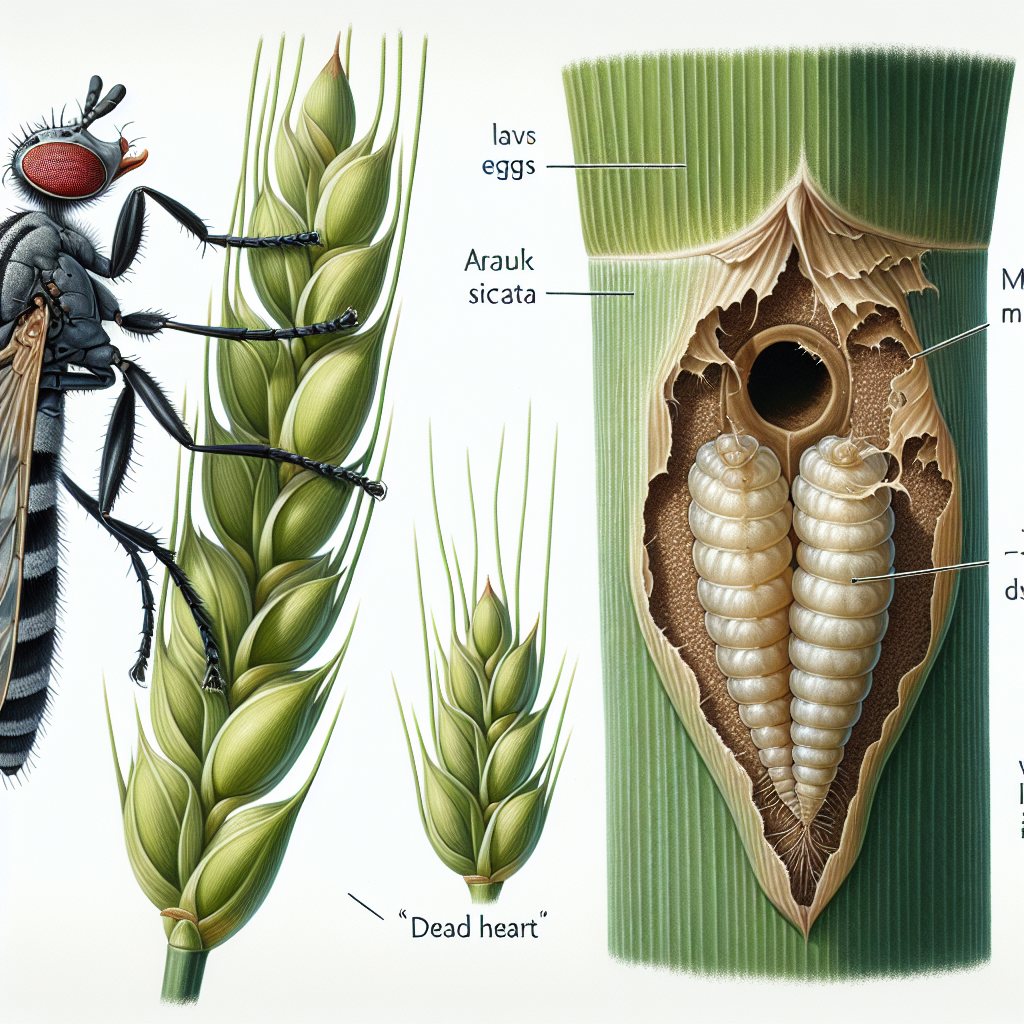
Introduction to shoot fly
Shoot flies (Atherigona spp.) represent a major threat to cereal production worldwide, particularly in tropical and subtropical regions. These tiny dipteran pests, belonging to the family Muscidae, lay eggs on young grass shoots, and their larvae tunnel into the central growing point, often killing the plant or severely stunting its growth. Known scientifically as species like Atherigona orientalis (onion shoot fly variant) and Atherigona soccata (wheat shoot fly), they cause economic losses estimated at 10-60% in susceptible crops during early growth stages. Farmers in wheat, rice, sorghum, and maize fields frequently battle these invaders, especially in monsoon-prone areas of Asia, Africa, and parts of Europe.
The pest's impact is amplified in dense plantings with lush, nitrogen-rich foliage, where females are attracted to lay eggs. Adult flies are grayish-black, about 3-5 mm long, with reddish eyes and three black stripes on the thorax. Damage manifests rapidly, often within 7-10 days of seedling emergence, making timely scouting essential. This definitive guide equips agricultural professionals with diagnostic tools, lifecycle knowledge, and proven organic strategies to mitigate shoot fly infestations effectively. By understanding their biology and implementing integrated pest management (IPM), growers can safeguard yields and reduce reliance on synthetic chemicals.
Identifying Symptoms & Damage
Early identification of shoot fly damage is critical for minimizing losses. The hallmark symptom is the 'dead heart'—a central leaf whorl that turns yellow, wilts, and dies while surrounding leaves remain green. Affected tillers show a pinhole entry mark at the base of the dead heart, often with reddish-brown discoloration inside the sheath. Larvae, creamy-white maggots 5-8 mm long, are visible upon splitting the sheath, accompanied by a dark reddish spot where they feed.
In severe infestations, multiple tillers per plant may be attacked, leading to tillerless plants or bushy growth from secondary shoots. Yield impacts include 20-30% reduction in early-planted crops, with up to 100% seedling mortality in worst cases. Differentiate from other pests like cutworms or stem borers, which cause clean cuts or longitudinal tunneling rather than central dead hearts. Secondary symptoms include bacterial infections entering through larval tunnels, causing rot and lodging.
Scout fields 10-15 days after emergence, checking 20-30 plants per square meter. A 5-10% dead heart incidence warrants action. Use a hand lens to confirm maggots or puparia (barrel-shaped, reddish-brown). In sorghum and barley, damage appears similar but often coincides with aphids, complicating diagnosis.
Lifecycle and Progression of shoot fly
Shoot flies complete 6-12 generations per year, depending on climate, with a lifecycle of 18-25 days. Adults emerge from overwintering pupae in soil or stubble, peaking during warm, humid periods (25-30°C, 70-80% RH). Females lay 100-150 eggs singly on leaf blades near the soil line, preferring 7-15 day-old seedlings. Eggs hatch in 1-2 days into maggots that bore into shoots, feeding for 4-7 days before pupating in the plant base or soil.
Pupae remain dormant 7-10 days before adults eclose. Flight peaks at dawn and dusk, with females dispersing up to 10 km seeking host plants. In rice, synchronized planting disrupts this cycle; in wheat, rabi season crops face peak pressure from September-November generations. Overlapping generations lead to continuous infestation pressure, exacerbated by volunteer plants harboring pupae.
Monitor with yellow sticky traps (10-15 per hectare) to track adult density >5 flies/trap/day signals risk. Lifecycle aligns with crop phenology: eggs on 1-2 leaf stage plants, larval damage by 3-4 leaf stage, pupation pre-tillering.
Environmental Triggers & Risk Factors
Shoot flies thrive in warm (24-32°C), humid conditions with prolonged leaf wetness, common in rainy seasons. High nitrogen fertilization (>120 kg/ha) produces succulent shoots attractive to ovipositing females. Early sowing (before optimal dates) exposes seedlings to peak fly populations, while dense stands (>300 plants/m²) hinder natural enemy access.
Risk spikes after unseasonal rains or irrigation creating moist microclimates. Susceptible varieties like early-maturing hybrids in corn or susceptible wheat cultivars amplify damage. Poor field sanitation—retaining stubble or ratoon crops—serves as pupal reservoirs. Monocropping cereals without breaks favors buildup, unlike rotations with peas or chickpeas that interrupt cycles.
Climate change extends activity periods, with models predicting 15-20% higher incidence in warming tropics. Assess risk via degree-day models (base 10°C, 200-250 DD for generation time).
Organic Control & Treatment Plans
Organic management emphasizes cultural, biological, and mechanical tactics within IPM. Cultural: Adjust sowing to evade peaks—delay wheat by 10-15 days post-monsoon. Use 20-25 cm row spacing for ventilation, reducing humidity. Apply balanced NPK (avoid excess N early); seed rates 20-25% higher for compensation. Destroy volunteer plants and deep plow (15-20 cm) post-harvest to expose pupae to predators/sun.
Biological: Conserve parasitoids like Trioxys utilis (up to 40% control) and predators (Coccinella beetles). Release egg parasitoids Telenomus spp. at 50,000/ha. Neem oil (5 ml/L) or azadirachtin (0.03%) sprays at 7-day intervals from seedling stage deter oviposition (80% reduction). Bacillus thuringiensis (Bt) var. israelensis targets larvae effectively.
Mechanical: Trap adults with light/yellow pan traps (1/100 m²). Hand-pick dead hearts weekly, crushing larvae. For Spring Pest Patrol: Organic AI Strategies to Shield Your Crops from Common Invaders, integrate AI scouting for timely intervention.
Treatment plan: Scout weekly; act at 5% dead hearts. Alternate neem (3 sprays) with silica-based boosters. Threshold: 10% infestation triggers full IPM. Refer to Shoot flies (pest) for detailed profiles.
Preventing shoot fly in the Future
Long-term prevention builds resilient systems. Select resistant varieties like wheat 'HD-2967' or sorghum hybrids 'CSH-15'. Rotate with legumes (2-3 years cereals max) to break lifecycle. Time sowing per zone: wheat post-October 15 in India, rice avoiding July peaks.
Enhance soil health with organic matter (5-10 t/ha FYM) for vigorous plants tolerating low infestations. Intercrop cereals with marigold or trap crops like sudangrass. Border traps (neem-mixed) reduce influx 30-50%. Monitor via AI apps for hyper-local forecasts, as in Why 80% of Small Farms Battle Weather Disasters - And How Hyper-Local AI Forecasts Can Save Your Harvest.
Post-harvest: Shred stubble, flood fields briefly to drown pupae. Seed treatments with biofungicides prevent secondary rots. Annual audits track progress; aim <2% incidence.
Crops Most Affected by shoot fly
Shoot flies primarily target Gramineae family: wheat (up to 25% loss), rice (direct rice shoot fly), sorghum (30-60% in Africa/India), barley, oats, maize/corn, pearl millet, finger millet, and sugarcane seedlings. Wheat faces 2-3 generations in rabi season; rice in kharif. Sorghum hybrids suffer most due to synchrony with fly peaks. Emerging threats in quinoa and forage grasses. Avoid confusion with onion/garlic shoot flies on Alliums.