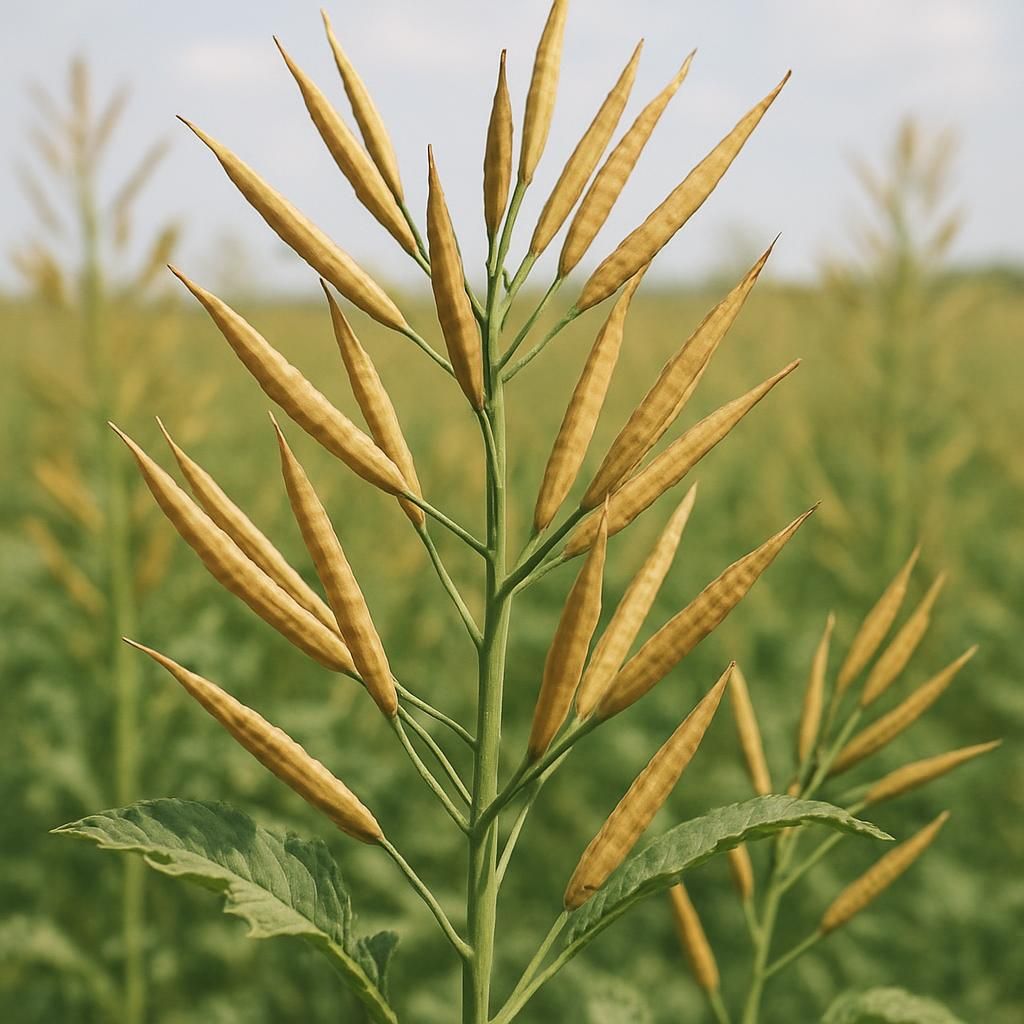
Introduction to Mustard Seed (Brown - Brassica juncea)
Brown mustard (Brassica juncea) ranks among the world’s most important oilseed and condiment crops. Its seeds deliver intense heat and flavor for Dijon-style mustards while the plant’s rapid growth supports short-season rotations and green-manure programs. Farmers appreciate its tolerance of marginal soils and its ability to suppress soil-borne pathogens through glucosinolate release.
Botanical Profile of Mustard Seed (Brown - Brassica juncea)
Brassica juncea is an annual herbaceous plant in the Brassicaceae family. It produces erect stems 60–150 cm tall with deeply lobed, glaucous leaves. Small yellow flowers form terminal racemes that develop into slender siliques containing 12–20 round seeds. Brown mustard seeds measure 1–2 mm in diameter and contain 35–45 % oil rich in erucic and oleic acids. The species is diploid (2n=36) and exhibits wide morphological diversity across Indian, Chinese, and European landraces.
Soil, pH, and Climate Requirements for Mustard Seed (Brown - Brassica juncea) (MUST INCLUDE A MARKDOWN TABLE OF IDEAL CONDITIONS)
Brown mustard performs best on well-drained loams with moderate fertility. It tolerates saline and slightly alkaline conditions better than most brassicas but declines on waterlogged or highly acidic soils. Cool temperatures during flowering and seed fill maximize oil content and reduce disease pressure.
| Parameter | Ideal Range | Notes |
|---|---|---|
| Soil Type | Loam to sandy loam | Avoid heavy clays; raised beds improve drainage |
| Soil pH | 6.0–7.5 | Tolerates up to 8.5; lime below 5.8 |
| Temperature (day) | 15–25 °C | Optimal vegetative growth |
| Temperature (night) | 5–12 °C | Prevents bolting |
| Frost Tolerance | Seedlings to –5 °C | Mature plants damaged below –8 °C |
| Rainfall / Irrigation | 400–700 mm season | Critical at flowering and pod fill |
Step-by-Step Planting & Propagation
- Select certified seed free of Alternaria and Bruchids.
- Prepare a firm, fine seedbed by disking and harrowing; incorporate 10–15 t ha⁻¹ well-rotted compost.
- Sow in rows 30–45 cm apart at 2–3 cm depth; target 8–12 kg ha⁻¹ for oilseed or 4–6 kg ha⁻¹ for condiment production.
- Maintain soil moisture at 60 % field capacity until emergence (5–8 days).
- Thin seedlings to 10–15 cm in-row spacing when the first true leaves appear.
Care & Maintenance regimes for Mustard Seed (Brown - Brassica juncea) (MUST INCLUDE A MARKDOWN TABLE OF WATER, FERTILIZER, AND PRUNING SCHEDULES)
Irrigation should be scheduled to avoid moisture stress during flowering. Nitrogen is split-applied to limit excessive vegetative growth while potassium supports seed oil synthesis. No pruning is required, but rogueing off-type plants maintains genetic purity.
| Growth Stage | Irrigation Frequency | Fertilizer (N-P-K kg ha⁻¹) | Notes / Pruning |
|---|---|---|---|
| Pre-plant | None | 20-40-20 basal | Incorporate P and K |
| Vegetative (20–40 DAS) | 1× every 10–12 days | 30-0-0 top-dress | None |
| Flowering (45–60 DAS) | 1× every 7–8 days | 10-0-20 | Rogue off-types |
| Pod Fill (65–90 DAS) | Maintain field capacity | 0-0-10 | Cease irrigation 10 days pre-harvest |
Pests, Diseases & Organic Management
Major insect threats include flea beetles, aphids, and pod borers. Disease pressure from Alternaria leaf spot, white rust, and downy mildew peaks under cool, humid conditions. Cultural controls—crop rotation, residue destruction, and certified seed—form the foundation of organic management. Neem-based sprays and Bacillus thuringiensis target chewing larvae while reflective mulches deter aphids. Copper hydroxide applications at first disease symptoms limit Alternaria spread.
Harvesting, Curing & Optimal Storage
Harvest when 75–80 % of siliques turn golden-brown and seed moisture falls below 12 %. Swath or direct combine at dawn to minimize shattering losses. Air-dry seed to 8 % moisture within 48 h. Store in sealed bins at 10–15 °C and <65 % RH; monitor for Bruchids and Storage Beetles. Viability remains above 85 % for two years under these conditions.
Companion Planting for Mustard Seed (Brown - Brassica juncea)
Mustard serves as an effective trap crop for flea beetles when interplanted with Cabbage or Broccoli. Its biofumigant residues suppress nematodes ahead of Tomato or Potato plantings. Avoid planting near other brassicas to limit shared disease cycles; instead pair with Onion, Garlic, or Carrot for pest deterrence. Clover under-sown after mustard harvest provides nitrogen and soil cover for the following season.