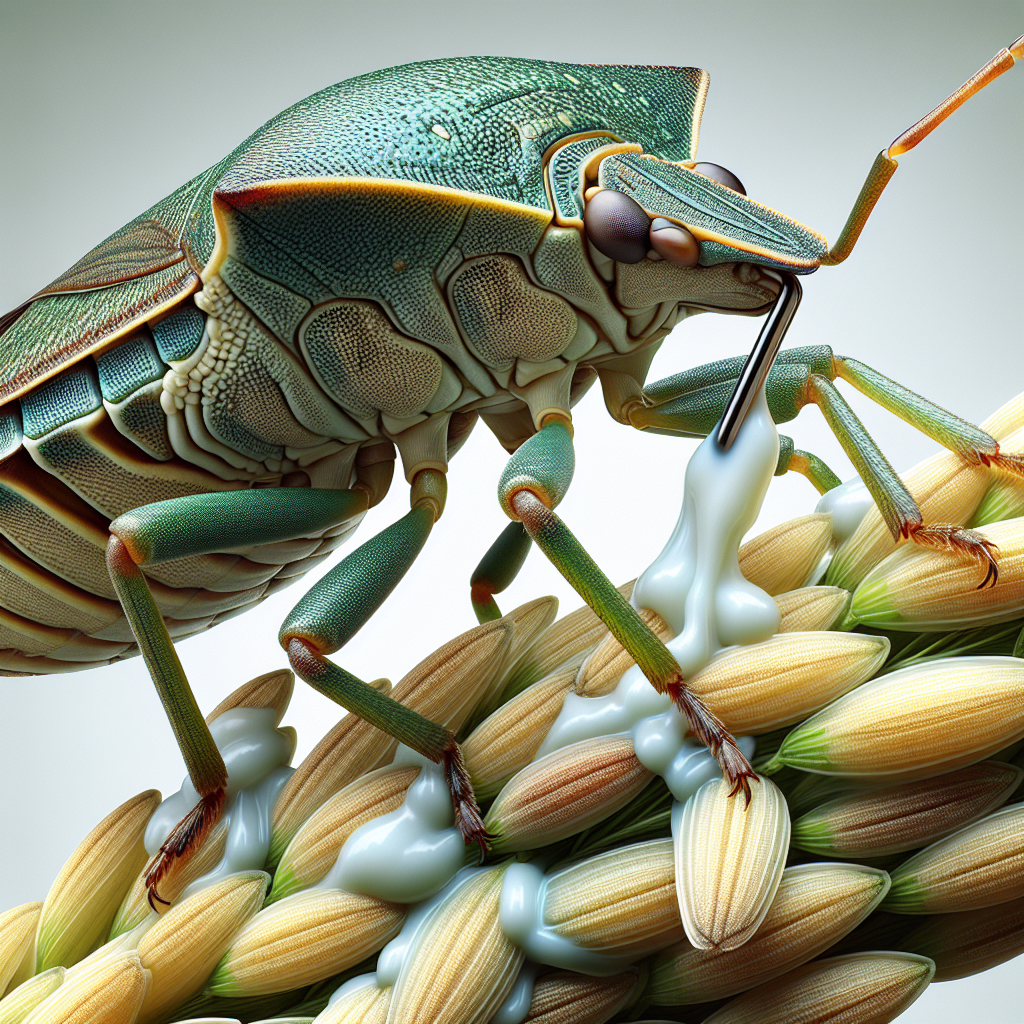
Introduction to grain-sucking bugs
Grain-sucking bugs, also known as rice bugs, wheat bugs, or stink bugs in grain contexts, represent a critical threat to global cereal production. These pests belong primarily to the genera Oebalus (e.g., Oebalus pugnax, the rice stink bug) and Nezara (e.g., Nezara viridula, the southern green stink bug), within the Pentatomidae family of true bugs (order Hemiptera). They are characterized by their shield-shaped bodies, piercing-sucking mouthparts, and the ability to emit a foul odor when disturbed—hence the 'stink bug' moniker.
These insects feed by inserting their stylets into developing grains, extracting nutrient-rich contents while injecting salivary enzymes and toxins. This dual action not only reduces grain weight and quality but also leads to 'milk-stink' kernels—discolored, shriveled seeds unfit for milling or consumption. In severe infestations, yield losses can exceed 20-30% in rice, wheat, and corn fields, with economic impacts in the billions annually across rice-growing regions in Asia, the Americas, and Africa.
As a professional botanist and entomologist, I've observed that grain-sucking bugs are particularly insidious because their damage is often invisible until harvest. Early detection and integrated pest management (IPM) are essential. This guide provides definitive diagnostics, lifecycle insights, and organic strategies tailored for small to medium-scale farmers aiming for sustainable, high-yield grain crops. For more on spring pest management, check this Spring Pest Patrol resource.
Identifying Symptoms & Damage
Recognizing grain-sucking bug damage requires vigilance during the reproductive stages of grain crops (R3-R6 in corn, milky to dough stages in wheat and rice). Key symptoms include:
- Shriveled, chalky grains: Affected kernels appear bronzed, pitted, or collapsed, with a characteristic 'peppery' appearance from toxin-induced cell death. In sorghum, this manifests as 'whitehead' panicles.
- Milk-stink kernels: A foul, fermented odor upon shelling, caused by yeast proliferation from bug saliva. Cut open affected grains to reveal discolored, watery endosperm.
- Yellowing or bronzing of panicles/ears: Feeding punctures cause localized necrosis, leading to premature grain abortion. Scout by shaking panicles over a white tray—bugs will drop and scurry.
- Secondary issues: Bugs vector fungal blights and bacteria through feeding wounds, exacerbating losses from grain mold or smut.
Diagnostic tip: Differentiate from head-feeding caterpillars or aphids by the presence of exuviae (shed skins) and dark fecal spots (frass). Use a hand lens to confirm the bugs' characteristic scutellum (shield) and five-segmented antennae. Threshold: 1-2 bugs per 6 panicles in rice; 20% chalky kernels signals action.
Economic damage thresholds vary: In wheat, 10% chalky kernels reduce milling quality by 15%; in corn, feeding on ears causes 1-2% yield loss per bug per ear. Regular scouting from flowering to soft dough stage is crucial.
Lifecycle and Progression of grain-sucking bugs
Grain-sucking bugs undergo incomplete metamorphosis: egg, nymph (5 instars), and adult. Lifecycle duration is 30-60 days, with 2-4 generations per season in tropical/subtropical zones.
- Eggs: Pale green, barrel-shaped clusters of 20-100 laid on undersides of leaves or panicles. Hatch in 5-10 days at 25-30°C.
- Nymphs: Resemble adults but wingless; early instars (1-3) gregarious and predaceous on small insects, later (4-5) phytophagous. Nymphal period: 20-35 days.
- Adults: Long-lived (6-8 weeks), dispersive with strong flight. Overwinter as adults in leaf litter or grasses.
Progression peaks during grain fill: Nymphs infest vegetative stages, adults target milk/dough. In rice, synchronized planting disrupts this; in wheat, fall-planted varieties face overwintered adults. Monitor with pheromone traps for adult influx.
Environmental Triggers & Risk Factors
Warm, humid conditions (25-35°C, 70-90% RH) accelerate reproduction. Key triggers:
- Weeds and volunteers: Grasses like johnsongrass host early nymphs; control with timely tillage.
- Continuous cropping: Monocultures of corn, sorghum, or rice build populations.
- Late planting: Extends overlap with peak bug activity.
- Irrigation and flooding: Rice fields retain adults; double-cropping increases risk.
Risk hotspots: Southern U.S., Southeast Asia, Brazil. Climate change extends ranges northward. Companion with clover or marigold to disrupt habitats. Avoid excess N-fertilizers, which boost soft tissues attractive to bugs.
Organic Control & Treatment Plans
Prioritize IPM: Prevention > Monitoring > Biological > Mechanical > Organic-approved inputs.
- Cultural: Destroy crop residues; rotate with legumes or potatoes. Flood fields briefly post-harvest to drown bugs. Plant early-maturing varieties resistant to stink bugs.
- Biological: Encourage parasitoids (e.g., Telenomus wasps) and predators like spiders or [big-eyed bugs* (Geocoris spp.). Release Trichogramma for eggs.
- Mechanical: Sweep nets, light traps at dusk. Hand-collect clusters from borders.
- Organic sprays: Neem oil (azadirachtin) at 1-2% weekly from flowering; insecticidal soaps or spinosad (OMRI-listed) for knockdown. Kaolin clay barriers deter feeding.
Treatment plan: Scout weekly; act at economic thresholds. For soybeans borders, use BTK. Integrate with stink bugs management. Efficacy: 70-90% reduction with combined tactics.
Preventing grain-sucking bugs in the Future
Long-term:
- Varietal resistance: Choose tolerant hybrids (e.g., rice cv. 'DRR Dhan 44').
- Habitat management: Maintain borders free of sorghum volunteers; plant trap crops like sesame.
- Monitoring tech: Pheromone traps + sticky cards.
- Soil health: Healthy crops resist better; incorporate hairy vetch cover.
Annual rotation reduces 50% incidence. Clean equipment to prevent spread.
Crops Most Affected by grain-sucking bugs
Primary: Rice (20-60% losses), wheat, corn, sorghum, barley. Secondary: Soybeans, millet, peanuts. Grains in milk-dough stages vulnerable.