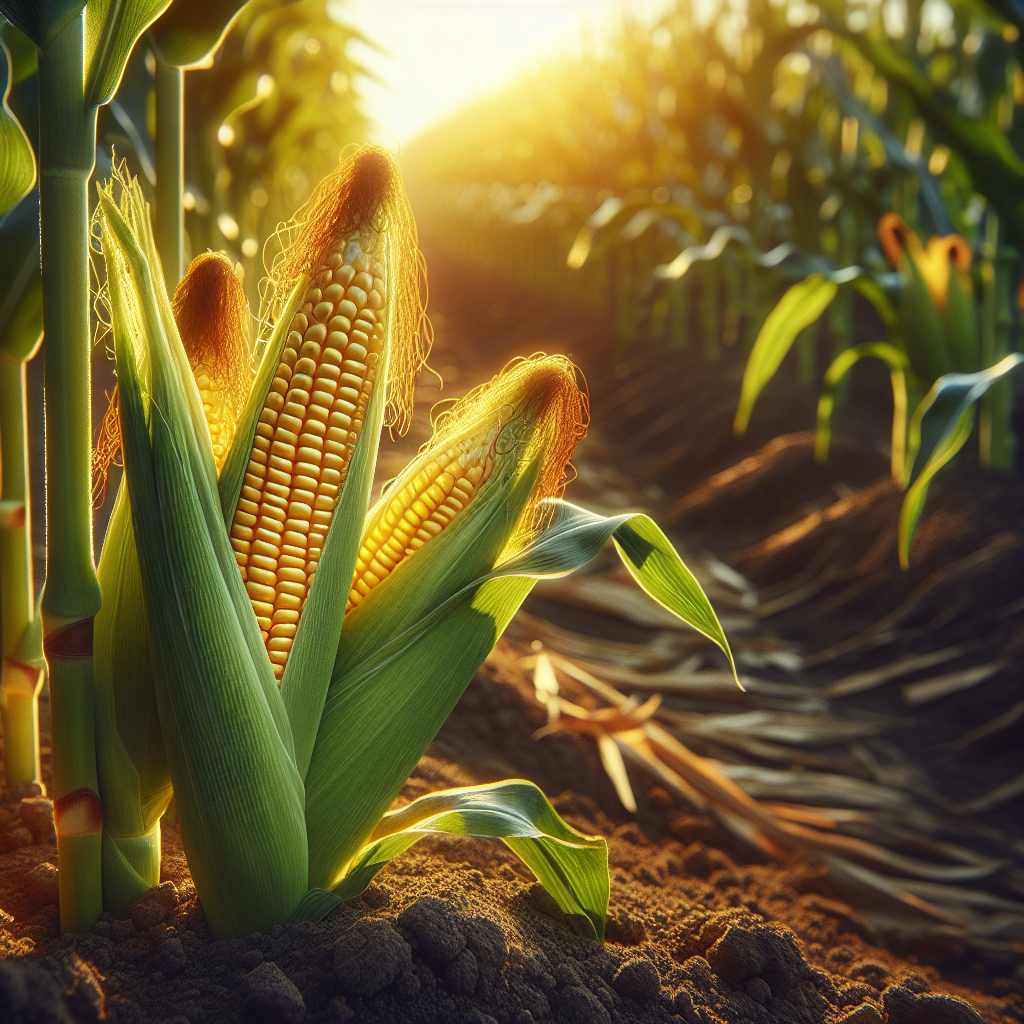
Introduction to Golden Bantam Sweet Corn
Introduced in the early 20th century, this variety is one of the foundational yellow sweet corns in North American gardening history. Before its release, many sweet corn cultivars were white-kernel types, and Golden Bantam helped popularize the now-classic image of buttery yellow sweet corn. It remains favored by home gardeners, seed savers, and market growers who value flavor over the extra shelf life of modern supersweet hybrids.
Its eating quality is often described as deeper, creamier, and more "corny" than high-sugar hybrid types. The ears are usually shorter and slimmer than modern shipping cultivars, but the flavor can be exceptional when harvested at peak milk stage and eaten promptly. Because it is open-pollinated, growers can save seed if isolation is managed properly, making it especially attractive in diversified gardens and heritage crop programs.
For background on the species itself, see our Corn guide. Golden Bantam is best understood as a traditional sugary sweet corn rather than a supersweet type, which means the sugar-to-starch conversion after harvest is relatively fast. That single trait shapes much of its management: harvest timing matters, rapid cooling matters, and culinary use is best soon after picking.
Botanical Profile of Golden Bantam Sweet Corn
This cultivar belongs to the grass family, Poaceae, and is a monoecious annual cereal selected specifically for immature sweet ears rather than dry grain. Plants produce separate male and female flowers on the same plant: tassels at the top shed pollen, while ears form at leaf axils and produce silks that catch wind-borne pollen. Each silk corresponds to one potential kernel, so incomplete pollination results in patchy ear fill.
Golden Bantam typically grows about 5 to 6 feet tall, sometimes slightly taller in fertile soils with adequate moisture. It is generally earlier and shorter than many field corns and some tall sweet corn cultivars. Ears are commonly 5 to 7 inches long with 8 rows of kernels, though growing conditions can influence ear size. The kernels are deep yellow at harvest maturity, with a tender texture when picked at the correct stage.
Like other traditional sweet corns, it carries the sugary (su) genetic background rather than sh2 supersweet genetics. Practically, that means seeds tend to germinate more reliably in cool-but-acceptable spring soils than fragile sh2 seeds, but the harvested ears do not hold sweetness nearly as long. Plants are wind-pollinated, have a fibrous root system concentrated in the upper soil profile, and can produce brace roots above the soil line for added anchorage.
Vegetative growth progresses rapidly under warm conditions. Seedlings emerge with a protective coleoptile, then produce linear leaves with a waxy cuticle. The crop’s highest sensitivity periods are early establishment, rapid vegetative expansion, tasseling, silking, and kernel fill. Stress during tasseling and silking is especially damaging because drought, nutrient shortage, or heat can reduce pollen viability and silk receptivity.
Soil, pH, and Climate Requirements for Golden Bantam Sweet Corn
This crop performs best in full sun, with at least 8 hours of direct light daily. It is fundamentally a warm-season annual and should be planted only after frost danger has passed and soils have warmed sufficiently. Ideal soil temperature for strong germination is 65-85°F (18-29°C). It can germinate at around 60°F (16°C), but emergence is slower and seedlings are more vulnerable to rot and pests in cold, wet ground.
The preferred soil is deep, fertile, well-drained loam or sandy loam with high organic matter and good moisture retention. Heavy clay can work if well structured, but compaction is a serious problem because roots need oxygen and freedom to explore. Avoid sites where water stands after rain for more than 24 hours. Saturated soil in the top 6-8 inches often leads to weak root systems, pale growth, and increased risk of seedling diseases.
Optimal pH is about 6.0-6.8, with a sweet spot near 6.3-6.5. Below pH 5.8, phosphorus availability can decline and aluminum toxicity may impair root growth in some soils. Above pH 7.2, micronutrient issues such as zinc or iron unavailability may show up as interveinal chlorosis or stunting. A soil test before planting is strongly recommended. If pH is too low, agricultural lime should be incorporated several months ahead of planting. If soil is alkaline, rely on compost, targeted micronutrient correction, and careful nutrient balance rather than trying to force rapid pH change.
Nutritionally, sweet corn is a moderately heavy feeder, especially for nitrogen. However, excessive early nitrogen can create lush foliage at the expense of standability and balanced ear development. A professional approach is to build soil with compost or well-finished manure in the off-season, then apply nitrogen in split doses: some at planting and the rest when plants are knee-high and again just before tasseling if needed. For broader soil-building ideas, see soil health strategies.
Climate-wise, Golden Bantam is best suited to temperate growing conditions with warm days, mild nights, and a frost-free window of roughly 70-90 days depending on local weather. It tolerates moderate summer heat, but prolonged periods above 95°F (35°C), especially with dry winds, can reduce pollination quality. Cool nights often improve sugar retention and flavor. It is less adapted to tropical lowland humidity than some tropical maize types, though it can still produce if disease pressure is managed well.
Wind exposure matters. Some air movement is helpful for pollination, but highly exposed sites can cause lodging, especially in rich soils or after storms. Shelter from severe prevailing winds, without shading the crop, is ideal.
Step-by-Step Planting & Propagation
Propagation is by seed only. Direct sowing is strongly preferred because corn dislikes root disturbance, and transplants usually lag behind direct-seeded plants unless grown in large biodegradable cells and transplanted very young.
Prepare the bed 2-3 weeks before planting. Remove perennial weeds, loosen soil to at least 8-10 inches, and incorporate 1-2 inches of finished compost. Do not use fresh manure immediately before sowing, as it can promote excessive vegetative growth and increase salt stress.
Wait for proper soil warmth. Plant when the top 2 inches of soil are consistently at least 60°F (16°C), ideally warmer. If the forecast includes prolonged cold rain right after sowing, delay planting; Golden Bantam is more forgiving than supersweet corn, but cold waterlogged soil still reduces stand establishment.
Plant in blocks, not single long rows. A minimum block of 4 short rows greatly improves pollination because corn relies on wind rather than insect pollinators. Poor block planting is one of the most common reasons for missing kernels.
Sow seed 1-1.5 inches deep in medium soils. In sandy soils or hot drying weather, go up to 2 inches deep to reach stable moisture. In heavy cool soils, stay closer to 1 inch. Space seeds 8-12 inches apart within rows, with rows 30-36 inches apart. For dense garden blocks, 12 inches by 30 inches is a reliable standard.
Thin after emergence if needed. Maintain final spacing of about 10-12 inches between plants. Overcrowding leads to thinner stalks, smaller ears, and more competition for water during tasseling.
Succession sow if desired. Since Golden Bantam matures fairly early, sowing every 10-14 days for 3-4 rounds can extend harvest. In short-season climates, keep successions tight and stop in time to avoid autumn frost before maturity.
Irrigate immediately after sowing if soil is not evenly moist. The goal is moisture throughout the seed zone without saturation. Soil should feel like a wrung-out sponge, not muddy. If squeezed in the hand, it should hold together lightly but not drip.
Mark isolation if saving seed. Sweet corn cross-pollinates readily with field corn, popcorn, and other sweet corn varieties. For varietal purity, isolate by distance, typically at least 800 feet and preferably more, or stagger planting dates so tasseling does not overlap.
In small gardens, some growers pre-soak seed for 6-8 hours before sowing to speed germination, but do not soak longer or seed may suffer oxygen stress. In cool weather, untreated dry seed is often safer than pre-soaked seed.
Care & Maintenance regimes for Golden Bantam Sweet Corn
Uniform moisture is the single most important management factor after establishment. The crop generally needs about 1-1.5 inches of water per week, but this must increase in sandy soils, hot weather, and especially from pre-tassel through ear fill. During tasseling and silking, soil moisture should remain consistently available in the top 8-12 inches. If the top 2 inches are powder dry and leaves begin rolling by mid-morning, the crop is already under meaningful stress. Slight leaf rolling in peak afternoon heat can be normal, but persistent morning rolling signals inadequate root-zone moisture.
Overwatering looks different. Plants may appear pale green, growth slows, lower leaves yellow prematurely, and the soil smells sour or stays slick and shiny below the surface. Standing water, algae, and weak brace root development are warning signs. Root oxygen deprivation can mimic nitrogen deficiency, so do not automatically add fertilizer before checking drainage.
Mulching can help, but use it judiciously. Once soil is fully warm and plants are 8-12 inches tall, a light organic mulch such as clean straw can reduce evaporation and suppress weeds. Keep mulch a few inches away from stalk bases in humid climates to avoid encouraging rot or vole damage.
Weed control is critical during the first 4-6 weeks. Corn is not highly competitive when young. Shallow hoeing is effective, but avoid deep cultivation because many feeder roots occupy the upper soil layer. After plants reach knee-high, hilling soil lightly around the base can improve anchorage and help suppress nearby weeds.
Nitrogen management should be timed to plant demand. If no soil test is available, a common garden-scale program is to side-dress with a balanced organic nitrogen source when plants are 12-18 inches tall, then repeat lightly when the first tassels are forming. Watch leaf color: healthy plants should be medium to deep green. Uniform paling, especially beginning on older leaves in a V-shape from the tip down the midrib, suggests nitrogen shortage.
Micronutrients can matter more than many growers realize. Zinc deficiency causes broad pale banding on young leaves and shortened internodes; sulfur deficiency causes overall yellowing of newer growth; potassium deficiency can show as leaf-edge scorch on older leaves, particularly during dry weather. These issues are best corrected by soil testing and targeted amendments rather than guesswork.
Because pollination is wind-driven, stand uniformity matters. Gaps in the row reduce pollen density. In calm weather, gently shaking tassels during peak pollen shed in the morning can improve kernel set in small plantings. Avoid overhead irrigation during the main pollen-shed window if possible, as heavy wetting can temporarily reduce pollen movement.
Pests, Diseases & Organic Management
The most common insect pests include corn earworm, European corn borer, cutworms, flea beetles, sap beetles, and occasionally armyworms. Raccoons and birds can also be serious pre-harvest pests.
corn earworm is often the key market-garden concern because larvae enter through fresh silks and feed at the ear tip. Monitoring adult moth flights helps, but practically, silk protection is the main defense. A common organic tactic is applying a few drops of food-grade mineral oil to the silk channel 4-7 days after silk emergence, sometimes combined with Bacillus thuringiensis (Bt), to deter larval entry. Timing matters: too early can interfere with pollination, too late misses the vulnerable stage.
European corn borer larvae tunnel in stalks and ears, weakening plants and reducing marketability. Sanitation is essential: destroy crop residues after harvest because larvae overwinter in stalks. Healthy rotation reduces carryover.
cutworms clip seedlings at the base, especially in fields recently transitioned from sod or weedy cover. Use collars in small gardens, cultivate pre-plant to disrupt habitat, and avoid planting into heavy fresh residue without monitoring.
Disease pressure depends strongly on weather and spacing. Common problems include common rust, northern corn leaf blight, smut, damping-off, and stalk rots. Open-pollinated heirlooms can be more variable in resistance than modern hybrids, so preventative management matters.
common rust appears as cinnamon-brown pustules on leaves. It is often tolerable in small amounts, but severe infection reduces photosynthesis. Avoid excessive nitrogen, maintain airflow, and water at soil level when feasible.
northern corn leaf blight causes elongated gray-green to tan lesions that can coalesce and blight leaves. Long periods of leaf wetness and overhead irrigation increase risk. Wider spacing, crop rotation, and residue management are core organic tools.
Corn smut, caused by Ustilago maydis, forms swollen gray galls on ears, tassels, or stalk tissue, usually after mechanical injury or growth stress. Remove and discard galls before they rupture if seed purity or appearance matters.
damping-off is most common in cold wet soil. Prevention starts before sowing: warm seedbeds, good drainage, fresh seed, and shallow but adequate planting depth.
Wildlife management is often decisive. Raccoons typically attack just before harvest, often flattening a patch in one night. Electric fencing is the most reliable control in serious situations. Birds can peck emerging seedlings and ripening ears; netting and visual deterrents may help, though results are mixed.
Organic management works best as an integrated program: rotation, sanitation, strong soil fertility, correct spacing, irrigation discipline, and targeted intervention only when needed. If a planting repeatedly suffers from earworm or foliar disease, adjust sowing window as well as controls, since pest pressure often peaks predictably by season.
Harvesting, Curing & Optimal Storage
Sweet corn is harvested immature, so there is no curing phase in the same sense used for dry grain corn or storage crops. The objective is to catch ears at peak milk stage, when sugars are high, kernels are fully expanded, and texture is tender but not watery.
Golden Bantam typically reaches harvest in about 75-85 days from sowing, though temperature and fertility can shift timing. Watch the ears rather than relying only on calendar days. Good signs include brown, drying silks; a filled-out ear shape to the tip; and husks that remain green but snug. Peel back a small section of husk and puncture a kernel with a fingernail. If the fluid is clear, it is immature. If it is milky, the ear is prime. If it is doughy with little liquid, harvest is late and texture will be starchier.
Harvest in the cool of early morning if possible. Twist the ear downward and away from the stalk in one clean motion. Immediately move harvest out of sun. Because this is a traditional sugary sweet corn, post-harvest sugar loss begins quickly, so flavor declines measurably within hours at warm temperatures.
For best quality, hydro-cool or refrigerate as soon as possible. Store ears unshucked at 32-36°F (0-2°C) with high humidity, ideally 95% or higher. In a household refrigerator, perforated plastic helps reduce dehydration. Even under excellent storage, peak eating quality is best within 1-3 days. If ears must be held longer, flavor will flatten as sugars convert to starch.
For processing, blanch and freeze soon after harvest. That is usually the best way to preserve something close to fresh flavor. If seed saving is the goal, leave selected ears on the stalk far beyond eating stage until fully mature and dry, then harvest before autumn rains cause mold. Dry ears further under cover until kernels are hard and too dry to dent with a thumbnail.
Companion Planting for Golden Bantam Sweet Corn
The classic companion system is the Three Sisters pattern: corn for vertical support, climbing beans for nitrogen contribution and additional yield, and sprawling squash to shade soil and suppress weeds. In practice, this system works best when spacing and timing are adjusted so the corn is well established before beans begin climbing. If beans are sown too early, they can overrun young stalks.
Good companions include Kentucky Wonder Pole Bean, Butternut Squash, and Nasturtium. Pole beans can use the stalks as support in small plantings, though very vigorous bean growth should be monitored so it does not pull stalks over. Squash acts as a living mulch, reducing weed pressure and helping conserve soil moisture. Nasturtium is useful at bed edges as a flowering trap and beneficial-insect plant, especially in mixed vegetable gardens.
Other compatible neighbors include low-growing lettuce or shallow-rooted early crops that finish before the corn canopy closes. Avoid planting Golden Bantam immediately next to other corn varieties that will tassel at the same time if you care about seed purity. Also avoid severe root competition from perennial grasses or aggressive weeds around the bed edge.
Companion planting should support the corn’s real needs: full sun, airflow, root-zone moisture, and pollination. Any companion that shades young plants, blocks wind movement through a tiny block, or competes heavily for nitrogen can reduce ear quality rather than improve it.