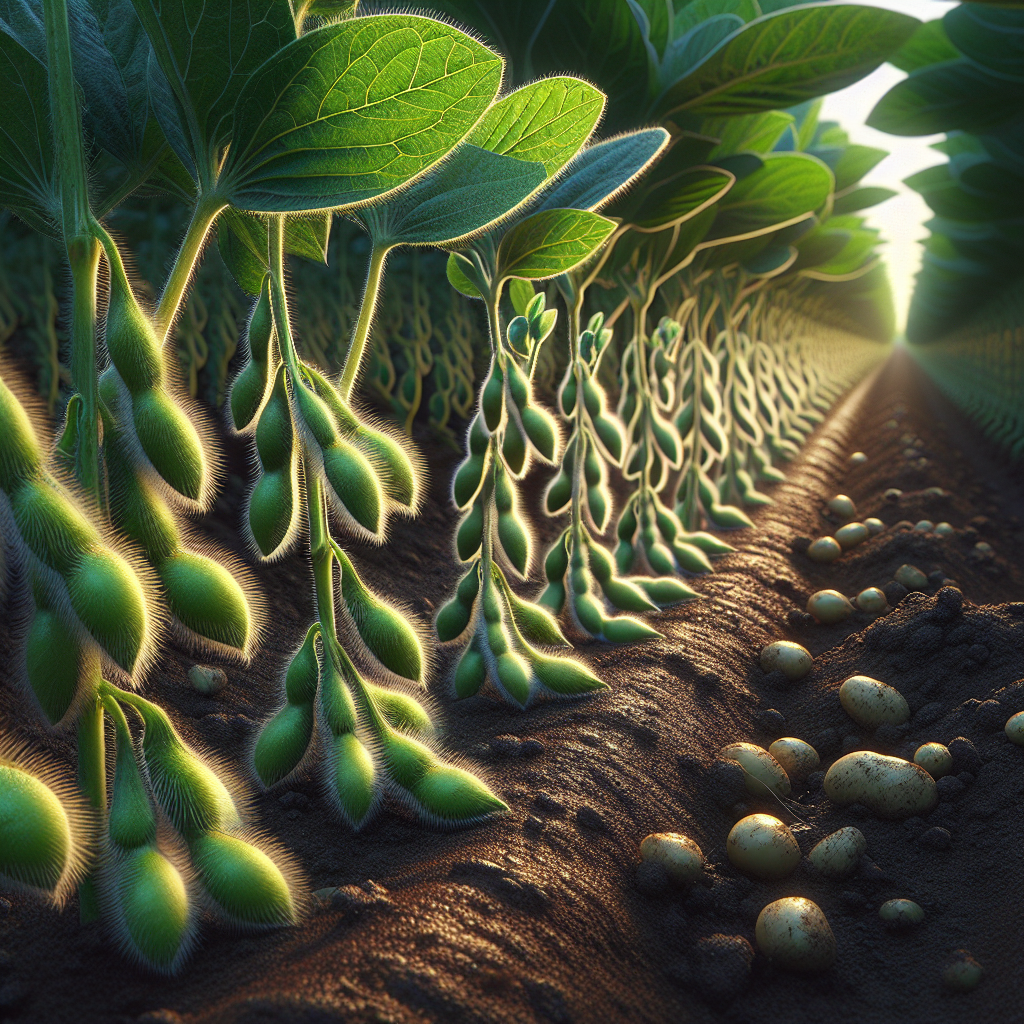
Introduction to Edamame (Soybean)
Edamame is simply soybean harvested at the immature, bright-green stage when pods are plump but seeds are still soft, sweet, and high in moisture. Unlike grain soybeans bred for oil and dry storage, vegetable soybeans are selected for larger seeds, sweeter flavor, less beany bitterness, and a pod set that is concentrated enough to make harvest practical. In East Asia, especially Japan, China, and Korea, edamame has long been valued as a fresh seasonal food and protein source; in modern market gardening it has become increasingly important because it fits warm-season rotations, adds nitrogen through symbiosis with rhizobia, and offers a premium harvest window.
From a production standpoint, edamame behaves like a short, bushy annual legume with a relatively narrow harvest stage. That narrow window is the defining management challenge: if harvested too early, pods are flat and yields are poor; too late, seeds become starchy, skins toughen, and sugars convert rapidly. Professional growers therefore plan variety choice, sowing date, irrigation, and labor availability backward from the desired harvest window.
For broad soybean production principles, see our Soybeans guide. For better field fertility planning and structure management, the soil-building concepts in this soil health article are especially relevant to edamame.
Botanical Profile of Edamame (Soybean)
This crop belongs to the Fabaceae family, the same legume family as peas, beans, chickpeas, and lentils. It is a warm-season, frost-sensitive annual that typically reaches 30-90 cm in height depending on cultivar, fertility, day length response, and growing conditions. Plants are usually erect to semi-bushy, with trifoliate leaves, self-pollinating flowers, and fuzzy pods borne in clusters along the stems.
The root system begins with a strong taproot supported by lateral branching roots. On compatible soils, roots develop nodules containing Bradyrhizobium bacteria that fix atmospheric nitrogen into plant-usable forms. Nodulation is one of the most important biological features of the crop: a healthy stand with effective nodules will usually show fewer signs of nitrogen hunger than uninoculated plants in low-nitrogen soils.
Flowers are small, white to pale violet, and often inconspicuous. Pod set occurs after flowering and is heavily influenced by temperature, light, and water supply. Edamame cultivars are often classified by maturity group and photoperiod sensitivity. In practical terms, this means some varieties flower and fill pods reliably only within certain latitude and season ranges. At high temperatures or under severe drought during flowering, plants may abort blossoms and set fewer marketable pods.
The edible stage is commonly the R6 growth stage in soybean terminology: seeds have filled the pod cavity but remain green and tender. At this stage, ideal pods are fully swollen, uniformly green, and firm but not leathery. Seed size is generally larger than in oilseed soybean, often with two or three large beans per pod.
Good edamame cultivars are usually bred for:
- Large seed size and high pod fill
- Sweet, nutty flavor with low lipoxygenase-related off-flavors
- Uniform maturity for once-over harvest
- Reduced pubescence staining on pods
- Strong emergence in warm soils
- Resistance or tolerance to common soybean diseases where available
Soil, pH, and Climate Requirements for Edamame (Soybean)
Edamame performs best in fertile, well-drained loam or sandy loam with good tilth and moderate water-holding capacity. Heavy clay can produce excellent yields if drainage is strong and compaction is minimal, but poorly aerated soils are risky because soybean seedlings are highly sensitive to crusting, waterlogging, and root-zone oxygen depletion. In compacted ground, emergence is uneven, nodulation is reduced, and root disease pressure rises sharply.
The optimal soil pH is generally 6.0-6.8, though plants can tolerate roughly 5.8-7.2 if nutrient balance is acceptable. Below pH 5.8, nodulation efficiency often drops, phosphorus availability may become limiting, and manganese or aluminum toxicity can stress seedlings. Above pH 7.2, iron chlorosis is more likely, especially in calcareous soils; young leaves may turn interveinally yellow while veins remain green.
Before planting, aim for:
- Organic matter above 2.5%, with 3-5% especially favorable in garden or small-farm soils
- Good aggregate stability so soil crumbles rather than smears when moist
- Electrical conductivity low enough to avoid salt stress; edamame is less salt tolerant than many growers assume
- Available phosphorus and potassium in the medium to high range based on soil testing
The crop prefers warm, frost-free growing conditions. Ideal germination begins when soil temperature at 5 cm depth is at least 16-18°C, though 20-30°C gives faster, more uniform emergence. Air temperatures of 22-30°C are highly favorable during vegetative growth. Once temperatures exceed about 32-35°C during flowering and early pod fill, reproductive stress increases and yields can suffer through flower abortion, poor pod fill, and accelerated maturity.
Edamame requires full sun. A minimum of 6 hours of direct sunlight may keep plants alive, but commercial-quality pod set is best with 8 or more hours. Shade reduces branching, delays drying after dew or rain, and increases disease risk.
Moisture is most critical from flowering through pod fill. A total seasonal water demand commonly ranges around 380-500 mm depending on climate, soil type, and cultivar duration. The key is not just total water, but consistency. Soil should remain evenly moist in the main root zone, especially the top 15-25 cm during establishment and the top 30-45 cm during active flowering and pod fill.
Useful field interpretation:
- At about 70-80% of field capacity, plants maintain vigorous growth and pod fill.
- Below roughly 50-60% of field capacity during bloom or pod fill, expect smaller pods, fewer filled seeds, and tougher texture.
- Saturated soil for more than 24-48 hours, especially in warm weather, can trigger yellowing, root stress, and seedling loss.
Step-by-Step Planting & Propagation
Edamame is propagated almost exclusively by direct seeding. Transplanting is generally inferior because soybeans dislike root disturbance, often pause after transplanting, and may never fully regain uniformity.
Select a suitable cultivar. Choose a true vegetable soybean type rather than a grain soybean. Look for days to harvest, seed size, pod color retention, and local adaptation. Early cultivars may mature in 70-85 days, while main-season types often take 85-110 days. For staggered harvests, sow two or three cultivars or repeat sowings every 10-14 days.
Prepare the seedbed. Create a fine, firm seedbed free of large clods. The surface should be level enough for even seeding depth and irrigation. Avoid excessive tillage that leaves powdery soil prone to crusting. In raised beds, a width of 75-100 cm works well for hand harvest; in field rows, machinery and labor access should dictate spacing.
Inoculate if needed. If soybeans have not been grown in the plot recently, apply a soybean-specific Bradyrhizobium inoculant to seed just before planting. This is especially important in new ground, sterilized media, or soils with a long history of non-legume crops. Effective nodules, when cut open, are pink to reddish inside due to leghemoglobin; white or greenish nodules are less active.
Time sowing correctly. Wait until danger of frost has passed and soil is thoroughly warm. Cold soil leads to slow emergence, seed rot, and patchy stands. In temperate regions, this usually means late spring to early summer. In warm subtropical zones, schedule planting to avoid the hottest part of flowering if possible.
Seed at the proper depth. Plant 2.5-4 cm deep in moist soil. Use the shallower end in heavier soils and the deeper end in lighter soils or when the topsoil dries quickly. Seed too shallow and roots may anchor poorly; seed too deep and emergence weakens.
Set spacing for your harvest method. For garden and hand-harvest systems, sow seeds 5-10 cm apart in rows 45-60 cm apart. For denser fresh-market stands, many growers target 25-35 viable plants per square meter. Wider spacing improves airflow and branching; closer spacing encourages more upright plants and a more synchronized harvest.
Irrigate for establishment. After sowing, water enough to moisten the seed zone without puddling. The target is uniform moisture in the top 5-8 cm until emergence. Under ideal warm conditions, seedlings appear in 5-10 days; in marginal cool soils, emergence can take 2 weeks or more.
Thin or replant quickly if needed. Any large gap in the stand reduces total pod yield. Replant within a few days of noticing failures, but remember late plants may mature behind the main crop and complicate harvest timing.
Care & Maintenance regimes for Edamame (Soybean)
Once established, edamame is relatively manageable, but high-quality pods require disciplined water and weed control.
Water management is the single most important maintenance task after establishment. During the first 2-3 weeks, keep the upper root zone evenly moist but never swampy. A practical target is soil that feels cool and slightly damp at finger depth, not glossy wet. After roots deepen, water more thoroughly and less frequently, encouraging roots into the 20-30 cm zone. During flowering and pod fill, avoid moisture swings. If the soil becomes dry 5-7 cm down and leaves lose midday turgor repeatedly, pod size and tenderness will suffer.
Signs of underwatering:
- Blossoms aborting or poor pod set
- Smaller, less filled pods
- Leaves folding or drooping in the heat and recovering slowly by evening
- Premature yellowing starting from lower canopy during reproductive growth
Signs of overwatering or poor drainage:
- Persistent yellowing despite adequate fertility
- Stunted plants in wet patches
- Soft lower stems, root browning, or sour soil smell
- Nodules sloughing off or turning inactive
A common benchmark is 25-38 mm of water per week early, rising toward 38-50 mm during flowering and pod fill in warm weather, adjusted upward for sandy soils and downward for heavier soils or rainy periods.
Fertilization should be conservative with nitrogen. Excessive soluble nitrogen often produces lush leaves at the expense of nodulation and can delay maturity. If soil is poor and no inoculation is used, a small starter dose may help seedlings, but in most well-managed soils edamame benefits more from balanced phosphorus, potassium, sulfur, and trace elements than heavy nitrogen feeding.
General nutrient priorities:
- Phosphorus supports root growth and early vigor.
- Potassium improves stress tolerance, water regulation, and pod fill.
- Sulfur is important for protein synthesis.
- Molybdenum and cobalt can influence nitrogen fixation in deficient soils.
If leaves are pale overall in early growth and nodulation is absent, a modest side-dress of nitrogen may rescue growth, but this should be a correction, not a routine habit.
Weed control is essential during the first 4-6 weeks because soybeans are not especially competitive as seedlings. Keep rows clean with shallow hoeing, stale seedbed techniques, or organic mulches applied after plants are established and soil is warm. Avoid deep cultivation once plants begin nodulating, because root pruning reduces plant vigor.
Hilling is generally unnecessary, but a light pull of soil toward stems can help stabilize plants in loose soils. Do not bury the lower canopy excessively, as poor airflow near the stem base can favor disease.
Flowering management matters more than many gardeners realize. Any severe stress during bloom, including drought, extreme heat, root disturbance, or herbicide drift, may reduce final yield substantially. Maintain steady irrigation, avoid cultivation injuries, and refrain from aggressive foliar feeding during heat events.
Pests, Diseases & Organic Management
Edamame shares most major pest and disease concerns with grain soybean, but the vegetable harvest stage changes tolerance thresholds. Cosmetic pod damage that might be acceptable in field soybeans can ruin fresh-market edamame.
Common insect pests include aphids, bean leaf beetles, Japanese beetles, stink bugs, caterpillars, and spider mites in hot, dry weather. aphids cluster on stems and undersides of leaves, sucking sap and excreting honeydew. Light infestations are often tolerable, but increasing colonies during pod fill can weaken plants and vector viruses. bean leaf beetles chew round holes in leaves and scar pods. stink bugs are especially problematic because they pierce pods and seeds, causing pitting, discoloration, and shriveled beans. caterpillars can skeletonize foliage and chew pods directly.
Organic management principles:
- Scout twice weekly from seedling stage through harvest.
- Inspect lower leaves, flower clusters, and developing pods, not just the canopy top.
- Use floating row cover immediately after sowing where beetles are severe, removing it at flowering if pollinator access for nearby crops or airflow becomes an issue.
- Encourage beneficial insects with borders of Nasturtium and Yarrow, which can support predatory and parasitic species.
- Use insecticidal soap for aphids only when colonies are expanding and beneficials are insufficient; thorough coverage is critical.
- Apply neem-based products carefully and only when needed, avoiding high-heat periods and respecting pre-harvest intervals.
- Hand-remove beetles in small plantings or use trap cropping where practical.
Major diseases include damping-off, Phytophthora root and stem rot, Rhizoctonia, bacterial blight, downy mildew, frogeye leaf spot, Cercospora leaf blight, and various viruses. Many begin with poor drainage, infested residue, or prolonged leaf wetness.
Preventive strategy is far more effective than rescue treatment:
- Rotate out of legumes for at least 2-3 years if disease pressure has been high.
- Avoid overhead irrigation late in the day; wet leaves overnight favor foliar pathogens.
- Maintain row spacing and weed control for good airflow.
- Do not work plants while wet, since bacterial diseases spread easily by contact.
- Remove heavily infected crop residue after harvest or compost only if the pile reaches effective sanitizing temperatures.
- Use resistant or tolerant varieties whenever available.
Watch for root disease symptoms in patches: yellowing, wilting despite moist soil, dark stem lesions near the soil line, and poor nodulation. In such cases, improving drainage is often more valuable than any input. In high-rainfall areas, raised beds or broad beds can make a major difference.
Birds and rodents may also target emerging seed or maturing pods. Uniform, rapid emergence through warm-soil planting is the best defense against seed predation.
Harvesting, Curing & Optimal Storage
Harvest timing defines eating quality. The best stage is when most pods are bright green, plump, and 85-90% filled, but before leaves are fully yellow and before pods lose fresh gloss. Seeds should be large enough to press against the pod wall, yet still tender and vividly green inside. If you wait until pods dull, dry, or yellow, the beans quickly become starchier and less sweet.
For home production, harvest by hand every 2-4 days during peak maturity. Pick whole plants when most pods on the plant are ready, or strip individual pods for a longer harvest. Commercial hand-harvesters often cut plants near the base and strip pods later in shade. Morning harvest is ideal because pods are cooler, crisper, and less prone to field heat damage.
Typical signs of prime harvest:
- Pods are swollen and uniformly green
- Seeds are full-sized but not hard
- Interior beans taste sweet, nutty, and creamy rather than chalky
- Pod fuzz is present but pods are not leathery
Edamame is not cured like dry beans. Instead, it should be hydrocooled or chilled as soon as possible after harvest to preserve sugars and texture. Field heat removal is critical because respiration is high. Hold pods at 0-5°C with high relative humidity, ideally 95% or above, to reduce wilting. Under ideal cold storage, quality is best within 3-5 days, though some lots may remain acceptable for about a week. At room temperature, sweetness declines fast.
Do not wash pods before storage unless they will be dried quickly on the surface and kept cold; free moisture can accelerate decay if ventilation is poor. For longer preservation, blanch shelled beans or whole pods 2-5 minutes depending on size, chill immediately in ice water, drain well, and freeze.
If the crop is allowed to mature fully for seed saving, let pods dry on the plant until tan to brown, then harvest before shattering. Dry further under cover until seeds are hard and moisture is low enough for safe storage. This is a different endpoint from eating-quality edamame and should not be confused with fresh harvest.
Companion Planting for Edamame (Soybean)
As a nitrogen-fixing legume, edamame can complement heavy-feeding crops, but the benefit is often greater in rotation and residue contribution than as instant in-season nitrogen transfer. Good companion planning focuses on space use, pest confusion, beneficial insect support, and avoiding direct competition.
Among the best companions are Corn, which provides a different canopy architecture and can help diversify the planting block; Radish, which matures quickly, helps break surface crust in some soils, and occupies space before soybean canopy closure; Nasturtium, useful around plot edges as a flowering insectary and trap plant in mixed gardens; and Yarrow, which attracts beneficial insects and supports ecological pest balance.
Companion guidelines:
- Pair with upright, non-spreading crops so the soybean canopy still receives full sun.
- Avoid crowding with very aggressive feeders at close spacing.
- Keep tall companions oriented so they do not excessively shade the crop during flowering.
- Use flowering insectary plants on borders rather than directly within dense rows to preserve airflow and harvest access.
Poor companions are usually those that create heavy shade, persistent humidity, or severe root competition. Alliums are sometimes said to conflict with legumes, but in practical garden systems the bigger issue is usually spacing and water management, not outright incompatibility. The safest strategy is to keep edamame in clean, sunny blocks with companion species on margins or in adjacent rows rather than intermingled too tightly.
In rotation, edamame fits especially well before leafy greens, brassicas, or other crops that appreciate improved soil structure and residual fertility. It can also help break pest cycles when alternated with non-legumes rather than repeatedly planted in the same family block.