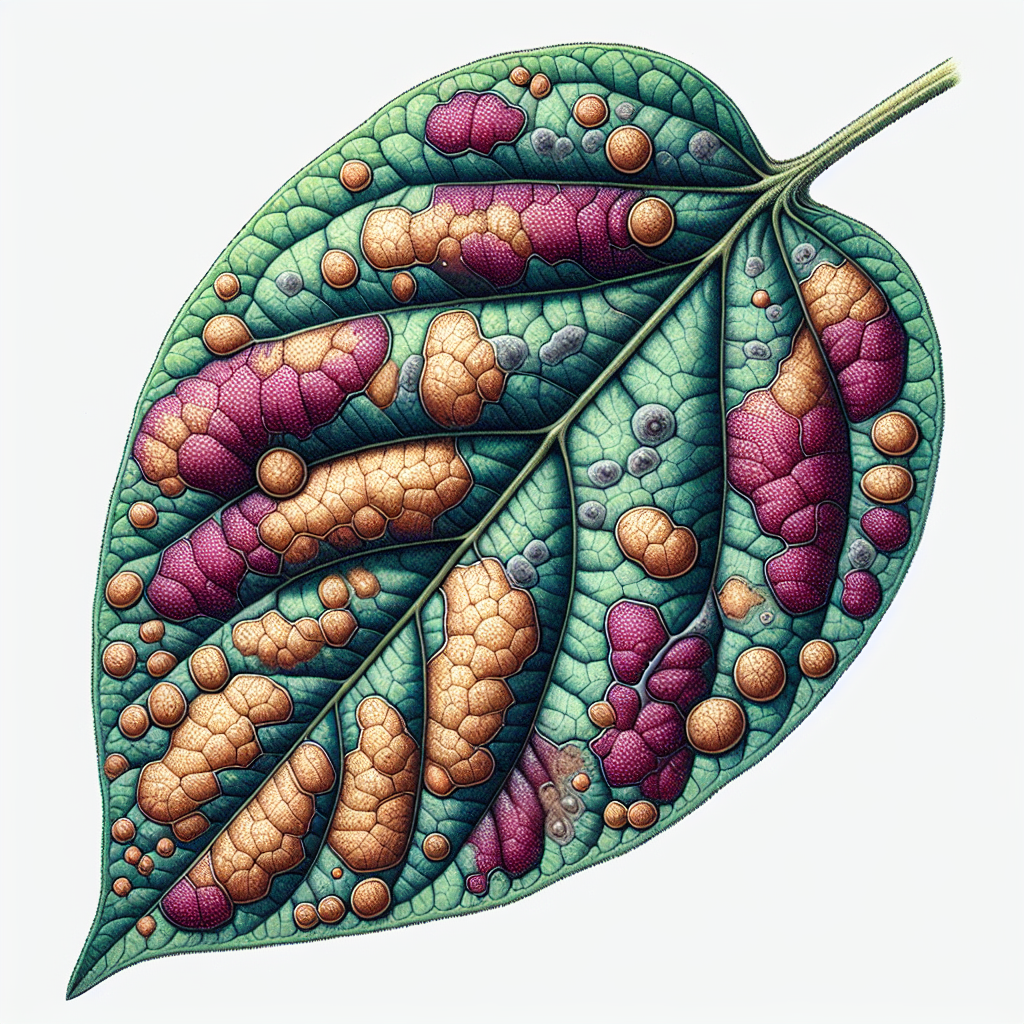
Introduction to Cercospora leaf blight
Cercospora leaf blight represents one of the most destructive foliar diseases in tropical and subtropical agriculture, caused by fungi in the genus Cercospora. This pathogen targets a broad spectrum of crops, manifesting as circular to irregular spots on leaves that coalesce into blights, ultimately compromising plant vigor and yield. First identified in the late 19th century, it has since become a global concern, particularly in high-humidity regions where it can reduce harvests by up to 50% in severe outbreaks.
The disease's impact extends beyond visible symptoms; infected leaves lose photosynthetic capacity, leading to stunted growth, smaller fruits, and lower quality produce. Farmers often confuse it with other leaf spot diseases, but Cercospora blight is distinguished by its tan to gray lesions with reddish margins and profuse sporulation under humid conditions. Understanding its biology is essential for effective management, especially as climate change intensifies favorable conditions for spore dispersal.
This definitive guide equips growers with professional-grade diagnostics, organic treatments, and prevention tactics. By integrating cultural practices, biological controls, and vigilant monitoring, you can safeguard your fields. For small farms, timely intervention is key to maintaining profitability amid rising input costs. Learn more about Cercospora leaf spot for deeper insights into related pathologies.
Identifying Symptoms & Damage
Early detection of Cercospora leaf blight hinges on recognizing its characteristic symptoms, which begin subtly but progress rapidly. Initial signs appear on lower, older leaves as small, circular spots measuring 1-3 mm in diameter. These lesions start as pale green or yellowish areas, evolving into tan to light brown centers with darker reddish-purple borders—a hallmark feature.
As the disease advances, spots enlarge to 5-10 mm, often merging into irregular blighted patches that cover entire leaves. Under high humidity, the undersides develop a grayish-white fungal growth, releasing millions of conidia (spores). Affected leaves yellow, wither, and drop prematurely, exposing fruits to sunburn and increasing susceptibility to secondary infections like Alternaria.
Damage quantification reveals severe economic toll: in soybeans, yield losses reach 20-40%; in sugar beets, up to 30% root weight reduction occurs due to defoliation. Visual diagnostics include a 10x hand lens to spot chain-like conidia, distinguishing it from bacterial spots lacking sporulation. Conduct a quadrant sampling: if >10% leaf area shows symptoms, initiate controls. Differentiate from Septoria leaf spot by Cercospora’s lack of pycnidia and preference for veins.
Severity scales (0-5) aid assessment: 0=no symptoms, 5=90% defoliation. Regular scouting every 7 days during peak risk prevents escalation. For precise identification, lab confirmation via culturing on V8 agar confirms C. sojina or C. beticola. Early symptoms mimic nutrient deficiencies, but lesion borders and spore masses confirm fungal etiology.
Lifecycle and Progression of Cercospora leaf blight
The lifecycle of Cercospora leaf blight is polycyclic, enabling multiple infection cycles per season. Primary inoculum overwinters in crop debris as dormant stromata—compact fungal masses on leaves and stems. Spring rains splash these structures, releasing conidia that germinate on wet leaf surfaces within 6-12 hours at 25-30°C.
Infection penetrates stomata or wounds, with incubation lasting 7-14 days. New lesions produce secondary conidia in acervuli, wind-dispersed up to 100m, perpetuating epidemics. Optimal conditions (95% RH, 24-28°C) yield 10^5 spores/lesion daily. Progression follows a logistic curve: slow initial spread, exponential mid-season, plateauing with host senescence.
In sugar beets, six cycles occur; in peanuts, fewer due to shorter seasons. Pseudostromata in debris survive 18 months, underscoring sanitation's role. Disease gradients show steep dispersal near inoculum sources, flattening with distance. Understanding this enables predictive modeling: forecast outbreaks using weather data (leaf wetness >12h triggers 80% infection risk).
Environmental Triggers & Risk Factors
Cercospora thrives in warm (22-32°C), humid environments with prolonged leaf wetness (>10h). Nighttime temps >20°C and daytime RH >85% accelerate epidemics. Overhead irrigation, dense canopies, and poor airflow exacerbate spread, as spores require free water for germination.
Risk factors include susceptible varieties, excessive nitrogen promoting lush foliage, and continuous cropping without rotation. Acidic soils (pH<6) and high clay content retain moisture, favoring pathogen. In corn, tassel-period infections spike with dew. Climate variability—erratic rains—amplifies outbreaks; El Niño years see 2x incidence.
For more on weather impacts, check this insightful post: Why 80% of Small Farms Battle Weather Disasters - And How Hyper-Local AI Forecasts Can Save Your Harvest. Assess farm microclimate: windbreaks reduce spore deposition by 40%.
Organic Control & Treatment Plans
Organic management integrates cultural, biological, and approved fungicides. Remove and destroy debris post-harvest to eliminate 90% inoculum. Rotate with non-hosts like grasses for 2-3 years. Prune for airflow, spacing plants 30-50cm.
Biologicals shine: Trichoderma viride (5kg/ha) colonizes debris, outcompeting Cercospora (70% reduction). Bacillus subtilis sprays (2-3L/ha, 7-day intervals) induce resistance. Neem oil (3%) + potassium bicarbonate disrupts spore germination (85% efficacy).
Approved OMRI products: sulfur (3-5kg/ha), copper octanoate (1-2L/ha, max 3 apps). Apply at first symptoms, 10-14 day intervals, avoiding bloom. Treatment plan: Scout weekly; at 5% incidence, apply biofungicide; escalate to copper if >20%. Integrate with marigold intercrops repelling vectors. Trials show IPM yields 25% higher than untreated.
Preventing Cercospora leaf blight in the Future
Prevention outperforms cure via resistant varieties (e.g., 'Patriot' soybeans, 50% less susceptible). Plant certified seed; solarize soil (6 weeks summer) kills stromata. Mulch suppresses splash dispersal. Monitor with sticky traps for spore counts; threshold <50 spores/m³ delays sprays.
Nutrient balance: moderate N, boost K (40kg/ha) for tougher cuticles. Irrigate furrow-style; time for dry foliage. Fallow + cover crops (clover) break cycles. Annual audits: map hot spots, adjust rotations. Long-term, breed for partial resistance; scout neighbors for inoculum.
Crops Most Affected by Cercospora leaf blight
Sugar beets suffer most, with C. beticola causing 30-50% losses. Soybeans (C. sojina) see 20-40% reductions in pods. Peanuts (C. arachidicola) defoliate early, slashing yields 25%. Tomato (C. tomatophila) spots reduce fruit size. Corn (C. zeae-maydis) faces gray leaf spot epidemics. Others: mung beans, cowpeas, okra. Regional hotspots: Midwest US beets, Southeast Asia rice alternates.