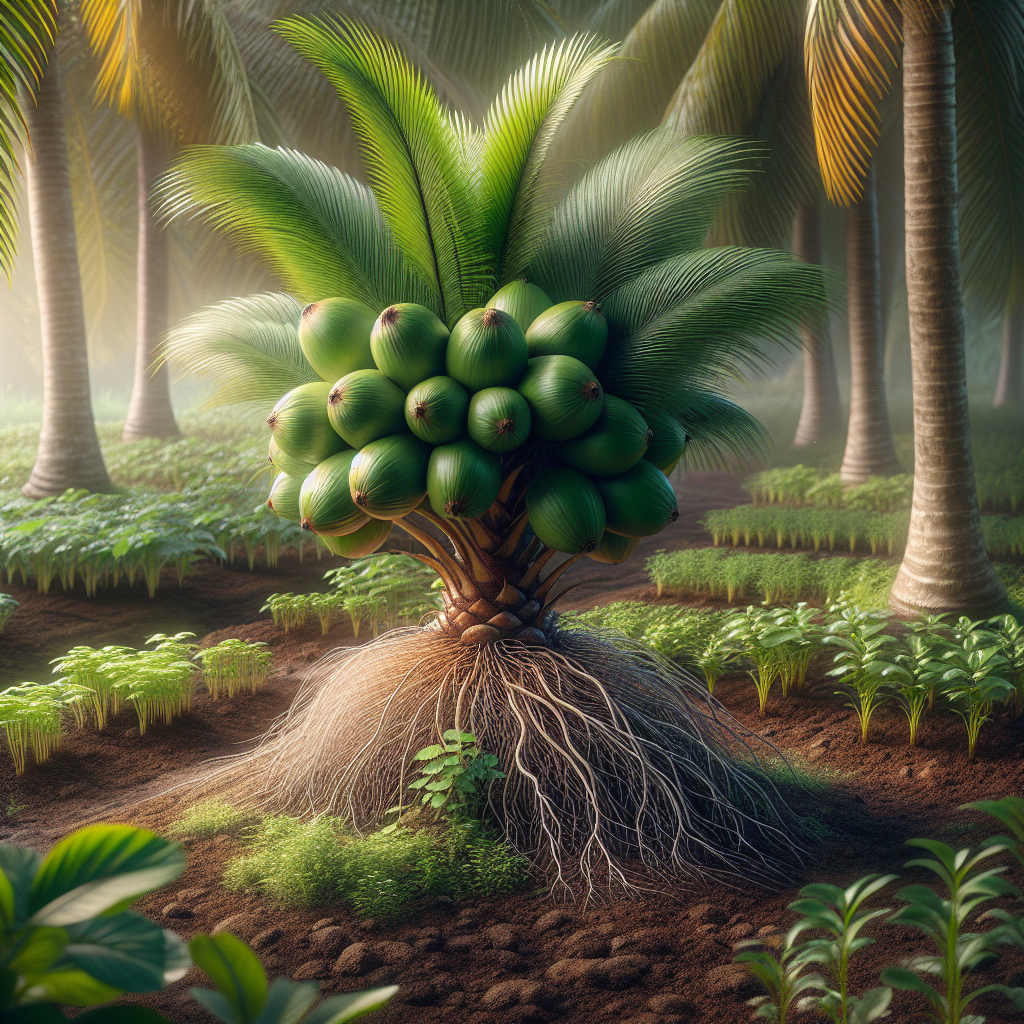
Introduction to Dwarf Coconut
Dwarf Coconut is not a separate species but a horticultural growth form of coconut selected for shorter stature, earlier flowering, and often more convenient harvesting than tall palms. In practical farm terms, this makes it highly desirable for homesteads, mixed tropical orchards, coastal gardens, and intensive nut-water production systems where labor efficiency matters.
Most dwarf types begin bearing significantly earlier than tall coconuts, often within 3 to 5 years under excellent management, whereas tall forms may take longer. This precocity is one of the strongest reasons growers choose dwarf palms. Many dwarf selections are also favored for tender coconut water because the fruits are easier to reach and harvest while still immature. If you want a general species-level baseline for comparison, see the broader Coconut guide.
Historically, dwarf coconuts have been selected and maintained in tropical regions of South and Southeast Asia, the Pacific, the Caribbean, and parts of Africa and Latin America. Well-known groups include Malayan Dwarf types in green, yellow, and orange forms, as well as aromatic or specialty local dwarfs. Compared with tall coconuts, dwarf palms tend to be more self-pollinating, which helps preserve type characteristics but can also narrow genetic diversity. That can matter in disease-prone regions, where hybridization between dwarf and tall types is sometimes preferred to combine early bearing with greater vigor.
Dwarf does not mean tiny. A mature palm can still reach roughly 6 to 12 meters depending on cultivar, age, soil fertility, and climate. It is simply shorter and generally more compact than standard tall coconuts. Growers who misunderstand this sometimes crowd plantings too tightly, causing chronic shade competition, poor air flow, elevated disease pressure, and declining nut set after the first productive years.
Botanical Profile of Dwarf Coconut
Dwarf Coconut is a monocotyledonous palm in the Arecaceae family. Unlike branching fruit trees, it grows from a single apical growing point, often called the crownshaft region or central spear zone. This means one major management rule governs all pruning and protection decisions: if the apical meristem dies, the palm dies. There is no scaffold system to regrow from lower buds.
The root system is fibrous and adventitious rather than dominated by a deep taproot. Most feeding roots occupy the upper 30 to 120 cm of soil, spreading widely beyond the canopy drip line if soil aeration is good. This explains why dwarf coconuts respond strongly to mulching, surface organic matter, and shallow irrigation, but also why they decline quickly in waterlogged, compacted, or oxygen-poor soils.
Leaves are pinnate, long, and arching, with leaflets arranged along a central rachis. A healthy dwarf palm should continuously produce a strong spear leaf and a succession of green fronds with no widespread chlorosis, tip necrosis, or leaflet shortening. Nutrient deficiency often first appears in the oldest fronds, especially potassium deficiency, which is very common in coconut-growing soils.
Inflorescences emerge from the leaf axils within a protective spathe. Coconut is monoecious, with male and female flowers borne on the same inflorescence. Dwarf forms are often more self-pollinating than tall types, and that contributes to their uniformity. Fruit is a fibrous drupe composed of exocarp, mesocarp husk, hard endocarp shell, and the seed containing water and kernel.
Commercially and horticulturally, dwarf cultivars are often categorized by fruit color and regional selection history. Green dwarf types are widely used for tender nuts, yellow and orange dwarfs are often popular in ornamental and mixed farm systems, and some specialty dwarfs are selected for sweetness, aroma, or clustered bearing habit. Productivity depends heavily on nutrition and water, because a short palm with poor potassium supply may flower but drop nuts prematurely.
Soil, pH, and Climate Requirements for Dwarf Coconut
Dwarf Coconut performs best in deep, well-drained, aerated soils with high rooting volume. Sandy loams, coastal alluvial soils, lateritic soils with amended organic matter, and well-structured loams all work if drainage is reliable. Heavy clay can be used only when planted on raised mounds or ridges and when surface runoff is well managed. Standing water around the base for more than 48 to 72 hours repeatedly is a serious risk factor for root decline, stem instability, and fungal disease.
Ideal soil pH is generally 5.5 to 7.5. It tolerates slightly alkaline conditions better than many fruit crops, especially in coastal environments, but micronutrient lock-up can increase above pH 7.8, particularly for iron, manganese, and zinc. In highly acidic soils below about pH 5.2, aluminum toxicity and nutrient imbalance may reduce vigor unless liming is done carefully.
Drainage matters more than absolute texture. A good field test is to fill a planting hole with water after digging. If water remains more than 24 hours in non-rain conditions, the site needs drainage correction or raised planting. Coconut roots need oxygen; a visually damp soil is acceptable, but a sour smell, gray mottling, algae crust, or blackened feeder roots indicate excess water retention.
Climatically, dwarf coconut is best suited to humid tropical and frost-free subtropical regions. Optimum mean temperatures are about 24 to 32°C. Growth slows under 20°C, is visibly stressed below 15°C, and can be killed by frost or prolonged chill. Young palms are much more cold-sensitive than mature ones. Heat tolerance is excellent if soil moisture and potassium are adequate.
Rainfall of 1200 to 2500 mm annually is favorable, especially when distributed through most of the year. In drier climates, irrigation becomes essential for regular flowering and nut filling. Long dry periods without irrigation often produce smaller nuts, button shedding, low water content, and poor kernel development. Relative humidity above 60% is preferred, though palms can survive lower humidity with adequate water.
Dwarf Coconut also tolerates saline winds better than most fruit trees, which makes it valuable near coasts. However, salt tolerance is not the same as tolerance to saline irrigation water. Moderate aerosol salt from sea spray is usually manageable, but repeatedly irrigating with high electrical conductivity water can reduce root function and leaf quality. Wind exposure is acceptable, but extremely strong cyclone-prone sites benefit from shelter design and wider spacing.
For broader tropical soil system thinking, the principles in soil health strategies are useful when building long-term coconut orchard resilience.
Step-by-Step Planting & Propagation
Propagation is almost always by seed nuts, because coconuts are not propagated like typical grafted fruit trees. Use only fully mature seed nuts from true-to-type, high-yielding, disease-free mother palms. For dwarfs, selecting mother palms with early bearing, regular bunch production, short internodes, and high tender-nut quality is especially important.
- Select seed nuts at full maturity, usually 11 to 12 months after flowering. They should be heavy, well-filled, and free from cracks, insect holes, or abnormal shape.
- Pre-sprout in a nursery bed or sandy medium laid on their side or slightly angled, with partial shade in very hot areas. Keep evenly moist but never waterlogged.
- Germination usually takes several weeks to a few months depending on temperature and cultivar. Discard weak, twisted, or late, poor-vigor sprouts.
- Transplant when seedlings have 4 to 6 leaves and a robust collar, typically at 6 to 10 months old.
Site preparation should begin before the rainy season or just before reliable irrigation can be started. Standard pit size is often 60 x 60 x 60 cm to 1 x 1 x 1 m depending on soil quality. In poor soils, larger pits are beneficial. Refill with topsoil mixed with well-decomposed compost or farmyard manure. Avoid putting fresh manure in direct contact with the sprouting nut or roots.
Spacing depends on the production system. For pure stands, 7.5 x 7.5 m to 8 x 8 m is common for dwarf types. In mixed orchards, adjust spacing for intercrops, light penetration, and mechanized access. Triangular planting can optimize light distribution, but square layouts simplify irrigation and management.
Plant the seedling so the sprouted nut sits partially above soil level in heavy or wet soils, or near soil level in lighter, well-drained soils. Do not bury the entire nut deeply. Over-deep planting encourages basal rot and delays establishment. Firm the soil gently, water thoroughly, and mulch around the basin while keeping mulch 15 to 20 cm away from the stem base.
In cyclone-prone areas, stake young palms lightly for the first year and maintain a broad watering basin rather than a narrow trunk ring. If planting in marginal subtropical climates, choose the warmest microclimate on the property: south-facing in the northern hemisphere, north-facing in the southern hemisphere, with reflected heat and wind protection but no frost pocket.
Care & Maintenance regimes for Dwarf Coconut
Water management is the central yield driver in dwarf coconuts. Young palms need consistently moist but aerated soil during establishment. As a practical target, the top 15 to 20 cm of soil should remain slightly moist, never dust-dry for long periods and never swampy. In sandy soils, this may mean watering 2 to 4 times weekly in hot weather. In loams, 1 to 2 deep irrigations weekly may be enough. Mature palms benefit from basin, drip, or micro-sprinkler irrigation delivering moisture through the active root zone rather than only at the trunk.
Signs of underwatering include folded leaflets during the hottest part of the day, slowed spear emergence, smaller fronds, nut shedding, and reduced nut water volume. Signs of overwatering include yellowing lower fronds despite wet soil, sour-smelling basins, moss or algae near the base, reduced spear growth, and blackened fine roots if examined. Frequent shallow irrigation in clay soils is especially risky because it keeps the root crown anaerobic.
Mulching improves soil temperature moderation, moisture retention, and feeder root activity. Apply 8 to 15 cm of coarse organic mulch such as coconut husk pieces, leaves, composted yard waste, or chipped prunings, keeping a bare collar around the stem. Coconut husk burial or ring placement can be especially effective in sandy soils because it acts like a moisture sponge.
Nutrition should emphasize potassium, nitrogen, magnesium, and chloride, plus boron and other micronutrients where deficient. Dwarf coconuts often show potassium deficiency as orange-yellow spotting or necrosis on older leaflets, progressing to frond tip burn and reduced nut set. A balanced palm fertilizer with relatively high K is preferable to a generic lawn or fruit-tree feed. Split annual applications into 3 to 4 doses in rainy climates or fertigate in smaller monthly doses where irrigation exists.
A mature palm may require multiple kilograms per year of a balanced palm formulation depending on soil tests, age, and yield target. Magnesium can be supplemented with kieserite or magnesium sulfate where leaflet banding or marginal chlorosis indicates deficiency. Boron is critical for normal spear and reproductive growth; deficiency may cause distorted new leaves, poor nut development, and malformed crowns. Because boron has a narrow safety margin, apply only based on local recommendations or laboratory diagnosis.
Weed control around the root zone should be shallow and non-injurious. Avoid repeated deep hoeing that severs feeder roots. Maintain a weed-free basin at least 1 to 1.5 m from the trunk in young plantings, then rely on mulch, low-growing intercrops, or living covers to suppress weeds. Mechanical string trimming should not wound the stem.
Pruning is minimal. Remove only fully dead, broken, or heavily diseased fronds. Over-pruning reduces photosynthetic capacity and can lower yield. A productive coconut palm needs a full canopy to fill nuts properly. Never cut green healthy leaves just to make harvest easier.
In container culture, which is only a temporary or specialty option for dwarf forms, use a very free-draining medium and expect much higher watering and nutrition frequency. True long-term production is far better in the ground.
Pests, Diseases & Organic Management
Major pest pressure varies by region, but common issues include Rhinoceros beetle, Red palm weevil, Scale insects, Mealybugs, Eriophyid mites, Leaf-eating caterpillars, and Rodents attacking young nuts. Organic management begins with sanitation and palm vigor, because stressed palms attract and sustain pests more readily.
Rhinoceros beetle damage often appears as V-shaped cuts in emerging fronds because the beetle bores into the crown and feeds on unopened tissue. Remove decaying organic piles where the pest breeds, use pheromone traps where recommended regionally, and inspect the crown regularly. Red palm weevil is more serious because it can kill palms; avoid trunk wounds, remove severely infested tissue promptly, and maintain strict field hygiene.
Scale and mealybug infestations are favored by dense shade, nutrient imbalance, and ant activity. Encourage natural enemies, manage ants, and use horticultural oils or insecticidal soaps only when necessary and when temperatures allow safe application. Thorough coverage matters, but take care not to concentrate sprays into the central spear during extreme heat.
Important diseases include Bud rot, Stem bleeding, Lethal yellowing in affected regions, Root wilt complexes, Leaf spot fungi, and various Basal rots. Bud rot is especially dangerous because the single growing point is involved. Early symptoms can include water-soaked spear tissue, foul odor, spear pull, and collapse of the central crown. Preventive management includes excellent drainage, avoiding injury, prompt removal of infected debris, and protection of the crown in prolonged wet weather where feasible.
Nutritional stress is often mistaken for disease. Potassium deficiency, magnesium deficiency, and boron deficiency can all produce dramatic canopy symptoms. Before treating chemically, assess patterning: deficiencies usually follow age-related leaf patterns or whole-block soil trends, while infectious disease may appear patchy, rapidly progressive, or associated with rot and odor.
Organic management for coconuts works best as an integrated system: resistant or locally adapted planting material, sanitation, balanced nutrition, mulching, biological diversity in the orchard floor, regular scouting, and pruning only when justified. Any removed diseased crown material should be destroyed or moved far from the orchard rather than composted casually nearby.
Harvesting, Curing & Optimal Storage
Harvest timing depends entirely on end use. For tender coconut water, fruits are commonly harvested at around 6 to 8 months after flowering, when the nut contains abundant sweet water and only a thin, jelly-like kernel. For mature nuts intended for copra, culinary kernel, seed, or oil, harvest is usually at 11 to 12 months when the husk begins to dry and the nut reaches full physiological maturity.
Dwarf palms make harvesting safer and more efficient, but fruit should still be cut with appropriate tools and trained technique. Pulling bunches carelessly can tear the inflorescence base or damage adjacent developing nuts. Regular harvest intervals of 30 to 60 days are common depending on market and labor schedule.
For tender nuts, quality is best when harvested in the cooler part of the day and shaded immediately after cutting. Avoid sun exposure of dehusked nuts, which accelerates heating and quality loss. For mature nuts, collect promptly after cutting or natural drop to avoid rodent damage, fungal contamination, and internal sprouting.
Curing is limited for tender coconuts but important for mature nuts. After harvest, mature nuts can be kept in a dry, airy place to reduce surface moisture and stabilize before storage or dehusking. Do not store in sealed humid rooms. Good air circulation reduces mold growth on the husk.
Storage life varies sharply by product form. Tender coconuts are highly perishable and should be sold or chilled quickly. Mature unhusked nuts can store for weeks to a few months in cool, dry, well-ventilated conditions, but quality gradually declines as water is lost and the embryo develops. Husked mature nuts lose moisture faster and should be marketed sooner. If seed nuts are being stored for planting, avoid excessive drying, direct sun, and rough handling that damages the embryo.
Yield expectations vary by cultivar and management, but a well-grown dwarf palm under tropical conditions may produce dozens to over a hundred nuts annually. Regularity matters as much as total count; nutritional stress often shows up first as erratic bunch filling rather than total canopy collapse.
Companion Planting for Dwarf Coconut
The best companions are low-competition species that improve ground cover, suppress weeds, diversify farm output, or make use of partial light during the coconut's juvenile years. In mature plantings, avoid aggressive root competitors planted too close to the palm base.
Peanuts are one of the most useful companions because they function as a low-growing groundcover, reduce weed pressure, and contribute biologically fixed nitrogen to the system. They are especially valuable in young orchards where sunlight still reaches the soil surface.
Ginger performs well in humid tropical systems with filtered light and can be highly profitable as an intercrop, provided irrigation and fertility are adequate. It benefits from the moderated microclimate under widely spaced young to mid-age palms.
Turmeric is similarly well suited as an understory cash crop in tropical agroforestry layouts. It prefers rich, organic soils and consistent moisture, conditions that also support active coconut feeder roots when drainage is correct.
Banana can be used in wider spacings and during early orchard establishment to create quick biomass, wind buffering, and additional income. However, it must be managed carefully because it competes strongly for water and potassium. In dry regions or low-fertility soils, keep banana plantings sparse and well away from the palm basin.
Avoid dense companions right against the trunk. Keep the palm collar open, maintain airflow, and remember that coconut roots occupy a broad shallow zone. The most successful companion systems are those that complement, rather than crowd, the palm's moisture and nutrient demands.