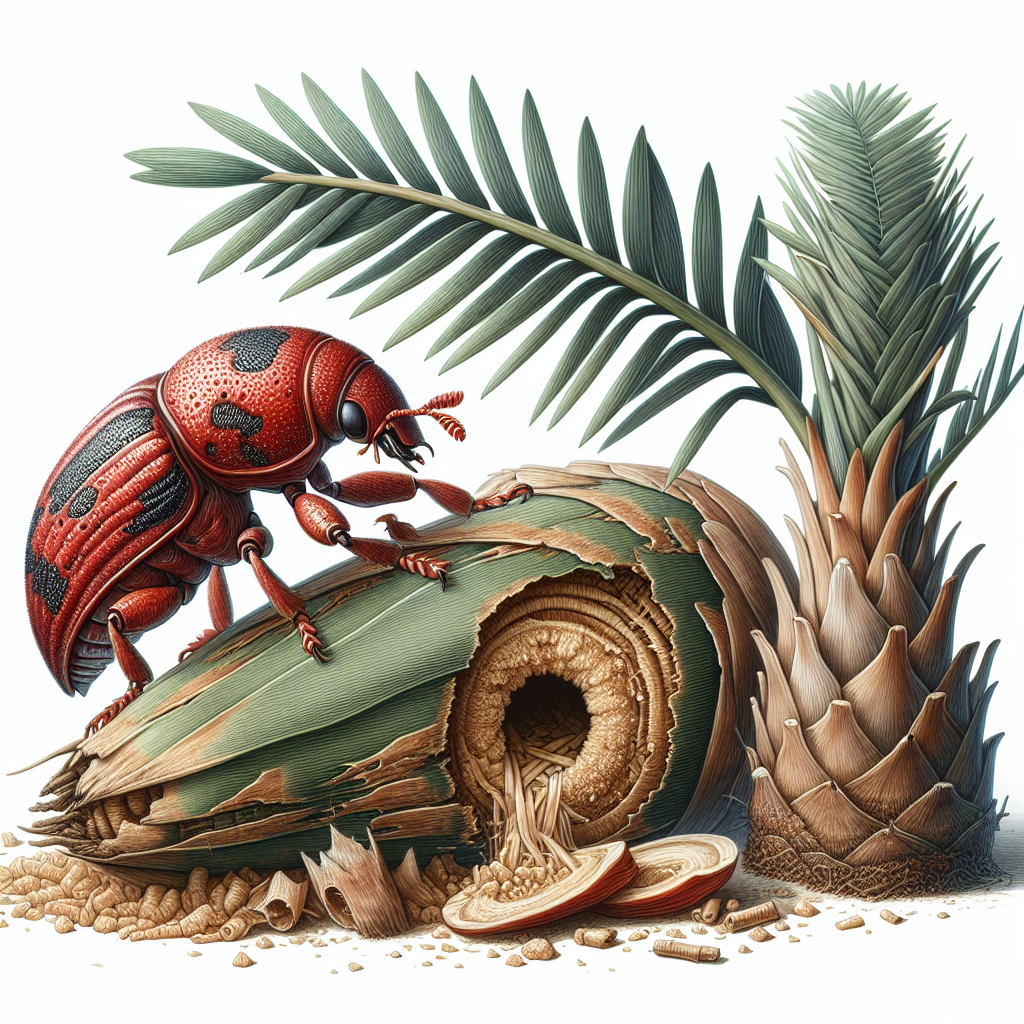
Introduction to Red palm weevil
The red palm weevil (Rhynchophorus ferrugineus), also known as the Asian palm weevil or red palm borer, ranks among the most devastating pests of palm trees globally. Native to Southeast Asia, it has spread to over 60 countries across the Middle East, Europe, Africa, and the Americas through international trade of infested palms. Adult weevils are large, reddish-brown beetles measuring 2-4 cm in length with a distinctive long snout, while larvae are creamy-white, legless grubs up to 4 cm long that bore deep into palm tissues.
This pest causes billions in economic losses annually, particularly in date palm (Phoenix dactylifera) orchards, coconut (coconut) plantations, and ornamental palms. Infestations often go undetected until severe damage occurs, as larvae feed internally on the tender meristematic tissues of the crown, apical meristem, and trunk. Without prompt intervention, affected trees collapse within months, making early scouting and management essential for agricultural sustainability. Farmers in tropical and subtropical regions must prioritize vigilance, especially near ports and nurseries importing palm materials.
Identifying Symptoms & Damage
Recognizing red palm weevil damage early is critical, as symptoms progress rapidly from subtle signs to tree death. Initial indicators include wilting or discolored fronds, often mistaken for drought stress or phytophthora. Look for:
- Pupation chambers: Fibrous, cocoon-like structures at the base of fronds or in trunk wounds, often with chewed fibers protruding.
- Oozing sap or gummosis: Dark, fermented liquid exuding from crown or trunk entry holes, accompanied by a foul odor.
- Frond damage: Yellowing, drooping spear leaves (the youngest central frond), with holes or sawdust-like frass at the base.
- Canopy asymmetry: One-sided wilting as larvae tunnel unevenly.
Advanced symptoms reveal hollowed trunks detectable by tapping with a rod—healthy palms produce a solid sound, infested ones echo hollowly. Larval galleries can extend 1-2 meters deep, severing vascular tissues and preventing nutrient flow. Cross-sections of infested trunks show extensive tunneling packed with frass and pupae. Differentiate from similar pests like rhinoceros-beetle by the weevil's snout and red coloration; unlike borers, weevils produce minimal external chewing.
Use acoustic detection tools or trained dogs for non-invasive diagnosis in large plantations. Regular crown inspections using poles or drones enhance accuracy, especially in tall species like Canary Island date palm.
Lifecycle and Progression of Red palm weevil
Understanding the red palm weevil's lifecycle enables targeted interventions at vulnerable stages. The complete cycle spans 3-4 months under optimal conditions (27-30°C, high humidity), with multiple generations per year.
- Eggs (3-5 days): Females lay 150-200 eggs singly or in clusters near wounds or at frond bases, preferring stressed palms.
- Larvae (1-3 months): Hatching grubs bore inward, molting 6-10 times while feeding on soft pith. They create extensive tunnels, growing to 4 cm.
- Pupa (15-45 days): Mature larvae form reddish-brown pupae in fibrous chambers within the tree.
- Adults (3-6 months): Emerge at dusk, fly up to 50 km seeking mates and hosts. Females oviposit immediately, peaking in warm seasons.
Progression accelerates in irrigated, nitrogen-fertilized palms, with peak activity in spring and fall. Overwintering occurs as diapausing larvae in cooler climates. Monitoring adult emergence via pheromone traps tracks population dynamics, informing treatment timing.
Environmental Triggers & Risk Factors
Red palm weevil thrives in warm, humid environments (20-35°C, >60% RH), spreading via human-mediated transport of infested offshoots or logs. Key triggers include:
- Tree stress: Drought, overwatering, mechanical wounds from pruning, lightning strikes, or lightning damage create entry points.
- Poor sanitation: Unremoved stumps, debris, or dumped palm waste harbor breeding sites.
- High host density: Monoculture plantations amplify outbreaks; proximity to infested areas heightens risk.
- Climate: Irrigated deserts (e.g., Middle East) and coastal tropics favor rapid proliferation.
Risk escalates with young palms (<10 years) or recently transplanted trees. Global warming extends ranges into Mediterranean and southern Europe. Companion stressors like root-knot-nematodes or fungal blights weaken defenses, synergizing damage.
Organic Control & Treatment Plans
Integrated Pest Management (IPM) emphasizes organic methods to minimize chemical use while preserving beneficial insects. No single cure exists for advanced infestations—destroy heavily infested palms by chipping or burning to prevent spread.
Cultural Controls:
- Prune and destroy only necessary fronds during dry periods; seal wounds with organic mastics.
- Enhance tree vigor with balanced fertilization and deep watering.
Biological Controls:
- Release natural enemies: Entomopathogenic nematodes (Steinernema carpocapsae), fungi (Beauveria bassiana), and parasitoids (Telenomus sp.).
- Promote predatory ants and birds.
Physical & Mechanical:
- Pheromone traps (ferrugineol + aggregation pheromones) at 1 per hectare capture males, disrupting mating.
- Inject trunks with organic-approved entomopathogens or silica-based products.
Monitoring & Thresholds:
- Scout weekly; treat at 1-2 adults/trap/week. For spring-pest-patrol, combine with early detection tech.
Step-by-Step Treatment Plan:
- Inspect crowns monthly.
- Deploy traps pre-infestation.
- Remove/destroy infested material.
- Apply bio-agents to wounds.
- Monitor for 6 months post-treatment.
Success rates exceed 80% with early IPM; consult local extension services for region-specific protocols.
Preventing Red palm weevil in the Future
Prevention outperforms cure through proactive strategies:
- Quarantine: Inspect imports; heat-treat offshoots at 50°C for 15 minutes.
- Sanitation: Remove stumps within 1 month; chip debris finely.
- Resistant Varieties: Plant less susceptible species like Washingtonia robusta.
- Trap Networks: Maintain 20-40 traps/ha year-round.
- Education: Train workers on symptoms; use apps for reporting.
Buffer zones and mass-trapping reduce incursions by 90%. Integrate with soil-health-mastery for resilient palms.
Crops Most Affected by Red palm weevil
Primarily palms:
- Date palm (Phoenix dactylifera)—economic backbone in arid regions.
- Coconut (coconut)—key in tropics.
- Oil palm (Elaeis guineensis).
- Canary Island date palm (Phoenix canariensis).
- Queen palm (Syagrus romanzoffiana).
Over 40 species impacted, including banana and sugarcane rarely. Ornamentals amplify urban spread.