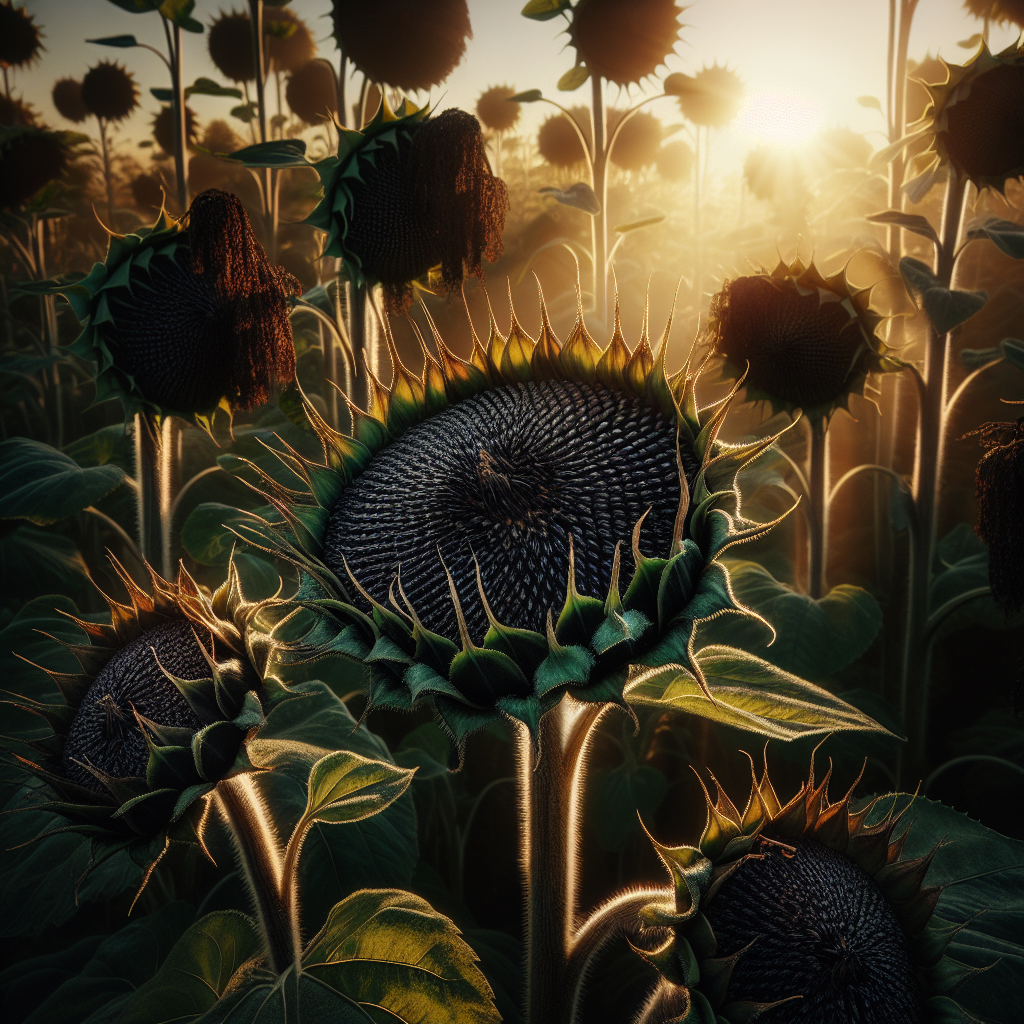
Introduction to Black Oil Sunflower
A classic oilseed form of annual sunflower, this crop is grown for its small, dark, high-fat seeds that are especially prized for bird feed, pressing, and wildlife plantings. Its popularity comes from a combination of rapid establishment, broad soil adaptability, excellent pollinator value, and a root system capable of scavenging nutrients from deeper horizons than many shallow-rooted annuals.
Historically, sunflowers were domesticated in North America and later improved extensively as oilseed crops in Europe and Russia before modern breeding spread improved types worldwide. Black oil strains are not always a single fixed cultivar in the home-garden sense; the term often refers to oilseed-type sunflowers selected for black seed coats, relatively thin hulls, and high kernel oil percentage. That distinction matters in practice: these are usually different from giant exhibition or striped snack-seed types, with somewhat denser seed set, more modest individual seed size, and a stronger emphasis on uniform maturity and oil yield.
For small farms and serious home growers, black oil sunflower fits several roles at once: a cash or feed crop, a pollinator-support plant, a wind-buffer strip, and a biomass contributor. It can also serve as a useful rotational break after cereals such as wheat, because it interrupts some grass-crop pest and disease cycles while bringing a contrasting root architecture to the system. For deeper planning around fertility and structure, see soil health strategies.
Botanical Profile of Black Oil Sunflower
This plant belongs to the Asteraceae family and is a warm-season annual broadleaf. Like other Helianthus annuus types, it produces a sturdy, pith-filled stem, coarse heart-shaped to lanceolate leaves, and a composite flower head composed of central disc florets surrounded by showy ray florets. What appears to be one flower is actually hundreds to thousands of individual florets developing in spiraled phyllotactic patterns.
Black oil forms typically reach 4 to 7 feet tall under ordinary garden conditions, though height can vary with fertility, spacing, soil moisture, and genotype. In lower-fertility dryland settings, plants may remain shorter, often 3 to 5 feet, while fertile irrigated ground can push taller growth. Stem diameter is a practical indicator of vigor; pencil-thin stems usually signal overcrowding or nitrogen deficiency, while excessively lush, soft stems often suggest too much nitrogen or overwatering, both of which can increase lodging risk.
The root system begins with a strong taproot that can penetrate 3 feet or more in friable soils, accompanied by extensive lateral roots in the top 12 to 18 inches. That architecture explains why the crop handles short dry spells better than many shallow-rooted vegetables, yet still responds strongly to moisture during bud formation and seed fill. Leaves are rough-textured, slightly pubescent, and arranged alternately on mature stems. The rough surface can trap dust and fungal spores, so airflow matters in humid climates.
The flower head, or capitulum, is usually medium-sized in black oil types rather than extremely oversized. Seeds are technically achenes. In oilseed strains, they are narrower, more elongated, and darker than confectionary types, with hulls that are relatively easier for birds to crack. Oil content commonly ranges from roughly 38% to over 45% depending on genetics and growing conditions. Heat and moisture stress during flowering can reduce seed set, while excessive rain near maturity can lower quality and encourage head rot.
Most black oil sunflowers are day-neutral enough for broad seasonal use within frost-free windows, but they still perform best when sown into warming soils and given uninterrupted growth through long, bright days. Time to maturity often falls between 90 and 120 days from sowing, though some early oilseed selections finish sooner.
Soil, pH, and Climate Requirements for Black Oil Sunflower
This crop performs best in full sun, meaning at least 8 hours of direct light and ideally more. Even slight shade reduces stem strength, head size, and final seed fill. It is fundamentally a temperate warm-season annual that thrives in daytime temperatures around 70 to 85°F (21 to 29°C). Germination begins when soil temperatures reach about 50°F (10°C), but more consistent and uniform emergence occurs once soils are 55 to 60°F (13 to 16°C) or warmer.
Optimal soil is a well-drained loam or sandy loam with moderate water-holding capacity and good depth. Heavy clay can work if drainage is improved and surface cRusting is prevented, but standing water for more than 24 to 48 hours around the root zone is a serious risk factor for stunting, chlorosis, root disease, and eventual lodging. In very sandy soils, frequent light irrigation is usually inferior to deeper, less frequent watering that encourages roots to move downward.
A pH range of 6.0 to 7.5 is generally ideal, with best nutrient availability often around 6.2 to 7.0. The plant tolerates slightly alkaline conditions better than many vegetables, but micronutrient issues can appear above pH 7.8, particularly iron-induced chlorosis in calcareous soils. If young leaves show interveinal yellowing while veins remain green, high pH rather than low fertility may be the real constraint.
Sunflowers are moderate feeders, not gross nitrogen users. A soil with excessive nitrogen produces lush foliage, delayed maturity, weaker stalks, and sometimes a larger disease burden. Typical nutrient demand is especially significant for phosphorus during rooting and early growth, potassium for stem strength and drought buffering, and boron in small amounts for reproductive development. Boron deficiency, though less common in gardens, can cause deformed heads, hollow stems, and poor seed set. Because the micronutrient threshold between deficiency and toxicity is narrow, boron should only be applied based on test results.
Rainfall or irrigation needs vary with soil type and climate, but a seasonal total around 18 to 25 inches often supports strong production. The critical moisture periods are emergence, the rapid vegetative stretch, bud formation, flowering, and especially the 2 to 3 weeks after pollination when kernels are filling. During these stages, soil moisture should ideally be maintained in the upper 50% to 75% of available water capacity, not saturated but not allowed to swing to powder-dry. A practical field test: soil from 4 to 6 inches deep should feel cool and slightly cohesive in the hand, forming a weak ball that crumbles with pressure. If it is dusty and cannot hold shape at all, the crop is entering stress. If it smears, shines, or leaves water on the hand, it is too wet.
Climatically, this crop prefers low to moderate humidity during flowering and ripening. Extended wet weather near bloom can interfere with pollinator activity and promote foliar disease. Strong wind is another major factor; while stems are sturdy, very exposed sites with high nitrogen and shallow rooting frequently lodge. In open fields, modest windbreak planning or slightly tighter in-row spacing can improve stand stability.
Step-by-Step Planting & Propagation
Propagation is by seed, and direct sowing is overwhelmingly preferred. Transplanting is possible at a very young stage, but the species resents root disturbance, and any kinked taproot can permanently reduce vigor.
- Prepare the bed or field 2 to 3 weeks before sowing. Remove perennial weeds, break compaction if present, and incorporate mature compost only if organic matter is low. Avoid heavy fresh manure, which can push excessive nitrogen.
- Do a soil test whenever possible. If fertility is moderate, a balanced pre-plant nutrient base is usually sufficient. Sunflowers often need less nitrogen than people assume.
- Wait until danger of hard frost has passed and soil has warmed to at least 55°F (13°C), preferably 60°F (16°C) for fast emergence.
- Sow seeds 1 to 1.5 inches deep in medium soils. In heavier clay, stay near 1 inch. In sandy dry soils, 1.5 inches helps place seed into more consistent moisture.
- Space plants 6 to 12 inches apart in rows 24 to 36 inches apart for seed production. For larger heads, use wider spacing; for smaller but more numerous uniform heads, keep spacing tighter. In garden blocks, 12 x 12 inches is common and efficient.
- Firm the soil gently after sowing to ensure seed-to-soil contact. Loose, fluffy planting often leads to erratic germination.
- Irrigate after planting if soil is not already evenly moist. The goal is moisture around the seed zone, not waterlogging.
Emergence usually occurs within 7 to 12 days in warm soils. Protect newly emerged seedlings from birds, cutworms, and slugs where pressure is known. In small plots, lightweight row cover can be used until plants are several inches tall, but remove it before flowering to allow pollinator access.
Succession planting every 2 to 3 weeks can spread bloom times and harvest windows, though later sowings may encounter more disease or bird pressure depending on region. In frost-short areas, choose earlier-maturing seed lots and avoid sowing so late that heads are drying during cold, wet autumn weather.
Care & Maintenance regimes for Black Oil Sunflower
Once established, this is a comparatively straightforward crop, but high-quality seed production still depends on disciplined management. Early growth is the most weed-sensitive stage. Keep the first 4 to 6 weeks especially clean, because competition at this stage permanently reduces stalk diameter and head development. Shallow hoeing is safer than deep cultivation, which can prune feeder roots.
Watering should shift with growth stage. From sowing to emergence, maintain evenly moist soil in the top 1 to 2 inches. After seedlings establish, encourage deeper rooting by watering thoroughly enough to wet the top 8 to 12 inches, then allowing the upper 2 to 3 inches to dry slightly before the next irrigation. On many loams, this means watering every 5 to 8 days in mild weather and every 3 to 5 days in hot weather, but always adjust to rainfall and soil type.
Signs of underwatering include dull, slightly folded leaves in midday that do not recover by evening, slowed height gain, reduced bud size, and premature yellowing of lower leaves during active growth. Signs of overwatering include uniformly limp leaves despite wet soil, lower stem softening, yellowing beginning across the whole plant rather than just older leaves, fungus gnats in small plantings, and a sour or anaerobic soil smell. Repeated overwatering is more damaging than mild short-term dryness.
Mulching with clean straw or shredded leaves can reduce weed pressure and conserve moisture, but keep mulch a couple of inches away from stems to reduce rot and rodent issues. In dense plantings, avoid overly thick mulch if slugs are common.
Fertilization should be restrained. If plants are pale and growth is slow on low-fertility ground, a light side-dress of nitrogen when plants are 10 to 18 inches tall can help, but stop well before flowering. Excess late nitrogen delays maturity and increases lodging. Potassium-deficient plants may show scorched leaf margins and weaker stalks, particularly in sandy soils.
Support is usually unnecessary in field culture, but in highly exposed gardens or with tall, lush plants, temporary staking may save stems from snapping before seed fill. If stems curve toward light, rotate container-grown plants regularly, though container production is usually inferior for seed crops because the taproot is constrained.
Pollination is mostly by insects. Although sunflowers can set seed with varying degrees of self-compatibility depending on line, bee activity usually improves fill and uniformity. This is one reason companion plantings with insect-attracting herbs and flowers are useful around production blocks.
Pests, Diseases & Organic Management
Birds are both a benefit and a challenge. Finches, sparrows, and other seed-eaters can strip heads quickly as seeds mature. If seed harvest is the goal, cover heads with breathable mesh bags once petals fade and seeds begin firming. Avoid plastic bags, which trap humidity and promote mold.
Common insect pests include sunflower moth, seed weevils, aphids, cutworms, and occasionally caterpillars or grasshoppers. sunflower moth larvae can tunnel into heads and contaminate seed with frass and webbing. Monitoring at early bloom is critical; damaged florets and fine webbing near the disc are warning signs. In small plantings, prompt removal of infested heads and encouraging predators can reduce pressure. aphids usually cluster on tender growth and head bracts. A strong water spray, insecticidal soap, and maintenance of beneficial insects often keeps them below damaging levels.
cutworms are most dangerous right after emergence, severing seedlings at the soil line. Use collars in high-pressure garden sites, maintain weed control before planting, and inspect at dusk if stand loss appears. slugs may damage cotyledons in cool, damp springs.
Diseases are most serious in humid or poorly rotated systems. Downy mildew can distort young plants and stunt growth, especially in cool wet soils. Rust appears as orange to cinnamon pustules on leaves and can reduce photosynthetic area late in the season. Alternaria leaf spot and Septoria create spotting and premature defoliation, especially where foliage stays wet. White mold and other head rots are especially damaging near flowering and ripening, causing brown decay, bleaching, or fuzzy fungal growth.
Organic disease management begins with spacing for airflow, watering the soil rather than the canopy, rotating away from sunflower and related broadleaf hosts for at least 3 years where disease pressure is known, and destroying heavily infected residues. Do not compost badly diseased heads unless your compost system runs hot enough to fully sanitize them. Avoid planting in low pockets where dew lingers.
Nutrient balance is also disease management. Soft, nitrogen-rich tissues are more inviting to pests and less resilient structurally. Conversely, a steady but not excessive potassium supply supports thicker cell walls and better stress tolerance. If you want a trap or support planting nearby, nasturtium can help attract beneficial insects and sometimes distract certain pests, while thyme at the margins can support pollinators and predatory insects.
Harvesting, Curing & Optimal Storage
Seed maturity is indicated by a combination of visual and tactile signs. The back of the head changes from green to yellow and then tan to brown, bracts dry down, petals have fully dropped, and seeds develop their mature dark black coloration with firm kernels inside. At this point, heads often begin to droop. If birds are a major threat, harvest slightly early when seeds are fully formed but the head is not completely dry, then finish curing under cover.
To harvest, cut heads with 6 to 12 inches of stem attached. Handle gently because cracked seeds lose storage life. If the weather is dry and pest pressure is manageable, heads can finish drying on the stalk, but this always increases the chance of bird loss. In wet climates, earlier cutting is safer.
For curing, hang heads upside down or place them on racks in a warm, dry, shaded, well-ventilated space. Ideal curing conditions are roughly 70 to 85°F (21 to 29°C) with low humidity and good airflow. Avoid direct intense sun during curing, which can overheat seed and reduce viability. Properly dried heads feel papery, and seeds rub out easily by hand or with a gloved palm.
Thresh by rubbing seeds loose into a clean bin or sack. Winnow away chaff using a fan or natural breeze. For storage, seed moisture should be low enough that kernels are hard and hulls brittle, generally near 8% to 10% for safe medium-term storage. If seeds bend rather than crack under pressure, they are still too moist. Overly moist seed in storage heats rapidly and can develop mold.
Store cleaned seed in airtight containers only if it is fully dry; otherwise use breathable sacks until dryness is certain. Keep in a cool, dark place below 50°F (10°C) when possible for best long-term viability. For feed seed, cool pantry-like conditions are acceptable if turnover is quick. For planting seed, label by date and lot, and protect from rodents, which can destroy a season's seed reserve in days.
Average yields vary enormously by spacing, climate, soil fertility, and bird pressure. In small-scale settings, a healthy stand can produce substantial seed from a relatively modest footprint, but quality depends heavily on moisture during bloom and protection at maturity.
Companion Planting for Black Oil Sunflower
This crop is most useful in companion systems when treated as a structural and ecological plant rather than just a seed producer. Its tall stems create light afternoon shade for some heat-sensitive crops, its flowers attract pollinators and beneficial insects, and its deep roots can help explore lower soil layers. The main caution is competition: avoid placing low, sun-loving crops too close on the north side in the northern hemisphere, and remember that sunflower roots are active feeders.
Good companions include clover as a living understory or edge cover to suppress weeds and support beneficial insects, cucumber where sunflowers can offer modest trellis-like shelter in informal plantings, and peas in cool-to-warm transitional systems where the timing avoids direct competition during peak sunflower growth. Lettuce can also benefit from partial shade in hotter climates if planted at an appropriate distance so it does not suffer from root competition.
Avoid pairing too tightly with crops that are heavy feeders in the exact same soil layer or that require very high, constant moisture. Dense proximity to potatoes or similarly demanding row crops can complicate cultivation and airflow. In market gardens, the best companion strategy is often perimeter or strip planting rather than intimate intercropping: sunflower rows at intervals, lower companion crops offset far enough away to preserve light and access.
For pollinator support, place companion herbs and low flowers on field margins rather than packed under the stems. That preserves airflow and reduces disease pressure while still building insect traffic through the planting. Done well, black oil sunflower becomes not just a crop, but a vertical anchor species in a diversified annual system.