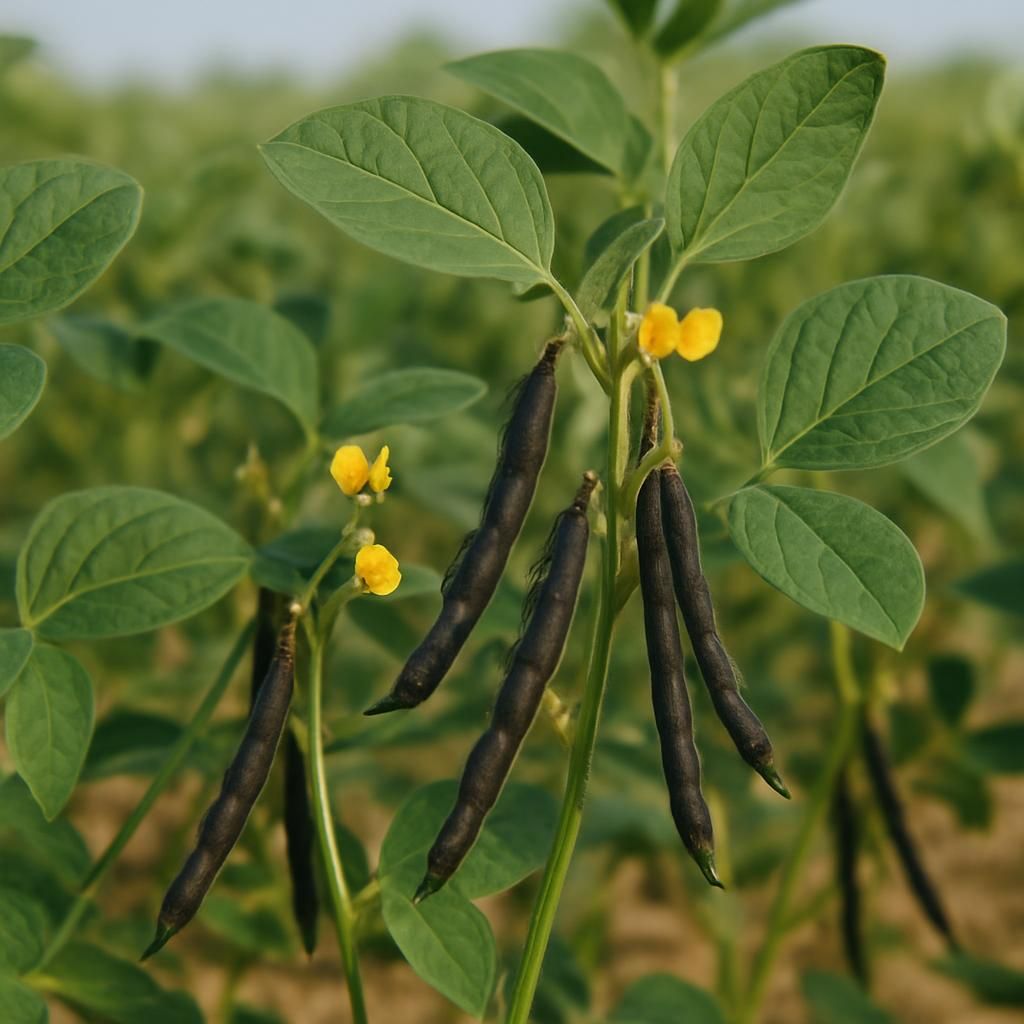
Introduction to Black Gram
Black gram (Vigna mungo), also known as urad bean, is a vital pulse crop in the Fabaceae family that delivers both nutritional security and soil fertility benefits. Farmers cultivate it primarily for its protein-rich dry seeds, which form the basis of popular dishes such as dal, idli, dosa, and papad. The crop matures in 70–90 days, making it an excellent choice for double-cropping systems following rice or wheat. Its deep taproot system and symbiotic relationship with Rhizobium bacteria allow it to fix atmospheric nitrogen, reducing fertilizer dependency in subsequent crops. In many smallholder systems across India, Myanmar, and Thailand, black gram serves as both a cash crop and a staple dietary component.
Botanical Profile of Black Gram
Black gram is an erect or semi-erect annual herb reaching 30–100 cm in height. Stems are angular, covered with fine hairs, and bear trifoliate leaves with ovate leaflets. Small, pale-yellow papilionaceous flowers appear in axillary racemes. Pods are cylindrical, 4–6 cm long, and contain 4–10 black or dark-brown seeds. The plant exhibits both determinate and indeterminate growth habits depending on cultivar. Roots develop extensive nodules that host nitrogen-fixing bacteria, enhancing soil organic matter when residues are incorporated.
Soil, pH, and Climate Requirements for Black Gram
Black gram thrives in well-drained sandy loam to clay loam soils with good organic matter. It tolerates moderate salinity but performs poorly in waterlogged or highly acidic conditions. The crop requires a warm, frost-free climate with temperatures between 25 °C and 35 °C during growth. Adequate rainfall of 600–800 mm distributed over the growing period supports rainfed cultivation, while supplemental irrigation boosts yields in drier zones.
| Parameter | Ideal Range/Value | Notes |
|---|---|---|
| Soil Type | Sandy loam to clay loam | Well-drained, avoid heavy clays |
| Soil pH | 6.5–7.8 | Slightly acidic to neutral; liming if <6.0 |
| Temperature (day) | 25–35 °C | Optimum flowering at 28–32 °C |
| Temperature (night) | 18–24 °C | Avoid <15 °C during pod set |
| Annual Rainfall | 600–900 mm | Well-distributed; irrigation in dry spells |
| Altitude | 0–1800 m | Best below 1200 m for commercial yields |
| Growing Season Length | 70–90 days | Short duration suits multiple cropping |
Step-by-Step Planting & Propagation
- Site Selection & Preparation: Choose fields with good drainage and previous cereal or legume history. Plough twice and harrow to achieve fine tilth; incorporate 5–8 t/ha well-rotted FYM.
- Seed Selection: Use certified seed of high-yielding, disease-resistant varieties such as PU-31, LBG-20, or T-9. Treat seeds with Rhizobium and PSB cultures at 5 g/kg seed.
- Sowing Time: In India, sow kharif crop in June–July and rabi crop in October–November depending on region. Summer crop can be sown in March–April under irrigation.
- Method & Spacing: Use line sowing or broadcasting followed by light planking. Maintain row spacing of 30 cm and plant spacing of 10 cm for a plant population of 3–3.5 lakh/ha.
- Seed Rate: 15–20 kg/ha for small-seeded varieties; 12–15 kg/ha for bold-seeded types. Sow at 3–5 cm depth.
- Inoculation & Fertilization at Planting: Apply basal dose of 20 kg N, 40 kg P₂O₅, and 20 kg K₂O per hectare. In low-phosphorus soils, increase P to 60 kg/ha.
Care & Maintenance regimes for Black Gram
Timely irrigation, nutrient management, and weed control are critical for realizing full yield potential. Light irrigation at 25–30 days after sowing (DAS) and at flowering/podding stages prevents moisture stress. Hand weeding or pre-emergence application of pendimethalin at 1.0 kg a.i./ha followed by one manual weeding at 30 DAS keeps fields clean.
| Stage (DAS) | Irrigation Schedule | Fertilizer Application | Pruning/Other Operations |
|---|---|---|---|
| 0–15 (Germination) | Light irrigation if soil dry | Basal NPK + FYM incorporated | — |
| 25–30 (Branching) | 30–40 mm irrigation | — | Weeding + earthing up |
| 40–45 (Flowering) | Critical stage; ensure moisture | Foliar 2% DAP or 19:19:19 at 0.5% | Monitor for pests |
| 55–60 (Podding) | Second irrigation if rainfall low | — | Remove diseased plants |
| 70–75 (Maturity) | Withhold irrigation | — | Harvest when 80% pods mature |
Pests, Diseases & Organic Management
Major insect pests include pod borers, jassids, whiteflies, and thrips. Pod borers can be managed with neem-based sprays (5 ml/L) and pheromone traps. Whiteflies and jassids respond to yellow sticky traps plus 5% neem oil. Key diseases are yellow mosaic virus, powdery mildew, root rot, and anthracnose. Use resistant varieties, seed treatment with Trichoderma viride (4 g/kg), and crop rotation with cereals. Remove and destroy infected plants; apply sulfur-based fungicides only when disease pressure is high.
Harvesting, Curing & Optimal Storage
Harvest when pods turn black and seeds rattle inside. Pull entire plants or use sickles and allow 4–6 days sun-drying in the field. Thresh by beating with sticks or using pedal-operated threshers. Clean seeds to remove chaff and broken grains. Store at 10–12% moisture in gunny bags or hermetic containers treated with 2% malathion dust. Place bags on wooden pallets in well-ventilated godowns. Under proper conditions, seeds retain viability and quality for 12–18 months.
Companion Planting for Black Gram
Black gram pairs well with sorghum, pearl millet, maize, and cotton in intercropping systems. These combinations improve land-use efficiency and provide natural pest deterrence. Avoid planting near onion or garlic as allelopathic effects may reduce germination. Legume-cereal rotations with wheat or rice enhance soil nitrogen and break pest cycles. Border planting of marigold or sesame further reduces pest incidence through trap-cropping and beneficial insect attraction.