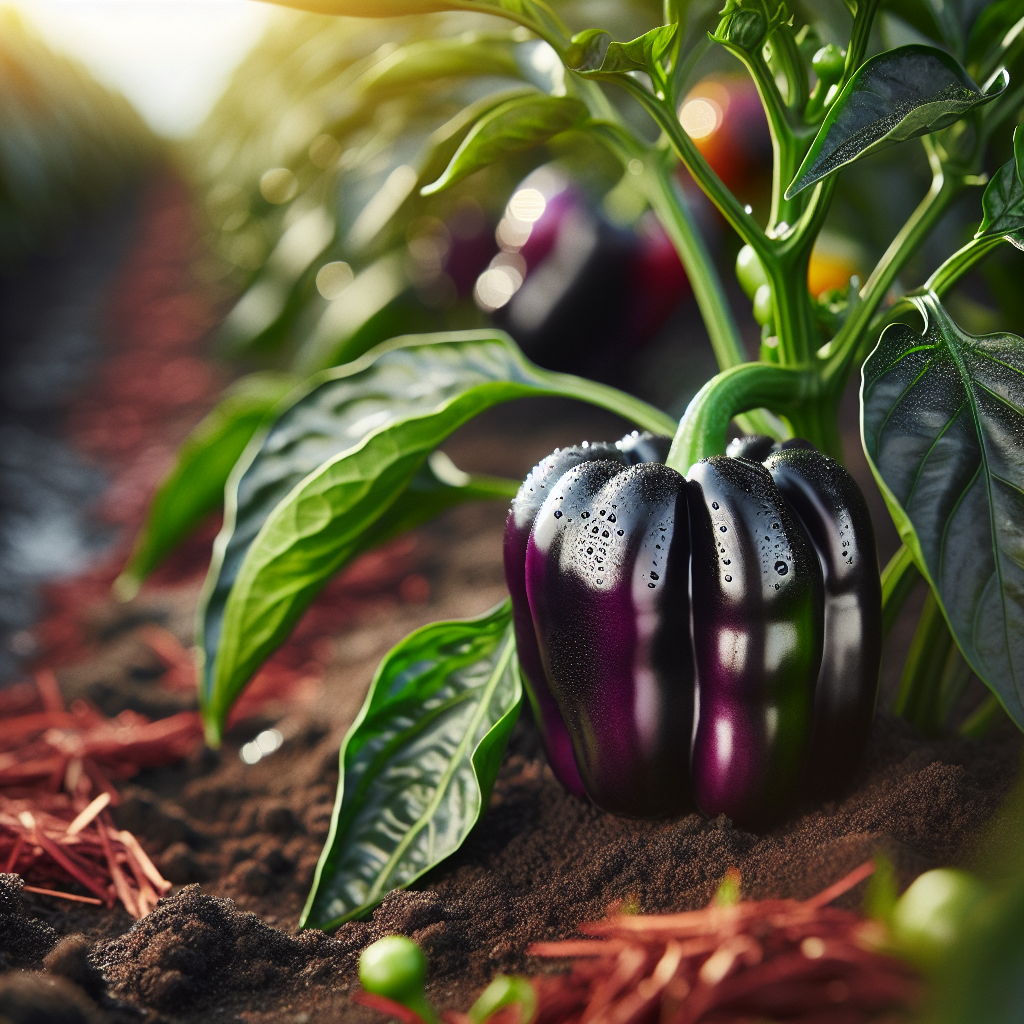
Introduction to Bell Pepper (Purple Beauty)
A classic sweet pepper cultivar, Purple Beauty is grown primarily for its unusual glossy violet-purple skin, blocky bell shape, and ornamental as well as culinary value. It belongs to the same species as most sweet peppers and many hot peppers, but unlike pungent forms it produces little to no capsaicin, so the fruits are mild, crisp, and suitable for fresh eating, stuffing, roasting, and mixed vegetable sales.
Purple-fruited peppers are especially valuable for direct-market growers because they add color diversity to harvest boxes and retail displays. The fruit is typically harvested when fully purple, before progressing toward deeper red at full botanical maturity. That harvest window matters: the purple stage offers the best visual appeal, firmer walls, and a fresh sweet flavor with slight grassy undertones. If left too long, fruits may soften slightly as they transition in color and become less uniform for premium market sales.
Historically, bell peppers trace their domestication to Central and South America, with sweet blocky forms selected much later than smaller pungent peppers. Purple Beauty represents one of the notable specialty bell types developed for visual novelty without sacrificing kitchen usefulness. For growers, its appeal lies in combining the manageable production habits of a standard bell pepper with the premium appearance of a specialty cultivar.
From a production standpoint, this is a warm-season crop that demands steady heat, fertile well-drained soil, even moisture, and a long frost-free period. It is less forgiving than beans or squash during establishment, but with proper transplant timing and irrigation consistency it performs very well in gardens, tunnels, and diversified vegetable farms.
Botanical Profile of Bell Pepper (Purple Beauty)
This cultivar is a member of the Solanaceae, the nightshade family, alongside tomato, eggplant, and potato. Plants are herbaceous perennials in frost-free climates but are grown as annuals in most temperate systems. Purple Beauty is generally compact to medium in height, often reaching about 18 to 24 inches tall and roughly as wide, though fertility, temperature, and spacing can push plants larger.
The plant forms a branching canopy with smooth green leaves, white star-shaped flowers, and pendent fruits. Flowers are perfect, meaning they contain both male and female structures, and peppers are largely self-pollinating, though insect activity and air movement can improve fruit set under some conditions. Pollen viability declines when daytime temperatures push very high and especially when nights remain warm, which is one reason peppers sometimes flower heavily but set poorly during heat waves.
Fruits are typically 3- to 4-lobed, blocky, thick-walled, and medium-sized. Immature fruit color begins greenish and quickly develops anthocyanin pigmentation, giving the cultivar its rich purple coloration. Anthocyanins are the same class of pigments that color some purple cabbages and berries. In Purple Beauty, this pigmentation is heavily influenced by genetics but can appear more intense under strong sunlight and moderate temperatures. Full physiological ripeness usually leads fruit toward red tones internally or externally if left on the plant long enough.
Days to first harvest commonly fall around 70 to 80 days from transplant, though cooler regions may run later. The plant’s compact size makes it especially suitable for raised beds, containers of at least 5 gallons, and high-density market garden blocks. Compared with larger bell cultivars, Purple Beauty may produce slightly smaller fruit, but often compensates through attractive color and manageable plant architecture.
If you want a broader production baseline for standard sweet pepper culture, see our Bell Pepper guide.
Soil, pH, and Climate Requirements for Bell Pepper (Purple Beauty)
This cultivar performs best in loose, fertile, well-aerated soil with excellent drainage and high biological activity. The ideal texture is sandy loam to loam enriched with mature compost. Heavy clay is workable only if improved with organic matter and formed into raised beds, because peppers are highly sensitive to prolonged root-zone saturation. In compacted wet soil, roots remain shallow, oxygen becomes limiting, and plants stall, yellow, and become vulnerable to Phytophthora and other root diseases.
Target a soil pH of 6.2 to 6.8. Plants tolerate a broader range, roughly 6.0 to 7.0, but nutrient uptake is most balanced in the mid-6 range. Below pH 5.8, calcium and magnesium availability may become limiting, and above about 7.2 iron, manganese, and phosphorus availability often declines. A soil test before planting is strongly recommended. Bell peppers are particularly prone to calcium-related disorders such as blossom end rot when pH, moisture, or salt balance is off.
Nutritionally, peppers need moderate nitrogen, good phosphorus availability during establishment, and ample potassium for fruit sizing, wall thickness, and stress tolerance. Excess nitrogen is a common mistake: it produces lush dark foliage, delayed flowering, and a soft canopy more attractive to Aphids. A professional target in field systems is to build organic matter and then apply fertility in split doses rather than front-loading all nitrogen before planting.
Temperature is the defining climate factor. Purple Beauty grows best when daytime temperatures remain around 70 to 85°F (21 to 29°C) and nighttime temperatures stay between 60 and 70°F (16 to 21°C). Growth slows markedly below 55°F (13°C), and chilling injury can occur with prolonged exposure below 50°F (10°C), especially in young transplants. Fruit set drops during extreme heat, especially when daytime temperatures exceed 90 to 95°F (32 to 35°C) and nights stay above 75°F (24°C).
This crop requires full sun, ideally 8 or more hours daily. In very hot inland climates, light afternoon shade can reduce sunscald and pollen sterility, but too much shade lowers purple pigmentation intensity and yield. Wind protection is helpful because brittle pepper branches can snap once fruit load increases.
Soil moisture should remain consistently in the range of evenly moist but never waterlogged. Practically, the top 1 inch of soil may begin to dry slightly between irrigations, but the root zone 2 to 6 inches down should stay lightly moist. If you squeeze soil from that depth, it should form a weak ball that crumbles with pressure, not smear into a sticky ribbon. Overwatered peppers show drooping despite wet soil, lower-leaf yellowing, edema, and reduced root vigor. Underwatered plants wilt during the hottest part of the day, drop blossoms, produce misshapen fruit, and develop thin walls.
For growers improving pepper ground over time, a resource on soil health strategies can help build structure and fertility before planting.
Step-by-Step Planting & Propagation
Propagation is almost always by seed. Because Purple Beauty is open-pollinated, seed saving is possible if plants are isolated from other Capsicum annuum peppers to avoid crossing. For pure seed, separation distances should be substantial, or blossoms should be bagged and hand-managed.
Start seeds indoors 8 to 10 weeks before the intended outdoor transplant date. Use a sterile, fine-textured seed-starting medium with excellent drainage. Sow seeds about 1/4 inch deep in plug trays or small cells. Germination is fastest at 80 to 90°F (27 to 32°C), often occurring in 7 to 14 days. Below 75°F (24°C), emergence becomes slow and uneven. Bottom heat is one of the most effective ways to improve pepper germination.
Once seedlings emerge, provide very bright light immediately. Insufficient light produces stretched, weak stems and delayed transplant recovery. Maintain air temperatures around 70 to 75°F (21 to 24°C) by day and 65 to 70°F (18 to 21°C) by night. Water carefully: media should remain moist but not saturated. Constantly soggy plug trays encourage Damping Off and shallow root systems.
Feed seedlings lightly after the first true leaves appear, using a diluted balanced fertilizer or a gentle organic liquid feed. Pot up if roots fill the initial cells before transplant time. Avoid root binding, because peppers can stall after transplant when circling roots are allowed to harden.
Begin hardening off 7 to 10 days before field planting. Expose plants gradually to outdoor light, wind, and fluctuating temperatures. Never transplant into cold soil. Wait until all danger of frost has passed, nighttime temperatures are reliably above 55°F (13°C), and soil temperatures are at least 65°F (18°C), with 70°F (21°C) even better for immediate establishment.
Prepare beds with compost and base amendments guided by soil testing. Raised beds with drip irrigation and plastic or organic mulch are highly effective. Black plastic mulch can increase soil warmth in cool regions, suppress weeds, and keep fruit cleaner. Organic mulches should be applied after soil has warmed.
Spacing depends on production intensity. For home gardens, set transplants 18 to 24 inches apart in rows 24 to 36 inches apart. In intensive beds, plants may be spaced 15 to 18 inches apart with adequate fertility and airflow. Deeper spacing is usually not necessary; unlike tomatoes, peppers should be transplanted at about the same depth they were growing in their pots.
Water transplants immediately after planting to settle soil around the root ball. A dilute transplant solution high in phosphorus is optional but less important than proper temperature and uniform moisture. If weather is windy or intensely sunny, temporary shade cloth for the first few days can reduce transplant shock.
Direct seeding is possible only in very warm climates with long seasons, but it is rarely preferred because emergence is slow, weed competition is fierce, and maturity is delayed.
Care & Maintenance regimes for Bell Pepper (Purple Beauty)
The first three weeks after transplanting are critical. During this establishment phase, maintain constant root-zone moisture without oversaturation. A practical benchmark is roughly 1 to 1.5 inches of total water per week early on, increasing to 1.5 to 2 inches during flowering and fruit fill depending on heat, wind, mulch, and soil type. Sandy soils may require more frequent but smaller irrigations; clay loams require fewer, deeper irrigations.
Drip irrigation is strongly preferred over overhead watering. It keeps foliage dry, reduces bacterial disease spread, limits evaporative waste, and delivers steady moisture. Moisture fluctuations are the main trigger for blossom end rot, fruit cracking, and uneven sizing. The goal is not simply frequent watering, but low-stress consistency. If plants repeatedly cycle from dry to saturated, calcium transport into developing fruit becomes erratic even if the soil technically contains enough calcium.
Mulching is one of the best management tools for Purple Beauty. Organic mulches such as clean straw or shredded leaves moderate soil temperature, reduce splash-borne disease, and preserve the stable moisture this crop needs. Keep mulch slightly away from the stem base to prevent crown rot and slug sheltering.
Side-dress fertility after plants establish and again at early fruit set if needed. A modest nitrogen application at these stages supports canopy function without driving excess vegetative growth. Potassium becomes increasingly important as the plant enters heavy fruiting. Foliar feeding can correct minor deficiencies quickly, but it should not substitute for balanced soil fertility.
Calcium management deserves specific attention. Blossom end rot in peppers appears as a tan to black, leathery, sunken patch on the blossom end of fruit. It is often blamed solely on low calcium, but the more common cause is interrupted calcium movement due to irregular watering, root stress, high salinity, or excessive ammonium nitrogen. Maintain even moisture, avoid root disturbance, and do not overfertilize with nitrogen.
Although Purple Beauty plants are compact, support is still useful. Fruits can be heavy enough to bend or split branches, especially after rain or under high fertility. A simple stake with soft ties, low tomato cage, or Florida weave variation for peppers can reduce lodging and keep fruit off the soil.
Pruning is usually minimal. Remove any damaged lower leaves touching the soil and consider thinning the very first flower or early fruit only if plants are undersized at transplant. In cool climates, removing the first fruit can redirect energy into vegetative growth and increase later total yield, though many home growers skip this step.
Weed control must be diligent during the first month after transplanting, when peppers are poor competitors. Hand hoeing should be shallow because roots run near the surface. Deep cultivation damages feeder roots and can set plants back for weeks.
In greenhouse or tunnel culture, manage humidity carefully. High humidity can reduce pollen release and increase Botrytis and bacterial disease risk. Ventilation, plant spacing, and morning irrigation help maintain a healthier canopy.
Pests, Diseases & Organic Management
Purple Beauty faces the same major pest complex as other sweet peppers. Aphids, Thrips, Whiteflies, Flea Beetles, Hornworms, Cutworms, and Spider Mites are the most frequent insect issues depending on region. Aphids cluster on new growth and leaf undersides, curling foliage and producing sticky honeydew. Thrips scar leaves and flowers and can vector Tomato Spotted Wilt Virus. Whiteflies weaken plants and promote sooty mold. Spider Mites become severe under hot, dry conditions and cause fine stippling before webbing becomes obvious.
Organic control begins with prevention and monitoring. Use row cover immediately after transplanting where Flea Beetles or early aphid colonization are predictable, removing covers at flowering if pollinator access is needed nearby. Encourage beneficial insects with flowering borders. Strong water sprays can suppress Aphids early, and insecticidal soap or neem-based products can work if applied thoroughly to leaf undersides. Spider Mites respond best when caught early; increasing humidity briefly in protected culture and using horticultural oils or soaps can help.
Cutworms can sever young transplants overnight. Collars around stems, weed control before planting, and evening scouting are effective preventive measures. Hornworms are usually hand-picked in small plantings.
Diseases include Bacterial Leaf Spot, Anthracnose, Phytophthora Blight, Damping Off, Powdery Mildew in some climates, and several viral diseases such as Cucumber Mosaic Virus, Tobacco Mosaic Virus, and Tomato Spotted Wilt Virus. Bacterial Leaf Spot appears as small greasy lesions on foliage and fruit, often spreading after overhead irrigation or storms. Phytophthora thrives in saturated soils and causes sudden wilt, crown rot, and fruit decay. Viral infections may show mosaic patterns, distortion, stunting, or ring spots and are often spread by insect vectors or contaminated hands and tools.
The core organic disease strategy is cultural: rotate away from peppers, tomatoes, eggplants, and potatoes for at least 3 years when possible; avoid poorly drained sites; use drip irrigation; mulch to reduce splash; space plants for airflow; and remove diseased fruit promptly. Sanitize stakes, trays, and tools. Never work plants when foliage is wet if bacterial disease is present.
Copper-based products may help suppress bacterial diseases when used preventively, though they are far more effective as part of an integrated program than as a rescue treatment. Biological fungicides based on Bacillus species can also play a role in preventive disease suppression. For viruses, rogue infected plants quickly and focus on vector control and sanitation.
Physiological problems are common and should not be mistaken for infectious disease. Sunscald causes bleached, papery patches on exposed fruit, often after leaf loss or sudden intense heat. Blossom drop occurs with heat or cold stress. Poor fruit coloration can result from insufficient sun or harvesting too early before purple pigment fully develops.
Harvesting, Curing & Optimal Storage
Harvest timing strongly influences quality in Purple Beauty. The market-preferred stage is usually when fruits are fully sized, glossy, firm, and uniformly deep purple. At this point, walls are thick and crisp, seeds are still pale to light tan, and the fruit has reached usable maturity without advancing too far toward red ripeness. If harvested too early, fruit may be small, less sweet, and unevenly colored. If left too long, fruits can lose some of the distinctive premium purple appearance and may soften slightly.
Use pruners or a sharp knife rather than pulling fruit by hand. Pepper branches are brittle, and rough harvesting can strip bark or break productive stems. Leave a short stem attached to the fruit to improve postharvest appearance and reduce wound entry.
Harvest every 3 to 5 days during peak production. Frequent picking encourages continued flowering and reduces plant stress from oversized fruit. In commercial practice, handle fruit gently and avoid piling deeply in the field, as bell peppers bruise more easily than they appear.
Peppers do not require curing in the same sense as onions, garlic, or winter squash. However, a brief postharvest drying period in shade with good airflow can remove field moisture before packing. Do not leave harvested fruit in direct sun or hot vehicles; field heat rapidly shortens shelf life and causes softening.
For best storage, hold fruit at 45 to 50°F (7 to 10°C) with 90 to 95% relative humidity. Under these conditions, peppers may keep for about 2 to 3 weeks. Below about 45°F, chilling injury becomes a risk, showing as pitting, water-soaked areas, poor color retention, and accelerated decay after removal from storage. Standard household refrigerators are often colder than ideal, so peppers may not store as long there unless placed in a slightly warmer crisper zone.
Do not wash fruit until shortly before use unless necessary for market preparation. Excess surface moisture encourages decay. If washing is required, dry fruit thoroughly before packing. Store away from ethylene-sensitive planning issues are less severe with peppers than with some crops, but good ventilation remains important.
For seed saving, allow selected fruits to ripen beyond the purple market stage toward full physiological maturity. Extract seeds from fully mature fruit, wash lightly if needed, and dry thoroughly on a screen in a warm, airy place out of direct intense sun. Store dry seeds cool and dark.
Companion Planting for Bell Pepper (Purple Beauty)
Useful companion planting around Purple Beauty should be based on pest pressure, root-zone competition, and canopy architecture rather than folklore alone. Low-growing or upright companions that do not heavily shade the pepper canopy are best.
Thai Basil is one of the most practical companions. It fits well in pepper beds, attracts beneficial insects when flowering, and does not compete aggressively for space. Onion is another strong companion because its narrow upright habit leaves pepper light interception largely unaffected while helping diversify the bed and potentially confusing some pests. Carrot works well in adjacent rows or between wider pepper spacing, using different soil layers and helping maximize bed productivity. Nasturtium can serve as a border or nearby trap and pollinator-support plant, though it should be positioned so it does not overrun small pepper transplants.
Avoid planting peppers close to crops with similar disease profiles, especially other solanaceous plants, when rotation space is limited. While peppers can physically grow near tomatoes or eggplants, grouping too many close relatives can intensify shared pest and disease cycles. Likewise, very tall or sprawling companions that cast heavy shade can reduce flowering, purple coloration, and fruit sweetness.
In practical bed design, place onions or carrots along row shoulders, basil at intervals between every few pepper plants, and nasturtiums at bed edges. This preserves airflow, limits competition, and creates a more diverse insect environment without sacrificing pepper yield.