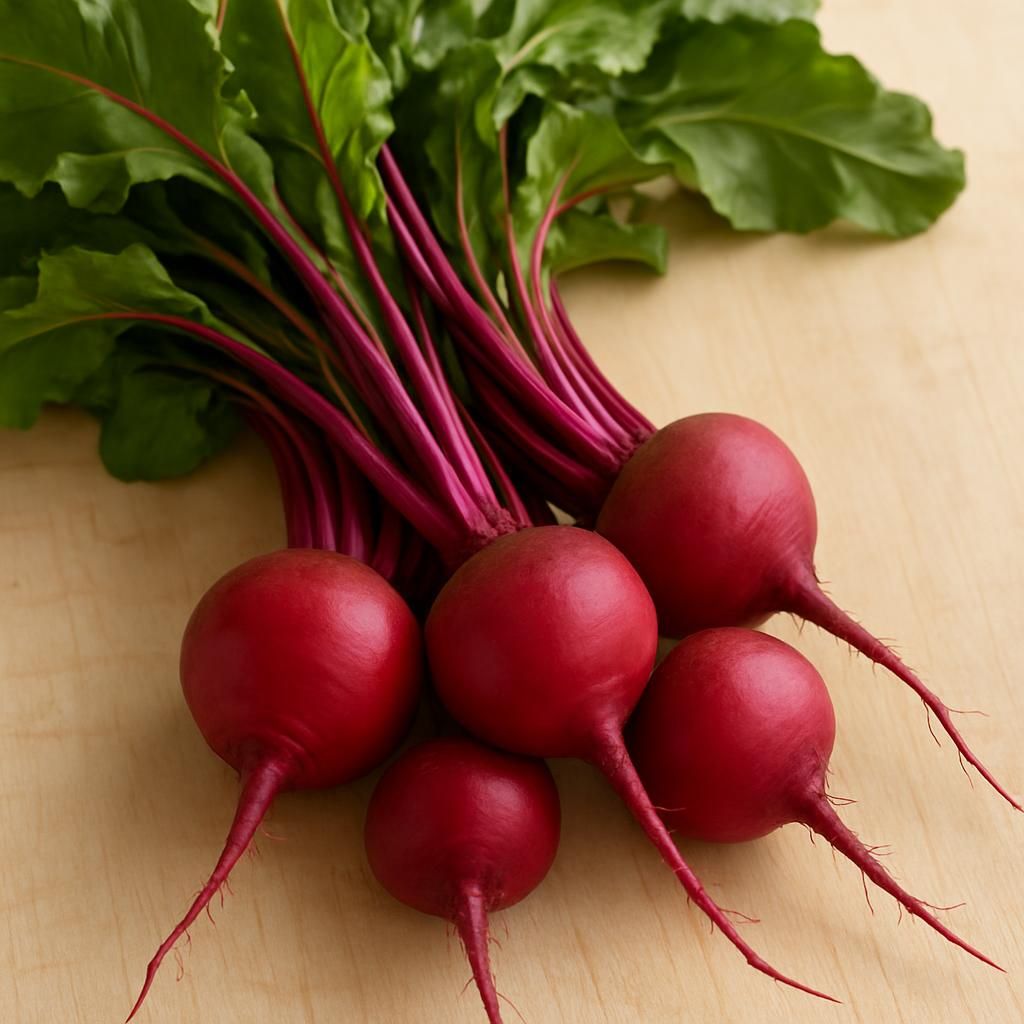
Introduction to Beet (Early Wonder)
Early Wonder is a classic open-pollinated beet cultivar developed for earliness and reliable performance in cool-season gardens and commercial plantings. It produces globe-shaped roots with smooth, thin skins and vibrant red interiors that retain color well when cooked or pickled. The variety is equally valued for its abundant, mild-flavored greens that can be harvested young as baby leaf or allowed to mature for bunching. Because it matures in approximately 50–55 days, Early Wonder is a favorite for succession planting and early-market sales.
Beets belong to the Amaranthaceae family and have been cultivated for both roots and foliage since ancient times. Early Wonder’s compact habit and tolerance to light frost make it suitable for northern climates and high-elevation gardens where the growing season is short. The crop is also well adapted to container culture and intensive raised-bed systems.
Commercial growers appreciate Early Wonder for its uniform sizing and resistance to zoning, a physiological disorder that produces white rings in the root. Home gardeners value the dual-purpose nature of the plant: roots for roasting, pickling, and juicing, and greens for sautéing or salads. This guide provides science-based recommendations for soil preparation, planting density, fertility programs, integrated pest management, and post-harvest handling to maximize both yield and quality.
Botanical Profile of Beet (Early Wonder)
Early Wonder exhibits the typical morphology of table beets: a swollen hypocotyl that forms the edible root, surrounded by a rosette of dark-green, ovate leaves with prominent red petioles. The root surface is smooth with minimal lateral root scars, reducing soil adhesion at harvest. Internally, the flesh is uniformly deep red with faint zoning that becomes less pronounced as the root matures.
The plant is a biennial grown as an annual for its root. Flowering occurs in the second year after vernalization; seed stalks can reach 1.2 m and produce wind-pollinated flowers. Early Wonder seed is actually a multigerm fruit containing 2–5 embryos, resulting in clusters of seedlings that require thinning.
Roots typically reach 6–8 cm in diameter at maturity and store well due to low respiration rates. The foliage remains tender and palatable throughout the season, providing an additional harvestable product that increases overall economic return per square meter.
Soil, pH, and Climate Requirements for Beet (Early Wonder)
Beets perform best in deep, well-drained loamy soils with high organic matter. Heavy clay soils should be amended with compost or aged manure to improve structure and drainage. Avoid freshly manured ground, as high nitrogen can cause excessive leaf growth at the expense of root development.
| Parameter | Ideal Range | Notes |
|---|---|---|
| Soil pH | 6.0–7.0 | Below 6.0 increases risk of scab and poor color |
| Soil Texture | Sandy loam to loam | Good drainage prevents root rot |
| Organic Matter | 3–5% | Improves moisture retention and fertility |
| Temperature (Germination) | 10–24 °C | Optimal 15–18 °C; slow below 10 °C |
| Temperature (Growth) | 15–21 °C | Tolerates light frost to –4 °C |
| Day Length | 12–14 hours | Long days promote bolting in sensitive varieties |
| Spacing (Row) | 30–45 cm | Allows air circulation and cultivation |
| Spacing (In-row) | 7–10 cm after thinning | Prevents crowding and small roots |
Adequate boron is critical; deficiency causes internal black spots (black heart). A soil test should confirm boron levels of 0.5–1.0 ppm before planting. Early Wonder tolerates a wide range of climates but yields best when daytime temperatures remain below 24 °C.
Step-by-Step Planting & Propagation
Site Selection & Preparation: Choose a location with full sun and good air movement. Remove crop residues and weeds, then incorporate 5–7 cm of well-rotted compost. Perform a soil test and correct pH to 6.5 with agricultural lime if necessary.
Seed Treatment: Early Wonder seed is multigerm; soak clusters in warm water for 12–24 hours to soften the pericarp and improve germination uniformity. Optionally, inoculate with beneficial microbes to suppress soil-borne pathogens.
Sowing: Direct seed 1–2 cm deep in rows 30–45 cm apart. For baby-leaf production, broadcast at 2–3 g/m² and rake lightly. Maintain consistent moisture during germination; seeds typically emerge in 5–10 days at 15 °C.
Thinning: When seedlings reach 5 cm, thin to 7–10 cm in-row spacing. Use thinned seedlings in salads. Avoid damaging remaining plants during thinning.
Succession Planting: Sow new blocks every 10–14 days from early spring until 8 weeks before first frost to ensure continuous harvest.
Transplant Option: Although direct seeding is standard, 3–4-week-old cell-grown seedlings can be transplanted with minimal root disturbance for gap filling or protected-culture systems.
Care & Maintenance regimes for Beet (Early Wonder)
Consistent moisture and balanced nutrition are essential for tender, well-shaped roots. Over-fertilization, especially with nitrogen, leads to oversized tops and woody roots. Mulching with 5 cm of straw or shredded leaves conserves moisture, suppresses weeds, and moderates soil temperature.
| Growth Stage | Watering Schedule | Fertilizer Application | Pruning / Other Tasks |
|---|---|---|---|
| Germination (0–14 days) | Light daily misting to keep surface moist | None; rely on soil reserves | Thin seedlings at 5 cm height |
| Vegetative (15–35 days) | 2.5 cm/week; maintain even moisture | Side-dress 20 kg N/ha at 3–4 true leaves | Remove yellowing outer leaves |
| Root Bulking (36–50 days) | 2.5–3 cm/week; avoid water stress | 30 kg K₂O/ha if soil test indicates deficiency | Hand-weed carefully around roots |
| Pre-Harvest (final 7 days) | Reduce to 1 cm to concentrate sugars | No additional fertilizer | Cease irrigation 48 h before harvest |
Boron foliar sprays (0.2% borax solution) at 30 and 45 days after sowing prevent deficiency symptoms. Monitor leaf color; pale foliage indicates nitrogen shortage while purple margins suggest phosphorus deficiency.
Pests, Diseases & Organic Management
Early Wonder is susceptible to several common pests and diseases, but integrated cultural practices and organic-approved inputs provide effective control.
Pests:
- Aphids: Cluster on undersides of leaves; use insecticidal soap or neem oil at first sign of infestation.
- Cutworms: Sever seedlings at soil line; apply collars or beneficial nematodes.
- Flea beetles: Create shot-hole damage; row covers and kaolin clay sprays deter feeding.
- Slugs and snails: Feed on foliage and roots in wet conditions; use iron-phosphate baits and improve drainage.
Diseases:
- Cercospora leaf spot: Causes circular lesions with red borders; remove infected leaves and rotate crops.
- Rhizoctonia crown and root rot: Dark lesions at soil line; improve drainage and avoid overwatering.
- Pythium damping-off: Seedling collapse; use treated seed and well-drained media.
- Beet cyst nematode: Causes stunting; practice long rotations with non-host crops such as Corn and Wheat.
Scout weekly and maintain field sanitation. Beneficial insects including lady beetles and lacewings provide natural aphid suppression.
Harvesting, Curing & Optimal Storage
Harvest when roots reach 5–8 cm diameter for optimal tenderness. Loosen soil with a fork and pull gently to avoid bruising. For bunching, cut tops 2 cm above the crown and wash thoroughly.
Curing is minimal; allow surface moisture to evaporate for 1–2 hours before packing. Store at 0–2 °C and 95% relative humidity for up to 4 months. Do not wash roots intended for long-term storage; simply remove loose soil. Greens should be kept separate and refrigerated at 0 °C for 3–5 days.
Companion Planting for Beet (Early Wonder)
Beets benefit from strategic neighbors that improve soil, deter pests, or provide physical support.
- Onion and Garlic repel aphids and leaf miners while sharing similar fertility needs.
- Lettuce and Spinach provide living mulch and shade roots during warm spells.
- Bush beans fix nitrogen and do not compete heavily for root space.
- Aromatic herbs such as Thyme and Rosemary mask beet scent from pest insects.
- Avoid planting near Swiss chard or other beets to reduce disease carryover.
Successive plantings of Early Wonder can be followed by Cabbage or Broccoli in the same season, leveraging the crop’s short cycle for efficient land use.